Most of our conception of Stoicism, an ancient school of thought much featured here on Open Culture, derives from the writings of just three figures: Epictetus, Marcus Aurelius, and Seneca the Younger. But there were other Stoics, and despite their antiquity, we may yet learn more about them. Take Chrysippus of Soli, who was officially known as the Second Founder of Stoicism due to his influence on its spread throughout the Greek and Roman world. What we know of his demanding work, we know because of references written on scrolls inadvertently preserved in a villa in Herculaneum when nearby Mount Vesuvius erupted in the year 79. To date, most of those “Herculaneum papyri” have been unreadable, but soon, thanks to technologies like X‑ray microtomography and artificial intelligence, that may change.
In 2023, we posted about the decoding of the first word of one such scroll, an achievement made with the incentive of prizes offered by a contest called the Vesuvius Challenge. Now, says its website, “we have completely virtually unwrapped and read PHerc. 1667 — the scroll the Vesuvius Challenge community knows as Scroll 4 — without ever touching its pages.”
What appears to be little more than a big hunk of charcoal, further damaged by several physical unrolling attempts in less technologically advanced times, turns out to be “a philosophical treatise on ethics, and the evidence points to a Stoic work: it turns on human nature, impulse, and the moral progress of human beings.” The scroll’s last preserved column even drops the name of Aristocreon, “nephew and disciple of the great Stoic Chrysippus,” suggesting it dates to the second century BC.
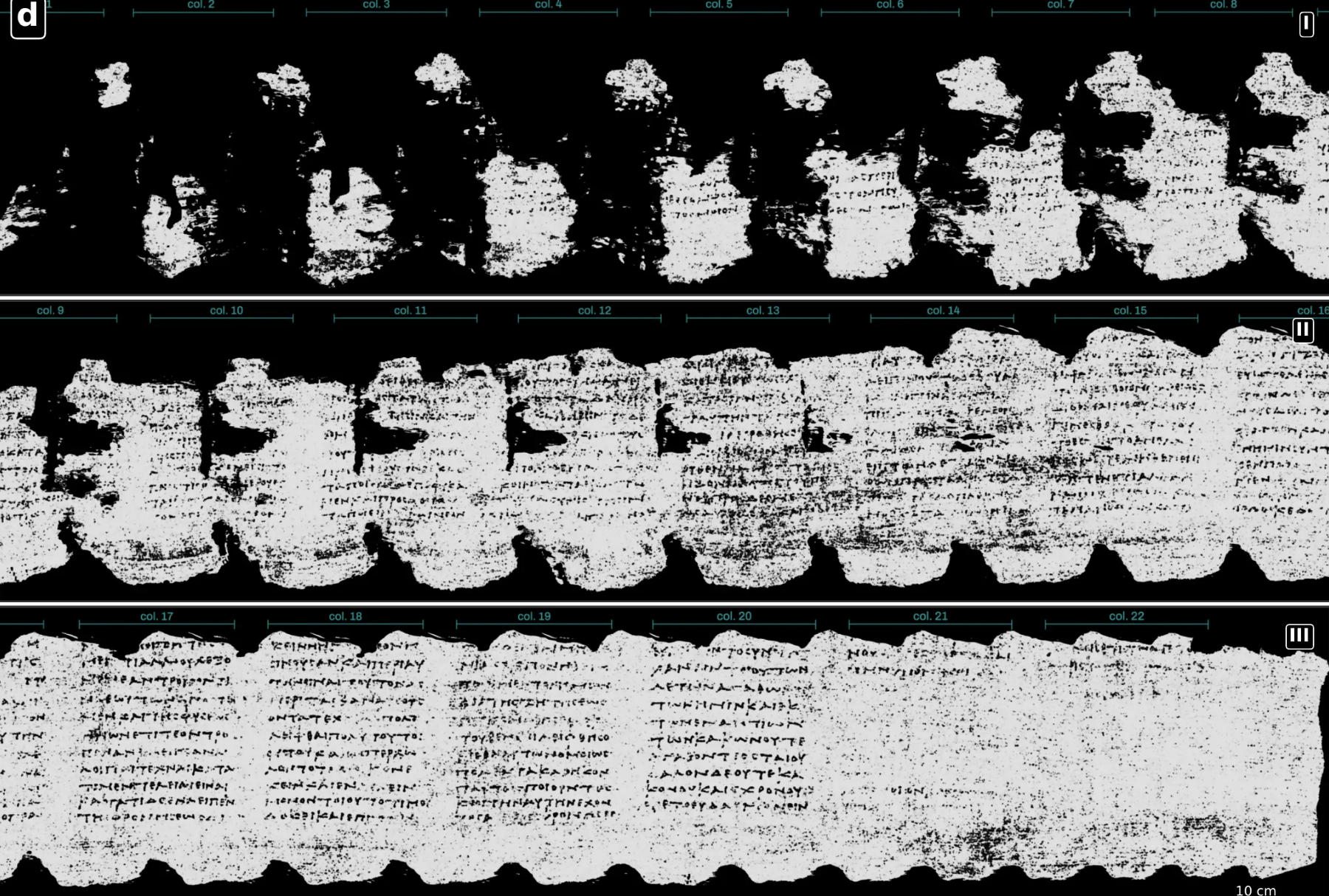
These collaborative efforts, both technological and intellectual, have made PHerc. 1667 “the first Herculaneum papyrus to be digitally unrolled and read in full, end to end, and made available for sustained scholarly study.” But there are also other texts still being deciphered, including PHerc. 139, which has been identified as “Philodemus, On Gods, Book 8 — a treatise by the Epicurean philosopher whose works fill so much of this library.” In their day, Stoicism and Epicureanism stood as similar but rival philosophies, and it seems that the owner of the so-called Villa of the Papyri (possibly Julius Caesar’s father-in-law) had an interest in both of them. Ancient Stoics and Epicureans carried on a lively debate about how to live, some of whose arguments were written down. If the necessary technologies continue to advance, perhaps we’ll one day be able to read them all and pick that conversation up right where they left it off. Learn more about the decoding of the papyrus here and here.
Related content:
Researchers Use AI to Decode the First Word on an Ancient Scroll Burned by Vesuvius
Based in Seoul, Colin Marshall writes and broadcasts on cities, language, and culture. He’s the author of the newsletter Books on Cities as well as the books 한국 요약 금지 (No Summarizing Korea) and Korean Newtro. Follow him on the social network formerly known as Twitter at @colinmarshall.




Leave a Reply