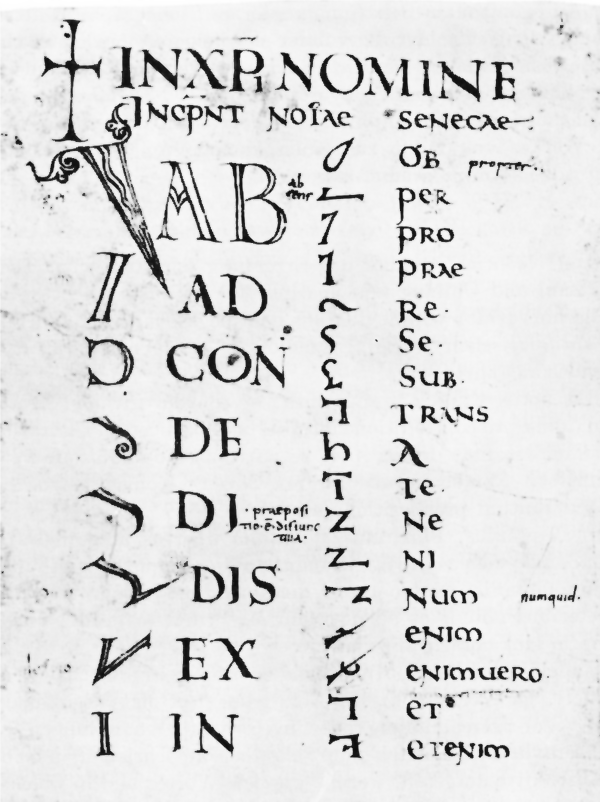
You can still type a symbol originally invented for Cicero nearly 21 centuries ago — at least if you configure your keyboard properly. The character ⁊ appears in Unicode as U+204A, but is better known as the “Tironian et”: the “et” is Latin for “and,” and the “Tironian” comes from its creator, a man named Tiro, or in full, Marcus Tullius Tiro. Tiro wasn’t a relative of Marcus Tullius Cicero, as you might expect, but rather his onetime slave: after being emancipated, he not only took on two of his former master’s names, but also remained his secretary and confidant. It was in that capacity that, at Cicero’s request, he created the system since known as Tironian notes.
Though now credited as “the father of stenography,” Tiro didn’t invent shorthand itself. Like so many developments in ancient Roman civilization, Hellenic inspiration was involved: no sooner did Cicero learn of the existence of Greek shorthand systems, so the story goes, than he asked Tiro to come up with one for Latin. It’s possible that he did so as early as 75 BC, when Cicero was assigned to Sicily and needed to encode his communications, especially those having to do with the corruption of local officials. Back in Rome, it became useful indeed for rapidly transcribing onto wax-covered tablets what the great orator had to say, in situations ranging from everyday dealings in the Forum to — as recorded by Plutarch — denouncing Catiline’s conspiracy to overthrow the Roman Republic.
Tiro created about 4,000 symbols to stand in for syllables, words, and other elements of language, and other of the system’s users, including Seneca, later brought the number up to 5,000. But “as Rome declined, so did shorthand,” writes Anita Kreitzman at the National Court Reporters Association. “The Emperor Justinian, in the sixth century, contemptuously forbade its use.” Yet Tironian notes survived, especially among the annotators of manuscripts, expanding and merging with other systems to contain 14,000 signs during the Carolingian dynasty. Alas, “Holy Roman Emperor Frederick II (1212–1250) considered the use of shorthand symbols ‘diabolical’ and ‘ordered the destruction of all shorthand characters.’ As a result, shorthand quickly became a lost art.”
Thereupon came the Dark Ages in which “learning and shorthand seemed to no longer exist.” Leave it to court reporters to equate abbreviation with civilization. Yet the association is hardly spurious, and can’t be accidental that its revival began in late sixteenth-century London, when the world’s transformation over the subsequent centuries was getting into motion. Many shorthand systems have risen and fallen since, and the digital technologies of recent decades have made the whole practice superfluous for most of us here in the twenty-first century. Yet we can still have ⁊, thanks to inadvertent preservation by the medieval Irish script and Gaelic type that use it as an ampersand. It may not have the same function in English, or even the Romance languages, but typing no other symbol could make us feel quite so Ciceronian.
Related content:
Alice in Wonderland, Hamlet, and A Christmas Carol Written in Shorthand (Circa 1919)
The Story of Lorem Ipsum: How Scrambled Text by Cicero Became Used by Typesetters Everywhere
What Ancient Latin Sounded Like, And How We Know It
The Writing Systems of the World Explained, from the Latin Alphabet to the Abugidas of India
Based in Seoul, Colin Marshall writes and broadcasts on cities, language, and culture. He’s the author of the newsletter Books on Cities as well as the books 한국 요약 금지 (No Summarizing Korea) and Korean Newtro. Follow him on the social network formerly known as Twitter at @colinmarshall.




Leave a Reply