Pitch to friends or family the idea of a trip to Mons, Belgium to visit the Mundaneum, and you may be met with a less-than-enthusiastic reception. That’s unfortunate, since such an experience could fundamentally change the way they regard technology they use every day. Though its name may seem to promise unrelieved dullness today, the Mundaneum arose out of enormous high-tech ambitions. The idea behind it, as conceived by Belgian lawyers Paul Otlet and Henri La Fontaine, was to gather, classify, centralize, and make universally available all human knowledge. This may sound familiar to anyone who’s used the internet, but it was a rather bolder proposition at the turn of the twentieth century.
Otlet and La Fontaine’s “city of knowledge” may not have been fully realizable at that time, but technology had made it imaginable. The Dewey Decimal System, with its standardized card catalogs, had been around since 1876. Starting in 1895, Otlet adapted that basic tool to a far larger project: the Mundaneum took shape as a vast paper archive. Millions of index cards, each recording bibliographic details about a single book, article, or document, were filed away in row upon row of catalog drawers. (See image below.)
“Otlet made this card central to his system,” writes Sidney Perkowitz at JSTOR. “Aiming to capture every book ever published, the Mundaneum stored bibliographic data for books under the UDC [Universal Decimal Classification], along with magazine articles, images, and more on over 15 million cards crammed into catalog drawers.” Originally housed in Brussels’ Cinquantenaire Palace, the Mundaneum was meant to get its own building designed by the forward-thinking Le Corbusier by the end of the nineteen-twenties. Alas, it was never built, and after the Nazi invasion of 1940, the Mundaneum was scrapped for a Third Reich art exhibition.
Discussions of the Mundaneum in our time often highlight what Otlet (1868–1944), despite the project’s many tribulations, eventually envisioned as “a global ‘réseau’ or network of ‘electric telescopes.’ These early workstations were to be linked to the Mundaneum by telephone and the new technology of television. A user would phone in a query, and the answer in a book or other source would appear displayed on a personal screen, which could be split to show multiple results.” Convinced that all homes would eventually have access to the network, he considered even the possibility of “data sharing and social interactions among its users.” This dream of the internet avant la technologie is now enshrined at the Mundaneum museum, which is open five days a week. Alternatively, you can point your electric telescope to its online catalog any time.
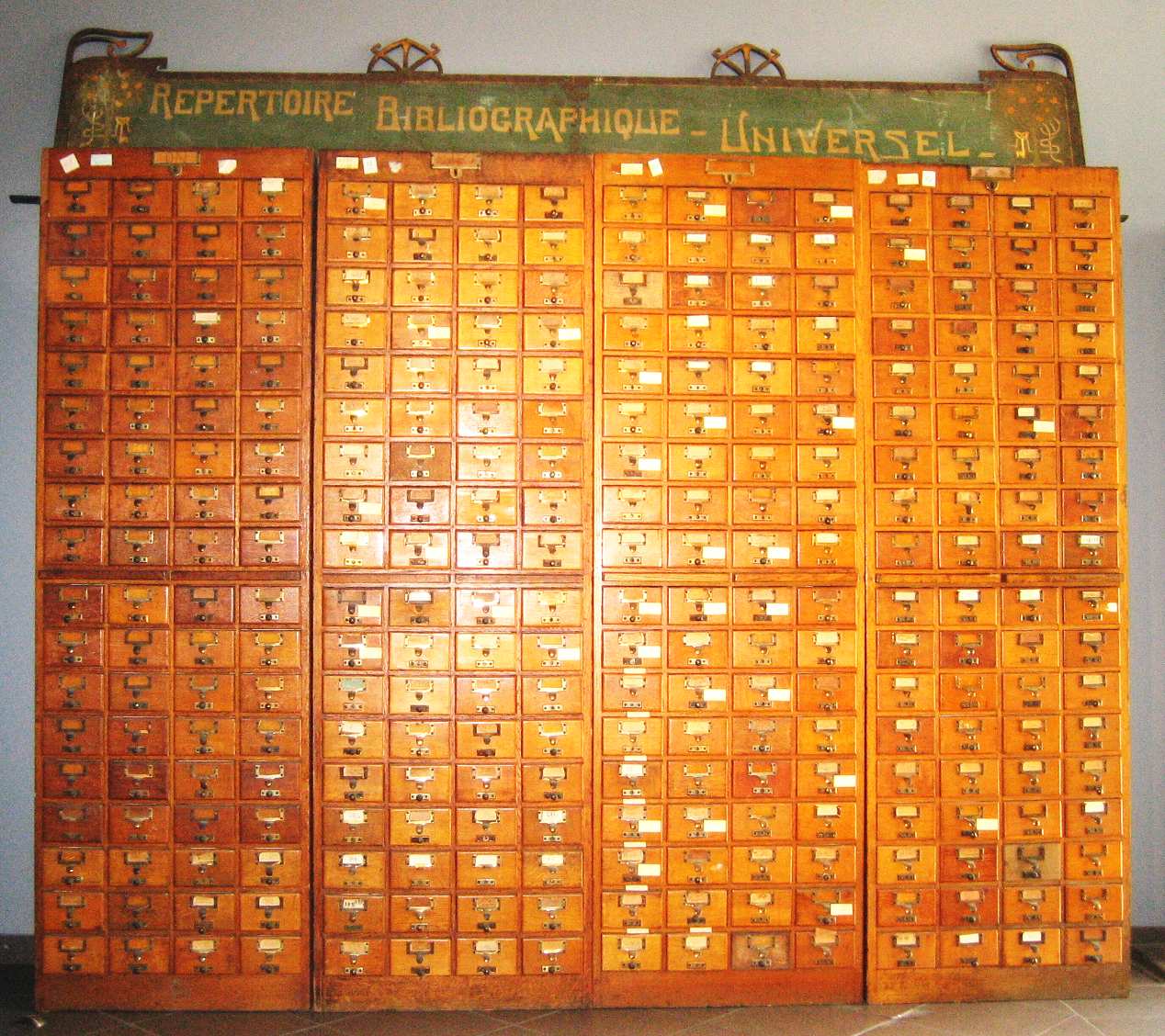
Image by Zinneke, via Wikimedia Commons
Related Content:
The Rise and Fall of the Great Library of Alexandria: An Animated Introduction
The First Music Streaming Service Was Invented in 1881: Discover the Théâtrophone
Meet the Syntopicon: The Ambitious Index That Tried to Organize All of Western Thought (1952)
What the Entire Internet Looked Like in 1973: An Old Map Gets Found in a Pile of Research Papers
Do All Roads Lead to Philosophy on Wikipedia?: They Do About 97.3% of the Time
Based in Seoul, Colin Marshall writes and broadcasts on cities, language, and culture. He’s the author of the newsletter Books on Cities as well as the books 한국 요약 금지 (No Summarizing Korea) and Korean Newtro. Follow him on the social network formerly known as Twitter at @colinmarshall.





Leave a Reply