Twenty years ago, United States senator Ted Stevens drew long-lasting online ridicule by describing the internet as “a series of tubes.” While some commentators noted that the analogy wasn’t quite as outlandish as it seemed, most reacted with nothing more than amused bafflement. Where had Stevens come up with that image? Given that he was born in 1923, perhaps he was drawing on memories of a technological wonder of his childhood: the underground pneumatic systems through which mail was delivered in major American cities from the eighteen-nineties until the early nineteen-fifties, whose story is told in the It’s History video above.
Such series of tubes entered service in London, Paris, and Berlin in the mid-nineteenth century. In 1893, Philadelphia became the first American city to get one, thanks to the advocacy of technologically minded department store magnate-turned-Postmaster General John Wanamaker. At the inauguration, writes Hidden City’s Harry Kyriakodis, Wanamaker “placed a Bible wrapped in an American flag into a canister that went flying (underground) to the Central Post Office with a loud ‘whish’.” Philadelphia’s network expanded apace, eventually including nearly twenty miles of tunnels, and “New York City, Boston, Chicago, and St. Louis adopted similar delivery systems by 1898, all operated by the Post Office Department.”
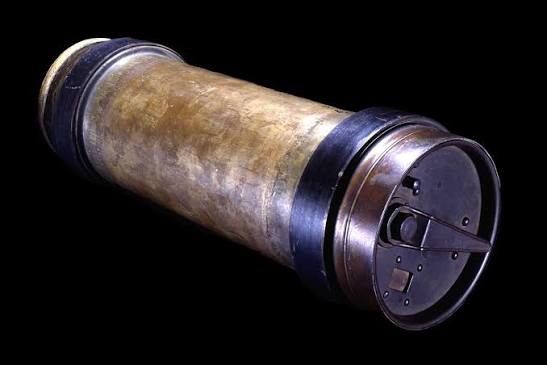
Operated at a serious loss, that is: when the U.S. got involved in World War I, the Post Office suspended pneumatic service to conserve resources. Only in the twenties did the tubes start whishing again in parts of New York and Boston, whose high volumes of mail could potentially justify the operation. In fact, the sheer amount of mail eventually got to be too much for the steel capsules and the cast-iron tunnels through which compressed air pushed them. As retired U.S. Postal Inspector Robert A. Cohen explains it in his history of these systems, “It takes a certain amount of time for a gallon of liquid to travel through a funnel. Two gallons take twice as long to pass through. The value of the Pneumatic Tube Service decreased as mail volume increased.”
The proliferation of automobiles and the expansion of their supporting infrastructure dealt an even more serious blow: after World War II, delivering mail on the roads had clearly become more efficient than doing it underground. Some “rocketeers,” as the system’s operators were called, stuck it out until December 12, 1953, when pneumatic mail service was officially suspended all across the country.
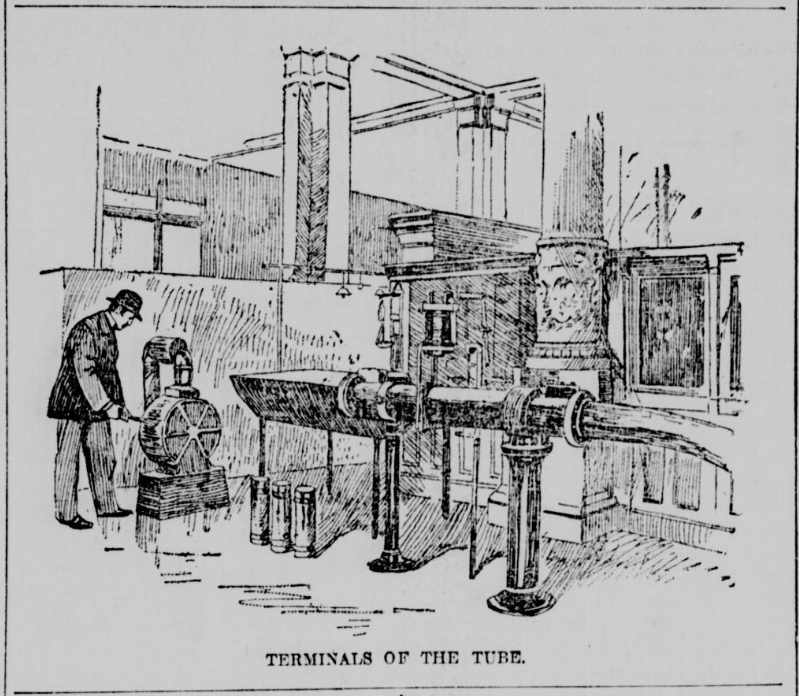
This marked the end of an era, especially for the rocketeers said to have used the network to surreptitiously receive orders from their favorite sandwich shops. Remembering Ted Stevens’ notorious remark, it’s tempting to describe the series of tubes that were pneumatic mail delivery systems as an early version of the internet — and even more so it was already getting people hooked on food delivery.
] 
Related Content:
What’s Under London? Discover London’s Forbidden Underworld
An Architect Breaks Down the Design of New York City Subway Stations, from the Oldest to Newest
Based in Seoul, Colin Marshall writes and broadcasts on cities, language, and culture. He’s the author of the newsletter Books on Cities as well as the books 한국 요약 금지 (No Summarizing Korea) and Korean Newtro. Follow him on the social network formerly known as Twitter at @colinmarshall.




Leave a Reply