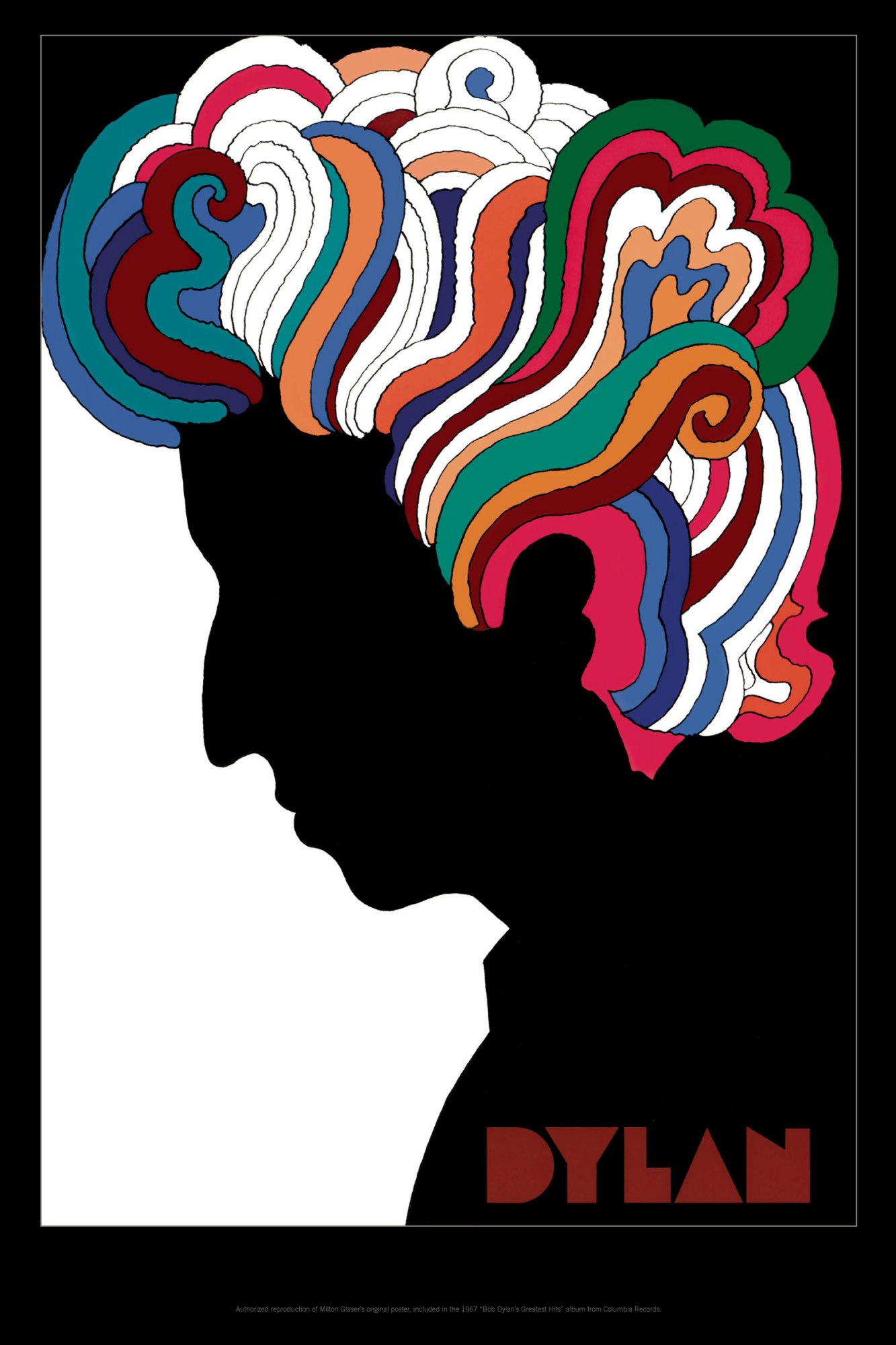
He only talks for five minutes–and before you know it, he’s produced a sketch of The Bard. We wish it was more, but his observations make for some good inspirational quotes, whether you dabble in art or not. He critiques art schools for dropping drawing from their curriculums because drawing doesn’t jibe with their computer-based, career focus. “While people have what they need, perhaps, for their professional life, what they don’t have is a fundamental instrument for understanding the reality of that life,” he opines.
Drawing is how Glaser understands the world, and how it keeps him present in reality. It’s the basis for all art that is to come, no matter if the student goes on to abstraction. It’s also essential, he says, for child development, and any child not given the tools to make art is being done a disservice.
For those wondering about that book Glaser mentions writing, Drawing Is Thinking, you can get it here.
And if you’re curious about Frank R. Wilson’s The Hand, which Glaser compliments, it’s here.
And finally, if you need a quick primer on the man, here’s a quick overview of Milton Glaser by the New York Times. “Drawing is my greatest pleasure,” he says, and it shows.
Ted Mills is a freelance writer on the arts who currently hosts the FunkZone Podcast. You can also follow him on Twitter at @tedmills, read his other arts writing at tedmills.com and/or watch his films here.
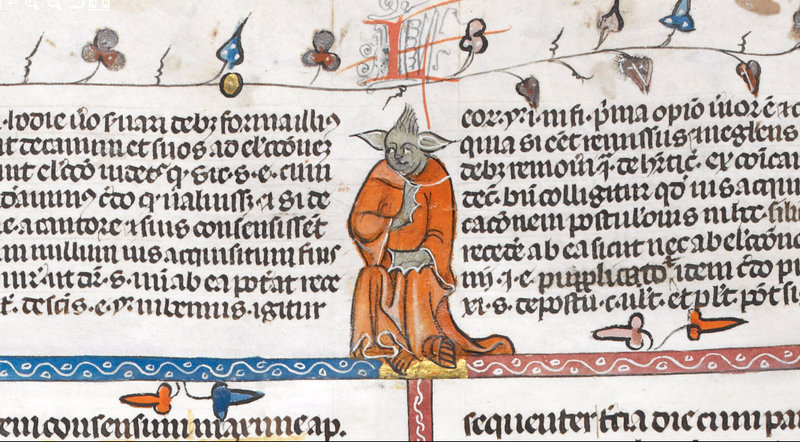
In a new picture book called Medieval Monsters, published by the British Library, historian Damien Kempf and art historian Maria L. Gilbert have gathered together illustrations that highlight the great monsters of the medieval world. Monsters were everywhere, including “on the edges of manuscript pages” and on “the fringes of maps.” The successor to Medieval Cats and Medieval Dogs, Medieval Monsterscontains no shortage of fascinating illustrations, including the one above. It looks remarkably like Yoda, doesn’t it?
A British Library curator told NPR, “The Yoda image comes from a 14th-century manuscript known as the Smithfield Decretals.” “I’d love to say that it really was Yoda, or was drawn by a medieval time traveler.” But “it’s actually an illustration to the biblical story of Samson — the artist clearly had a vivid imagination!”
In this talk, artist Jae Rhim Lee models her Mushroom Death Suit, a kicky little snuggy designed to decompose and remediate toxins from corpses before they leech back into the soil or sky. Despite Björk’s fondness for outré fashion, I’m pretty sure this choice goes beyond the merely sartorial.
For more information, or to get in line for a mushroom suit of your own, see the Infinity Burial Project.
Continuing with the mushroom / fashion theme, Björk next turns to designer Suzanne Lee, who demonstrates how she grows sustainable textiles from kombucha mushrooms. The resulting material may variously resemble paper or flexible vegetable leather. It is extremely receptive to natural dyes, but not water repellent, so bring a non-kombucha-based change of clothes in case you get caught in the rain.
For more information on Lee’s homegrown, super green fabric, visit BioCouture.
Björk’s clearly got a soft spot for things that grow: mushrooms, mushroom-based fabric, and now…building materials? Professor of Experimental Architecture Rachel Armstrong’s plan for self-regenerating buildings involves protocols, or “little fatty bags” that behave like living things despite an absence of DNA. I’m still not sure how it works, but as long as the little fatty bags are not added to my own ever-growing edifice, I’m down.
For more information on what Dr. Armstrong refers to as bottom up construction (including a scheme to keep Venice from sinking) see Black Sky Thinking.
Björk’s next choice takes a turn for the serious… with games. Game Designer Brenda Romero began exploring the heavy duty emotional possibilities of the medium when her 9‑year-old daughter returned from school with a less than nuanced understanding of the Middle Passage. The success of that experiment inspired her to create games that spur players to engage on a deeper level with thorny historical subjects. (The Trail of Tears required 50,000 individual reddish-brown pieces).
Remember those 50,000 individual pieces? As photographer Aaron Huey documented life on Pine Ridge Reservation, he was humbled by hearing himself referred to as “wasichu,” a Lakota word that can be translated as “non-Indian.” Huey decided not to shy away from its more pointed translation: “the one who takes the best meat for himself.” His TED Talk is an impassioned history lesson that begins in 1824 with the creation of the Bureau of Indian Affairs and ends in an activist challenge.
Proof that Björk is not entirely about the quirk.
Björk opts to close things on a musical note with excerpts from composer Eric Whitacre’s “Lux Aurumque” and “Sleep” performed by a crowdsourced virtual choir. Its members—they swell to 1999 for “Sleep”—record their parts alone at home, then upload them to be mixed into something sonically and spiritually greater than the sum of its parts.
In this short video, Romanian animator Sebastian Cosor brings together two haunting works from different times and different media: The Scream, by Norwegian Expressionist painter Edvard Munch, and “The Great Gigin the Sky,” by the British rock band Pink Floyd.
Munch painted the first of four versions of The Scream in 1893. He later wrote a poem describing the apocalyptic vision behind it:
I was walking along the road with two Friends the Sun was setting — the Sky turned a bloody red And I felt a whiff of Melancholy — I stood Still, deathly tired — over the blue-black Fjord and City hung Blood and Tongues of Fire My Friends walked on — I remained behind – shivering with anxiety — I felt the Great Scream in Nature
Munch’s horrific Great Scream in Nature is combined in the video with Floyd’s otherworldly “The Great Gig in the Sky,” one of the signature pieces from the band’s 1973 masterpiece, Dark Side of the Moon. The vocals on “The Great Gig” were performed by an unknown young songwriter and session singer named Clare Torry.
Torry had been invited by producer Alan Parsons to come to Abbey Road Studios and improvise over a haunting piano chord progression by Richard Wright, on a track that was tentatively called “The Mortality Sequence.” The 25-year-old singer was given very little direction from the band. “Clare came into the studio one day,” said bassist Roger Waters in a 2003 Rolling Stone interview, “and we said, ‘There’s no lyrics. It’s about dying — have a bit of a sing on that, girl.’ ”
Forty-two years later, that “bit of a sing” can still send a shiver down anyone’s spine. For more on the making of “The Great Gig in the Sky,” and Torry’s amazing contribution, see the clip below to hear Torry’s story in her own words.
Follow Open Culture on Facebook and Twitter and share intelligent media with your friends. Or better yet, sign up for our daily email and get a daily dose of Open Culture in your inbox. And if you want to make sure that our posts definitely appear in your Facebook newsfeed, just follow these simple steps.
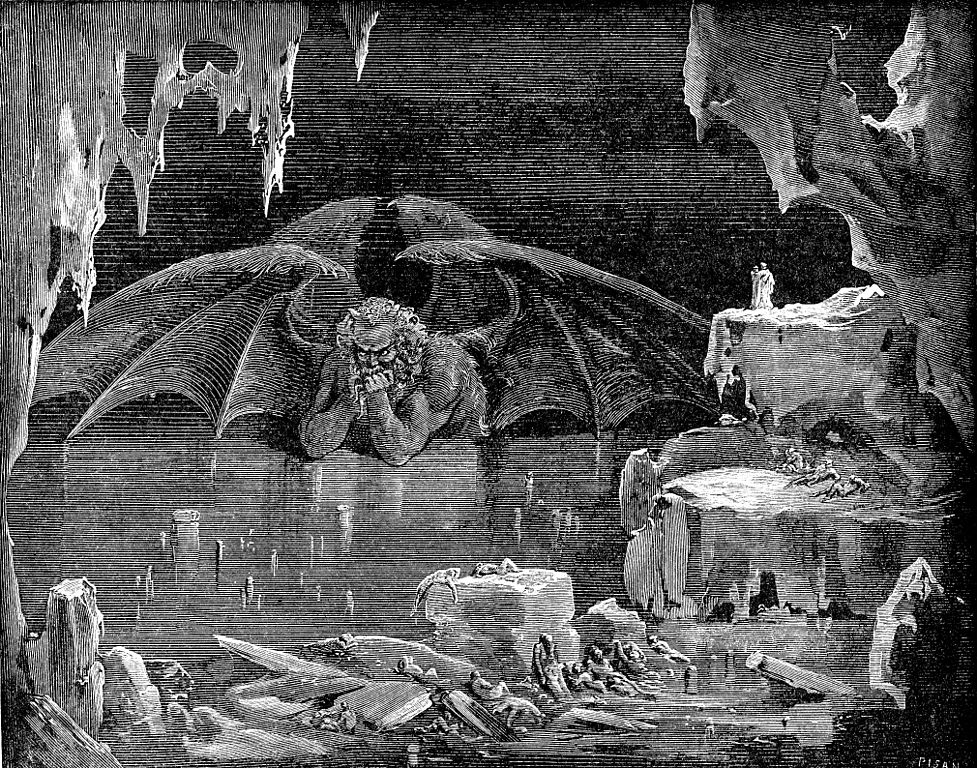
For a book about medieval theology and torture, filled with learned classical allusions and obscure characters from 13th century Florentine society, Dante Alighieri’s Inferno, first book of three in his Divine Comedy, has had considerable staying power, working its way into pop culture with a video game, several films, and a baleful appearance on Mad Men. While the Mad Men reference may be the more literary, the former two may hint at the more prominent reason the Inferno has captivated readers, players, and viewers for ages: the lengthy poem’s intensely visual representation of human extremity makes for some unforgettable images. Like Achilles dragging Hector behind his chariot in Homer, who can forget the lake of ice Dante encounters in the ninth circle of Hell, in which (in John Ciardi’s modern translation), he finds “souls of the last class,” which “shone below the ice like straws in glass,” and, frozen to his chest, “the Emperor of the Universe of Pain,” almost too enormous for description and as hideous as he once was beautiful.
Like the rest of us, artists have been drawn to Dante’s extraordinary images and extensive fantasy geography since the Divine Comedy first appeared (1308–1320). In prolific French artist Gustave Doré’s rendering of the ninth circle scene, above, Satan is a huge, bearded grump with wings and horns. Doré so desperately wanted to illustrate the Divine Comedy (find in our collection of 700 Free eBooks) that he financed the first book in 1861 with his own money.
Afterwards, as Mike Springer wrote in a previous post on Dore’s illustrations, his publisher Louis Hachette agreed to put out the next two books with the telegram, “Success! Come quickly! I am an ass!” Doré’s eerie, beautiful drawings are just one such set of famous illustrations we’ve featured on the site previously.
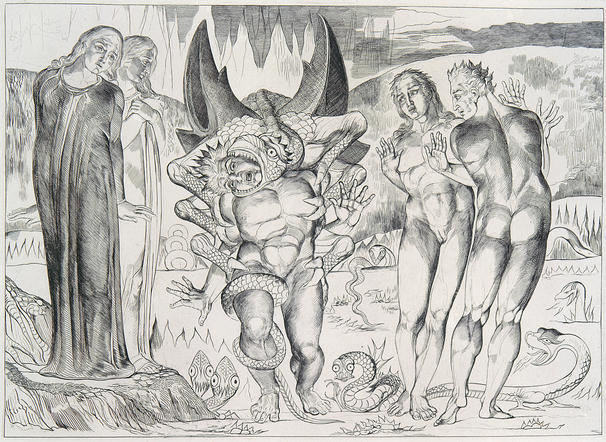
Another artist perfectly suited to the task, William Blake, whose own poetry braved similar heights and depths as Dante’s, took on the Inferno at the end of his life. While he didn’t live to complete the engravings, his unsettling, yet highly classical, renderings of the poet the Italians call il Sommo Poeta—“The Supreme Poet”—certainly do justice to the vividness and horror of Dante’s descriptions. Above, see Blake’s 1827 interpretation of the thief Agnolo Brunelleschi attacked by a six-footed serpent in Canto twenty-five, a scene reprinted many times in color.
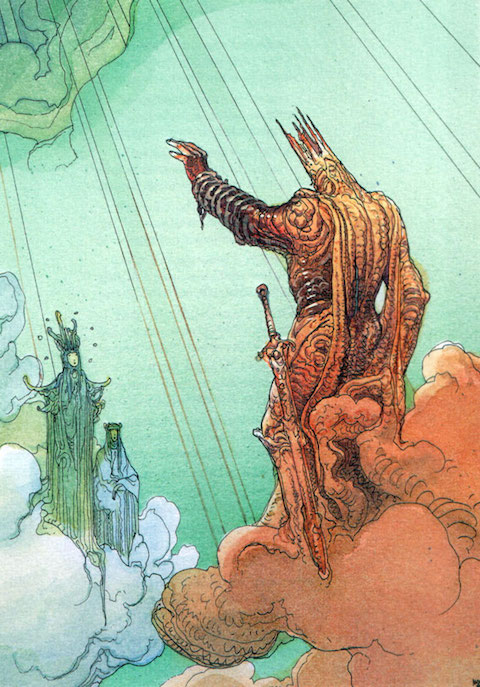
Like the makers of films and video games, artists have mainly chosen to focus on the most bizarre and harrowing of the three books, the Inferno. One modern artist who undoubtedly would have had a fascinating take on Dante’s hell instead illustrated his heaven, being chosen to imagine Paradiso by the Milan’s Nuages Gallery in 1999. I refer to graphic artist Jean Giraud, known in the world of fantasy, sci-fi, and comics as Mœbius. Despite some arguable artistic miscasting (Mœbius did after all make films like Alien and Tron “even weirder”), the French artist took what may be the least visually interesting of Dante’s three Divine Comedy books and created some incredibly striking images. See one above, and more at our previous post.
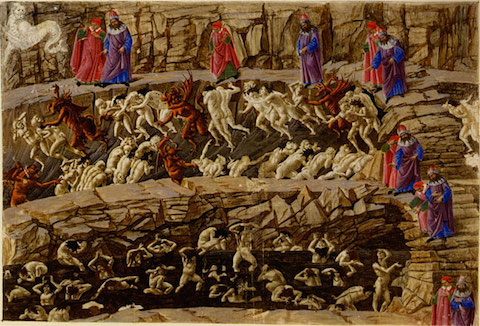
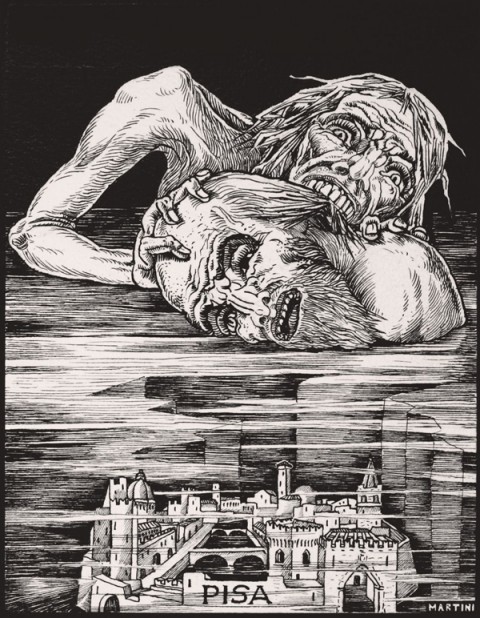
Other artists, like Alberto Martini, who worked on his Divine Comedy for over forty years, have produced terrifying images (above) and highly stylized ones—like these medieval illuminations from a 1450 manuscript. The range of interpretations all have one thing in common—their subject matter seems to allow artists almost unlimited freedom to imagine Dante’s weird cosmography. No vision of the Inferno or the loftier realms above it can go too far, it seems, even in the absurd video game finale you really have to see to believe. Somehow, I think Dante would approve… well… mostly.
We all found it impressive when Amsterdam’s Rijksmuseum put up 125,000 Dutch works of art online. “Users can explore the entire collection, which is handily sorted by artist, subject, style and even by events in Dutch history,” explained Kate Rix in our first post announcing it. ” “Not only can users create their own online galleries from selected works in the museum’s collection, they can download Rijksmuseum artwork for free to decorate new products.”
And so they’ve kept hard at work adding to their digital archive, which, as of this writing, offers nearly 361,000 works of art. This brings them within shouting distance of having doubled the collection in size since we first wrote about it.
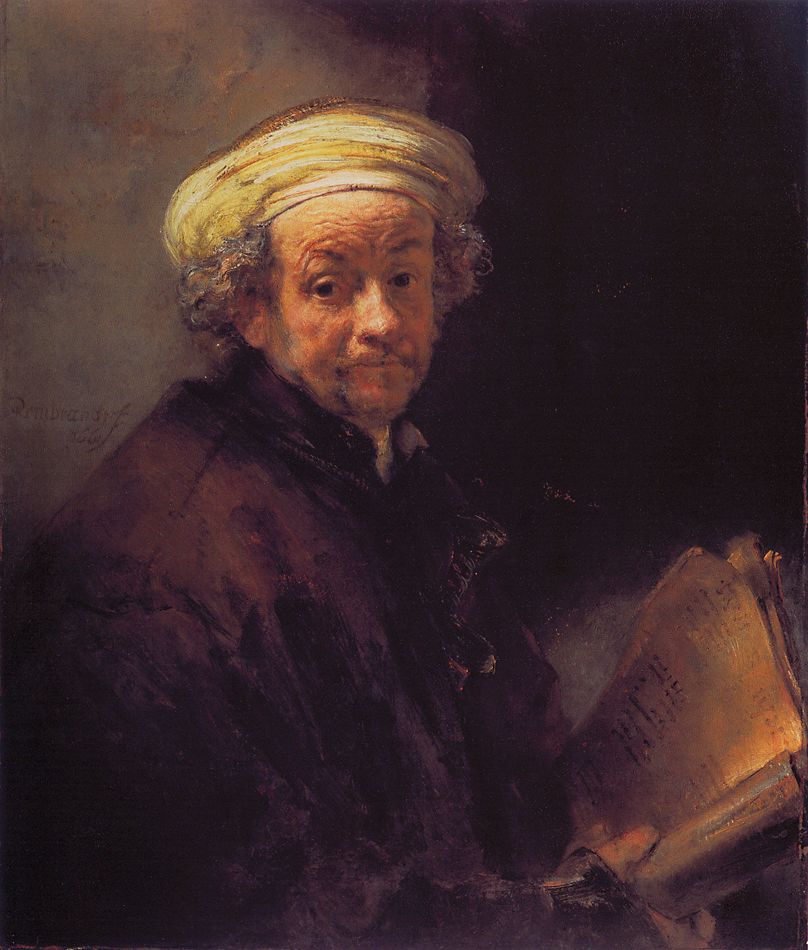
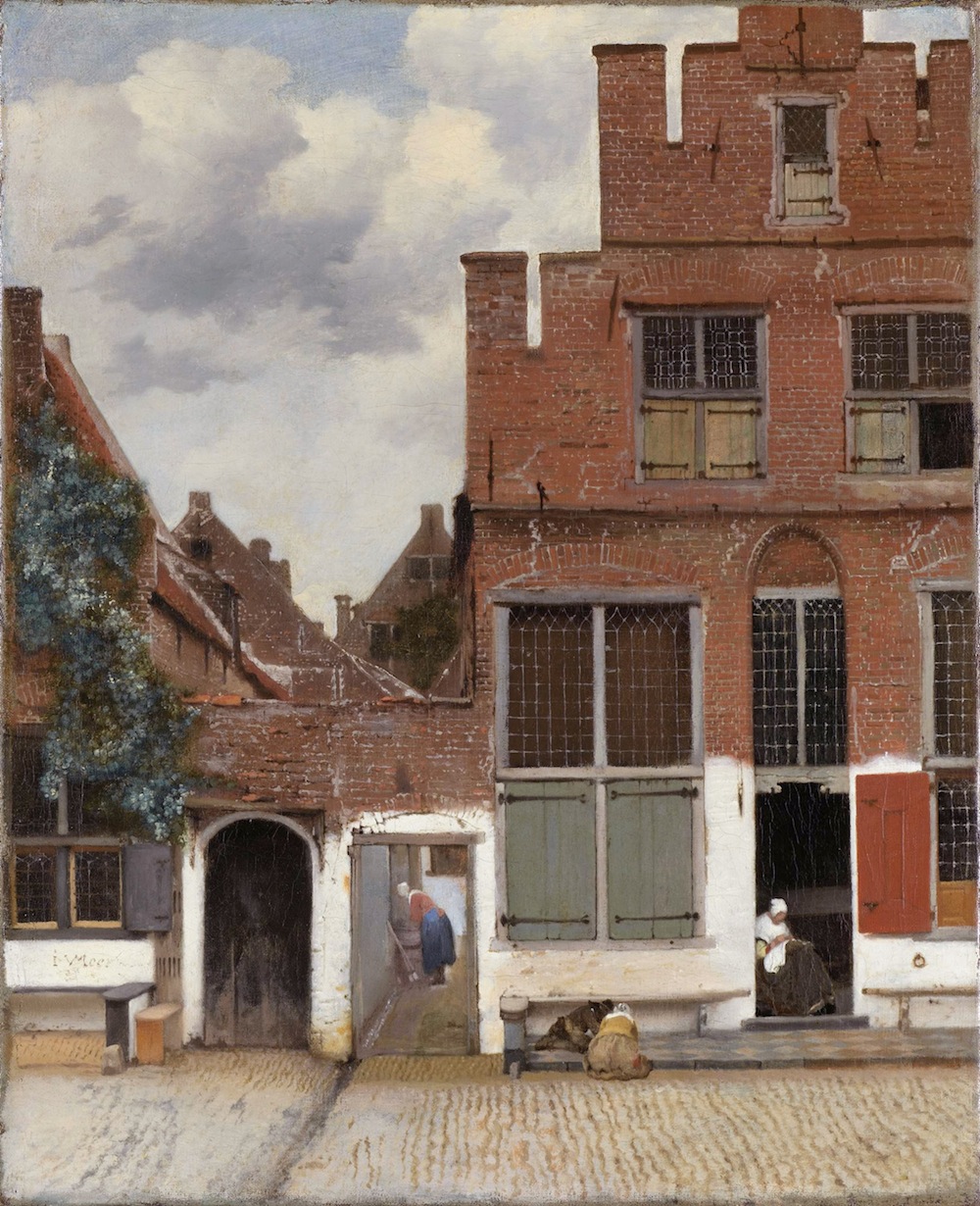
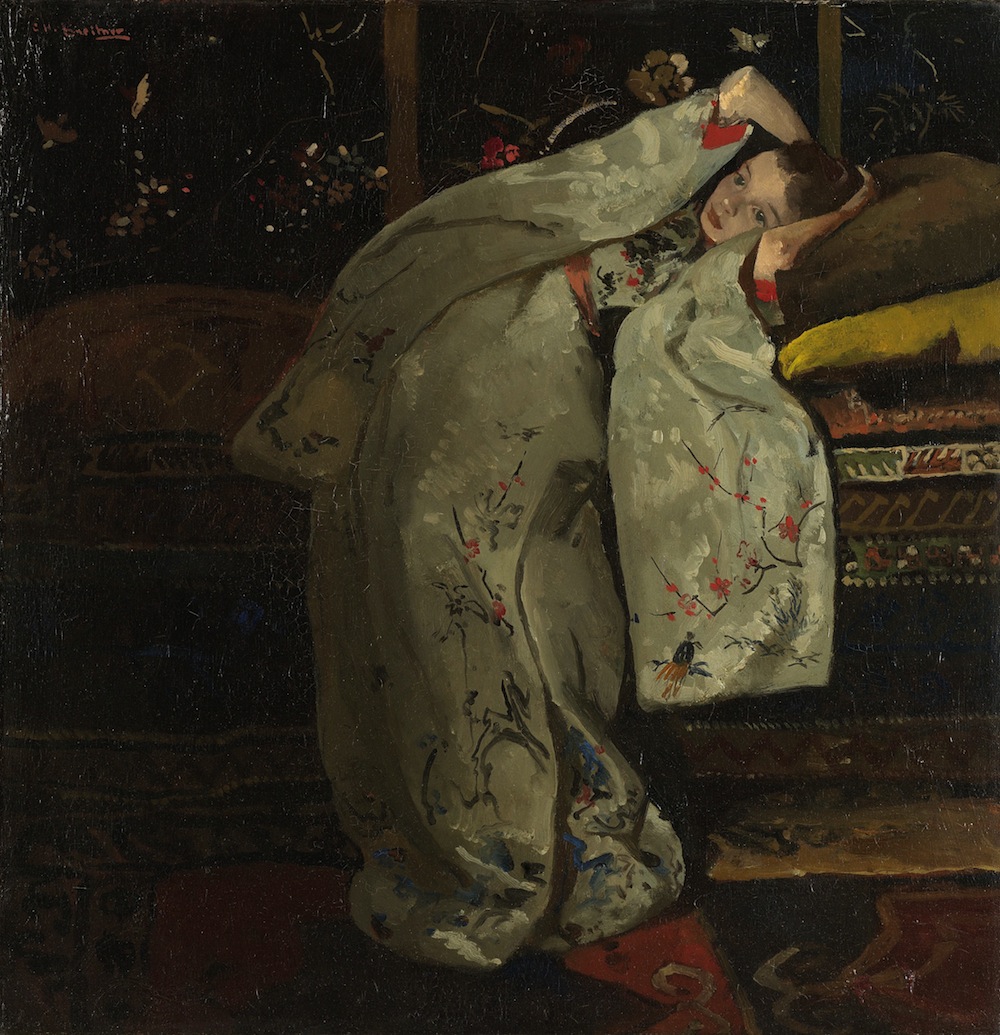
You want the Dutch Masters? You got ’em. You want Rembrandt’s Self-portrait as the Apostle Paul? It’s in the archive, right alongside Night Watch. You want Vermeer’s View of Houses in Delft, better known as The Little Street? It’s in there too. But don’t stop now; the Rijksmuseum has put up a much greater breadth of Dutch art than that. You’ll also find important Dutch painters you may not have heard so much about before, such as the impressionist George Hendrik Breitner, whose Girl in a White Kimono appears just above. And it even includes high-resolution images of works of art and design in other media, such as Michel de Klerk’s 1918 suite of furniture for ‘t Woonhuys, whose armchair you see below. Looks almost good enough to sit in, doesn’t it? You can enter the collection here, or search the collection here.
We all know that saying about walking in another’s shoes, but what about seeing through another’s eyeballs? I’m not talking about perspective. I’m talking about color. As in I see it, and my husband doesn’t. At least not the way I do.
His coping mechanism is to challenge me whenever I refer to something as “blue.” To him, it’s grey, or brown, or some other non-blue shade. He wants me to see it that way too. To admit that I am wrong. For my part, I feel it’s important that the person to whom I’m married acknowledge that there’s no way my favorite bowl can be the color of cement, no matter what his cone cell receptors are telling him.
Perhaps he’d have better luck asking patient strangers to describe color to him, as blind-from-birth film critic Tommy Edison does below. Hmm. Color may be more subjective than my husband’s and my spectral stand-offs would suggest.
According to EnChroma, the company that designed and sells the color-correcting lenses the onscreen guinea pigs are seen wearing in the video up top, an estimated 300 million people suffer from some form of color blindness. Their glasses offer some of those three million a chance at seeing red in the literal sense. The video participants are, not surprisingly, blown away by their first encounter with a Crayola-colored world.
Having refreshed myself on the structures of the eye, I took the color blindness test on EnChroma’s website. I tested normal, having identified the hidden (or in my case not-so-hidden) numbers in a variety of virtual mosaics.
My color blind friend, Bob, agreed to take it too, provided I muzzle myself from offering the sort of commentary to which husbands are subjected. (Whaddaya mean you can’t see it!? It’s bright fuchsia!!!) He pulled a pretty heavy duty protan deficiency, otherwise known as red-green color blindness.
According to the manufacturer, EnChroma glasses are unlikely to color his world. The best he could hope for is a slight improvement after weeks of wearing.
Perhaps Bob will get a peek at something he hasn’t seen before. Like red. Others will experience a revelation. Meanwhile, an insufferable non-colorblind individual such as myself might get an effect akin to an Instagram filter. My colors will pop.
“Unfair,” say Bob and my husband. I have to agree. Should the Museum of Contemporary Art offer color-leeching glasses, I will wear them, even if the frames are really ugly. Until then, the video below provides some sense of what those of us who see the full range of color aren’t missing.
Note: You will hear sound 37 seconds into the film.
Humanity has endured a great many wartime atrocities since 1937, but to this day, if you think of an artwork born of one such event, you’ll more than likely still think of Guernica. Pablo Picasso’s large black-and-white canvas, which he began painting less than a month after the aerial bombing during the Spanish Civil War of the small Basque town which gave it its name, renders the horror of sudden, thorough destruction in a way nobody had ever seen before, or has seen again since.
“When I visited the town the whole of it was a horrible sight, flaming from end to end. The reflection of the flames could be seen in the clouds of smoke above the mountains from 10 miles away,” wrote The Times’ war correspondent George Steer, in the report that moved Picasso to take on the subject of Guernica for the mural the Spanish Republican government had commissioned for the 1937 World’s Fair. “Throughout the night houses were falling until the streets became long heaps of red impenetrable debris.”
In 1950, both Guernica and Guernica inspired an equally haunting short film of the same name [part one, part two] by Alain Resnais and Robert Hessens. In black and white just like Picasso’s painting, the picture uses nightmarish cutting to combine imagery from Guernica and other artistic sources, a score by Guy Bernard, and the poem “Victory of Guernica” by Paul Éluard. “You hold the flame between your fingers and paint like a fire,” said the poet to the painter during their close friendship in the years after the bombing.
Resnais, who would go on to direct such classics of French cinema as Hiroshima mon amour (another study of an aftermath) and Last Year at Marienbad, only just ended his long and distinguished filmmaking career when he died last year. But in 1950, his career had only just begun, his first forays into film having come in the form of short documentaries on working artists in the mid-1940s. Those led to a commission to do one on the paintings of Van Gogh for a Paris exhibition, which led to one on Gauguin, which led to Guernica. Clearly, Resnais had the tendency to unite the arts in his work from the very beginning, and many of his fans would say it served him well to the end.
We're hoping to rely on loyal readers, rather than erratic ads. Please click the Donate button and support Open Culture. You can use Paypal, Venmo, Patreon, even Crypto! We thank you!
Open Culture scours the web for the best educational media. We find the free courses and audio books you need, the language lessons & educational videos you want, and plenty of enlightenment in between.