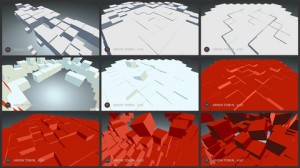
The Surrealist is ready for his close up, Mr. Warhol. Are you ready for him?
As previously noted on this site, Andy Warhol filmed nearly 500 “screen tests” in the mid-60s. He wasn’t looking to discover unknown talent or cast an upcoming movie. His interest seemed to stem more from voyeurism, the collector’s impulse, and his fixation with glamour. The majority of his celebrated subjects, obeying Warhol’s instructions, refrained from hamming it up on camera.
But it was not until Salvador Dalí faced the lens that the maker met his match…twice. The Museum of Modern Art documents the Spanish artist’s flagrant disregard for Warhol’s strictures, while also speculating on Warhol’s response.
And yet, something soulful does come through in the clip above. Is Dalí emoting? Or is the shimmering background melody by Armando Dominguez the inspiration for Destino, a Dali-Disney animated joint that took 57 years in the making?
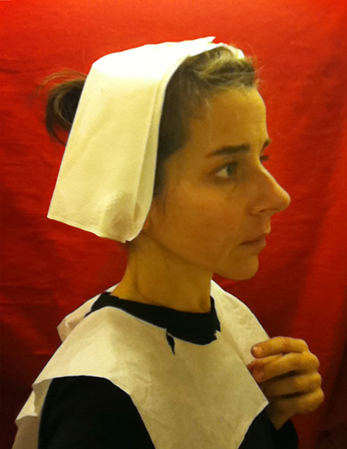
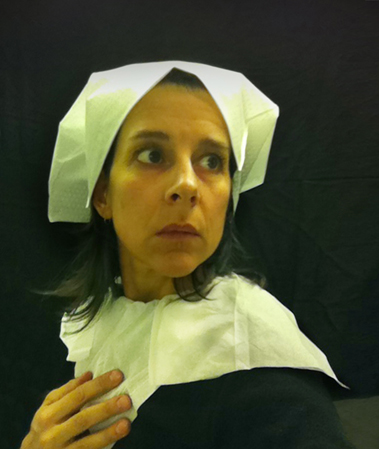
The work of artist Nina Katchadourian is highly accessible. So much so that it’s likely her fault if the line for the bathroom on your next flight stretches all the way from tail to the cockpit. Such is the power of Lavatory Self-portraits in the Flemish Style, the best known segment of her ongoing Seat Assignment project. How can passengers pass up the opportunity to recreate Katchadourian’s widely disseminated images, knowing that the originals were shot in the mirror on an iPhone, using props like disposable seat covers and an inflatable neck pillow?
Shy and/or civic-minded types who don’t relish the implications of tying up the johnny at high altitudes should have a go at restaging the other aspects to Katchadourian’s inflight work, on display above.
(Hint: book a window seat and exercise restraint when the fight attendant hands you your complimentary bag of mini pretzels.)
Honestly, much of what you’ll see, from the unnervingly named Disasters to the genius of Sweater Gorillas, can be accomplished without leaving the ground. Though it may prove more creatively rewarding to delay until the only palatable alternative is an unregulated amount of reality TV screening on the seat back ahead of you.
Likely you envisioned a fat cat with a designer checkbook. It’s the accepted image, but not every benefactor fits the mold.
Take Mark Landis, a gentle soul who’s spent three decades surprising the staffs of small American museums with artwork presented out of the blue. Not just any artwork, and certainly not the nineteenth-century originals they were represented as—in every case, donor Landis was eventually revealed to be the artist.
In Terri Timely’s documentary glimpse, “Father Philanthropy” (above, with a deleted scene below), Landis obligingly guides viewers through the multi-step process by which his forgeries are created, but he reveals little about his motivation, beyond a desire to honor the memory of his parents (Mother looms large here.)
His fakes don’t add up to a grand conceptual piece, a la artist J. S. G. Boggs’ incredibly detailed, far-more-valuable-than-the-items-they-were-used-to-purchase banknotes. He seems indifferent to the possibility of high profile, if ill gotten, prestige. He is, quite simply a giver. His gifts cost the recipients professional pride and unexpected fees associated with ferreting out the truth, but they seem malice-free. “About all I’ve got is an ability to draw and paint,” he states, “So naturally it led me to give away drawing and paintings.”
Cartoonist Lynda Barry, who has helped legions of adults grope their way back to the unselfconscious creativity of childhood, is teaching at the university level. Barry’s Unthinkable Mind course is designed to appeal to students of the humanities. Also hardcore science majors, the sort of lab-coated specimens the first group might refer to as “brains.” The instructor describes her University of Wisconsin spring semester offering thus:
A writing and picture-making class with focus on the basic physical structure of the brain with emphasis on hemispheric differences and a particular sort of insight and creative concentration that seems to come about when we are using our hands (the original digital devices) —to help us figure out a problem.
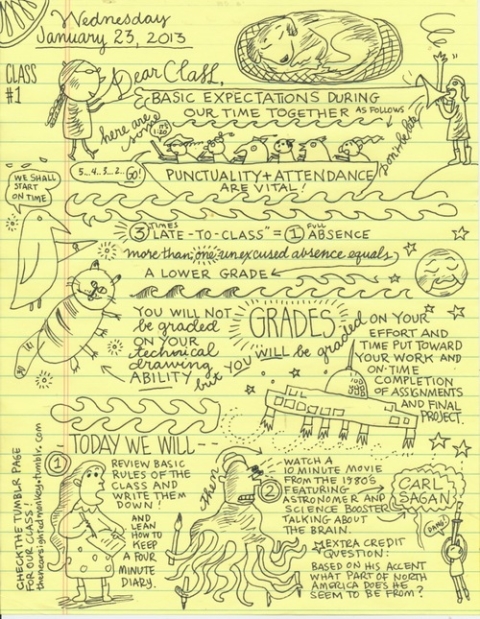
The twenty-one grads and undergrads accepted into Professor Barry’s course have been warned, via the illustrated letter above, handwritten on legal paper, that the workload will be heavy.
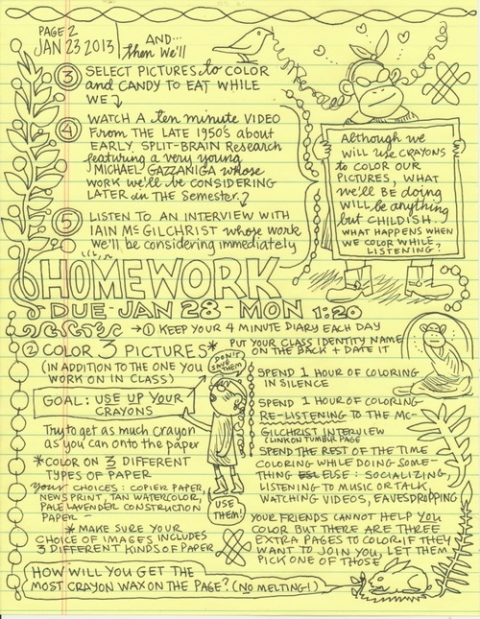
You should be warned as well, if you elect to audit this course from home. Enrollment is not necessary. Professor Barry will be posting her weekly assignments and curriculum materials on her tumblr, a forum where her abiding interest in science is as apparent as her devotion to undirected doodling. Your first assignment, posted above, requires a box of crayons, the coloring pages of your choice, downloaded to four types of paper, and a significant chunk of time set aside for brain-related articles and vintage videos starring Cognitive Neuroscientist Michael Gazzaniga and astronomer Carl Sagan. You should also be committed to keeping a four-minute diary and serving as your own guinea pig.
We told you in the fall about the album released by Beck and a troupe of other musicians to celebrate composer Philip Glass’s 75th birthday. Rework—Philip Glass Remixed is a collection of Glass works by artists including Beck, Tyondai Braxton, and Cornelius. Turns out that Glass himself was pretty turned on by the results. In the above video, Glass plays around with his own music using an interactive “Glass Machine” app, designed to complement the album.
You can almost see the wheels in Glass’s head turning as he swipes and taps away on the screen, creating new loops with phrases from his own music.
The app that Glass enjoys so much is available to anyone with an iPad, iPod touch or iPhone (3Gs or newer) and $10. The Rework app was designed by Scott Snibbe, who also created the interactive galaxy in Bjork’s Biophilia app.
The app includes eleven interactive visualizations of remixed songs from the Rework album (example on left) and a Glass Machine, allowing users to create their own Glass-inspired music.
As Glass himself said, while playing with the Machine, “the user has become the artist.”
Fans of Mexican painter and prolific self-portraitist Frida Kahlo have one destination above all others: the Blue House, her 1904 home, easily identifiable by color, at the corner of Londres and Allende in Mexico City’s Coyoacán borough. I myself dropped in a couple years back, impressed at the attention to detail in converting the building and its courtyard into the Frida Kahlo Museum. (It repaid the time spent in a line that, even in the middle of a weekday, stretched down the block.) Other visitors, clearly lovers of Kahlo’s work, walked the grounds trying to sense how much of the artist’s spiritual presence remained. Just above, you can see film of the Blue House in its pre-museum years, featuring the living presences of both Kahlo and her muralist husband Diego Rivera. Though the artists themselves have long gone, the effort to preserve their domicile has clearly succeeded; gift shop aside, these parts of its grounds look much the same today.
“Nobody will ever know how much I love Diego,” says a narrator reading Kahlo’s words as the camera captures her and Rivera together:
I don’t want anything to hurt him, nothing to bother him and rob him of the energy he needs for living — for living as he likes, for painting, seeing, loving, eating, sleeping, being by himself, being with someone. But I’d never want him to be sad. If I had good health, I’d give him all of it. If I had youth, he could take it all.
The footage above was shot by a simultaneously significant man in Kahlo’s life, the photographer Nickolas Muray, who put in a ten-year shift as her man on the side. Yet she preferred Rivera to Muray as husband material, divorcing and re-marrying Rivera even as she spurned Muray’s proposals. But then, bohemian artists have always had their own way of handling married life; I recall one particular framed Mexican newspaper clipping displayed at the Frida Kahlo Museum, a story about how, despite his reputation for ugliness, Rivera never once had to suffer in the female department.
Colin Marshall hosts and produces Notebook on Cities and Cultureand writes essays on literature, film, cities, Asia, and aesthetics. He’s at work on a book about Los Angeles, A Los Angeles Primer. Follow him on Twitter at @colinmarshall.
We can thank many of Rock ‘n’ Roll’s royalty for showing us how to age with style. Mick Jagger is still a professional rocker, as disciplined and outrageous as ever. Now David Bowie has introduced a new album—his first in a decade—on the day he celebrated his 66th birthday.
Bowie’s new album The Next Day comes out in March, but a single, “Where Are We Now?,” is available to download on iTunes. The song is lovely and melancholy, as is the accompanying video, shot by artist Tony Oursler.
Bowie, officially in his late 60s, is in a nostalgic mood. The video is set in a cluttered artist’s studio dominated by projected images of Berlin in the late 1970s. The video is alternately inscrutable (who is the woman whose face shares the two-headed puppet with Bowie while he sings?) and reflective. The old Berlin footage, it turns out, is from Bowie’s old neighborhood where he once shared an apartment with Iggy Pop. Bowie moved to West Berlin in 1976 and recorded his Berlin trilogy—Low, Heroes and Lodger—with producer Tony Visconti.
The Next Page was also produced by Visconti, and that’s no coincidence. Bowie seems to be taking stock of his musical life, and that’s a lot to inventory. The continuity between the new album and one of the richest periods of his career bodes well for this latest work.
Bowie has also re-launched his website as part of the birthday celebration. He offers a new collection of videos—some never before broadcast—from his stellar stage career. As his audience we get a chance to appreciate his breadth as an artist and the amazing arc of his career. Dig the red boots in 1972’s Queen Bitch. This song endures after more than forty years. One of the best videos is an alternate take of Oh You Pretty Things from 1972. Bowie is young and brash at the piano in full Ziggy Stardust regalia. Look Back in Anger from 1979 shows the man at his rocking, operatic best. Even the less-than-stellar Let’s Dance from 1983 looks better now than it did at the time.
Watching him perform over the decades highlights just how authentic Bowie’s artistry has been and continues to be. When he flips his blond mop and croons into the microphone, he’s no poseur. He’s the real thing: a man trying on all the masks he can as a way to show all of himself to the world.
This is one birthday that won’t go forgotten. Thanks, David, for the terrific party.
Kate Rix writes about digital media and education. Read more of her work at .
Another year gone by. Another 1200+ cultural blog posts in the books. Which ones did you like best? We let the data decide. Below, you’ll find the 17 that struck a chord with you. Free Art Books from The Guggenheim and The Met: Way back in January, the Guggenheim made 65 art catalogues available online, all free of charge. The catalogues offer an intellectual and visual introduction to the work of Calder, Munch, Bacon, and Kandinsky, among others. Then, months later, The Met followed suit and launched MetPublications, a portal that now makes available 370 out-of-print art titles, including works on Vermeer, da Vinci, Degas and more.
The Best Animated Films of All Time, According to Terry Gilliam: Terry Gilliam knows something about animation. For years, he produced wonderful animations for Monty Python (watch his cutout animation primer here), creating the opening credits and distinctive buffers that linked together the offbeat comedy sketches. Given these bona fides, you don’t want to miss Gilliam’s list, The 10 Best Animated Films of All Time.
Here Comes The Sun: The Lost Guitar Solo by George Harrison: Here’s another great discovery — the long lost guitar solo by George Harrison from my favorite Beatles’ song, “Here Comes the Sun.” In this clip, George Martin (Beatles’ producer) and Dhani Harrison (the guitarist’s son) bring the forgotten solo back to life. When you’re done taking this sentimental journey, also see another favorite of mine: guitarist Randy Bachman demystifying the opening chord of ‘A Hard Day’s Night’.
Ray Bradbury Offers 12 Essential Writing Tips and Explains Why Literature Saves Civilization: In June, we lost Ray Bradbury, who now joins Isaac Asimov, Arthur C. Clarke, Robert A. Heinlein, and Philip K. Dick in the pantheon of science fiction. In this post, we revisit two moments when Bradbury offered his personal thoughts on the art and purpose of writing — something he contemplated during the 74 years that separated his first story from the last.
Free Science Fiction Classics on the Web: Speaking of science fiction, we brought you a roundup of some of the great Science Fiction, Fantasy and Dystopian classics available on the web in audio, video and text formats. They include Orwell’s 1984, Huxley’s Brave New World, Asimov’s Foundation Trilogy, C.S. Lewis’ Chronicles of Narnia,many stories by Philip K. Dick and Neil Gaiman, and much more. Find more great works in our collections of Free Audio Books and Free eBooks.
This is Your Brain in Love: Scenes from the Stanford Love Competition: Can one person experience love more deeply than another? That’s what Stanford researchers and filmmaker Brent Hoff set out to understand when they hosted the 1st Annual Love Competition. Seven contestants, ranging from 10 to 75 years of age, took part. And they each spent five minutes in an fMRI machine. It’s to hard watch this short film and not shed a happy tear.
Rare 1959 Audio: Flannery O’Connor Reads ‘A Good Man is Hard to Find’: In April of 1959–five years before her death at the age of 39 from lupus–Flannery O’Connor ventured away from her secluded family farm in Milledgeville, Georgia, to give a reading at Vanderbilt University. She read one of her most famous and unsettling stories, “A Good Man is Hard to Find.” The audio is one of two known recordings of the author reading that story.
33 Free Oscar Winning Films Available on the Web: On the eve of the 2012 Academy Awards, we scouted around the web and found 33 Oscar-winning (or nominated) films from previous years. The list includes many short films, but also some long ones, like Sergei Bondarchuk’s epic version of War & Peace. Sit back, enjoy, and don’t forget our collection of 500 Free Movies Online, where you’ll find many great noir films, westerns, classics, documentaries and more.
The Story Of Menstruation: Walt Disney’s Sex Ed Film from 1946: Staying with movies for a second, we also showed you a very different mid-1940s Disney production – The Story of Menstruation. Made in the 1940s, an estimated 105 million students watched the film in sex ed classes across the US.
30 Free Essays & Stories by David Foster Wallace on the Web: We spent some time tracking down 23 free stories and essays published by David Foster Wallace between 1989 and 2011, mostly in major U.S. publications like The New Yorker, Harper’s, The Atlantic, and The Paris Review. Enjoy, and don’t miss our other collections of free writings by Philip K. Dick and Neil Gaiman.
Everything I Know: 42 Hours of Buckminster Fuller’s Visionary Lectures Free Online (1975): In January 1975, Buckminster Fuller sat down to deliver the twelve lectures that make up Everything I Know, all captured on video and enhanced with the most exciting bluescreen technology of the day. The lecture series is now online and free to enjoy, so please do so.
Kurt Vonnegut’s Eight Tips on How to Write a Good Short Story: When it came to giving advice to writers, Kurt Vonnegut was never dull. He once tried to warn people away from using semicolons by characterizing them as “transvestite hermaphrodites representing absolutely nothing.” In this brief video, Vonnegut offers eight tips on how to write a short story.
Free Online Certificate Courses & MOOCs from Great Universities: A Complete List: We gathered a list of 200 free massive open online courses (MOOCs) offered by leading universities. Most of these free courses offer “certificates” or “statements of completion.” Many new courses start in January 2013. So be sure to check it out. Also don’t miss our other new resource collection: 200 Free Kids Educational Resources: Video Lessons, Apps, Books, Websites & Beyond.
We're hoping to rely on loyal readers, rather than erratic ads. Please click the Donate button and support Open Culture. You can use Paypal, Venmo, Patreon, even Crypto! We thank you!
Open Culture scours the web for the best educational media. We find the free courses and audio books you need, the language lessons & educational videos you want, and plenty of enlightenment in between.