Last week, The New York Times profiled Joseph Herscher, a 26-year-old kinetic artist who hails from New Zealand and now develops intentionally “absurd” and “useless” Rube Goldberg machines in his Brooklyn apartment. His latest contraption, called “The Page Turner,” just gets better as it rolls along. Perhaps the best part comes towards the end when Herscher’s pet hamster, Chester, makes a cameo appearance. Enjoy…
Music and comic book art are the two passions of Robert Crumb’s creative life. In this video from W.W. Norton, Crumb talks about his obsessive interest in the old-time blues, folk and country music of the 1920s and 1930s. “I think it’s neurological,” he says. “Some quirky types of nervous systems are just attracted to that old music.”
As one of the pioneers of the underground comix movement in the late 1960s, Crumb’s work often related in some way to his love of music. His famous “Keep on Truckin’ ” comic of 1968 was inspired by the lyrics of Blind Boy Fuller’s song, “Truckin’ My Blues Away.” That same year Janis Joplin, who was singing with Big Brother & the Holding Company, asked Crumb to design the cover of the band’s album Cheap Thrills.
Since then, Crumb has designed hundreds of album covers and music posters. His new book, R. Crumb: The Complete Record Cover Collection, brings together all the covers and many related works. The book contains portraits of famous artists like Robert Johnson and Woody Guthrie, along with works featuring obscure artists with names like “Ukelele Ike” and “Big John Wrencher and his Maxwell Street Blues Boys.” There are also covers and posters made for Crumb’s own band, the Cheap Suit Serenaders.
Crumb is a banjo and mandolin player. One group he has sat in with in recent years is Eden & John’s East River String Band. This video was directed by the group’s co-leader, John Heneghan, and includes appearances by himself and his partner Eden Brower. The video features the following songs:
“Sing Song Girl” by Leroy Sheild (1930)
“Some of these Days” by Cab Calloway (1930)
“Lindberg Hop” by the Memphis Jug Band (1928)
“Down On Me” by Eddie Head and His Family (1930)
“Chasin’ Rainbows” by R. Crumb and his Cheap Suit Serenaders (1976)
“Singing in the Bathtub” by R. Crumb and his Cheap Suit Serenaders (1978)
“So Sorry Dear” by Eden & John’s East River String Band, featuring R. Crumb
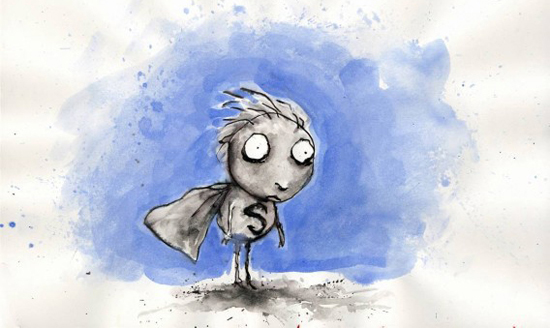
In his 1997 book of drawings and verse, The Melancholy Death of Oyster Boy & Other Stories, Tim Burton imagines a bizarre menagerie of misfits with names like Toxic Boy, Junk Girl, the Pin Cushion Queen and the Boy with Nails in his Eyes.
“Inspired by such childhood heroes as Dr. Seuss and Roald Dahl,” writes James Ryan in the New York Times, “Mr. Burton’s slim volume exquisitely conveys the pain of an adolescent outsider. Like his movies, the work manages to be both childlike and sophisticated, blending the innocent with the macabre.”
One of those adolescent outsiders is Stain Boy, a strange kind of superhero:
He can’t fly around tall buildings,
or outrun a speeding train,
the only talent he seems to have
is to leave a nasty stain.
Sometimes I know it bothers him,
that he can’t run or swim or fly,
and because of this one ability,
his dry cleaning bill is sky-high.
In 2000, Burton extended Stain Boy’s adventures (and compressed his name into one word) with The World of Stainboy, a series of short animations commissioned for the Internet by Shockwave.com. “For some stories you have to wait for the right medium,” Burton said at the time. “I think (the Internet’s) the perfect forum to tell a sad little story like this one. Stainboy is a character that doesn’t do much. He’s just perfect for four-minute animations.”
Burton created a series of sketches, watercolors and pastel-accented gray-on-gray washes and brought them, along with a script and storyboards, to Flinch Studio for translation into Macromedia Flash animation. Twenty-six episodes were planned, but only six were completed. “Stainboy was an experiment in developing revenue streams for the Web,” writes Alison McMahan in The Films of Tim Burton: Animating Live Action in Contemporary Hollywood, “but it did not succeed, at least not financially.”
The Stainboy character was resurrected briefly in late 2010, when Burton invited fans to compose a new Stainboy adventure in brief installments via Twitter. Burton pieced together a story using the best tweets. (You can read the final result here.) Meanwhile, the original Web animations have continued to attract a following. You can watch the complete six-part series below in HD. As you will see, some episodes introduce new characters — Stare Girl, Toxic Boy, Bowling Ball Head and the rest:
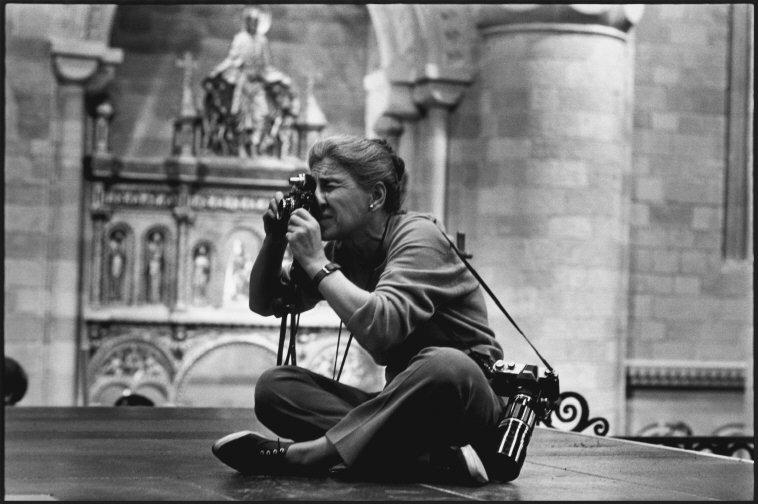
Eve Arnold, one of the pioneering women of photojournalism, died Wednesday at the age of 99.
Widely known for her photographs of Marilyn Monroe and other celebrities, Arnold just as often photographed the poor and the unknown. “I don’t see anybody as either ordinary or extraordinary,” she told the BBC in 1990. “I see them simply as people in front of my lens.”
Born Eve Cohen in Philadelphia on April 21, 1912, she was one of nine children of Ukrainian immigrant parents. When she was 28 years old she gave up plans to become a doctor after a boyfriend gave her a camera. She studied photography for a brief time under Alexey Brodovitch at the New School for Social Research before going out on her own and finding her style.
“I didn’t work in a studio, I didn’t light anything,” Arnold would later say. “I found a way of working which pleased me because I didn’t have to frighten people with heavy equipment. It was that little black box and me.”
A series of photographs Arnold took of fashion shows in Harlem attracted the attention of Henri Cartier-Bresson, one of the founders of Magnum Photos, and she was invited to contribute to the agency. In 1957 Arnold became the first woman photographer to join Magnum as a full member. She worked often for Life and later, after moving to England in 1961, for The Sunday Times Magazine, traveling to places like Afghanistan, South Africa, Mongolia and Cuba while always maintaining a personal point of view. In her 1976 book, The Unretouched Woman, Arnold wrote:
Themes recur again and again in my work. I have been poor and I wanted to document poverty; I had lost a child and I was obsessed with birth; I was interested in politics and I wanted to know how it affected our lives; I am a woman and I wanted to know about women.
Arnold published 15 books in her lifetime, including the National Book Award-winning In China. In 2003 she was awarded the Order of the British Empire by Queen Elisabeth II, whom she had once photographed. In the 2007 book Magnum Magnum, photographer Elliott Erwitt summed things up:
Eve Arnold’s legacy is as varied as it is fascinating. It is hard to fathom how one person’s work can be so diverse. I covers the humblest to the most exalted, the meanest to the kindest, and everything in between. The subjects are all there in Eve Arnold’s photographs and they are treated with intelligence, consideration and sympathy. Most important is Eve’s ability to visually communicate her concerns directly, without fanfare or pretense, in the best humanistic tradition.
It started simply enough in 1999. Jeff Harris, a photographer based in Toronto, took his first self-portrait, something he has since repeated every day. His visual diary now amounts to 4,748 photos and they tell a very personal story. They show the passing of time, some fairly normal moments, but also some difficult ones. In November 2008, Harris was diagnosed with cancer, and his experience with it — his surgery, radiation treatment, eventual paralysis in one leg — all gets visually documented by his project. The video above, originally appearing on TIME’s web site, takes you inside Harris’ project. The clip runs 5 minutes.
Walter Isaacson’s new biography of Steve Jobs (click image below to get a free audio copy) covers a lot of ground in 571 pages. By design, it’s broad and comprehensive, but it doesn’t always go deep. One facet of Steve Jobs’ life that doesn’t get much coverage here was his relationship with Kobun Chino Otogawa (1938–2002), a Buddhist priest who taught Jobs the way of Zen and shared his passion for art and design. The two became close — close enough that Kobun presided over the Steve Jobs-Laurene Powell wedding in 1991. This relationship receives a fuller treatment in The Zen of Steve Jobs, a new 80-page graphic novel that uses stripped down dialogue and bold calligraphic panels to tell this story. The book was authored by Forbes writer Caleb Melby, and the artwork provided by the creative agency JESS3. The video above gives you a good introduction to the imaginative work. h/t BoingBoing
Before we rush headlong into a new year, it’s worth pausing, ever so briefly, to consider the ground we covered in 2011. What topics resonated with you … and jazzed us? Today, we’re highlighting 10 thematic areas (and 46 posts) that captured the imagination. Chances are you missed a few gems here. So please join us on our brief journey back into time. Tomorrow, we start looking forward again.
1) Universities Offer More Free Courses, Then Start Pushing Toward Certificates: The year started well enough. Yale released another 10 stellar open courses. (Find them on our list of 400 Free Courses). Then other universities started pushing the envelope on the open course format. This fall, Stanford launched a series of free courses that combined video lectures with more dynamic resources — short quizzes; the ability to pose questions to Stanford instructors; feedback on your overall performance; a statement of accomplishment from the instructor, etc. A new round of free courses will start in January and February. (Get the full list and enroll here.) Finally, keep your eyes peeled for this: In 2012, MIT will offer similar courses, but with one big difference. Students will get an official certificate at the end of the course, all at a very minimal charge. More details here.
3) Books Intelligent People Should Read: Neil deGrasse Tyson’s list “8 (Free) Books Every Intelligent Person Should Read” ended up generating far more conversation and controversy than we would have expected. (Users have left 83 comments at last count.) No matter what you think of his rationale for choosing these texts, the books make for essential reading, and they’re freely available online.
4) Christopher Hitchens and Stephen Fry: Christopher Hitchens left us this past month. And, until his last day, Hitchens was the same old Hitch — prolific, incisive, surly and defiant, especially when asked about whether he’d change his position on religion, spirituality and the afterlife. All of this was on display when he spoke at the American Jewish University in Los Angeles last February. We covered his comments in a post called, No Deathbed Conversion for Me, Thanks, But it was Good of You to Ask. And even from the grave, Hitchens did more of the same, forcing us to question the whole modern meaning of Christmas.
In this video created by the Guardian, writer and award-winning documentary filmmaker Errol Morris talks about the nature of truth, art, and propaganda in photography. He draws examples from the photographs of Abu Ghraib and the Crimean War, both cited in his book Believing is Seeing, and he asks the viewer to consider a most fundamental question: how does a photograph relate to the physical world? Unlike a verbal or written statement, a photograph cannot be true or false. It simply is.
Then comes another argument worth considering — the idea that all photographs are posed. By way of example, Morris cites an instance where a photographer (in this case Roger Fenton) omits an elephant standing outside the frame. And it leads Morris to suggest that we shouldn’t take photos at face value. Rather we should do our due diligence to find out whether there isn’t always a metaphorical elephant looming beyond the frame. As Morris states, a photograph decontextualizes everything. It reveals to us a two dimensional reality that’s “been torn out of the fabric of the world.”
This video is part of the Guardian’s “Comment is Free” series, in which the world’s top thinkers, newsmakers, and people with stories to tell are interviewed. For more meditations on photography, give some time to Errol Morris’ speech at the Harvard Bookstore. Find the transcript here.
Eugene Buchko is a blogger and photographer living in Atlanta, GA. He maintains a photoblog, Erudite Expressions, and writes about what he reads on his reading blog.
We're hoping to rely on loyal readers, rather than erratic ads. Please click the Donate button and support Open Culture. You can use Paypal, Venmo, Patreon, even Crypto! We thank you!
Open Culture scours the web for the best educational media. We find the free courses and audio books you need, the language lessons & educational videos you want, and plenty of enlightenment in between.