A new NASA breakthrough lets us see the sun in a 360 degree, panoramic view. The upshot? Better space weather reports coming our way. The video from NASA’s YouTube channel has all the good details …
NASA: The Frontier Is Everywhere
Reid Gower writes: “NASA is the most fascinating, adventurous, epic institution ever devised by human beings …” but “none of their brilliant scientists appear to know how to connect with the social media crowd.” Strange given that “NASA is an institution whose funding directly depends on how the public views them.” Taking matters into his own hands, Gower has produced a little marketing gift for NASA: The Frontier is Everywhere, a video modeled after Michael Marantz’s beautiful short film, Earth: The Pale Blue Dot, which also features the voice of Carl Sagan – someone who understood the importance of popularizing science…
P.S. NASA isn’t exactly inept on the marketing front. We should remind you of two pretty cool and recent NASA productions:
The Best of NASA Space Shuttle Videos (1981–2010)
NASA Lauches Photo Archive on Flickr
via Zadi.TV
The Best of NASA Space Shuttle Videos (1981–2010)
Next year, NASA plans to put an end to its 30 year old space shuttle program. Since 1981, the program has launched five space shuttles (Columbia, Challenger, Discovery, Atlantis, Endeavor) into orbit, or 132 flights in total. Here, Matt Melis, a NASA engineer, has compiled what he calls the “best of the best, state of the art” video produced by the space shuttle program. And he has stitched it into a 45 minute tribute video, called Ascent, that narrates the anatomy of a space launch, from start to finish. A great visual way to commemorate the space shuttle program, and the people who filmed it… NOTE: The video remains dark for the first nine seconds.
The Milky Way over Texas
This 45 second timelapse video of the “Galactic Center of the Milky Way” rising over Texas Star Party (2009) just gets more spectacular as it rolls along. William Castleman created this sequence using a Canon EOS-5D, with exposures at 20 and 40 second intervals. This complements nicely Stéphane Guisard’s panoramic view of the Milky Way taken from the Atacama desert in Chile. See the The Milky Way in 360 Degrees here.
Find us on Facebook and Twitter!
NASA Lauches Photo Archive on Flickr
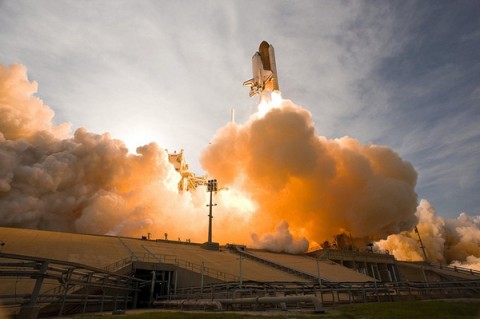
This week, NASA rolled a big archive of historical images into Flickr Commons, giving users access to more than a half century of NASA’s photographic history. The images are divided into three neat sets – “Launch and Takeoff,” “Building NASA” and “Center Namesakes” – and they’re all copyright-free, meaning that you can share and use these images however you like. You can jump into the archive here and watch it grow over time. Thanks for the heads up @eugenephoto! They’re always appreciated…
The Hubble Celebrates 20 Years of Discovery
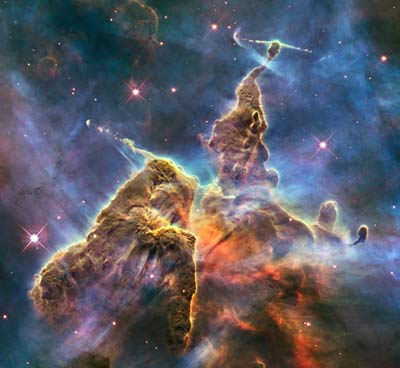 20 years ago (April 24, 1990) the Hubble Space Telescope was launched, beginning a long period of discovery. Today, NASA is celebrating the Hubble’s 20th anniversary by releasing one of the many brilliant photos taken by the space telescope. The image shows us a small portion of one of the largest star-birth regions in the galaxy, the Carina Nebula. As NASA goes on to describe it:
“Towers of cool hydrogen laced with dust rise from the wall of the nebula. The scene is reminiscent of Hubble’s classic “Pillars of Creation” photo from 1995, but is even more striking in appearance. The image captures the top of a three-light-year-tall pillar of gas and dust that is being eaten away by the brilliant light from nearby bright stars. The pillar is also being pushed apart from within, as infant stars buried inside it fire off jets of gas that can be seen streaming from towering peaks like arrows sailing through the air.”
You can download NASA’s featured photo in various sizes and resolutions here. You can also look through an amazing gallery of Hubble photos sponsored by NASA, plus a beautiful collection by National Geographic’s here. Lastly, NPR has a nice audio slideshow that features astronomers talking about their favorite Hubble images. Thanks @lauraehall for the heads up on that.
The Milky Way in Time-Lapse Video
This humbling footage of the Milky Way was filmed on Mauna Kea in Hawaii, the same location that recently gave us footage of stars orbiting a black hole. This is, of course, not a coincidence. Mauna Kea hosts the world’s largest observatory for optical, infrared, and submillimeter astronomy. Thanks Robert for sending this our way.
Stars Orbiting Black Holes
Above, we bring you what astrophysicist Daniel Holz calls “one of the coolest movies in all of science.” What you see here is not exactly straightforward. But it’s the work of UCLA astronomer Andrea Ghez, and it essentially shows stars orbiting around a supermassive black hole at the center of our galaxy over the past 15 earth years. According to Holz, these orbits, filmed with the largest telescopes in the world on Mauna Kea, are simply “one of the best ways (short of the detection of gravitational waves from black hole mergers) of confirming that black holes exist.” And it’s quite rightly an “incredible feat of observational astronomy.” For more, read Holz’s piece on Discover’s Cosmic Variance blog. Another big thanks to Mike for passing this one our way…
Support Us
We're hoping to rely on loyal readers, rather than erratic ads. Please click the Donate button and support Open Culture. You can use Paypal, Venmo, Patreon, even Crypto! We thank you!

About Us

Open Culture scours the web for the best educational media. We find the free courses and audio books you need, the language lessons & educational videos you want, and plenty of enlightenment in between.
Advertise With Us

