Likely, in a moment of quiet downtime, you’ve wondered: Just what would happen if a star, burning bright in the sky, wandered by a black hole? What would that meeting look like? What kinds of cosmic things would go down?
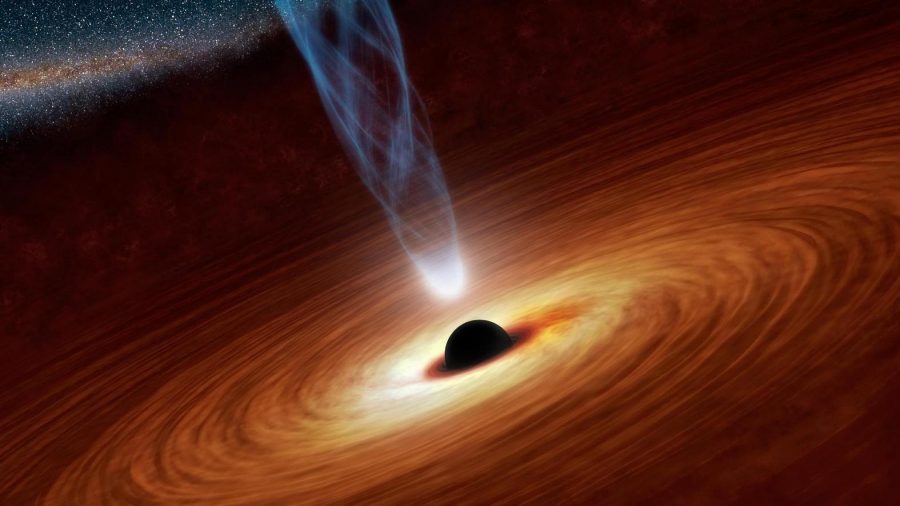
Now, thanks to an artistic rendering made available by NASA, you don’t have to leave much to imagination. Above, watch a star stray a little too close to a black hole and get shredded apart by “tidal disruptions,” causing some stellar debris to get “flung outward at high speed while the rest falls toward the black hole.”
This rendering isn’t theoretical. It’s based on observations gleaned from “an optical search by the All-Sky Automated Survey for Supernovae (ASAS-SN) in November 2014.” The “tidal disruptions” witnessed above, writes NASA, “occurred near a supermassive black hole estimated to weigh a few million times the mass of the sun in the center of PGC 043234, a galaxy that lies about 290 million light-years away.” It’s a sight to behold.
If you would like to sign up for Open Culture’s free email newsletter, please find it here. It’s a great way to see our new posts, all bundled in one email, each day.
If you would like to support the mission of Open Culture, consider making a donation to our site. It’s hard to rely 100% on ads, and your contributions will help us continue providing the best free cultural and educational materials to learners everywhere. You can contribute through PayPal, Patreon, and Venmo (@openculture). Thanks!
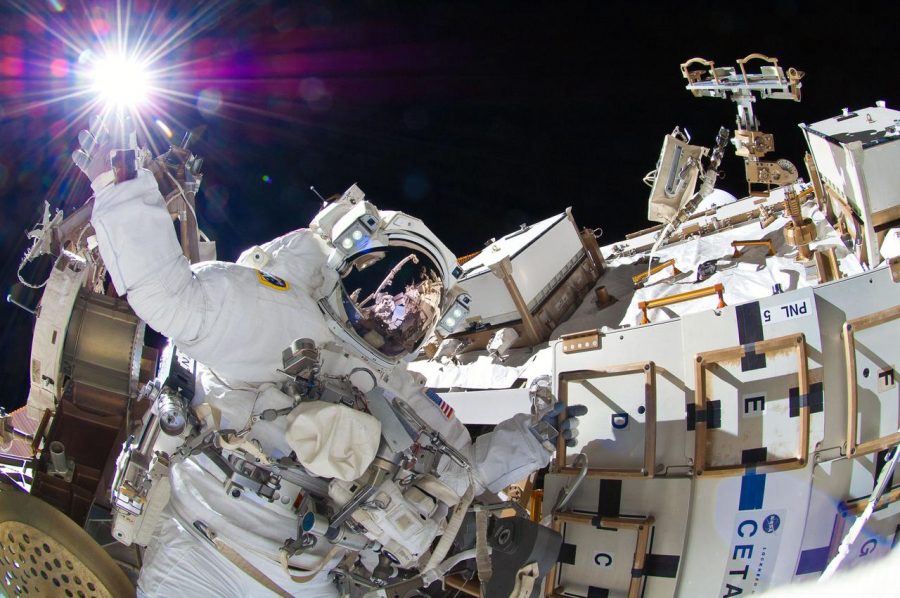
Last summer, astronomer Michael Summer wrote that, despite a relatively low profile, NASA and its international partners have been “living Carl Sagan’s dream for space exploration.” Summers’ catalogue of discoveries and groundbreaking experiments—such as Scott Kelly’s yearlong stay aboard the International Space Station—speaks for itself. But for those focused on more earthbound concerns, or those less emotionally moved by science, it may take a certain eloquence to communicate the value of space in words. “Perhaps,” writes Summers, “we should have had a poet as a member of every space mission to better capture the intense thrill of discovery.”
Sagan was the closest we’ve come. Though he never went into space himself, he worked closely on NASA missions since the 1950s and communicated better than anyone, in deeply poetic terms, the beauty and wonder of the cosmos. Likely you’re familiar with his “pale blue dot” soliloquy, but consider this quote from his 1968 lectures, Planetary Exploration:
There is a place with four suns in the sky — red, white, blue, and yellow; two of them are so close together that they touch, and star-stuff flows between them. I know of a world with a million moons. I know of a sun the size of the Earth — and made of diamond. There are atomic nuclei a few miles across which rotate thirty times a second. There are tiny grains between the stars, with the size and atomic composition of bacteria. There are stars leaving the Milky Way, and immense gas clouds falling into it. There are turbulent plasmas writhing with X- and gamma-rays and mighty stellar explosions. There are, perhaps, places which are outside our universe. The universe is vast and awesome, and for the first time we are becoming a part of it.
Sagan’s lyrical prose alone captured the imagination of millions. But what has most often made us to fall in love with, and fund, the space program, is photography. No mission has ever had a resident poet, but every one, manned and unmanned, has had multiple high-tech photographers.
NASA has long had “a trove of images, audio, and video the general public wanted to see,” writes Eric Berger at Ars Technica. “After all, this was the agency that had sent people to the Moon, taken photos of every planet in the Solar System, and launched the Hubble Space Telescope.”
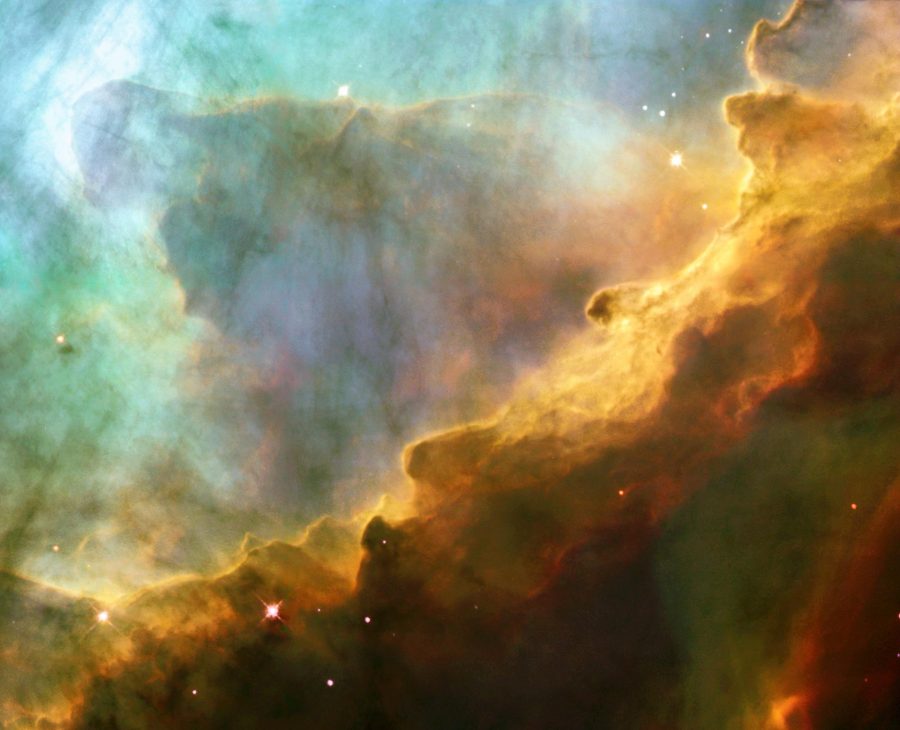
Until the advent of the Internet, only a few select, and unforgettable, images made their way to the public. Since the 1990s, the agency has published hundreds of photos and videos online, but these efforts have been fragmentary and not particularly user-friendly. That changed this month with the release of a huge photo archive—140,000 pictures, videos, and audio files, to be exact—that aggregates materials from the agency’s centers all across the country and the world, and makes them searchable. The visual poetry on display is staggering, as is the amount of technical information for the more technically inclined.
Since Summers lauded NASA’s accomplishments, the fraught politics of science funding have become deeply concerning for scientists and the public, provoking what will likely be a well-attended march for science tomorrow. Where does NASA stand in all of this? You may be surprised to learn that the president has signed a bill authorizing considerable funding for the agency. You may be unsurprised to learn how that funding is to be allocated. Earth science and education are out. A mission to Mars is in.
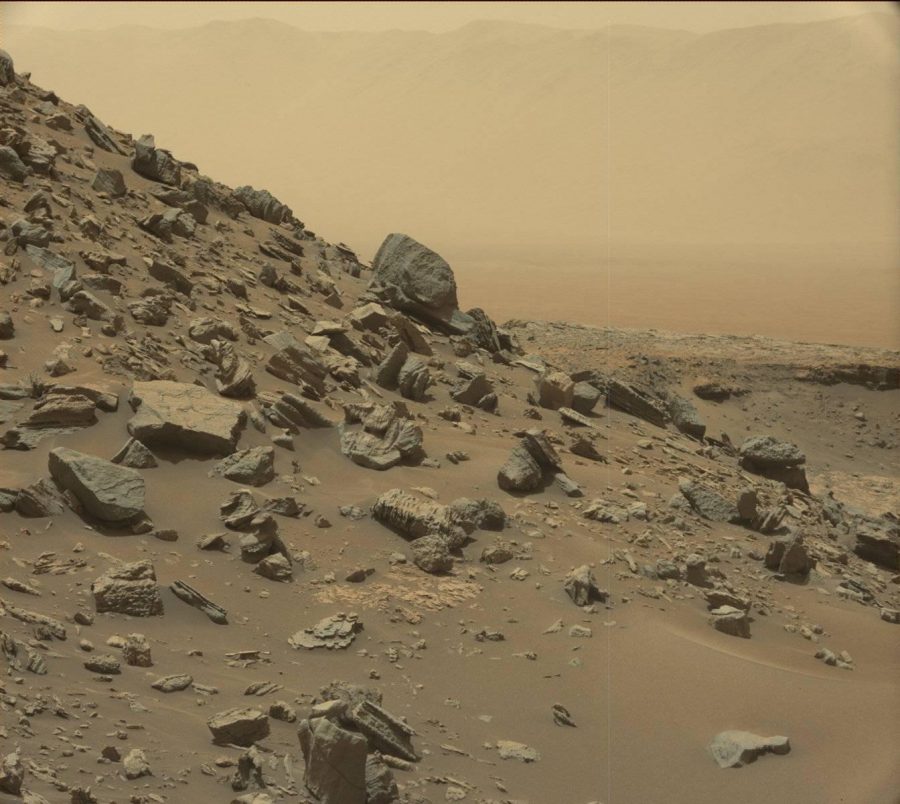
As I perused the stunning NASA photo archive, picking my jaw up from the floor several times, I found in some cases that my view began to shift, especially while looking at photos from the Mars rover missions, and reading the captions, which casually refer to every rocky outcropping, mountain, crater, and valley by name as though they were tourist destinations on a map of New Mexico. In addition to Sagan’s Cosmos, I also began to think of the colonization epics of Ray Bradbury and Kim Stanley Robinson—the corporate greed, the apocalyptic wars, the history repeating itself on another planet….
It’s easy to blame the current anti-science lobby for shifting the focus to planets other than our own. There is no justification for the mutually assured destruction of climate science denialism or nuclear escalation. But in addition to mapping and naming galaxies, black holes, and nebulae, we’ve seen an intense focus on the Red Planet for many years. It seems inevitable, as it did to the most far-sighted of science fiction writers, that we would make our way there one way or another.
We would do well to recover the sense of awe and wonder outer space used to inspire in us—sublime feelings that can motivate us not only to explore the seemingly limitless resources of space but to conserve and preserve our own on Earth. Hopefully you can find your own slice of the sublime in this massive photo archive.
In 1900, Greek sponge divers discovered a shipwreck off the Greek island of Antikythera. The artifacts they came back up with included money, statues, pottery, and various other works of art and craft, as well as a curious lump of bronze and wood that turned out to be by far the most important item onboard. When an archaeologist named Valerios Stais took a look at it two years later, he noticed that the lump had a gear in it. Almost a half-century later, the science historian Derek J. de Solla Price thought this apparently mechanical object might merit further examination, and almost a quarter-century after that, he and the nuclear physicist Charalambos Karakalos published their discovery–made by using X‑ray and gamma-ray images of the interior–that those divers had found a kind of ancient computer.
“Understanding how the pieces fit together confirmed that the Antikythera mechanism was capable of predicting the positions of the planets with which the Greeks were familiar — Mercury, Venus, Mars, Jupiter and Saturn — as well as the sun and moon, and eclipses,” writes Big Think’s Robby Berman. “It even has a black and white stone that turns to show the phases of the moon.”
Determining how it really worked has required the building of various different models of various different kinds, one of which you can see assembled, operated, and disassembled before your very eyes in the CGI rendering at the top of the post. Its design comes from the work of historian of mechanism Michael T. Wright, who also put together the physical recreation of the Antikythera mechanism you can see him explain just above.
By its very nature, an artifact as fascinating and as incomplete as this draws all sorts of theories about the specifics of its design, purpose, and even its age. (It dates back to somewhere between 205 and 100 BC.) In 2012, Tony Freeth and Alexander Jones published their own model, different from Wright’s, of this “machine designed to predict celestial phenomena according to the sophisticated astronomical theories current in its day, the sole witness to a lost history of brilliant engineering, a conception of pure genius, one of the great wonders of the ancient world,” — but one which “didn’t really work very well.” Some of the problems has to do with the limitations of ancient Greek astronomical theory, and some with the unreliability of its layers of handmade gears.
More recent research, adds Berman, has discovered that “the device was built by more than one person on the island of Rhodes, and that it probably wasn’t the only one of its kind,” indicating that the ancient Greeks, despite the apparent deficiencies of the Antikythera mechanism itself, “were apparently even further ahead in their astronomical understanding and mechanical know-how than we’d imagined.” Now watch the video just above, in which the Apple engineer makes his own Antikythera mechanism with an entirely more modern set of components, and just imagine what the ancient Greeks could have accomplished had they developed Lego.
The recent hit film Arrival took on a question that has, in recent decades, deeply concerned those involved in the search for intelligent life elsewhere in the universe. Say we locate that intelligent life. Say we decide what we want to say. On what basis, then, do we figure out how to say it? Aliens, while they may well have evolved certain qualities in common with us humans, probably haven’t happened to come up with any of the same spoken or written languages we have.
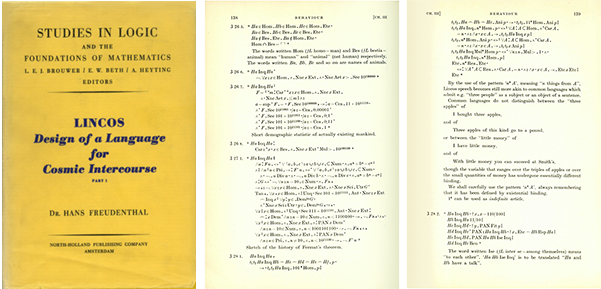
In 1960, the Dutch mathematician Hans Freudenthal came up with a solution: why not create a language they could learn? The efforts came published in the book Lincos: Design of a Language for Cosmic Intercourse. In it, writes TheAtlantic’s Daniel Oberhaus, “Freudenthal announced that his primary purpose ‘is to design a language that can be understood by a person not acquainted with any of our natural languages, or even their syntactic structures … The messages communicated by means of this language [contain] not only mathematics, but in principle the whole bulk of our knowledge.’ ”
Freudenthal created Lincos as a kind of spoken language “made up of unmodulated radio waves of varying length and duration, encoded with a hodgepodge of symbols borrowed from mathematics, science, symbolic logic, and Latin. In their various combinations, these waves can be used to communicate anything from basic mathematical equations to explanations for abstract concepts like death and love.” You can read Lincos: Design of a Language for Cosmic Intercourse (PDF), over at Monoskop, and even though it constitutes only the first of a planned series of books Freudenthal never finished, you can still learn the basics of Lincos from it.
Be warned, however, of the intellectual challenge ahead: Freudenthal just plows ahead without even defining many of the concepts, which readers without a background in mathematics or logic will likely need explained, and Oberhaus quotes even one astrophysicist as calling Freudenthal’s book “the most boring I have ever read. Logarithm tables are cool compared to it.” Still, 56 years on from its creation, this intergalactic Esperanto has had a kind of influence: Freudenthal demonstrated the idea of including an intuitively understandable dictionary in the spaceward-sent message itself, an idea Carl Sagan went on to use in his novel Contact, in which extraterrestrial intelligence-seeking astronomers receive a signal from elsewhere that considerately does the same.
Contact became a major motion picture, something of the Arrival of its day, in 1997. Two years later, a couple of Canadian Defense Research Establishment astrophysicists used a radio telescope to beam out a Lincos-encoded message toward a few close stars. Like any enthusiastic member of their profession would, they sent out information about math, physics, and astronomy. They have yet to hear back from any residents, fellow astrophysicists or otherwise, of those distant neighborhoods. But if any extraterrestrials did hear the message, and even if they have yet to fully grasp Lincos, I have to believe they feel at least a little grateful that, unlike some humans attempting to communicate with others unlike them here on Earth, we didn’t just start yammering in English and hope for the best.
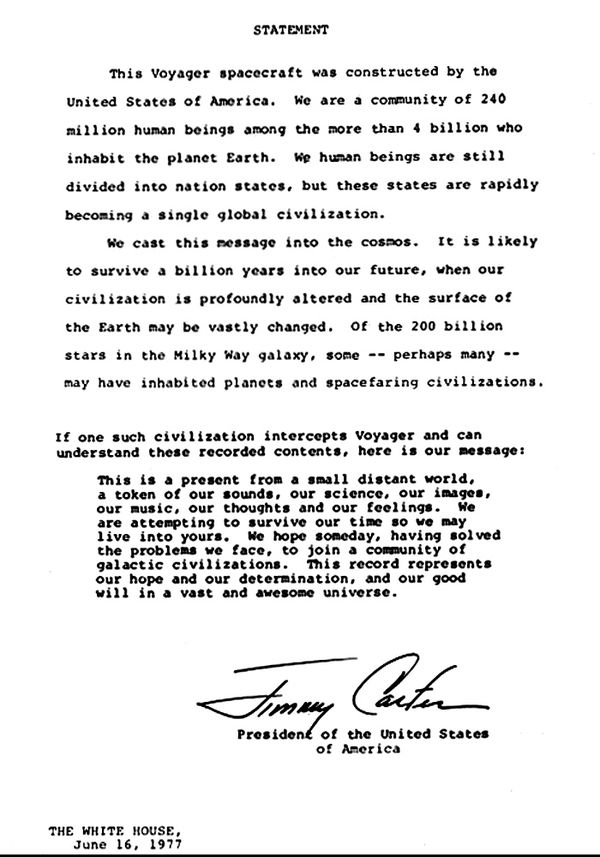
This week, Blank on Blank wraps up its series “The Experimenters,” with an episode animating a conversation between Carl Sagan and Studs Terkel–two figures we’ve highlighted on our site many times before. But never have we brought them together. So here they are.
Recorded in October, 1985, as part of Terkel’s long-running Chicago radio show (find an archive of complete episodes here), the conversation touched on some the big questions you might expect: the compatibility between science and religion; the probability we’ll encounter extraterrestrials if given enough time; and more. You can hear more outtakes from their conversation here:
Other episodes in “The Experimenters” series feature:
I found it difficult to wrap my head around the sheer quantities of information Savage shoehorns into the seven minute video, giving similarly voluble and omnivorous mathmusician Vi Hart a run for her money. Clearly, he understands exactly what he’s talking about, whereas I had to take the review quiz in an attempt to retain just a bit of this new-to-me material.
I’m glad he glossed over Feynman’s childhood fascination with inertia in order to spend more time on the lesser known of his three subjects. Little Feynman’s observation of his toy wagon is charming, but the Nobel Prize winner’s life became an open book to me with Jim Ottaviani and Leland Myrick’s excellent graphic biography. What’s left to discover?
How about Eratosthenes? I’d never before heard of the Alexandrian librarian who calculated the Earth’s circumference with astonishing accuracy around 200 BC. (It helped that he was good at math and geography, the latter of which he invented.) Inspiration fuels the arts, much as it does science, and I’d like to learn more about him.
Ditto Fizeau, whom Savage describes as a less sexy scientific swashbuckler than methodical fact checker, which is what he was doing when he wound up cracking the speed of light in 1849. Two centuries earlier Galileo used lanterns to determine that light travels at least ten times faster than sound. Fizeau put Galileo’s number to the test, experimenting with his notched wheel, a candle, and mirrors and ultimately setting the speed of light at a much more accurate 313,300 Km/s. Today’s measurement of 299792.458 km/s was arrived at using technology unthinkable even a few decades ago.
Personally, I would never think to measure the speed of light with something that sounds like a zoetrope, but I might write a play about someone who did.
Ayun Halliday is an author, illustrator, and Chief Primatologist of the East Village Inky zine. Her play, Fawnbook, opens in New York City later this fall. Follow her @AyunHalliday
Wylie Overstreet and Alex Gorosh set out to create something you’ve never seen before — our solar system drawn to actual scale. Forget what you’ve seen in books, or on web sites. To depict things accurately, you need a bigger surface. A really large canvas. Like a seven-mile expanse in Nevada’s Black Rock Desert (which otherwise hosts The Burning Man Festival). It’s on this dry lakebed that Overstreet and Gorosh built “the first scale model of the solar system with complete planetary orbits” and it’s a sight to behold. Creative, industrious, and humbling. Enjoy.
“Ever since our species first looked up at the sky, we dreamed of reaching Mars. Back in 2029, that dream became real, when the first humans stepped foot on the Red planet. And, in a few months, a new group of astronauts will make the journey.…”
It all seems like many other Neil deGrasse Tyson videos you’ve seen before. Until he says, “Back in 2029.” Wait, what?
Behold Neil deGrasse Tyson appearing in a clever promo for Ridley Scott’s upcoming film The Martian.
Based on Andy Weir’s bestselling 2011 novel The Martian, the movie will star Matt Damon as Mark Watney, an astronaut who goes on a big mission to Mars — the one so stirringly described by Tyson above. But the journey to Mars is not where the real action happens, and we’ll just leave it at that. No spoilers here.
We're hoping to rely on loyal readers, rather than erratic ads. Please click the Donate button and support Open Culture. You can use Paypal, Venmo, Patreon, even Crypto! We thank you!
Open Culture scours the web for the best educational media. We find the free courses and audio books you need, the language lessons & educational videos you want, and plenty of enlightenment in between.