“Ever since our species first looked up at the sky, we dreamed of reaching Mars. Back in 2029, that dream became real, when the first humans stepped foot on the Red planet. And, in a few months, a new group of astronauts will make the journey.…”
It all seems like many other Neil deGrasse Tyson videos you’ve seen before. Until he says, “Back in 2029.” Wait, what?
Behold Neil deGrasse Tyson appearing in a clever promo for Ridley Scott’s upcoming film The Martian.
Based on Andy Weir’s bestselling 2011 novel The Martian, the movie will star Matt Damon as Mark Watney, an astronaut who goes on a big mission to Mars — the one so stirringly described by Tyson above. But the journey to Mars is not where the real action happens, and we’ll just leave it at that. No spoilers here.
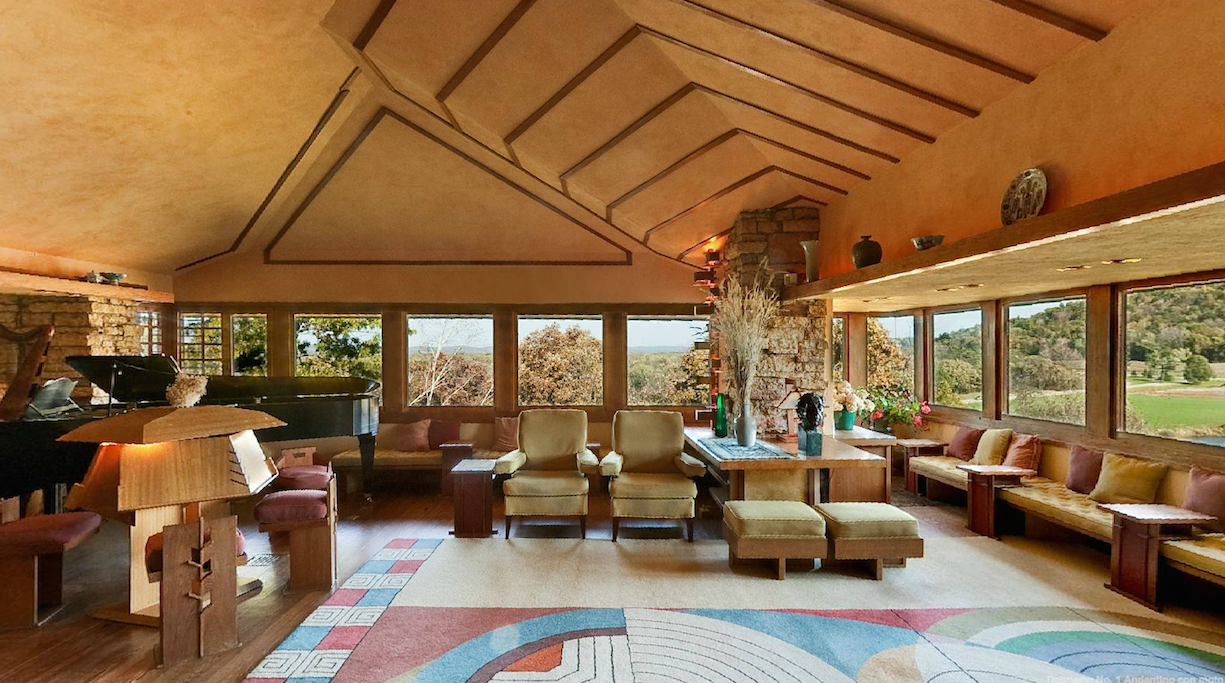
You can learn a lot about an architect from looking at the buildings they designed, and you can learn even more by looking at the buildings they lived in, but you can learn the most of all from Frank Lloyd Wright’s Taliesin. For that best-known of all American architects, this house stands still today not just as his home but as one of his notable works, and as the studio in which he designed other notable works (including Fallingwater). Wright’s enthusiasts make pilgrimages out to Spring Green, Wisconsin to pay their respects to this singular house on a hill, which offers tours from May through October.
For those less inclined toward architectural pilgrimages, we have this HD 360-degree “virtual visit” of Taliesin (also known as Taliesin East since 1937, when Wright built a Taliesin West in Scottsdale, Arizona). “The center of Frank Lloyd Wright’s world was Taliesin East,” write the online tour’s developers. “It was his home, workshop, architectural laboratory and inspiration for nearly all his life.” In the comfort of your web browser, you can “experience what he saw daily, surrounded by Asian art, expansive views of Wisconsin’s rolling hills, his own courtyard gardens and a space to relax before a fire watched over by a portrait of his mother.”
You can also get a view of “the actual drafting tables where Wright designed his most famous buildings” and the drawings on them, all while “staff historian Keiran Murphy shares the history, the personal stories and points out special objects in the room” (if you choose to keep the “tour guide” option turned on). And Taliesin certainly doesn’t lack history, either personal or architectural. Wright built its first iteration in 1911, and it lasted until a paranoid servant burnt it down in 1941, axe-murdering seven people there (including Wright’s live-in ladyfriend and her children) in the process. Wright, who’d been away at the time of the tragedy, recovered from the shock of it all, then set to work on Taliesin II, though he didn’t really live in it until after he returned from his work on Tokyo’s Imperial Hotel in 1922.
Three years later, another fire (this time probably due to an electrical problem) badly damaged the house again, necessitating the design of a Taliesin III, which he could begin only after digging himself out of a financial hole in 1928. It is more or less that Taliesin that you can see today, whether you visit in person or through the internet. If you feel sufficiently inspired as a result, you could even apply to study at the Frank Lloyd Wright School of Architecture located there. While the house won’t likely turn you into an architectural genius just by osmosis, at least you can rest assured that it has probably put its most dramatic disasters behind it.
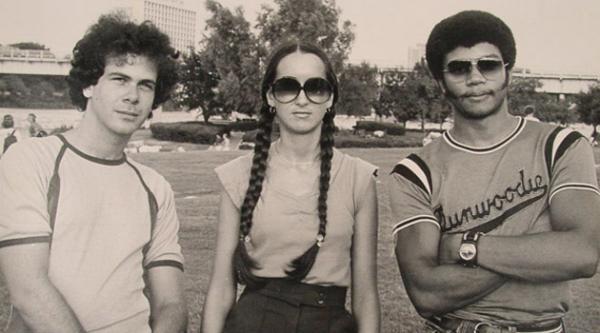
Last year, we revisited the high school days of Neil deGrasse Tyson. Growing up in New York City during the 1970s, Tyson attended Bronx Science (class of ’76), ran an impressive 4:25 mile, captained the school’s wrestling team, and, he fondly recalls, wore basketball sneakers belonging to the Knick’s Walt “Clyde” Frazier. Tyson was, of course, also a precocious student. Famously, Carl Sagan recruited Tyson to study with him at Cornell. But Tyson politely declined and went to Harvard for his undergraduate studies. Then, he headed off to Texas, to start his PhD at UT-Austin. That’s where the photo, taken circa 1980, captures him above — hanging out with friends, and looking hipper than your average astrophysics student.
This photo (now making the rounds on Reddit) originally appeared in a 2012 article published in the Alcalde, the alumni magazine of The University of Texas. To the magazine’s credit, the article takes an unvarnished look at Tyson’s “failed experiment” in Texas. The piece starts with the lede “Neil deGrasse Tyson, MA ’83, is the public face of science. But he says his success has nothing to do with UT.” And, from there, it recounts how professors and university police immediately stereotyped him.
The first comment directed to me in the first minute of the first day by a faculty member I had just met was, ‘You must join the department basketball team!
or
I was stopped and questioned seven times by University police on my way into the physics building. Seven times. Zero times was I stopped going into the gym—and I went to the gym a lot. That says all you need to know about how welcome I felt at Texas.
But the real problem wasn’t race. According to Tyson, “there was simply no room for me to be the full person that I was.” “An obsessive focus on one thing at a time; a strong connection to pop culture, from the moonwalk to the Rubik’s cube; and a refusal to put research first: these traits contributed to Tyson’s failure at UT,” concludes the Alcalde. They also allowed him to flourish later in life.
After his “advisors dissolved his dissertation committee—essentially flunking him,” Tyson transferred to Columbia, earned his PhD in 1988, and became the greatest popularizer of science since Carl Sagan. We like stories with happy endings.
Read more about Tyson’s experience in Texas at the Alcalde.
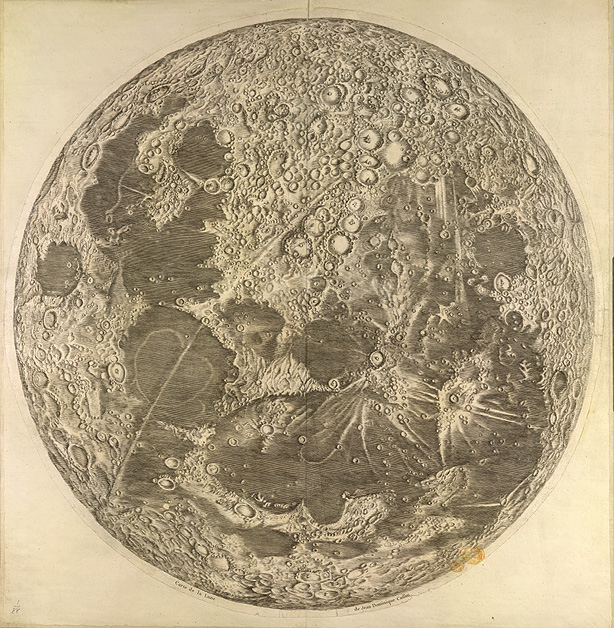
Needless to say, the event was not televised and Cassini never had the opportunity to walk on the surface he studied. Instead he observed it through the eyepiece of a telescope, a relatively new invention.
Cassini, then eight years into his forty year career as Director of the Paris Observatory, produced a map so exhaustive, it provided his peers with far more details of the moon’s surface than they had with regard to their own planet.
He also used his powers of observation to expand human understanding of Mars, Saturn, and France itself (which turned out to be much smaller than previously believed).
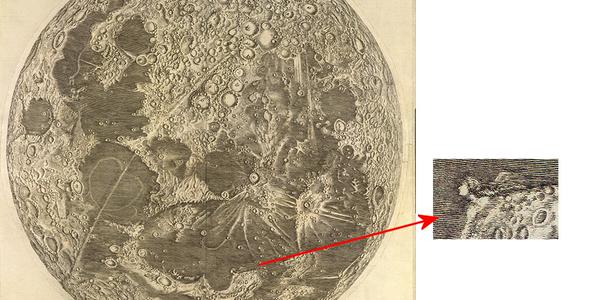
A man of science, he may not have been entirely immune to the sort of moon-based whimsy that has long infected poets, songwriters, and 19th-century romantic heroines. Hiding in the lower right quadrant, near Cape Heraclides on the Sinus Iridum (aka Bay of Rainbows), is a tiny, bare-shouldered moon maid. See right above.
Or perhaps this appealingly playful vision can be attributed to Cassini’s engraver Claude Mellan.
Either way, she seems exactly the sort of female life form a 17th-century human male might hope to encounter on a trip to the moon.
Patreon, a crowd funding site where fans can automatically tithe a set amount to their fave artist every time that person uploads content, is a great way for passionate, under-recognized individuals to gain visibility and a bit of dough.
So what’s astrophysicist Neil deGrasse Tyson doing there? He’s already famous, and one would think his gig as director of New York City’s Hayden Planetarium, coupled with the proceeds from his books and dvds, would prove sufficient to any financial needs.
The latest Tyson-narrated episode, above, shoots the moon by cramming the entire History of the Universe (and some complimentary Stravinsky) into an 8.5‑minute framework (a negligible amount when you consider phenomena like light years, but still many times the series’ standard minute).
If you’re feeling flush (or nervous about the upcoming school year), you can join these 1075 fans, earning admission to a supporters-only activity feed where you can ask questions, watch outtakes, preview upcoming attractions, and possibly even get your name in the credits.
If you would like to support the mission of Open Culture, consider making a donation to our site. It’s hard to rely 100% on ads, and your contributions will help us continue providing the best free cultural and educational materials to learners everywhere. You can contribute through PayPal, Patreon, and Venmo (@openculture). Thanks!
On Friday, to help celebrate Dante’s 750th birthday, Colin Marshall presented for you Samantha Cristoforetti, Italy’s first female astronaut, reading lines from The Divine Comedy aboard the International Space Station. Little did we know that, just a few days later, we could serve up a new video of Cristoforetti reading lines (this time in English) from a much more modern text — Douglas Adams’ The Hitchhiker’s Guide to the Galaxy(1979). The video was filmed as part of Towel Day, a celebration held every May 25th, where fans across the universe carry a towel in Adams’ honour. Above you can see Cristoforetti, floating upside down, doing just that, and reading the section of the book that touches on towels, the “most massively useful thing an interstellar hitch hiker can have.”
We're hoping to rely on loyal readers, rather than erratic ads. Please click the Donate button and support Open Culture. You can use Paypal, Venmo, Patreon, even Crypto! We thank you!
Open Culture scours the web for the best educational media. We find the free courses and audio books you need, the language lessons & educational videos you want, and plenty of enlightenment in between.
 , the movie will star Matt Damon as Mark Watney, an astronaut who goes on a big mission to Mars — the one so stirringly described by Tyson above. But the journey to Mars is not where the real action happens, and we’ll just leave it at that. No spoilers here.