The “Galaxy Song” first appeared in the 1983 film Monty Python’s The Meaning of Life, and it has been revived in later years — on Monty Python albums, and in Monty Python stage plays. Now the song originally written by Eric Idle has been re-recorded, this time with the lyrics sung by the world-famous physicist Stephen Hawking. The lyrics include a lot of astronomical facts, some now considered outdated by scholars. But that doesn’t take the fun out of the recording.
The song will be available for download on iTunes. (If you live in the UK, find it here.) And it will also be released as a 7″ single. But you can stream it online for free above. Enjoy.
If you would like to support the mission of Open Culture, consider making a donation to our site. It’s hard to rely 100% on ads, and your contributions will help us continue providing the best free cultural and educational materials to learners everywhere. You can contribute through PayPal, Patreon, and Venmo (@openculture). Thanks!
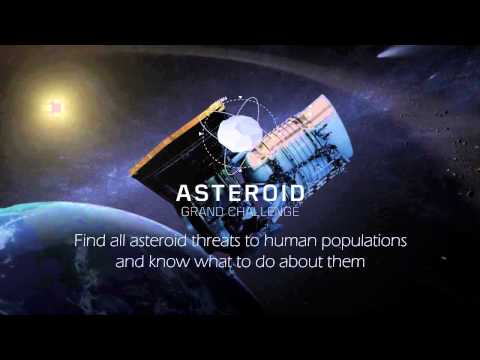
Yes, you can help save the world. And just by downloading some free software. Writes NASA:
Protecting the Earth from the threat of asteroid impacts means first knowing where they are. NASA is harnessing the incredible potential of innovators, makers and citizen scientists by opening up the search. In an increasingly connected world, NASA recognizes the value of the public as a partner in addressing some of the country’s most pressing challenges. We need your help in identifying asteroids – and to help further this effort, we’ve built an application that enables everyone, everywhere, to help solve this global challenge.
To download the app and join the hunt for asteroids, please click here. To get more information on the project (in which Harvard is a strategic participant) click here.
Nobody likes the way an entire human life can get reduced to a sound bite, but even if you know absolutely nothing else about Carl Sagan, you know that he said the words “billions and billions.” Or rather, you think you know it; in reality (and in accordance with the “Play it again, Sam” principle), the famous astronomer and science popularizer never actually said quite those words on television. A posthumous essay collection used them as its title, but the public only latched on to the catchphrase — or catch half-phrase, anyway — in 1980, when Johnny Carson used it in a Tonight Show parody of Sagan’s broadcast persona. But if you want to hear the real Sagan invoking very large numbers in his characteristic intonation, have we got the video for you.
At the top of the post, you’ll find a supercut of each and every one of his uses of “million,” “billion,” “trillion,” and even “quadrillion” during the entirety of his acclaimed television series Cosmos — to a beat. Alternatively, using similar source material to an entirely different aesthetic end, the sound clip above contains just one instance of Sagan saying “billion” — but stretched out to an hour in length, which turns it into a sort of dronelike ambient music. A not just outward- but forward-thinking scientific visionary like Sagan surely understood more about what lies ahead for humanity than the rest of us do, but could he possibly have foreseen us using our technology for stuff like this? Still, he probably would’ve dug it.
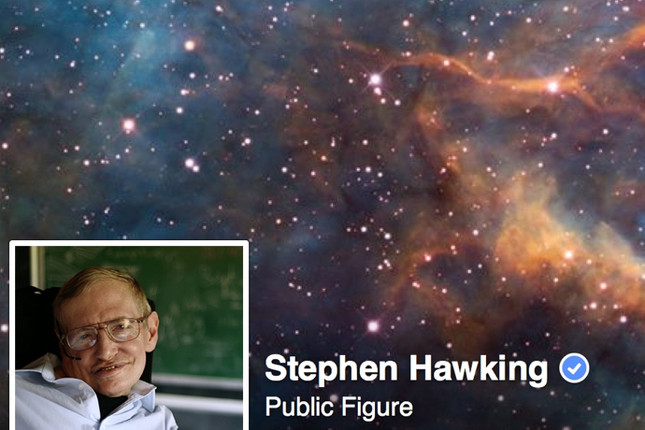
I have no idea whether there’s intelligent life out there in the universe. But we can at least confirm that there’s a little intelligent life on Facebook, seeing that Stephen Hawking, the world’s best known theoretical physicist, began posting there yesterday. His first status update reads:
I have always wondered what makes the universe exist. Time and space may forever be a mystery, but that has not stopped my pursuit. Our connections to one another have grown infinitely and now that I have the chance, I’m eager to share this journey with you. Be curious, I know I will forever be.
Welcome, and thank you for visiting my Facebook Page. ‑SH
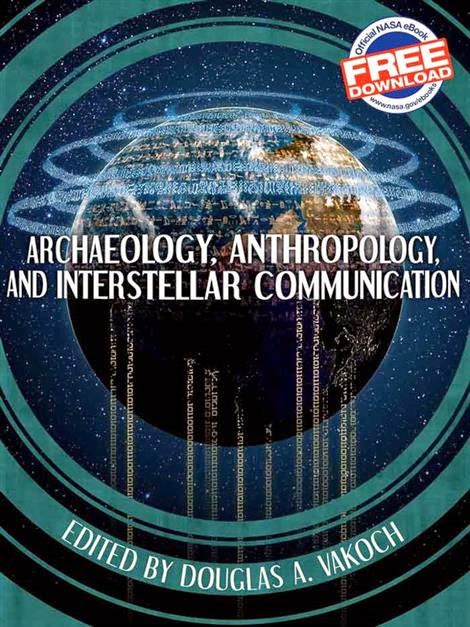
During the past few years, NASA has released a series of free ebooks, including NASA Earth As Art and various interactive texts focusing on the Webb and Hubble space telescopes. Last week, they added a new, curious book to the collection, Archaeology, Anthropology, and Interstellar Communication. Edited by Douglas A. Vakoch (the Director of Interstellar Message Composition at the SETI Institute), the text contemplates how we’ll go about “establishing meaningful communication with an extraterrestrial intelligence.” The scholars contributing to the volume “grappl[e] with some of the enormous challenges that will face humanity if an information-rich signal emanating from another world is detected.” And to make sure that we’re “prepared for contact with an extraterrestrial civilization, should that day ever come,” they draw on “issues at the core of contemporary archaeology and anthropology.” Why archaeology and anthropology? Because, says Vackoch, communication with intelligent life probably won’t be through sound, but through images. We will need to read/understand the civilization we encounter based on what we observe. Vakoch says:
[D]on’t think of “sound worlds” or music or speech as the domains, vehicles, or contents of ETI [extra terrestrial intelligence] messages. Regardless of semiotic concerns, the accessibility of acoustic messaging must remain doubtful. Furthermore, there will be intended and unintended aspects of performance, which elaborate the difficulties of using sound. In my view avoidance of the sound world need not be controversial.
On the other hand, vision and the use of images would appear to be at least plausible. Although spectral details cannot be considered universal, the physical arrangement of objects on a habitable planet’s surface will be shaped in part by gravity (the notion of a horizon might well be universal) and thus multispectral images might plausibly be considered worthwhile for messages. More generally, the implications for considering SETI/CETI as some sort of anthropological challenge need teasing out.
Episode 5 of Neil deGrasse Tyson’s Cosmos series aired last night on Fox. Thanks to Hulu, US viewers can now watch it online. The episode, called “Hiding the Light,” explores the wave theory of light. It moves across 2000+ years of history and eventually gets into the scientific work of Isaac Newton, William Herschel and Joseph von Fraunhofer, before winding up in modern times and touching on big questions contemplated by astronomers. (For a deeper dive into this material, see our collection of Free Astronomy Courses.) If you need to catch up on earlier episodes, you can find them below.
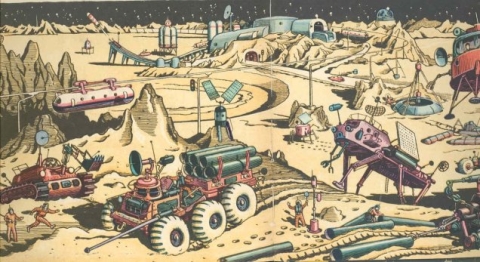
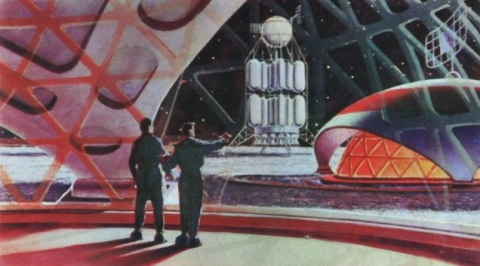
Workers, hell. It’s not hard to imagine Andrei Sokolov, whose paintings were exhibited aboard the Mir station, producing high quality renderings for Mad Men’s Don Draper to show high-rolling Martian clients.
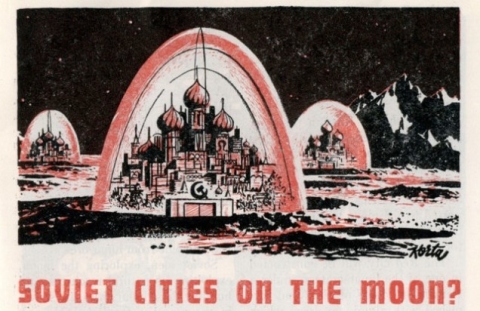
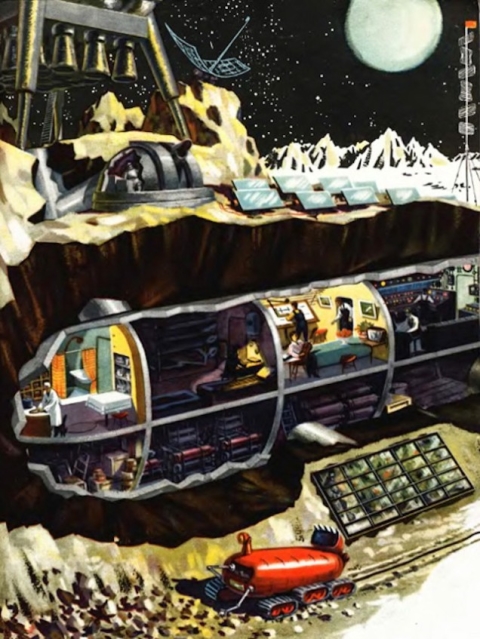
And pop science mag Tekhnika Molodezhi (“Technology for the Youth”) promoted the space race with pages of intriguing four-color images. The dollhouse-like cross section (above) of a communal residence below the moon’s crust is practically screaming Wes Anderson’s name.
On Monday, the science world joyously celebrated a seminal astrophysics discovery. Using a telescope in the South Pole, researchers from the Harvard-Smithsonian Center for Astrophysics detected ripples in the fabric of space-time, called gravitational waves. These waves confirmed the inflation theory, which stated that for a brief moment — one trillionth of a trillionth of a trillionth of a second after the big bang — the universe was violently expanding faster than the speed of light. Stanford’s Andrei Linde (along with MIT’s Alan Guth) was one of the thinkers responsible for working out this theory in the 1980s. In the video above, another Stanford professor, Chao-Lin Kuo, visits Linde to break the news of the discovery to him on his front porch. Finding out that much of his career had been vindicated in such spectacular fashion, Linde was appropriately moved and stunned. You can learn more about Linde’s work in The Stanford Report.
We're hoping to rely on loyal readers, rather than erratic ads. Please click the Donate button and support Open Culture. You can use Paypal, Venmo, Patreon, even Crypto! We thank you!
Open Culture scours the web for the best educational media. We find the free courses and audio books you need, the language lessons & educational videos you want, and plenty of enlightenment in between.