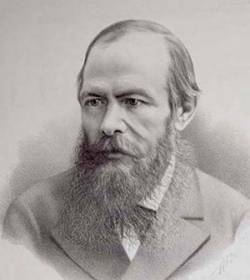
In 1865, Fyodor Dostoevsky found himself in a deep hole. He had gambled away his last savings and wracked up big debts. He also had to support the family of his recently deceased brother. Looking to make some quick money, Dostoevsky asked Mikhail Katkov, publisher of The Russian Messenger, for an advance. Then he began writing in earnest a novella that soon sprawled into a grand novel. The first part of Crime and Punishment would appear in The Russian Messenger in January 1866; the second part in December of that same year. Like The Brothers Karamazov (Dostoevsky’s other major work), Crime and Punishment probes the dark side of human psychology and asks some hard existential questions. Nietzsche would later call Dostoevsky “the only psychologist from whom I have something to learn: he belongs to the happiest windfalls of my life, happier even than the discovery of Stendhal.” One of the masterpieces of the Russian literary tradition, Crime and Punishment is now available as a free audio book thanks to Lit2Go. You can download the novel in full via iTunes, or as mp3s via the Lit2Go web site. Meanwhile, if you’re looking for a free etext version of the novel, you can find it in the following formats: Google Mobile – Kindle – Feedbooks — ePub.
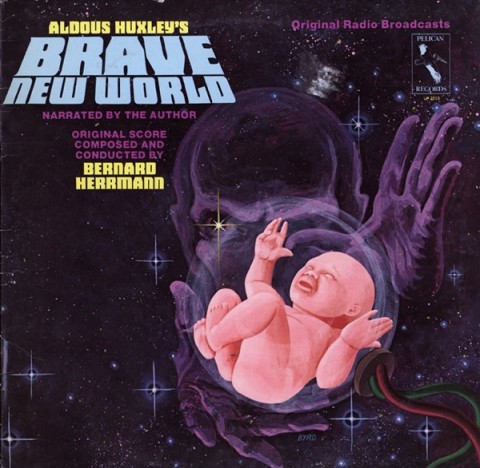
The CBS Radio Workshop was an “experimental dramatic radio anthology series” that aired between 1956 and 1957. And it premiered with a two-part adaptation of Aldous Huxley’s now classic 1932 novel, Brave New World. Huxley himself introduced and narrated the program, and now this classic radio drama has resurfaced online. You can listen to Part 1 and Part 2 below. The mp3s will be permanently housed in our collection of Free Audio Books.
William Carlos Williams – doctor by day, poet by night, and certainly one of America’s finest. In this 1954 audio clip, we hear Williams reading his own poetry at the storied 92nd Street Y in New York City. Poems include: “A Sort of a Song,” “The Maneuver,” “Seafarer,” “The Three Graces,” “Paterson, Episode 17,” “The Descent” and “Fish.” The reads are now added to the Poetry section of our Free Audio Books Collection.
Poetry lovers take note: People Reading Poems is a very new web site where users can come to hear recordings of people reading poems they love, and also to share their own favorite poems. It’s all completely free and easy to use. If you have a free moment, pay it a visit and help the site grow.
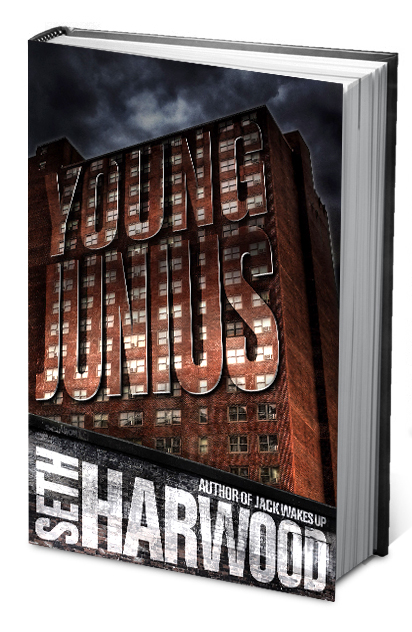
OC contributor Seth Harwood has something exciting going on over at his site today: he’s launching the pre-order sales of his new novel YOUNG JUNIUS, which is due out this fall. This is partly worth noting because Seth’s path to publication involves giving away his work for free as MP3 audiobooks. You can even listen to all of YOUNG JUNIUS before you make a buy. If you’re a fan of crime or mystery fiction, or you dig The Wire, you’ll love this book!
Now, Seth is partnering with independent publisher Tyrus Books to break new ground in publishing strategies. To read the full description of what he’s up to, go here. The brief version involves the pre-order of special, limited edition copies of the book that feature cloth binding, fan-created cover art, photos of the story’s locations, signed personalization and more. By offering these for a limited time via his site, he and Tyrus are able to print just the quantity sold and balance some of the cost (reduce the risk) of the book’s full print run–hardcover, paperback AND special edition.
If you’d like to read more about this or order a copy, head over to sethharwood.com. When you do, use the code OC to save $3 off the cover price of the book! Enjoy!!
Seth Harwood is a voracious reader, subversive publishing maven and crime novelist.
This year, Tim Burton’s production of Alice In Wonderland was welcomed by a flurry of media buzz and a rather polarized public response debating whether the iconic director had butchered or reinvented the even more iconic children’s classic. But discussion of the film’s creative merits aside, one thing it did do brilliantly was rekindle the public’s interest in what’s easily the most beloved work of children’s literature of the past two centuries.
So beloved, in fact, that Lewis Carroll’s 1865 novel has generated hundreds of reprints, film adaptations and various derivative works over the years. Many of these works are now available in the public domain — even a simple search in the Internet Archive sends you down a rabbit hole of adaptations and remakes, spanning from landmark early cinema treasures to offbeat products of contemporary digital culture.
Today, we’ve curated a selection of the most interesting and culturally significant — the “curiouser and curiouser,” if you will — free versions of, tributes to, and derivatives of Alice’s Adventures In Wonderland.
The fundamentals: A Project Gutenberg free digital copy of Carroll’s original Alice’s Adventures In Wonderland text
A 1916 abridged version intended for younger children, digitized by the Library of Congress, is available from the International Children’s Digital Library and features some wonderful illustration — though, regrettably, it lacks the Cheshire Cat
For a classic with a spin, try this audio version read by blogger extraordinaire, BoingBoing co-editor, Popular Science columnist and vocal free content advocate Cory Doctorow
The earliest cinematic adaptation of the book, directed by Cecil Hepworth in 1903, is a silent film gem, clocking in at just 8 minutes and 19 seconds. Watch above.
In 1915, W. W. Young directed the second American adaptation of Alice — a massive six-reel production that showcased the rapid evolution of filmmaking in just a decade since the first production. Though much of the film is now lost, 42 minutes of it can be seen at the Internet Archive for free
A 1966 British adaptation by director Jonathan Miller for the BBC features an ambitious cast — including Peter Sellers as the King of Hearts, Sir John Gielguld as Mock Turtle, Michael Redgrave as The Caterpillar and Peter Cook as the Mad Hatter — and its soundtrack, scored by the legendary Ravi Shankar, exudes the borderline folk-psychedelia sound of the Woodstock era. The film, divided into seven parts, is available for free on YouTube.
This 2‑minute version of Alice In Wonderland shot in the virtual world Second Life is an eerie testament to just how widely Carroll’s classic resonates.
Perhaps the biggest treasure of all, Lewis Carroll’s original manuscript, available from the British Library — 91 pages of precious literary history, with original illustrations from artist John Tenniel. The online gallery also features a preface telling the fascinating story of the Oxford mathematician’s real-life inspiration for the book and the fate of the real Alice
Maria Popova is the founder and editor in chief of Brain Pickings, a curated inventory of eclectic interestingness and indiscriminate curiosity. She writes for Wired UK, GOOD Magazine and Huffington Post, and spends a disturbing amount of time curating interestingness on Twitter.
We’re bringing you some great authors this week. First it was Hemingway, then Orwell, and now Capote.
In 1958, Truman Capote put his stamp on the American literary scene when he published his short novel, Breakfast at Tiffany’s, in the pages of Esquire magazine. Authors and critics were quick to recognize what Capote had accomplished here. The always opinionated Norman Mailer would say that Capote “is the most perfect writer of my generation, he writes the best sentences word for word, rhythm upon rhythm. I would not have changed two words in Breakfast at Tiffany’s which will become a small classic.” About that, Mailer was exactly right. Breakfast at Tiffany’s is now a classic book – not to mention a classic film too (watch the trailer with the iconic Audrey Hepburn here). And now let’s rewind the audiotape and take you back to 1963, to the great 92nd Street Y in New York city, where Truman Capote reads from his little classic in his own distinctive voice. This audio clip runs about 17 minutes. Have a listen.
Looking for free, professionally-read audio books from Audible.com? Here’s a great, no-strings-attached deal. If you start a 30 day free trial with Audible.com, you can download two free audio books of your choice. Get more details on the offer here.
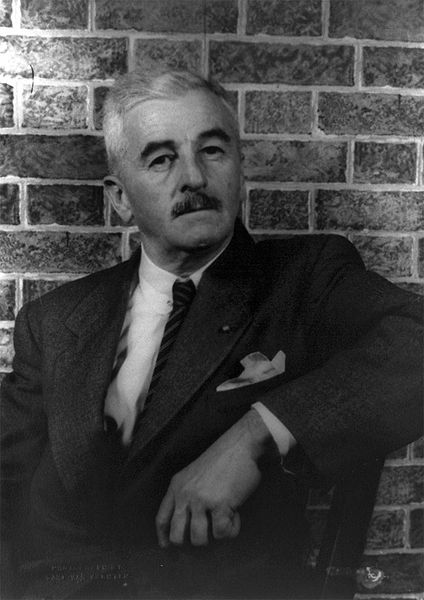
William Faulkner’s As I Lay Dying is widely considered one of the great American novels. Quite an accomplishment, especially considering that Faulkner wrote the novel in six weeks while working at a power plant in 1929–30. Read more about his day jobs here.
Thanks to HarperCollins, you can now listen to Faulkner, himself, reading from his masterpiece: .au file (4.4 Mb), .gsm file (0.9 Mb), .ra file (0.5 Mb). The audio can be a little difficult to make out at times. But you can read right along with the text in Google Books. Enjoy. Thanks MS.
For more audio classics, check out our collection of Free Audio Books.
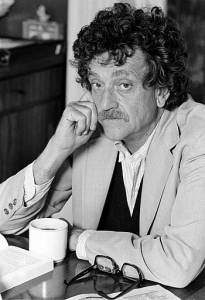
Kurt Vonnegut’s Slaughterhouse-Five was published back in 1969, and the anti-war sci fi novel quickly became a classic. (The book now appears, for example, on Time Magazine’s list of All Time 100 Novels.) Whether you’ve read the novel or not, you’ll want to check this out. HarperCollins has posted online a recording of Vonnegut himself reading a lengthy passage from the work. And he does it with the “casual irony that complements the novel’s wonderfully eccentric tone.” You can stream Vonnegut’s reading in the following formats: .au format (4.5 Mb), .gsm format (900 Kb), .ra format ( Mb). (Sorry a straightforward mp3 is not available.) Also, if you want some more Vonnegut, feel free to download his 1962 sci fi short story, 2BR02B, which is otherwise listed in our collection of Free Audio Books.
Note: Audible.com offers a version of Slaughterhouse-Five narrated by actor/writer Ethan Hawke. You can download it (or any another other book) for free if you start a free 14 day trial. It has no strings attached. Get some more basic details here.
We're hoping to rely on loyal readers, rather than erratic ads. Please click the Donate button and support Open Culture. You can use Paypal, Venmo, Patreon, even Crypto! We thank you!
Open Culture scours the web for the best educational media. We find the free courses and audio books you need, the language lessons & educational videos you want, and plenty of enlightenment in between.
 In 1865, Fyodor Dostoevsky found himself in a deep hole. He had gambled away his last savings and wracked up big debts. He also had to support the family of his recently deceased brother. Looking to make some quick money, Dostoevsky asked Mikhail Katkov, publisher of The Russian Messenger, for an advance. Then he began writing in earnest a novella that soon sprawled into a grand novel. The first part of Crime and Punishment would appear in The Russian Messenger in January 1866; the second part in December of that same year. Like The Brothers Karamazov (Dostoevsky’s other major work), Crime and Punishment probes the dark side of human psychology and asks some hard existential questions. Nietzsche would later call Dostoevsky “the only psychologist from whom I have something to learn: he belongs to the happiest windfalls of my life, happier even than the discovery of Stendhal.” One of the masterpieces of the Russian literary tradition, Crime and Punishment is now available as a free audio book thanks to Lit2Go. You can download the novel in full via iTunes, or as mp3s via the Lit2Go web site. Meanwhile, if you’re looking for a free etext version of the novel, you can find it in the following formats: Google Mobile – Kindle – Feedbooks — ePub.