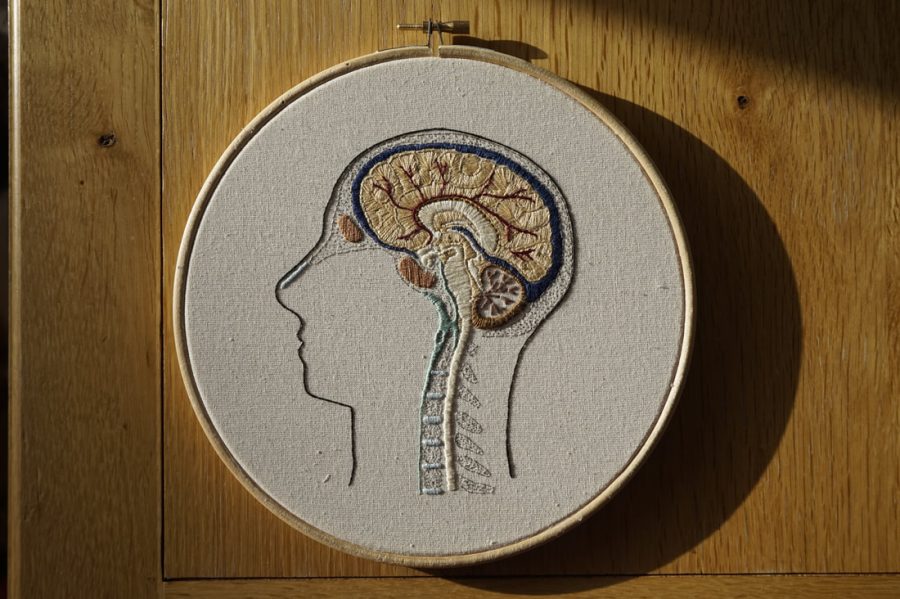
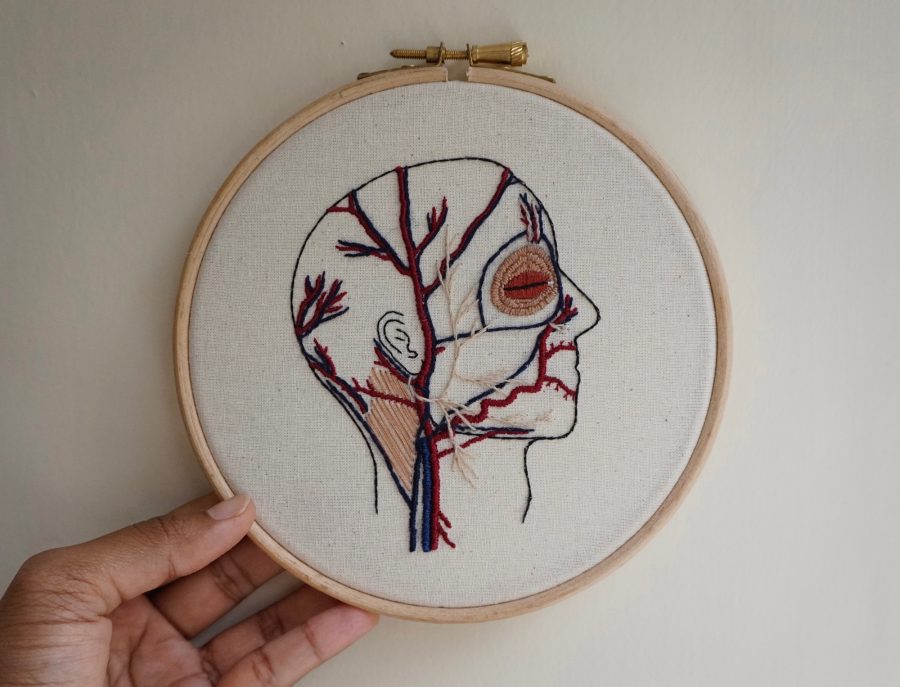
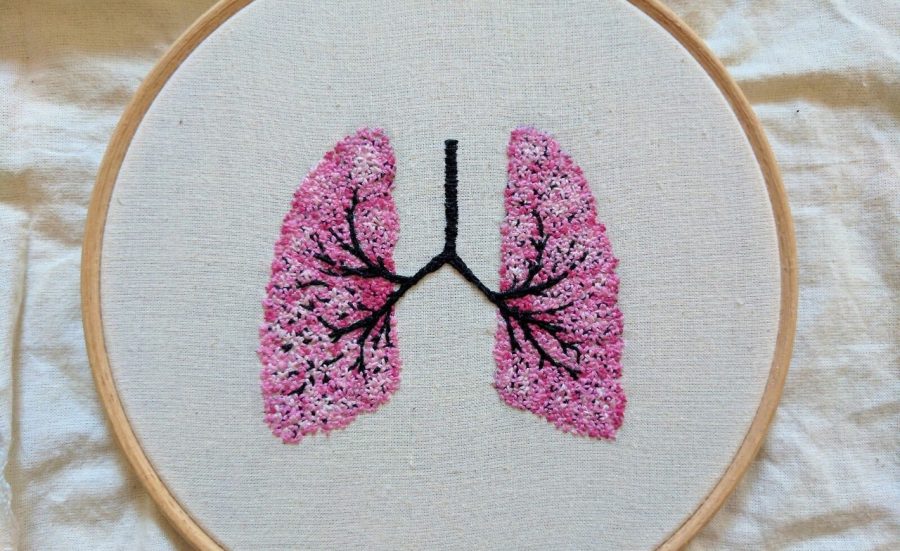
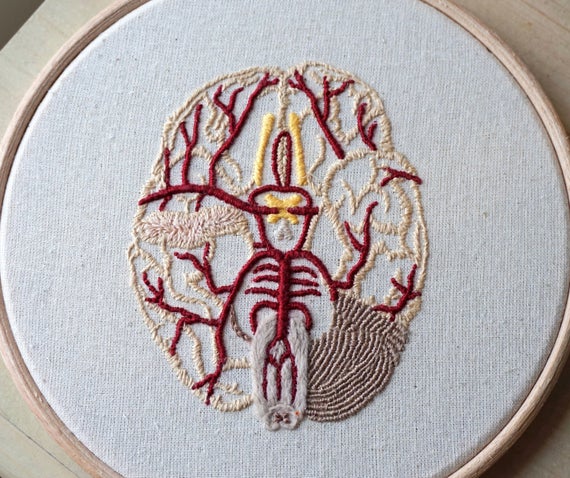
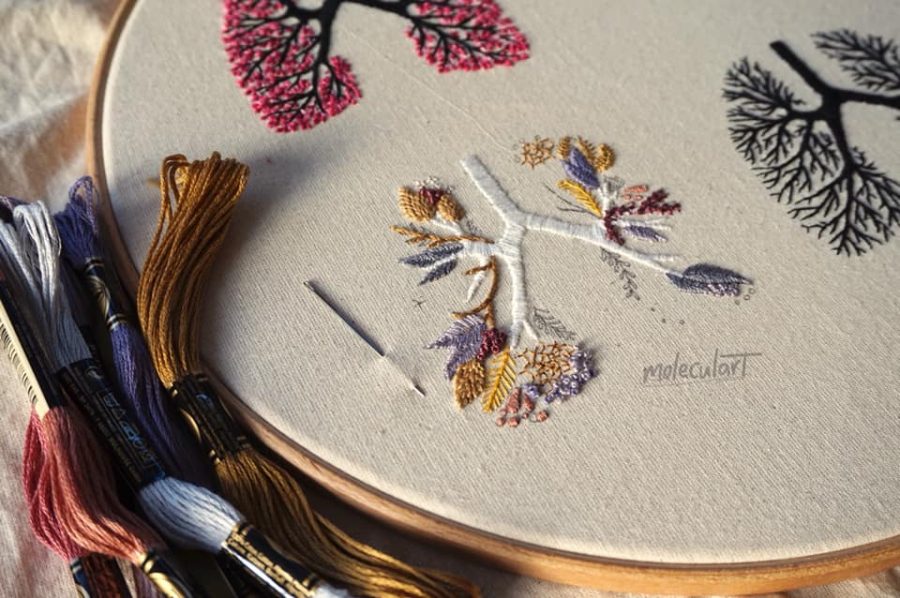
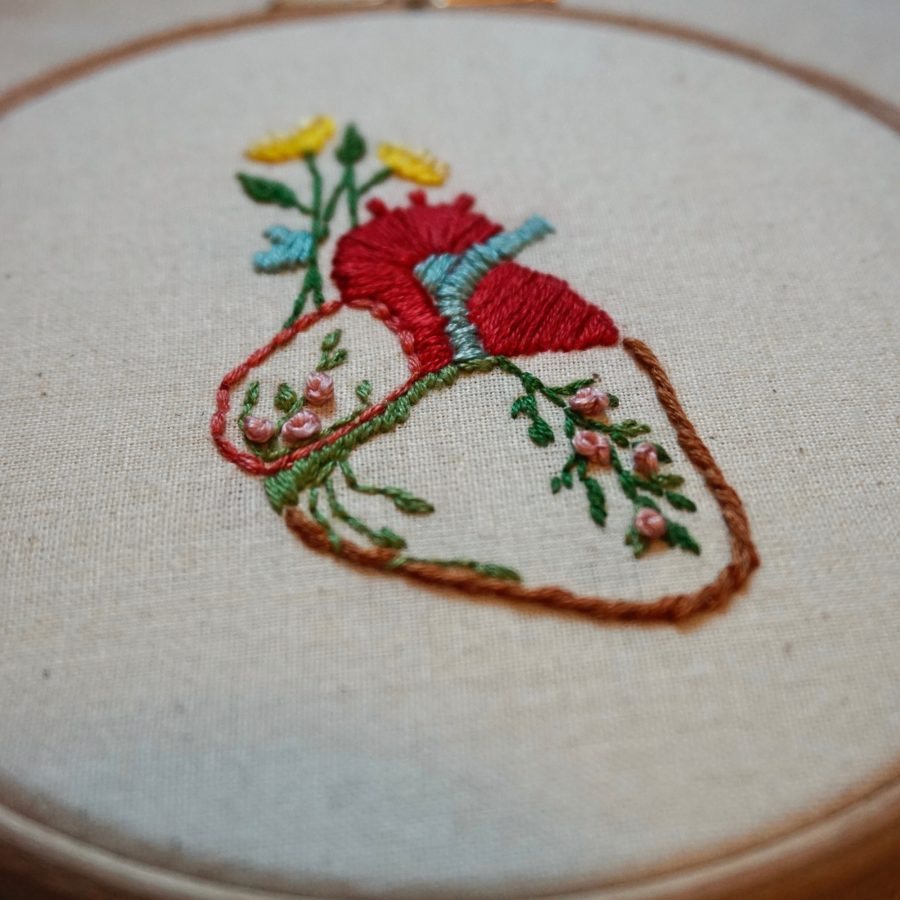
A Medical Student Creates Intricate Anatomical Embroideries of the Brain, Heart, Lungs & More

My first thought upon see­ing the del­i­cate, anato­my-based work of the 23-year-old embroi­dery artist and med­ical stu­dent Emmi Khan was that the Girl Scouts must have expand­ed the cat­e­gories of skills eli­gi­ble for mer­it badges.

(If mem­o­ry serves, there was one for embroi­dery, but it cer­tain­ly didn’t look like a cross-sec­tioned brain, or a sinus cav­i­ty.)

Clos­er inspec­tion revealed that the cir­cu­lar views of Khan’s embroi­deries are not quite as tiny as the round badges stitched to high achiev­ing Girl Scouts’ sash­es, but rather still framed in the wood­en hoops that are an essen­tial tool of this artist’s trade.

Meth­ods both sci­en­tif­ic and artis­tic are a source of fas­ci­na­tion for Khan, who began tak­ing needle­work inspi­ra­tion from anato­my as an under­grad study­ing bio­med­ical sci­ences. As she writes on her Mol­e­c­u­lart web­site:

Sci­ence has par­tic­u­lar meth­ods: it is fun­da­men­tal­ly objec­tive, con­trolled, empir­i­cal. Sim­i­lar­ly, art has par­tic­u­lar meth­ods: there is an empha­sis on sub­jec­tiv­i­ty and explo­ration, but there is also an ele­ment of reg­u­la­tion regard­ing how art is cre­at­ed… e.g. what type of nee­dle to use to embroi­der or how to prime a can­vas.

The pro­ce­dures and tech­niques adopt­ed by sci­en­tists and artists may be very dif­fer­ent. Ulti­mate­ly, how­ev­er, they both have a com­mon aim. Artists and sci­en­tists both want to 1) make sense of the vast­ness around them in new ways, and 2) present and com­mu­ni­cate it to oth­ers through their own vision. 

A glimpse at the flow­ers, intri­cate stitch­es, and oth­er dain­ties that pop­u­late her Pin­ter­est boards offers a fur­ther peek into Khan’s meth­ods, and might prompt some read­ers to pick up a nee­dle them­selves, even those with no imme­di­ate plans to embroi­der a kary­otype or The Cir­cle of Willis, the cir­cu­lar anas­to­mo­sis of arter­ies at the base of the brain.

The Cardiff-based med­ical stu­dent delights in embell­ish­ing her thread­ed obser­va­tions of inter­nal organs with the occa­sion­al dec­o­ra­tive element—sunflowers, posies, and the like…

She makes her­self avail­able on social media to answer ques­tions on sub­jects rang­ing from embroi­dery tips to her rela­tion­ship to sci­ence as a devout Mus­lim, and to share works in progress, like a set of lungs that embody the Four Sea­sons, com­mis­sioned by a cus­tomer in the States.

To see more of Emmi Khan’s work, includ­ing a down­load­able anatom­i­cal flo­ral heart embroi­dery pat­tern, vis­it Mol­e­c­u­larther Insta­gram page, or her Etsy shop.

via Colos­sal

Relat­ed Con­tent:

Behold an Anatom­i­cal­ly Cor­rect Repli­ca of the Human Brain, Knit­ted by a Psy­chi­a­trist

An Artist Cro­chets a Life-Size, Anatom­i­cal­ly-Cor­rect Skele­ton, Com­plete with Organs

Watch Nina Paley’s “Embroi­der­ma­tion,” a New, Stun­ning­ly Labor-Inten­sive Form of Ani­ma­tion

Ayun Hal­l­i­day is an author, illus­tra­tor, the­ater mak­er and Chief Pri­ma­tol­o­gist of the East Vil­lage Inky zine.  Join her in NYC on Mon­day, Feb­ru­ary 3 when her month­ly book-based vari­ety show, Necro­mancers of the Pub­lic Domain cel­e­brates New York: The Nation’s Metrop­o­lis (1921). Fol­low her @AyunHalliday.

Plants Emit High-Pitched Sounds When They Get Cut, or Stressed by Drought, a New Study Shows

Image via Wiki­me­dia Com­mons

Are plants sen­tient? We know they sense their envi­ron­ments to a sig­nif­i­cant degree; like ani­mals, they can “see” light, as a New Sci­en­tist fea­ture explains. They “live in a very tac­tile world,” have a sense of smell, respond to sound, and use taste to “sense dan­ger and drought and even to rec­og­nize rel­a­tives.” We’ve pre­vi­ous­ly high­light­ed research here on how trees talk to each oth­er with chem­i­cal sig­nals and form social bonds and fam­i­lies. The idea sets the imag­i­na­tion run­ning and might even cause a lit­tle para­noia. What are they say­ing? Are they talk­ing about us?

Maybe we deserve to feel a lit­tle uneasy around plant life, giv­en how ruth­less­ly our con­sumer economies exploit the nat­ur­al world. Now imag­ine we could hear the sounds plants make when they’re stressed out. In addi­tion to releas­ing volatile chem­i­cals and show­ing “altered phe­no­types, includ­ing changes in col­or, smell, and shape,” write the authors of a new study pub­lished at bioRx­iv, it’s pos­si­ble that plants “emit air­borne sounds [their empha­sis] when stressed—similarly to many ani­mals.”

The researchers who test­ed this hypoth­e­sis at Tel Aviv Uni­ver­si­ty “found that toma­to and tobac­co plants made sounds at fre­quen­cies humans can­not hear,” New Sci­en­tist reports. “Micro­phones placed 10 cen­time­tres from the plants picked up sounds in the ultra­son­ic range of 20 to 100 kilo­hertz, which the team say insects and some mam­mals would be capa­ble of hear­ing and respond­ing to from as far as 5 metres away.”

The plants made these sounds when stressed by lack of water or when their stems were cut. Toma­to plants stressed by drought made an aver­age of 35 sounds per hour. Tobac­co plants, on aver­age, made 11. Unstressed plants, by con­trast, “pro­duced few­er than one sound per hour.” The sci­en­tists used machine learn­ing to dis­tin­guish between dif­fer­ent kinds of dis­tress calls, as it were, and dif­fer­ent kinds of plants, “cor­rect­ly iden­ti­fy­ing in most cas­es whether the stress was caused by dry­ness or a cut,” and they con­duct­ed the exper­i­ments in both closed acoustic cham­bers and a green­house.

Plants do not, of course, have vocal cords or audi­to­ry sys­tems. But they do expe­ri­ence a process known as “cav­i­ta­tion,” in which “air bub­bles form, expand and explode in the xylem, caus­ing vibra­tions,” the paper explains. These vibra­tions have been record­ed in the past by direct, con­tact-based meth­ods. This new study, which has yet to pass peer review, might be the first to show how plants might use sound to com­mu­ni­cate with each oth­er and with oth­er liv­ing organ­isms, sug­gest­ing “a new modal­i­ty of sig­nal­ing.”

The pos­si­bil­i­ties for future research are fas­ci­nat­ing. We might learn, for exam­ple, that “if plants emit sounds in response to a cater­pil­lar attack, preda­tors such as bats could use these sounds to detect attacked plants and prey on the her­bi­vores, thus assist­ing the plant.” And just as trees are able to respond to each oth­er’s dis­tress when they’re con­nect­ed in a for­est, “plants could poten­tial­ly hear their drought stressed or injured neigh­bors and react accordingly”—however that might be.

Much remains to be learned about the sen­so­ry lives of plants. Whether their active calls and respons­es to the stim­uli around them are indica­tive of a kind of con­scious­ness seems like a philo­soph­i­cal as much as a bio­log­i­cal ques­tion. But “even if the emis­sion of the sounds is entire­ly invol­un­tary,” the researchers write (seem­ing to leave room for plant voli­tion), it’s a phe­nom­e­non that counts as a form of com­mu­ni­ca­tion: maybe even what we might some­day call plant lan­guage, dif­fer­ent from species to species and, per­haps, between indi­vid­ual plants them­selves.

Relat­ed Con­tent:

The Secret Lan­guage of Trees: A Charm­ing Ani­mat­ed Les­son Explains How Trees Share Infor­ma­tion with Each Oth­er

The Social Lives of Trees: Sci­ence Reveals How Trees Mys­te­ri­ous­ly Talk to Each Oth­er, Work Togeth­er & Form Nur­tur­ing Fam­i­lies

Graph­ic Shows the House Plants That Nat­u­ral­ly Clean the Air in Your Home, Accord­ing to a NASA Study

Josh Jones is a writer and musi­cian based in Durham, NC. Fol­low him at @jdmagness

Chill Out to 70 Hours of Oceanscape Nature Videos Filmed by BBC Earth

Those who har­bor a deep-seat­ed fear of the water may want to look for oth­er meth­ods of stress relief than BBC Earth’s relax­ing 10-hour video loops, but every­one else is encour­aged to take a dip in these stun­ning nat­ur­al worlds, pre­sent­ed with­out com­men­tary or back­ground music.

All sev­en 10-hour playlists are salt-water based: coral reefscoast­linesdeep oceanopen ocean, frozen seasocean sur­faces, and sea forests.

As in most com­pelling nature doc­u­men­taries, non-human crea­tures loom large, but unlike such BBC Earth offer­ings as Creepi­est Insect Moments or Ants Attack Ter­mite Mounds, there’s a benign, live-and-let-live vibe to the pro­ceed­ings.

Unsur­pris­ing­ly, the pho­tog­ra­phy is breath­tak­ing, and the uses of these marathon-length por­traits are man­i­fold: med­i­ta­tion tool, sleep aid, child soother, social media decom­pres­sor, trav­el­ogue, and—less calmingly—call to action.

Sci­ence tells us that many of these life forms, and the ocean in which they dwell, are in seri­ous dan­ger, thanks to decades of human dis­re­gard for the envi­ron­ment. This is an oppor­tu­ni­ty to immerse our­selves in what we stand to lose while it’s still pos­si­ble to do some­thing about it.

If that thought seems too depress­ing, there’s also strong sci­en­tif­ic evi­dence that nature doc­u­men­taries such as these pro­mote increased feel­ings of well­be­ing

What are you wait­ing for?

Click here to trav­el the oceans with polar bears, jel­ly­fish, dol­phins, sea­hors­es, bright­ly col­ored trop­i­cal fish and oth­er crea­tures of the deep, com­pli­ments of BBC’s Earth’s Ocean­scapes playlists.

Relat­ed Con­tent:

Watch­ing Nature Doc­u­men­taries Can Pro­duce “Real Hap­pi­ness,” Finds a Study from the BBC and UC-Berke­ley

Bob Odenkirk & Errol Mor­ris Cre­ate Comedic Shorts to Help You Take Action Against Glob­al Warm­ing: Watch Them Online

Do Octopi Dream? An Aston­ish­ing Nature Doc­u­men­tary Sug­gests They Do

Ayun Hal­l­i­day is an author, illus­tra­tor, the­ater mak­er and Chief Pri­ma­tol­o­gist of the East Vil­lage Inky zine.  Join her in NYC on Mon­day, Novem­ber 4 when her month­ly book-based vari­ety show, Necro­mancers of the Pub­lic Domain cel­e­brates Louise Jor­dan Miln’s “Woo­ings and Wed­dings in Many Climes (1900). Fol­low her @AyunHalliday.

Download 435 High Resolution Images from John J. Audubon’s The Birds of America

In our expe­ri­ence, bird lovers fall into two gen­er­al cat­e­gories:

Keen­ly obser­vant cat­a­loguers like John James Audubon â€¦

And those of us who can­not resist assign­ing anthro­po­mor­phic per­son­al­i­ties and behav­iors to the 435 stars of Audubon’s The Birds of Amer­i­ca, a stun­ning col­lec­tion of prints from life-size water­col­ors he pro­duced between 1827 and 1838.

Our sus­pi­cions have lit­tle to do with biol­o­gy, but rather, a cer­tain zesti­ness of expres­sion, an overem­phat­ic beak, a droll gleam in the eye.

The Audubon Society’s new­ly redesigned web­site abounds with trea­sure for those in either camp:

Free high res down­loads of all 435 plates.

Mp3s of each specimen’s call.

And vin­tage com­men­tary that effec­tive­ly splits the dif­fer­ence between sci­ence and the unin­ten­tion­al­ly humor­ous locu­tions of anoth­er age.

Take for instance, the Bur­row­ing Owl, as described by self-taught nat­u­ral­ist Thomas Say (1787–1834):

It is delight­ful, dur­ing fine weath­er, to see these live­ly lit­tle crea­tures sport­ing about the entrance of their bur­rows, which are always kept in the neat­est repair, and are often inhab­it­ed by sev­er­al indi­vid­u­als. When alarmed, they imme­di­ate­ly take refuge in their sub­ter­ranean cham­bers; or, if the dread­ed dan­ger be not imme­di­ate­ly impend­ing, they stand near the brink of the entrance, brave­ly bark­ing and flour­ish­ing their tails, or else sit erect to recon­noitre the move­ments of the ene­my.

The notes of ornithol­o­gist John Kirk Townsend (1809 – 1851) sug­gest that not every­one was as tak­en with the species as Say (who was, in all fair­ness, the father of Amer­i­can ento­mol­o­gy):

Noth­ing can be more unpleas­ant than the bag­ging of this species, on account of the fleas with which their plumage swarms, and which in all prob­a­bil­i­ty have been left in the bur­row by the Bad­ger or Mar­mot, at the time it was aban­doned by these ani­mals. I know of no oth­er bird infest­ed by that kind of ver­min. 

The Com­mon Gallinule, above, sug­gests that there’s often more to these birds than meets the eye. His some­what sheep­ish look­ing coun­te­nance belies the red hot love life Audubon recounts:

… the man­i­fes­ta­tions of their ama­to­ry propen­si­ty were quite remark­able. The male birds court­ed the females, both on the land and on the water; they fre­quent­ly spread out their tail like a fan, and moved round each oth­er, emit­ting a mur­mur­ing sound for some sec­onds. The female would after­wards walk to the water’s edge, stand in the water up to her breast, and receive the caress­es of the male, who imme­di­ate­ly after would strut on the water before her, jerk­ing with rapid­i­ty his spread tail for awhile, after which they would both resume their ordi­nary occu­pa­tions.

Being that we are firm­ly plant­ed in the sec­ond type of bird lover’s camp, this ornitho­log­i­cal cor­nu­copia main­ly serves to whet our appetite for more Falseknees, self-described bird nerd Joshua Bark­man’s beau­ti­ful­ly ren­dered web­com­ic.

Yes, Audubon’s Indi­go Birdaka Petit Pape­bleu, “an active and live­ly lit­tle fel­low” who “pos­sess­es much ele­gance in his shape, and also a cer­tain degree of firm­ness in his make” was sep­a­rat­ed by a cen­tu­ry or so from “Mood Indi­go”—we pre­sume that’s the tune stuck in Barkman’s bird’s head—but he does look rather pre­oc­cu­pied, no?

Pos­si­bly just think­ing of meal­worms…

Explore Audubon’s Birds of Amer­i­ca by chrono­log­i­cal or alpha­bet­i­cal order, or by state, and down­load them all for free here.

Relat­ed Con­tent:

Cor­nell Launch­es Archive of 150,000 Bird Calls and Ani­mal Sounds, with Record­ings Going Back to 1929

What Kind of Bird Is That?: A Free App From Cor­nell Will Give You the Answer

Explore an Inter­ac­tive Ver­sion of The Wall of Birds, a 2,500 Square-Foot Mur­al That Doc­u­ments the Evo­lu­tion of Birds Over 375 Mil­lion Years

Mod­ernist Bird­hous­es Inspired by Bauhaus, Frank Lloyd Wright and Joseph Eich­ler

Ayun Hal­l­i­day is an author, illus­tra­tor, the­ater mak­er and Chief Pri­ma­tol­o­gist of the East Vil­lage Inky zine.  Join her in NYC on Mon­day, Novem­ber 7 for her month­ly book-based vari­ety show, Necro­mancers of the Pub­lic Domain. Fol­low her @AyunHalliday.

Free: Download the Sublime Sights & Sounds of Yellowstone National Park

Moments before writ­ing these words I was feel­ing a lit­tle stressed—a not uncom­mon expe­ri­ence for most every­one these days. Then I watched the 25-sec­ond video of a bighorn sheep, above, and some­thing hap­pened. Not an epiphany or moment of Zen. Just a momen­tary sus­pen­sion of human woe as the ani­mal silent­ly munched, a crea­ture so unlike myself and yet so moti­vat­ed by the same basic needs.

How much bet­ter to observe the sheep first­hand, in its home at Yel­low­stone Nation­al Park? But per­haps we can, through our com­put­ers, touch into a lit­tle of the rem­e­dy Oliv­er Sacks sug­gest­ed for our mod­ern trau­mas. Nature gives us “sense of deep time,” the neu­rol­o­gist wrote, which “brings a deep peace with it, a detach­ment from the timescale, the urgen­cies of dai­ly life… a pro­found sense of being at home, a sort of com­pan­ion­ship with the earth.”

Research has found that watch­ing nature doc­u­men­taries can bring on real con­tent­ment, con­firm­ing what mil­lions of Nation­al Geo­graph­ic devo­tees already know. Now, at the Nation­al Park Service’s site, you can immerse your­self in vir­tu­al vis­its with not only our silent bighorn sheep friend, but the song of a moun­tain blue­bird, or cho­rus­es of howl­ing wolves. The audio library con­tains dozens more such melo­di­ous and haunt­ing sounds from Yellowstone’s bio­pho­ny.

The video library is replete with not only short clips of ani­mals doing what ani­mals do, but also video tours like that above, in which we learn how park rangers cap­ture and han­dle bison in their con­ser­va­tion efforts at the park. Then there are stun­ning land­scape videos like that below of Low­er Falls viewed from Look­out Point in the spring of 2017, with sooth­ing nat­ur­al white noise from the rush­ing water and blow­ing wind.

All of this con­tent is avail­able for down­load and free for any­one to use. Remix the sounds of falling snow, gey­sers, and moun­tain lions; make as many nature gifs as you desire. As you do, bear in mind that while humans might great­ly benefit—both psy­cho­log­i­cal­ly and culturally—from the dig­i­tal preser­va­tion of the nat­ur­al world, the true pur­pose may be to help us under­stand why we need to step back and pre­serve the real thing.

Just above see a (non­down­load­able) video from Yel­low­stone on the impor­tance of lis­ten­ing to and con­serv­ing the land’s nat­ur­al soundscapes—a fea­ture of the world that best thrives in the near absence of human involve­ment.

Enter the sound library here, and the video library here.

via Kot­tke

Relat­ed Con­tent:

How the Japan­ese Prac­tice of “For­est Bathing”—Or Just Hang­ing Out in the Woods—Can Low­er Stress Lev­els and Fight Dis­ease

Watch 50 Hours of Nature Sound­scapes from the BBC: Sci­en­tif­i­cal­ly Proven to Ease Stress and Pro­mote Hap­pi­ness & Awe

The British Library’s “Sounds” Archive Presents 80,000 Free Audio Record­ings: World & Clas­si­cal Music, Inter­views, Nature Sounds & More

10 Hours of Ambi­ent Arc­tic Sounds Will Help You Relax, Med­i­tate, Study & Sleep

Josh Jones is a writer and musi­cian based in Durham, NC. Fol­low him at @jdmagness.

Where Did Human Beings Come From? 7 Million Years of Human Evolution Visualized in Six Minutes

One vul­gar con­cep­tion of human evo­lu­tion holds that we “come from mon­keys.” You don’t have to be a bona fide evo­lu­tion­ary biol­o­gist to know that’s not quite how we cur­rent­ly under­stand it to have hap­pened, but how clear­ly do you grasp the real sto­ry? The ani­ma­tion from the Amer­i­can Muse­um of Nat­ur­al His­to­ry above goes over sev­en mil­lion years of evo­lu­tion in a mere six min­utes, and it’s cer­tain­ly not a straight line down from “mon­keys” to us. The video does, how­ev­er, start its sto­ry with apes, and specif­i­cal­ly chim­panzees, “our clos­est liv­ing rel­a­tives” with whom “we share a com­mon ances­tor that lived sev­en mil­lion years ago.”

But we once had “much clos­er rel­a­tives, hominins, who are no longer liv­ing.” These we know about through the fos­sils they left behind in Africa, from which the first known hominin emerged those sev­en mil­lion years ago. Dif­fer­ent bones from dif­fer­ent species of hominins found else­where on the con­ti­nent sug­gest small teeth, upright walk­ing, and bipedal­ism, some of the qual­i­ties that dis­tin­guish humans from apes.

And though hominins may have walked upright, they also climbed trees, but even­tu­al­ly lost the grasp­ing feet need­ed to do so. Lat­er they com­pen­sat­ed with the very human-like devel­op­ment of mak­ing and using stone tools. Two mil­lion years ago, the well-known Homo erec­tus, with their large brains, long legs, and dex­trous hands, made the famous migra­tion out of Africa.

We know that by 1.2 mil­lion years there­after Homo erec­tus’ brains had grown larg­er still, fueled by new cook­ing tech­niques. Only about 200,000 years ago do we, Homo sapi­ens, enter the pic­ture, but not long after, we inter­breed with the var­i­ous hominin species already in exis­tence as we spread out­ward to fill “every geo­graph­ic niche” of the Earth. Ulti­mate­ly, hominins could­n’t keep up: “Cli­mate pres­sures and com­pe­ti­tion with Homo sapi­ens may have wiped them out.” Now that we’ve seen their sto­ry and ours reca­pit­u­lat­ed, let’s pour one out for the once-mighty hominin who pre­ced­ed us, lived along­side us, and influ­enced us in ways genet­ic and oth­er­wise — at least if it has­n’t giv­en us too much pause won­der­ing when the evo­lu­tion­ar­i­ly inevitable suc­ces­sor to Homo sapi­ens will appear in our midst.

via Laugh­ing Squid

Relat­ed Con­tent:

Watch 570 Mil­lion Years of Evo­lu­tion on Earth in 60 Sec­onds

550 Mil­lion Years of Human Evo­lu­tion in an Illus­trat­ed Flip­book

Carl Sagan Explains Evo­lu­tion in an Eight-Minute Ani­ma­tion

New Ani­mat­ed Web Series Makes the The­o­ry of Evo­lu­tion Easy to Under­stand

Richard Dawkins Explains Why There Was Nev­er a First Human Being

10 Mil­lion Years of Evo­lu­tion Visu­al­ized in an Ele­gant, 5‑Foot Long Info­graph­ic from 1931

Based in Seoul, Col­in Mar­shall writes and broad­casts on cities, lan­guage, and cul­ture. His projects include the book The State­less City: a Walk through 21st-Cen­tu­ry Los Ange­les and the video series The City in Cin­e­ma. Fol­low him on Twit­ter at @colinmarshall or on Face­book.

Do Octopi Dream? An Astonishing Nature Documentary Suggests They Do

With regard to the sleep­ing and wak­ing of ani­mals, all crea­tures that are red-blood­ed and pro­vid­ed with legs give sen­si­ble proof that they go to sleep and that they wak­en up from sleep; for, as a mat­ter of fact, all ani­mals that are fur­nished with eye­lids shut them up when they go to sleep. 

Fur­ther­more, it would appear that not only do men dream, but hors­es also, and dogs, and oxen; aye, and sheep, and goats, and all vivip­a­rous quadrupeds; and dogs show their dream­ing by bark­ing in their sleep. With regard to oviparous ani­mals we can­not be sure that they dream, but most undoubt­ed­ly they sleep. 

And the same may be said of water ani­mals, such as fish­es, mol­luscs, crus­taceans, to wit craw­fish and the like. These ani­mals sleep with­out doubt, although their sleep is of very short dura­tion. The proof of their sleep­ing can­not be got from the con­di­tion of their eyes-for none of these crea­tures are fur­nished with eyelids—but can be obtained only from their motion­less repose.

-Aris­to­tle, The His­to­ry of Ani­mals, Book IV, Part 10,350 B.C.E

2,369 years lat­er, Marine Biol­o­gist David Scheel, a pro­fes­sor at Alas­ka Pacif­ic Uni­ver­si­ty, wit­nessed a star­tling event, above, that allowed him to expand on Aristotle’s obser­va­tions, at least as far as eight-armed cephalo­pod mollusks—or octopi—are con­cerned

Appar­ent­ly, they dream.

Scheel, whose spe­cial­ties include preda­tor-prey ecol­o­gy and cephalo­pod biol­o­gy, is afford­ed an above-aver­age amount of qual­i­ty time with these alien ani­mals, cour­tesy of Hei­di, an octo­pus cyanea (or day octo­pus) who inhab­its a large tank of salt water in his liv­ing room.

Scheel’s usu­al beat is cold water species such as the giant Pacif­ic octo­pus. Hei­di, who earned her name by shy­ly stick­ing to the far­thest recess­es of her arti­fi­cial envi­ron­ment upon arrival, belongs to a warmer water species who are active dur­ing the day. Very active. Once she real­ized that Scheel and his 16-year-old daugh­ter, Lau­rel, were instru­ments of food deliv­ery, she came out of her shell, so to speak.

The hours she keeps affords her plen­ty of stim­u­lat­ing play­time with Lau­rel, who’s thrilled to have an ani­mal pal who’s less ambiva­lent than her pet gold­fish and out­door rab­bit.

Mean­while, the co-hous­ing arrange­ment pro­vides Pro­fes­sor Scheel with an inti­ma­cy that’s impos­si­ble to achieve in the lab.

He was not expect­ing the aston­ish­ing noc­tur­nal behav­ior he record­ed, above, for the hour-long PBS Nature doc­u­men­tary Octo­pus: Mak­ing Con­tact.

As Hei­di slept, she changed col­ors, rapid­ly cycling through pat­terns that cor­re­spond to her hunt­ing prac­tices. Scheel walks view­ers through:

So, here she’s asleep, she sees a crab, and her col­or starts to change a lit­tle bit.

Then she turns all dark.

Octo­pus­es will do that when they leave the bot­tom.

This is a cam­ou­flage, like she’s just sub­dued a crab and now she’s going to sit there and eat it and she does­n’t want any­one to notice her.

It’s a very unusu­al behav­ior to see the col­or come and go on her man­tel like that.

I mean, just to be able to see all the dif­fer­ent col­or pat­terns just flash­ing, one after anoth­er.

You don’t usu­al­ly see that when an ani­mal is sleep­ing.

This real­ly is fas­ci­nat­ing.

But, yeah, if she’s dream­ing, that’s the dream.

As dreams go, the nar­ra­tive Scheel sup­plies for Hei­di seems extreme­ly mun­dane. Per­haps some­where out on a coral reef, anoth­er octo­pus cyanea is dream­ing she’s trapped inside a small glass room, feast­ing on eas­i­ly got­ten crab and occa­sion­al­ly crawl­ing up a teenaged human’s arm.

Watch the full episode for free through Octo­ber 31 here.

via Laugh­ing Squid/This is Colos­sal

Relat­ed Con­tent:

Every U.S. Vice Pres­i­dent with an Octo­pus on His Head: Kick­start The Veep­to­pus Book

Watch 50 Hours of Nature Sound­scapes from the BBC: Sci­en­tif­i­cal­ly Proven to Ease Stress and Pro­mote Hap­pi­ness & Awe

Envi­ron­ment & Nat­ur­al Resources: Free Online Cours­es 

Ayun Hal­l­i­day is an author, illus­tra­tor, the­ater mak­er and Chief Pri­ma­tol­o­gist of the East Vil­lage Inkyzine.  Join her in NYC tonight, Mon­day, Octo­ber 7 when her month­ly book-based vari­ety show, Necro­mancers of the Pub­lic Domaincel­e­brates the art of Aubrey Beard­s­ley. Fol­low her @AyunHalliday.

Science Shows That Snowball the Cockatoo Has 14 Different Dance Moves: The Vogue, Headbang & More

We humans think we invent­ed every­thing.

The wheel…

The print­ing press…

Danc­ing…

Well, we’re right about the first two.

Turns out the impulse to shake a tail feath­er isn’t an arbi­trary cul­tur­al con­struct of human­i­ty but rather a hard-wired neu­ro­log­i­cal impulse in beings clas­si­fied as vocal learners—us, ele­phants, dol­phins, song­birds, and par­rots like the Inter­net-famous sul­phur-crest­ed cock­a­too, Snow­ball, above.

Ani­mals out­side of this elite set can be trained to exe­cute cer­tain phys­i­cal moves, or they may just look like they’re danc­ing when track­ing the move­ments of their food bowl or shim­my­ing with relief at being picked up from dog­gy day­care.

Snow­ball, how­ev­er, is tru­ly danc­ing, thanks to his species’ capac­i­ty for hear­ing, then imi­tat­ing sounds. Like every great spon­ta­neous dancer, he’s got the music in him.

Anirud­dh Patel, a Pro­fes­sor of Psy­chol­o­gy at Tufts who spe­cial­izes in music cog­ni­tion, was the first to con­sid­er that Snowball’s habit of rock­ing out to the Back­street Boys CD he’d had in his pos­ses­sion when dropped off at a par­rot res­cue cen­ter in Dyer, Indi­ana, was some­thing more than a par­ty trick.

Dr. Patel notes that par­rots have more in com­mon with dinosaurs than human beings, and that our mon­key cousins don’t dance (much to this writer’s dis­ap­point­ment).

(Also, for the record? That goat who sings like Ush­er? It may sound like Ush­er, but you’ll find no sci­en­tif­ic sup­port for the notion that its vocal­iza­tions con­sti­tute singing.)

Snow­ball, on the oth­er hand, has made a major impres­sion upon the Acad­e­my.

In papers pub­lished in Cur­rent Biol­o­gy and Annals of the New York Acad­e­my of Sci­ences, Patel and his co-authors John R. Iversen, Mic­ah R. Breg­man, and Ire­na Schulz delved into why Snow­ball can dance like … well, maybe not Fred Astaire, but cer­tain­ly your aver­age mosh­ing human.

After exten­sive obser­va­tion, they con­clud­ed that an indi­vid­ual must pos­sess five spe­cif­ic men­tal skills and predilec­tions in order to move impul­sive­ly to music:

  1. They must be com­plex vocal learn­ers, with the accom­pa­ny­ing abil­i­ty to con­nect sound and move­ment.
  2. They must be able to imi­tate move­ments.
  3. They must be able to learn com­plex sequences of actions.
  4. They must be atten­tive to the move­ments of oth­ers.
  5. They must form long-term social bonds.

Cock­a­toos can do all of this. Humans, too.

Patel’s for­mer stu­dent R. Joanne Jao Keehn recent­ly reviewed footage she shot in 2009 of Snow­ball get­ting down to Queen’s “Anoth­er One Bites the Dust” and Cyn­di Lauper’s “Girls Just Want to Have Fun,” iden­ti­fy­ing 14 dis­tinct moves.

Accord­ing to her research, his favorites are Vogue, Head-Foot Sync, and Head­bang with Lift­ed Foot.

If you’ve been hug­ging the wall since mid­dle school, maybe it’s time to take a deep breath, fol­lowed by an avian danc­ing les­son.

How did Snow­ball come by his aston­ish­ing rug-cut­ting con­fi­dence? Cer­tain­ly not by watch­ing instruc­tion­al videos on YouTube. His human com­pan­ion Schulz dances with him occa­sion­al­ly, but does­n’t attempt to teach him her moves, which she describes as “lim­it­ed.”

Much like two human part­ners, they’re not always doing the same thing at the same time.

And the chore­og­ra­phy is pure­ly Snowball’s.

As Patel told The Har­vard Gazette:

It’s actu­al­ly a com­plex cog­ni­tive act that involves choos­ing among dif­fer­ent types of pos­si­ble move­ment options. It’s exact­ly how we think of human danc­ing.

If he is actu­al­ly com­ing up with some of this stuff by him­self, it’s an incred­i­ble exam­ple of ani­mal cre­ativ­i­ty because he’s not doing this to get food; he’s not doing this to get a mat­ing oppor­tu­ni­ty, both of which are often moti­va­tions in exam­ples of cre­ative behav­ior in oth­er species.

You can read more sci­ence-based arti­cles inspired by Snow­ball and watch some of his many pub­lic appear­ances on the not-for-prof­it, dona­tion-based sanc­tu­ary Bird Lovers Only’s web­site.

Relat­ed Con­tent:

Why We Dance: An Ani­mat­ed Video Explains the Sci­ence Behind Why We Bust a Move

The Strange Danc­ing Plague of 1518: When Hun­dreds of Peo­ple in France Could Not Stop Danc­ing for Months

Explore an Inter­ac­tive Ver­sion of The Wall of Birds, a 2,500 Square-Foot Mur­al That Doc­u­ments the Evo­lu­tion of Birds Over 375 Mil­lion Years

Ayun Hal­l­i­day is an author, illus­tra­tor, the­ater mak­er and Chief Pri­ma­tol­o­gist of the East Vil­lage Inkyzine.  Join her in NYC on Mon­day, Sep­tem­ber 9 for anoth­er sea­son of her book-based vari­ety show, Necro­mancers of the Pub­lic Domain. Fol­low her @AyunHalliday.

« Go BackMore in this category... »
Quantcast