An Artist Crochets a Life-Size, Anatomically-Correct Skeleton, Complete with Organs

How to make a life-sized fac­sim­i­le of a human skele­ton:

  1. Down­load files pub­lished under a Cre­ative Com­mons license, and arrange to have them 3‑D print­ed.

or

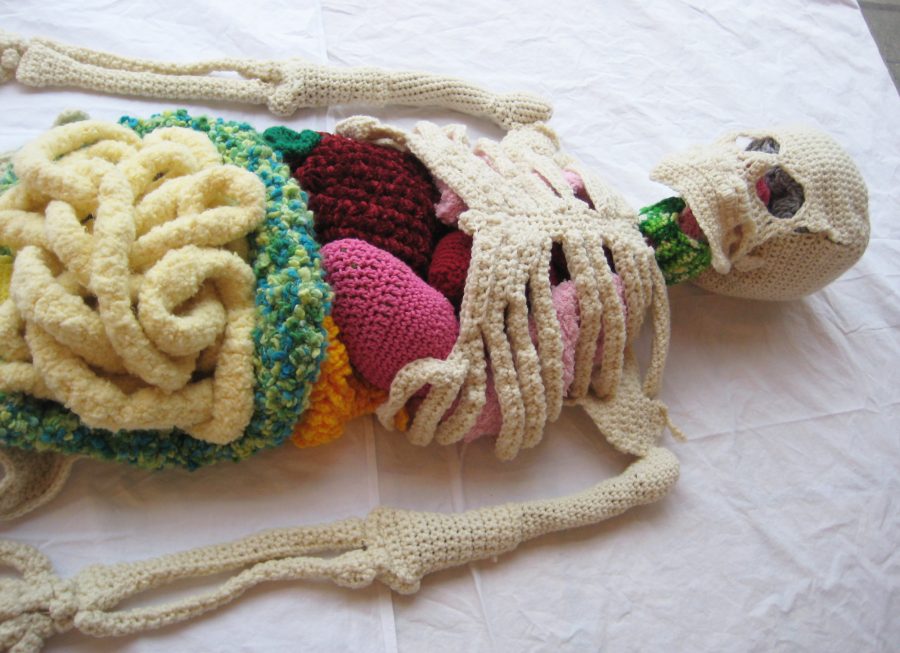
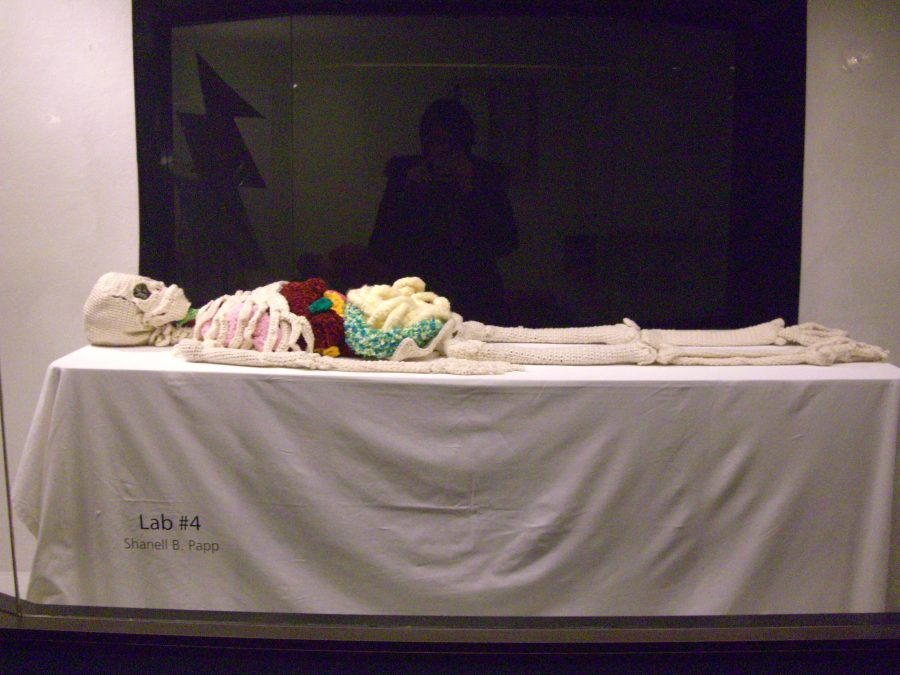
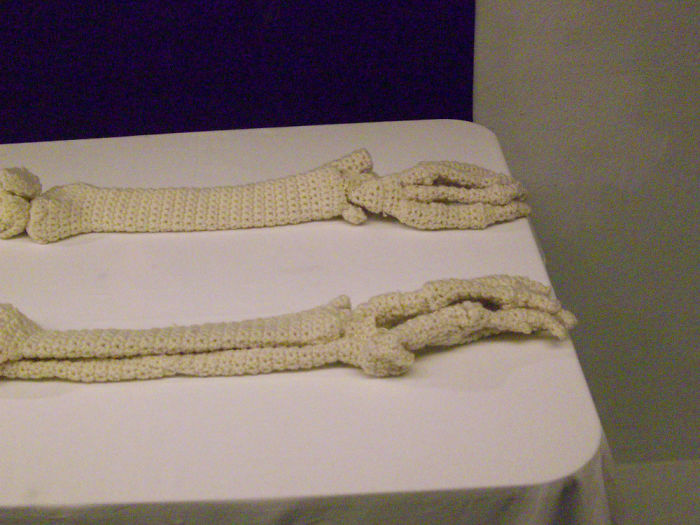
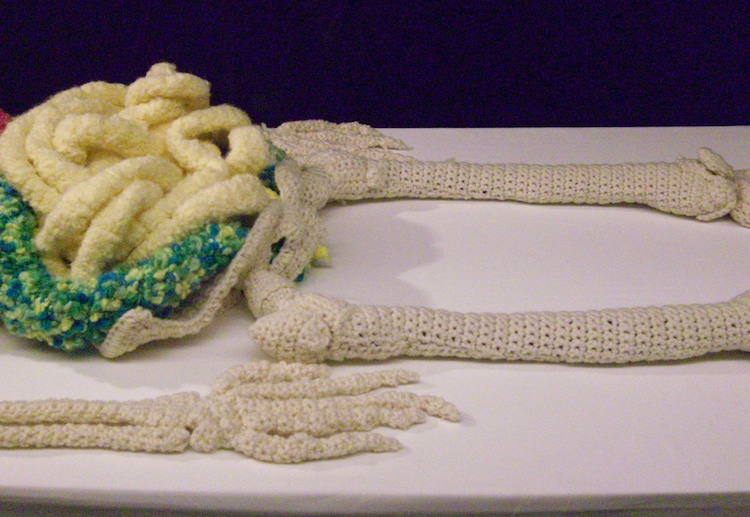
  1. Do as artist Shanell Papp did, above, and cro­chet one.

The lat­ter will take con­sid­er­ably more time and atten­tion on your part. Papp gave up all extracur­ric­u­lar activ­i­ties for four months to hook the woolen skele­ton around her work and school sched­ule. Equip­ping it with inter­nal organs ate up anoth­er four.

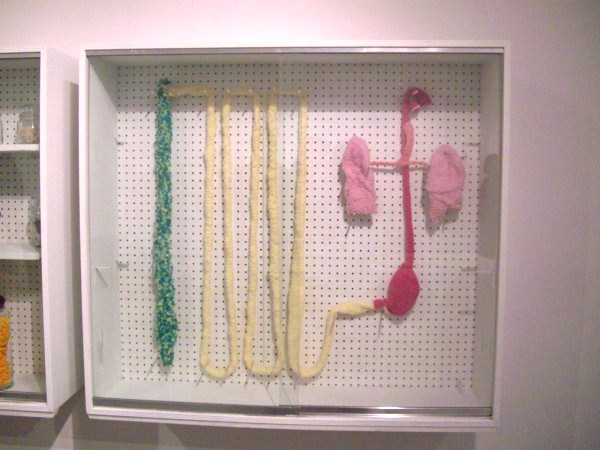
To ensure accu­ra­cy, Papp armed her­self with anatom­i­cal text­books and an actu­al human skele­ton on loan from the Uni­ver­si­ty of Leth­bridge, where she was an under­grad. The brain has gray and white mat­ter, there’s mar­row in the bones, the stom­ach con­tains half-digest­ed wool food, and the intestines can be unspooled to a real­is­tic length.

The gru­el­ing 2006 project did not exhaust her fas­ci­na­tion for the intri­ca­cies of human anato­my. The Uni­ver­si­ty of Saskatchewan grant­ed her open access to draw in the gross anato­my lab while she pur­sued her MFA.


As she told MICE mag­a­zine:

I want­ed this work to illus­trate all of the organs and bones every­one shares and to not high­light dif­fer­ences. Much of anatom­i­cal his­to­ry is about defin­ing dif­fer­ence, by com­par­a­tive analy­sis. This can set up strange tax­onomies and hier­ar­chies. I was­n’t inter­est­ed in par­tic­i­pat­ing in that; I want­ed to expose the frag­ile, com­mon, and unseen things in all of us.  

The fin­ished piece, which is dis­played supine on a gur­ney she nabbed for free dur­ing a mor­tu­ary ren­o­va­tion, incor­po­rates many of Papp’s oth­er abid­ing inter­ests: hor­ror, med­ical his­to­ry, Franken­stein, crime inves­ti­ga­tion, and mor­tu­ary prac­tices.

Papp, who taught her­self how to cro­chet from books as a child, using what­ev­er yarn found its way to her grandma’s junk shop, appre­ci­ates how her cho­sen medi­um adds a lay­er of homey soft­ness and famil­iar­i­ty to the macabre.

It’s also not lost on her that fiber arts, often dis­missed as too “crafty” by the estab­lish­ment, were an impor­tant com­po­nent of 70s-era fem­i­nist art, though in her view, her work is more of a state­ment on the his­to­ry of tex­tile man­u­fac­tur­ing, which is to say the his­to­ry of labor and class strug­gle.

See more of Shanell Papp’s work here.

All images in this post by Shanell Papp.

via design­boom/Mymod­ern­met

Relat­ed Con­tent:

Behold an Anatom­i­cal­ly Cor­rect Repli­ca of the Human Brain, Knit­ted by a Psy­chi­a­trist

The BBC Cre­ates Step-by-Step Instruc­tions for Knit­ting the Icon­ic Dr. Who Scarf: A Doc­u­ment from the Ear­ly 1980s

The Beau­ti­ful Math of Coral & Cro­chet

Ayun Hal­l­i­day is an author, illus­tra­tor, the­ater mak­er and Chief Pri­ma­tol­o­gist of the East Vil­lage Inkyzine.  Join her in NYC on Mon­day, Sep­tem­ber 9 for anoth­er sea­son of her book-based vari­ety show, Necro­mancers of the Pub­lic Domain. Fol­low her @AyunHalliday.

Why a Cat Always Lands on Its Feet: How a French Scientist Used Photography to Solve the Problem in 1894

In the era of the CATS trail­er and #cat­sofin­sta­gram, it’s easy to for­get that sci­en­tif­ic research is what orig­i­nal­ly con­vinced our feline friends to allow their images to be cap­tured and dis­sem­i­nat­ed.

An anony­mous white French pussy took one for the team in 1894, when scientist/inventor Éti­enne-Jules Marey dropped it from an unspec­i­fied height in the Bois de Boulogne, film­ing its descent at 12 frames per sec­ond.

Ulti­mate­ly, this brave and like­ly unsus­pect­ing spec­i­men fur­thered the cause of space explo­ration, though it took over 50 years for NASA-backed researchers T.R. Kane and M.P. Sch­er to pub­lish their find­ings in a paper titled “A Dynam­i­cal Expla­na­tion of the Falling Cat Phe­nom­e­non.”

As the Vox Dark­room episode above makes clear, Marey’s obses­sion was lofti­er than a fond­ness for Stu­pid Pet Tricks and the mis­chie­vous impulse to drop things off of tall build­ings that moti­vat­ed TV host David Let­ter­man once upon a time.

Marey’s pre­oc­cu­pa­tion with the mechan­ics of organ­ic loco­mo­tion extend­ed to hors­es and humans. It prompt­ed him to invent pho­to­graph­ic tech­niques that pre­fig­ured cin­e­matog­ra­phy, and, more dark­ly, to sub­ject oth­er, less-cat­like crea­tures to dead­falls from sim­i­lar heights.

(Chil­dren and ani­mal rights activists, con­sid­er this your trig­ger warn­ing.)

The white cat sur­vived its ordeal by arch­ing its back mid-air, effec­tive­ly split­ting its body in two to har­ness the iner­tia of its body weight, much like a fig­ure skater con­trol­ling the veloc­i­ty of her spin by the posi­tion of her arms.

Why waste a sin­gle one of your nine lives? Physics is your friend, espe­cial­ly when falling from a great height.

See one of Marey’s pio­neer­ing falling cat chronopho­tographs below.

Relat­ed Con­tent:

Thomas Edison’s Box­ing Cats (1894), or Where the LOL­Cats All Began

An Ani­mat­ed His­to­ry of Cats: How Over 10,000 Years the Cat Went from Wild Preda­tor to Sofa Side­kick

Explo­sive Cats Imag­ined in a Strange, 16th Cen­tu­ry Mil­i­tary Man­u­al

Ayun Hal­l­i­day is an author, illus­tra­tor, the­ater mak­er and Chief Pri­ma­tol­o­gist of the East Vil­lage Inkyzine.  Join her in NYC on Mon­day, Sep­tem­ber 9 for anoth­er sea­son of her book-based vari­ety show, Necro­mancers of the Pub­lic Domain. Fol­low her @AyunHalliday.

The Secret Language of Trees: A Charming Animated Lesson Explains How Trees Share Information with Each Other

Shel Silverstein’s bit­ter­sweet clas­sic The Giv­ing Tree paints an inac­cu­rate view of trees as sim­ple, eas­i­ly vic­tim­ized lon­ers.

If only the tit­u­lar char­ac­ter had had a same-species best friend around to talk some sense into her when her human pal start­ed help­ing him­self to her branch­es… You’ve Got­ta Be Kid­ding Me Tree, or maybe No Bull­shit Tree.

You’ve Got­ta Be Kid­ding Me Tree could’ve passed some vital nutri­ents to The Giv­ing Tree, whose self care reg­i­men is clear­ly not cut­ting it, via the myc­or­rhizae sys­tem, a vast net­work of fil­a­ment-like tree roots and sym­bi­ot­ic soil fun­gi.

That same sys­tem could serve as the switch­board by which You’ve Got­ta Be Kid­ding Me Tree could alert the extend­ed Tree fam­i­ly to the dan­gers of pro­longed asso­ci­a­tion with cute, but needy kids.

Imag­ine the upbeat end­ing, had Sil­ver­stein gone light—The Giv­ing Tree N’ Friends.

Not as poignant per­haps, but not entire­ly inac­cu­rate from a sci­en­tif­ic stand­point.

As for­est ecol­o­gists Suzanne Simard and Camille Defrenne point out in the ani­mat­ed TED-Ed les­son, “The Secret Lan­guage of Trees,” above, trees have large fam­i­ly (for­give me) trees, whose liv­ing mem­bers are in con­stant com­mu­ni­ca­tion, using the myc­or­rhizae sys­tem.

Host­ing mul­ti­ple fun­gal species allows each tree to con­nect with a wider net­work, as each group of sym­bi­ot­ic shrooms spreads infor­ma­tion to their own per­son­al crews, par­ty line style.

On the oth­er end, the receiv­ing tree can iden­ti­fy its rela­tion to the tree of ori­gin, whether they are both mem­bers of what we humans refer to as a nuclear fam­i­ly, or much more dis­tant rela­tions.

And while this giant sub­ter­ranean sys­tem for shar­ing infor­ma­tion and resources is spe­cif­ic to trees, when we con­sid­er how many oth­er for­est denizens depend on trees for food and shel­ter, the mes­sage sys­tem seems even more vital to the planet’s health.

Defrenne and Simard’s full TED-Ed les­son, com­plete with quiz, cus­tomiz­able les­son plan, and dis­cus­sion top­ics, can be found here.

Simard delves more deeply into the top­ic in the 18-minute TED Talk, “How Trees Talk to Each Oth­er,” below.

View more of ani­ma­tor Avi Ofer’s charm­ing work here.

Relat­ed Con­tent:

The Social Lives of Trees: Sci­ence Reveals How Trees Mys­te­ri­ous­ly Talk to Each Oth­er, Work Togeth­er & Form Nur­tur­ing Fam­i­lies

This 392-Year-Old Bon­sai Tree Sur­vived the Hiroshi­ma Atom­ic Blast & Still Flour­ish­es Today: The Pow­er of Resilience

3,000-Year-Old Olive Tree on the Island of Crete Still Pro­duces Olives Today

Ayun Hal­l­i­day is an author, illus­tra­tor, the­ater mak­er and Chief Pri­ma­tol­o­gist of the East Vil­lage Inky zine.  Fol­low her @AyunHalliday.

The Brilliant Colors of the Great Barrier Revealed in a Historic Illustrated Book from 1893

Paul Simon’s famous lyric about every­thing look­ing worse in black and white
is hard­ly a uni­ver­sal truth, but when it comes to William Sav­ille-Kent’s ground­break­ing 1893 book The Great Bar­ri­er Reef of Aus­tralia: its prod­ucts and poten­tial­i­tiesthe asser­tion may have some mer­it.

Sav­ille-Kent, a nat­u­ral­ist whose work in var­i­ous British aquar­i­ums even­tu­al­ly led to a gig rebuild­ing deplet­ed Tas­man­ian oys­ter beds, fell hard for the col­or­ful fish, bêche-de-mer, corals, sponges, tur­tles, and oth­er marine species he encoun­tered in Aus­tralia.

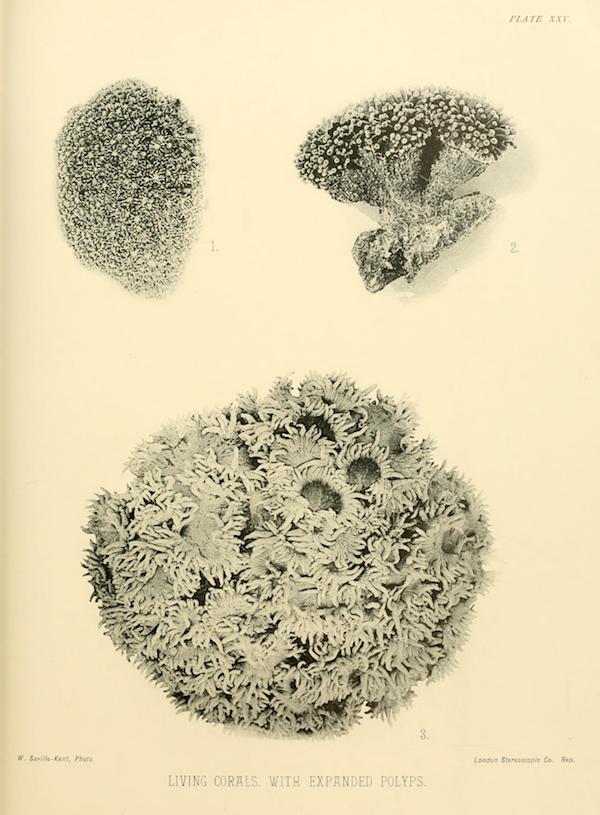
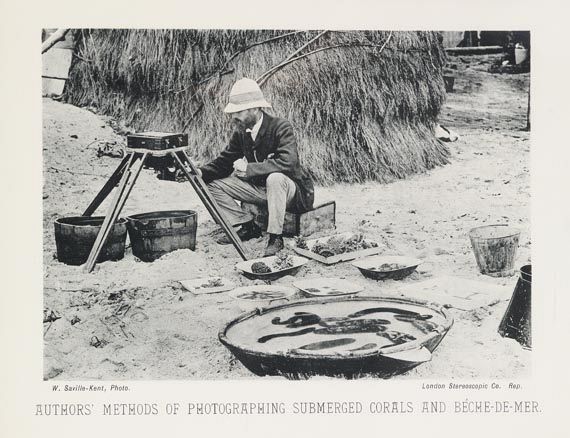
He pho­tographed the Great Bar­ri­er Reef while serv­ing in Queens­land as Com­mis­sion­er of Fish­eries. 48 of his images were pub­lished in the afore­men­tioned book, offer­ing read­ers an unprece­dent­ed arm­chair tour of a coral reef, albeit in black and white.


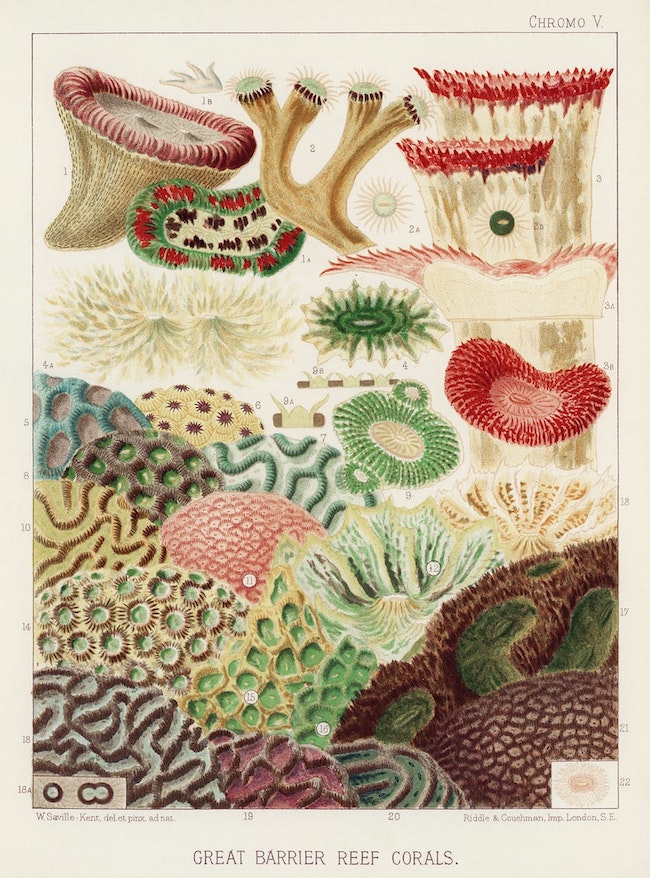
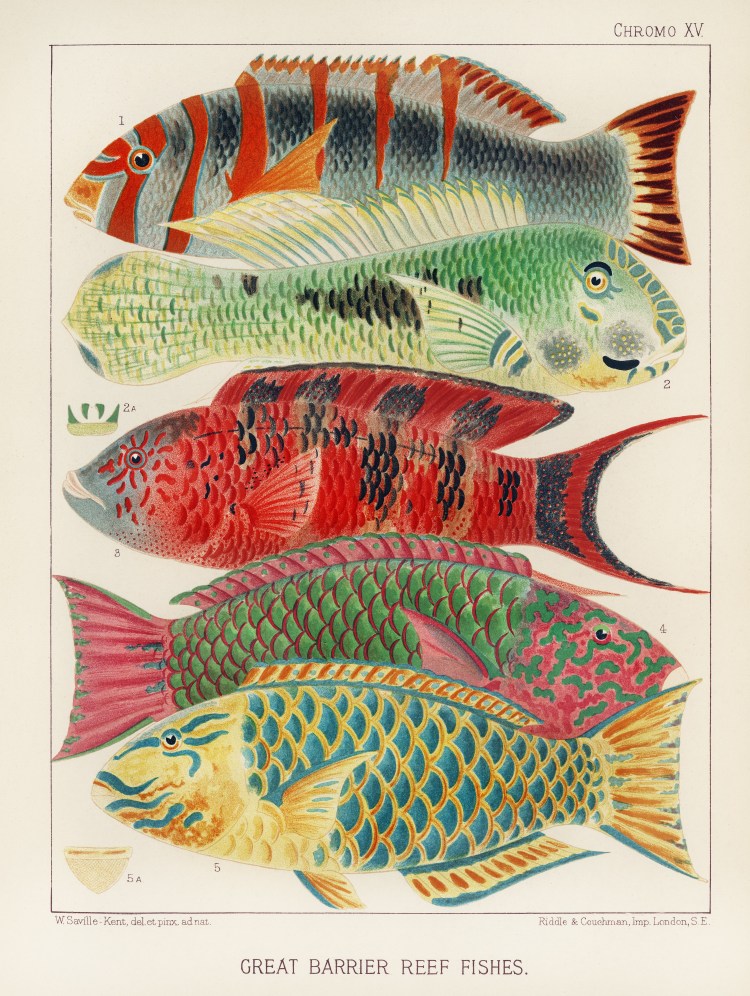
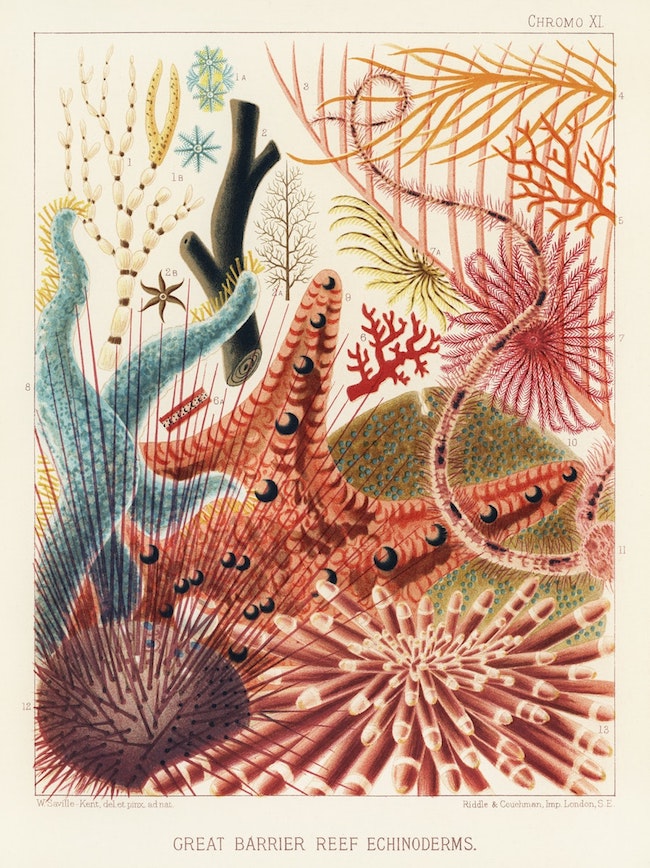
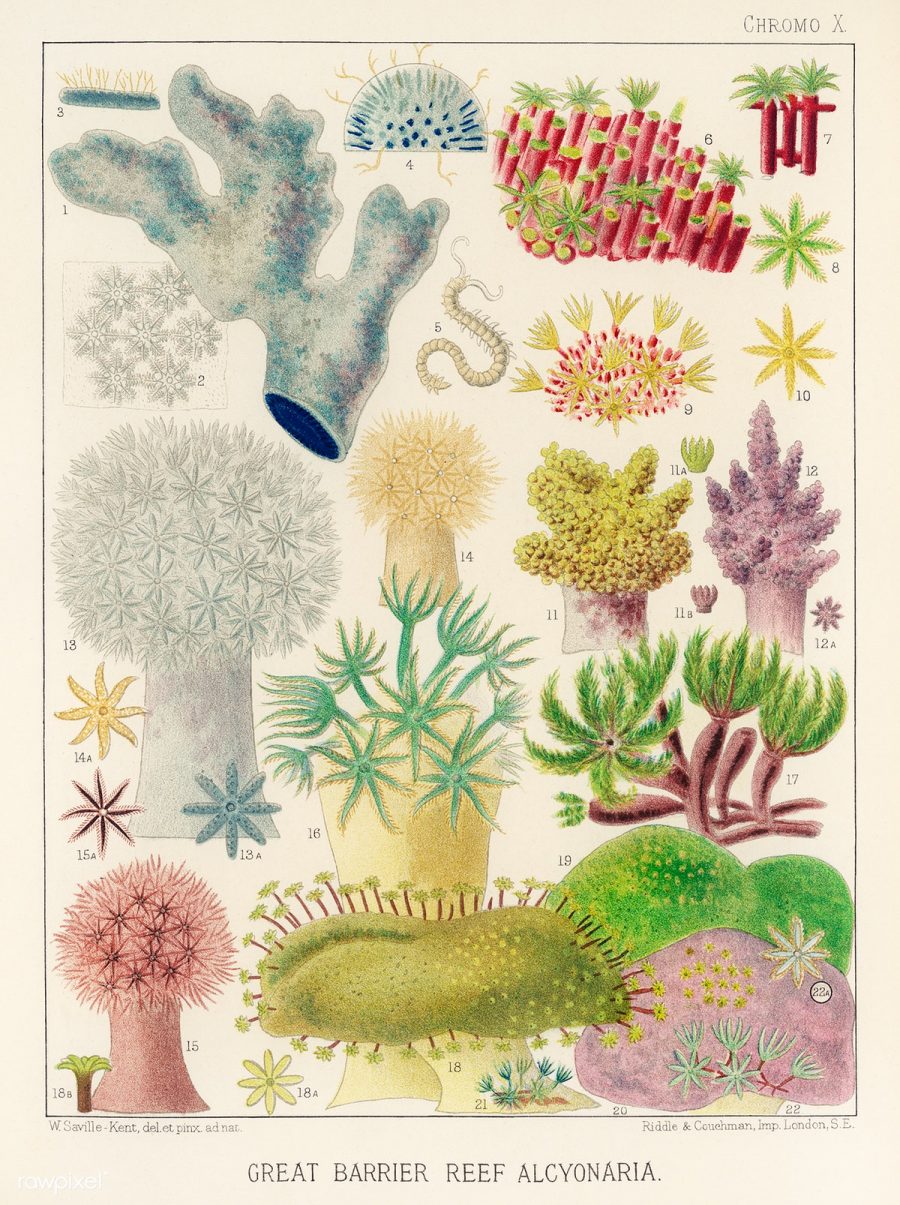
While Sav­ille-Kent def­i­nite­ly achieved his goal of fur­ther­ing the public’s aware­ness of the reef, he also upstaged him­self by includ­ing 16 col­or lith­o­graphs inspired by his orig­i­nal water­col­ors.

These plates, by Lon­don-based lith­o­g­ra­phers Rid­dle and Couchman—whose work usu­al­ly ran toward por­traits of well-born gen­tle­men—exude a live­ly Seuss­ian appeal.

Saville-Kent’s care­ful­ly cap­tured fish, echin­o­derms, and anemones lit­er­al­ly pale in com­par­i­son to the bright spec­i­mens the lith­o­g­ra­phers, who pre­sum­ably lacked his first­hand expe­ri­ence of the forms they were depict­ing, brought to such vibrant life in the back of the book.

These days, alas, the Great Bar­ri­er Reef resem­bles Sav­ille-Ken­t’s pho­tos more close­ly than those gor­geous lith­o­graphs, the vic­tim of back-to-back bleach­ing events brought on by pol­lu­tion-relat­ed cli­mate change.

Sav­ille-Kent is buried at All Saints Churchin Mil­ford-on-Sea, Hamp­shire, Eng­land. His grave is dec­o­rat­ed with coral.

Browse a dig­i­tal copy of The Great Bar­ri­er Reef of Aus­tralia: its prod­ucts and poten­tial­i­ties here.

via The Pub­lic Domain Review

Relat­ed Con­tent:

Ernst Haeckel’s Sub­lime Draw­ings of Flo­ra and Fau­na: The Beau­ti­ful Sci­en­tif­ic Draw­ings That Influ­enced Europe’s Art Nou­veau Move­ment (1889)

Two Mil­lion Won­drous Nature Illus­tra­tions Put Online by The Bio­di­ver­si­ty Her­itage Library

New Archive Dig­i­tizes 80,000 His­toric Water­col­or Paint­ings, the Medi­um Through Which We Doc­u­ment­ed the World Before Pho­tog­ra­phy

Ayun Hal­l­i­day is an author, illus­tra­tor, the­ater mak­er and Chief Pri­ma­tol­o­gist of the East Vil­lage Inkyzine.  Join her in NYC on Mon­day, June 17 for anoth­er month­ly install­ment of her pub­lic domain-based vari­ety show, Necro­mancers of the Pub­lic Domain. Fol­low her @AyunHalliday.

A Subway Map of Human Anatomy: All the Systems of Our Body Visualized in the Style of the London Underground

We all have bod­ies, but how many of us tru­ly know our way around them? Plen­ty of books explain in detail the func­tions of and rela­tion­ships between each and every part of our anato­my, but few of them do it in a way the lay­man — and espe­cial­ly the lay­man not yet accus­tomed to the sight of human vis­cera laid bare — can read­i­ly grasp. We need a visu­al­iza­tion of the human body, but what kind of visu­al­iza­tion can best rep­re­sent it with a max­i­mum of clar­i­ty and a min­i­mum of mis­lead­ing dis­tor­tion?

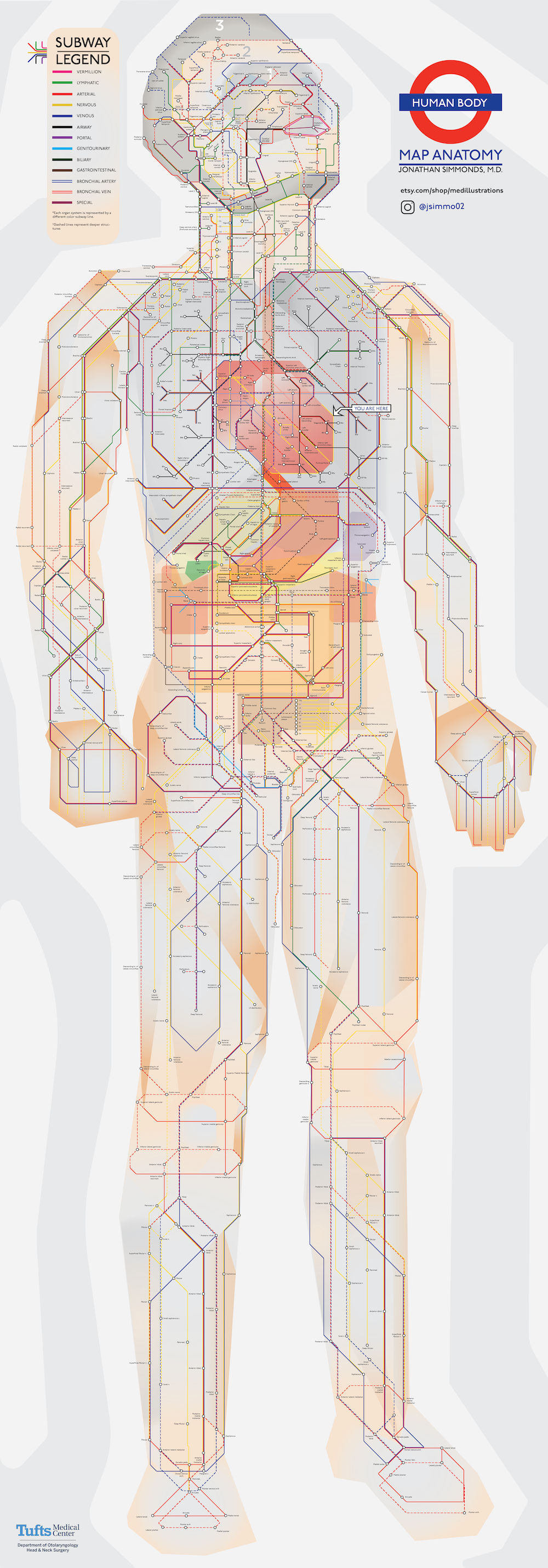
“Most peo­ple might imag­ine an intri­cate net­work of blood ves­sels or the com­plex neur­al cir­cuits of the brain,” writes Visu­al Cap­i­tal­ist’s Iman Ghosh. “Or we might pic­ture dia­grams from the icon­ic med­ical text­book, Gray’s Anato­my.” But how about a visu­al­iza­tion of the body in the style of a clas­sic piece of infor­ma­tion design we’ve all seen at least once, the Lon­don Under­ground map? “Cre­at­ed by Jonathan Sim­monds M.D., a res­i­dent physi­cian at Tufts Med­ical Cen­ter,” Ghosh writes, “it’s a sim­ple yet beau­ti­ful­ly intu­itive demon­stra­tion of how effi­cient­ly our bod­ies work.”

Just as Har­ry Beck­’s orig­i­nal 1933 Lon­don Under­ground map straight­ened out and col­or-cod­ed each of the lines then in oper­a­tion, Sim­monds’ anatom­i­cal map traces thir­teen dif­fer­ent “lines” through the body, each of which rep­re­sents a dif­fer­ent sys­tem of the body: the ner­vous sys­tem in yel­low, for exam­ple, the air­way sys­tem in black, and the lym­phat­ic sys­tem in green. “While dashed lines rep­re­sent deep­er struc­tures, sec­tions with ‘trans­fers’ show where dif­fer­ent organ sys­tems inter­sect,” Ghosh writes. If you’re won­der­ing where to start, she adds, “there’s a help­ful ‘You Are Here’ at the heart.”

You can take a close look at Sim­monds’ work in a large, high-res­o­lu­tion ver­sion here. Not only does fol­low­ing the mod­el of the Lon­don Under­ground map intro­duce a degree of imme­di­ate leg­i­bil­i­ty sel­dom seen (at least by non-med­ical stu­dents) in anatom­i­cal dia­grams, it also under­scores an aspect of the very nature of our human bod­ies that we don’t often con­sid­er. We might instinc­tive­ly think of them as sets of dis­crete organs all encased togeth­er and func­tion­ing inde­pen­dent­ly, but in fact they’re more like cities: just as busy, just as inter­con­nect­ed, just as depen­dent on con­nec­tions and rou­tines, and just as improb­a­bly func­tion­al.

via Visu­al Cap­i­tal­ist

Relat­ed Con­tent:

Down­load the Sub­lime Anato­my Draw­ings of Leonar­do da Vin­ci: Avail­able Online, or in a Great iPad App

Map­ping Emo­tions in the Body: A Finnish Neu­ro­science Study Reveals Where We Feel Emo­tions in Our Bod­ies

The Roman Roads of Britain Visu­al­ized as a Sub­way Map

The Genius of Har­ry Beck’s 1933 Lon­don Tube Map–and How It Rev­o­lu­tion­ized Sub­way Map Design Every­where

A Won­der­ful Archive of His­toric Tran­sit Maps: Expres­sive Art Meets Pre­cise Graph­ic Design

Based in Seoul, Col­in Mar­shall writes and broad­casts on cities, lan­guage, and cul­ture. His projects include the book The State­less City: a Walk through 21st-Cen­tu­ry Los Ange­les and the video series The City in Cin­e­ma. Fol­low him on Twit­ter at @colinmarshall, on Face­book, or on Insta­gram.

Mapping Emotions in the Body: A Finnish Neuroscience Study Reveals Where We Feel Emotions in Our Bodies

“East­ern med­i­cine” and “West­ern medicine”—the dis­tinc­tion is a crude one, often used to mis­in­form, mis­lead, or grind cul­tur­al axes rather than make sub­stan­tive claims about dif­fer­ent the­o­ries of the human organ­ism. Thank­ful­ly, the med­ical estab­lish­ment has large­ly giv­en up demo­niz­ing or ignor­ing yog­ic and med­i­ta­tive mind-body prac­tices, incor­po­rat­ing many of them into con­tem­po­rary pain relief, men­tal health care, and pre­ven­ta­tive and reha­bil­i­ta­tive treat­ments.

Hin­du and Bud­dhist crit­ics may find much not to like in the sec­u­lar appro­pri­a­tion of prac­tices like mind­ful­ness and yoga, and they may find it odd that such a fun­da­men­tal insight as the rela­tion­ship between mind and body should ever have been in doubt. But we know from even a slight famil­iar­i­ty with Euro­pean phi­los­o­phy (“I think, there­fore I am”) that it was from the Enlight­en­ment into the 20th cen­tu­ry.

Now, says Riit­ta Hari, co-author of a 2014 Fin­ish study on the bod­i­ly loca­tions of emo­tion, “We have obtained sol­id evi­dence that shows the body is involved in all types of cog­ni­tive and emo­tion­al func­tions. In oth­er words, the human mind is strong­ly embod­ied.” We are not brains in vats. All those col­or­ful old expressions—“cold feet,” “but­ter­flies in the stom­ach,” “chill up my spine”—named qual­i­ta­tive data, just a hand­ful of the embod­ied emo­tions mapped by neu­ro­sci­en­tist Lau­ri Num­men­maa and co-authors Riit­ta Hari, Enri­co Glere­an, and Jari K. Hieta­nen.

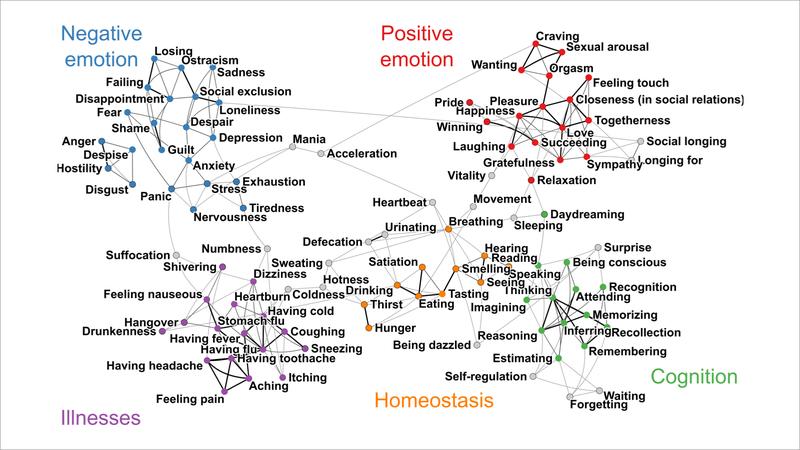
In their study, the researchers “recruit­ed more than 1,000 par­tic­i­pants” for three exper­i­ments, reports Ash­ley Hamer at Curios­i­ty. These includ­ed hav­ing peo­ple “rate how much they expe­ri­ence each feel­ing in their body vs. in their mind, how good each one feels, and how much they can con­trol it.” Par­tic­i­pants were also asked to sort their feel­ings, pro­duc­ing “five clus­ters: pos­i­tive feel­ings, neg­a­tive feel­ings, cog­ni­tive process­es, somat­ic (or bod­i­ly) states and ill­ness­es, and home­o­sta­t­ic states (bod­i­ly func­tions).”

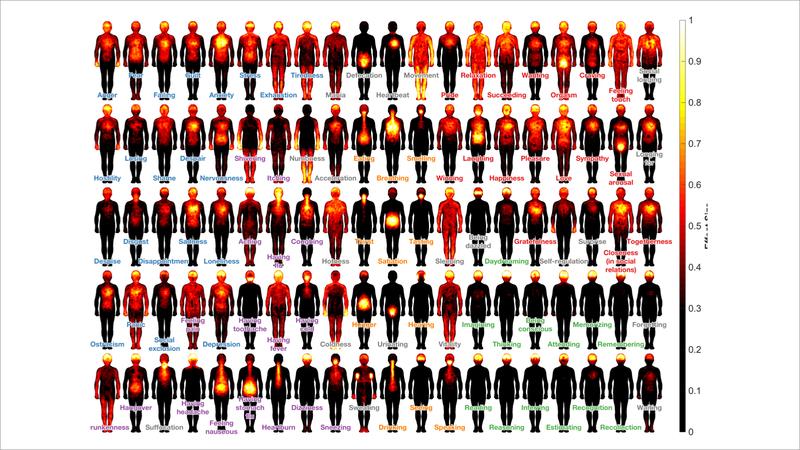
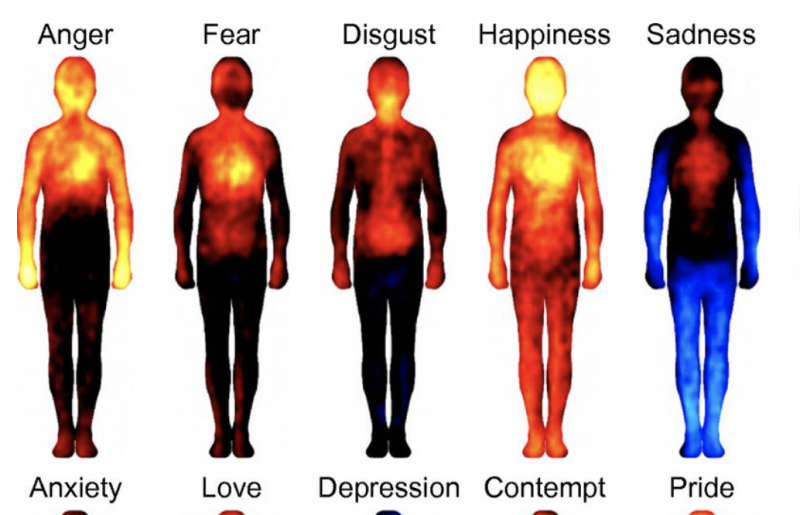
After mak­ing care­ful dis­tinc­tions between not only emo­tion­al states, but also between think­ing and sen­sa­tion, the study par­tic­i­pants col­ored blank out­lines of the human body on a com­put­er when asked where they felt spe­cif­ic feel­ings. As the video above from the Amer­i­can Muse­um of Nat­ur­al His­to­ry explains, the researchers “used sto­ries, video, and pic­tures to pro­voke emo­tion­al respons­es,” which reg­is­tered onscreen as warmer or cool­er col­ors.

Sim­i­lar kinds of emo­tions clus­tered in sim­i­lar places, with anger, fear, and dis­gust con­cen­trat­ing in the upper body, around the organs and mus­cles that most react to such feel­ings. But “oth­ers were far more sur­pris­ing, even if they made sense intu­itive­ly,” writes Hamer “The pos­i­tive emo­tions of grate­ful­ness and togeth­er­ness and the neg­a­tive emo­tions of guilt and despair all looked remark­ably sim­i­lar, with feel­ings mapped pri­mar­i­ly in the heart, fol­lowed by the head and stom­ach. Mania and exhaus­tion, anoth­er two oppos­ing emo­tions, were both felt all over the body.”

The researchers con­trolled for dif­fer­ences in fig­u­ra­tive expres­sions (i.e. “heartache”) across two lan­guages, Swedish and Finnish. They also make ref­er­ence to oth­er mind-body the­o­ries, such as using “somatosen­so­ry feed­back… to trig­ger con­scious emo­tion­al expe­ri­ences” and the idea that “we under­stand oth­ers’ emo­tions by sim­u­lat­ing them in our own bod­ies.” Read the full, and ful­ly illus­trat­ed, study results in “Bod­i­ly Maps of Emo­tions,” pub­lished by the Nation­al Acad­e­my of Sci­ences.

Relat­ed Con­tent:

An Inter­ac­tive Map of the 2,000+ Sounds Humans Use to Com­mu­ni­cate With­out Words: Grunts, Sobs, Sighs, Laughs & More

How Med­i­ta­tion Can Change Your Brain: The Neu­ro­science of Bud­dhist Prac­tice

A Dic­tio­nary of Words Invent­ed to Name Emo­tions We All Feel, But Don’t Yet Have a Name For: Vemö­dalen, Son­der, Chrysal­ism & Much More

Josh Jones is a writer and musi­cian based in Durham, NC. Fol­low him at @jdmagness

An Animated History of Dogs, Inspired by Keith Haring

That quiv­er­ing teacup Chi­huahua…

The long-suf­fer­ing Labrador whose child-friend­ly rep­u­ta­tion has led to a life­time of ear tug­ging and tail pulling…

The wheez­ing French bull­dog, whose own­er has out­fit­ted with a full wardrobe of hood­ies, tutus, rain slick­ers, and paja­mas

All descend­ed from wolves.

As anthro­pol­o­gist and sci­ence edu­ca­tor David Ian Howe explains in the ani­mat­ed TED-Ed les­son, A Brief His­to­ry of Dogs, above, at first glance, can­is lupus seemed an unlike­ly choice for man’s best friend.

For one thing, the two were in direct com­pe­ti­tion for elk, rein­deer, bison, and oth­er tasty prey wan­der­ing Eura­sia dur­ing the Pleis­tocene Epoch.

Though both hunt­ed in groups, run­ning their prey to the point of exhaus­tion, only one roast­ed their kills, cre­at­ing tan­ta­liz­ing aro­mas that drew bold­er wolves ever-clos­er to the human camps.

The ones who will­ing­ly dialed down their wolfish­ness, mak­ing them­selves use­ful as com­pan­ions, secu­ri­ty guards and hunt­ing bud­dies, were reward­ed come sup­per­time. Even­tu­al­ly, this mutu­al­ly ben­e­fi­cial tail wag­ging became full on domes­ti­ca­tion, the first such ani­mal to come under the human yoke.

The intense focus on pure­breds did­n’t real­ly become a thing until the Vic­to­ri­ans began host­ing dog shows. The push to iden­ti­fy and pro­mote breed-spe­cif­ic char­ac­ter­is­tics often came at a cost to the ani­mals’ well­be­ing, as Neil Pem­ber­ton and Michael Wor­boys point out in BBC His­to­ry Mag­a­zine:

…the improve­ment of breeds towards ‘per­fec­tion’ was con­tro­ver­sial. While there was approval for the greater reg­u­lar­i­ty of type, many fanciers com­plained that stan­dards were being set on arbi­trary, large­ly aes­thet­ic grounds by enthu­si­asts in spe­cial­ist clubs, with­out con­cern for util­i­ty or the health of the ani­mal. This meant that breeds were chang­ing, and not always for the bet­ter. For exam­ple, the mod­ern St Bernard was said to be a beau­ti­ful ani­mal, but would be use­less in Alpine res­cue work.

Cat-fanciers, rest assured that the oppo­si­tion received fair and equal cov­er­age in a feline-cen­tric TED-Ed les­son, pub­lished ear­li­er this year.

And while we applaud TED-Ed for spark­ing our curios­i­ty with its “Brief His­to­ry of” series, cov­er­ing top­ics as far rang­ing as cheese, numer­i­cal sys­tems, goths, video games, and tea, sure­ly we are not the only ones won­der­ing why the late artist Kei­th Har­ing isn’t thanked or name checked in the cred­its?

Every canine-shaped image in this ani­ma­tion is clear­ly descend­ed from his icon­ic bark­ing dog.

While we can’t explain the omis­sion, we can direct read­ers toward Jon Nelson’s great analy­sis of Haring’s rela­tion­ship with dogs in Get Leashed:

They’re sym­bol­ic of unan­swered ques­tions, preva­lent in the 80s: “Can I do this?” “Is this right?” “What are you doing?” “What is hap­pen­ing?” Dogs stand by peo­ple, bark­ing or danc­ing along, some­times in pre­car­i­ous sce­nar­ios, even involved in some of Haring’s explic­it­ly sex­u­al work. Dogs are nei­ther approv­ing nor dis­ap­prov­ing of what peo­ple do in the images; their mouth angle is neu­tral or even hap­py. In some cas­es, human bod­ies wear a dog’s head, pos­si­bly stat­ing that we know only our own enjoy­ment, unaware, like a dog, of life’s next stage or the con­se­quences of our actions.

Vis­it Eth­no­cynol­o­gy, David Ian Howe’s Insta­gram page about the ancient rela­tion­ship between humans and dogs.

Relat­ed Con­tent:

An Ani­mat­ed His­to­ry of Cats: How Over 10,000 Years the Cat Went from Wild Preda­tor to Sofa Side­kick

Dis­cov­er David Lynch’s Bizarre & Min­i­mal­ist Com­ic Strip, The Angri­est Dog in the World (1983–1992)

Pho­tos of Famous Writ­ers (and Rock­ers) with their Dogs

Ayun Hal­l­i­day is an author, illus­tra­tor, the­ater mak­er and Chief Pri­ma­tol­o­gist of the East Vil­lage Inky zine.  Join her in New York City April 15 for the next install­ment of her book-based vari­ety show, Necro­mancers of the Pub­lic Domain. Fol­low her @AyunHalliday.

A Brief Animated Introduction to Noam Chomsky’s Linguistic Theory, Narrated by The X‑Files’ Gillian Anderson

How is it that chil­dren just enter­ing tod­dler­hood pick up the struc­ture of their respec­tive lan­guages with ease? They are not for­mal­ly taught to use speech; they have lim­it­ed cog­ni­tive abil­i­ties and a “pover­ty of stim­u­lus,” giv­en their high­ly cir­cum­scribed envi­ron­ments. And yet, they learn the func­tion and order of sub­jects, verbs, and objects, and learn to rec­og­nize improp­er usage. Chil­dren might make rou­tine mis­takes, but they under­stand and can be under­stood from a very ear­ly age, and for the most part with­out very much dif­fi­cul­ty. How?

These are the ques­tions that con­front­ed Noam Chom­sky in the ear­ly years of his career in lin­guis­tics. His answers pro­duced a the­o­ry of Uni­ver­sal Gram­mar in the 1960s, and for decades, it has been the reign­ing the­o­ry in the field to beat, ini­ti­at­ing what is often referred to as the “Chom­skyan Era,” a phrase the man him­self dis­likes but which nonethe­less sums up the kinds of issues that have been at stake in lin­guis­tics for over fifty years.

Ques­tions about lan­guage acqui­si­tion have always been the sub­ject of intense philo­soph­i­cal spec­u­la­tion. They were fold­ed into gen­er­al the­o­ries of epis­te­mol­o­gy, like Plato’s the­o­ry of forms or John Locke’s so-called “blank slate” hypoth­e­sis. Vari­a­tions on these posi­tions sur­face in dif­fer­ent forms through­out West­ern intel­lec­tu­al his­to­ry. Descartes picks up Plato’s dual­ism, argu­ing that humans speak and ani­mals don’t because of the exis­tence of an immor­tal “ratio­nal soul.” Behav­ior­ist B.F. Skin­ner sug­gests that oper­ant con­di­tion­ing writes lan­guage onto a total­ly impres­sion­able mind. (“Give me a child,” said Skin­ner, “and I will shape him into any­thing.”)

Chom­sky “gave a twist” to this age-old debate over the exis­tence of innate ideas, as Gillian Ander­son tells us in the ani­mat­ed video above from BBC 4’s His­to­ry of Ideas series. Chomsky’s the­o­ry is biolin­guis­tic: it sit­u­ates lan­guage acqui­si­tion in the struc­tures of the brain. Not being him­self a neu­ro­bi­ol­o­gist, he talks of those the­o­ret­i­cal struc­tures, respon­si­ble for repro­duc­ing accu­rate syn­tax, as a metaphor­i­cal “lan­guage acqui­si­tion device” (LAD), a hard­wired fac­ul­ty that sep­a­rates the human brain from that of a dog or cat.

Chomsky’s the­o­ry has lit­tle to do with the con­tent of lan­guage, but rather with its struc­ture, which he says is uni­ver­sal­ly encod­ed in our neur­al archi­tec­ture. Chil­dren, he writes, “devel­op lan­guage because they’re pre-pro­grammed to do this.” Syn­tax is pri­or to and inde­pen­dent of spe­cif­ic mean­ing, a point he demon­strat­ed with the poet­ic sen­tence “Col­or­less green ideas sleep furi­ous­ly.” Every Eng­lish speak­er can rec­og­nize the sen­tence as gram­mat­i­cal, even very small chil­dren, though it refers to no real objects and would nev­er occur in con­ver­sa­tion.

Con­verse­ly, we rec­og­nize “Furi­ous­ly sleep ideas green col­or­less” as ungram­mat­i­cal, though it means no more nor less than the first sen­tence. The region­al vari­a­tions on word order only under­line his point since, in every case, chil­dren quick­ly under­stand how to use the ver­sion they’re pre­sent­ed with at rough­ly the same devel­op­men­tal age and in the same way. The exis­tence of a the­o­ret­i­cal Lan­guage Acqui­si­tion Device solves the chick­en-egg prob­lem of how chil­dren with no under­stand­ing of and only a very lim­it­ed expo­sure to lan­guage, can learn to speak just by lis­ten­ing to lan­guage.

Chomsky’s the­o­ry was rev­o­lu­tion­ary in large part because it was testable, and researchers at the professor’s long­time employ­er, MIT, recent­ly pub­lished evi­dence of a “lan­guage uni­ver­sal” they dis­cov­ered in a com­par­a­tive study of 37 lan­guages. It’s com­pelling research that just might antic­i­pate the dis­cov­ery of a phys­i­cal Lan­guage Acqui­si­tion Device, or its neu­ro­bi­o­log­i­cal equiv­a­lent, in every human brain.

Relat­ed Con­tent:

Watch Michel Gondry Ani­mate Philoso­pher, Lin­guist & Activist Noam Chom­sky

The Ideas of Noam Chom­sky: An Intro­duc­tion to His The­o­ries on Lan­guage & Knowl­edge (1977)

Noam Chom­sky Defines What It Means to Be a Tru­ly Edu­cat­ed Per­son

5 Ani­ma­tions Intro­duce the Media The­o­ry of Noam Chom­sky, Roland Barthes, Mar­shall McLuhan, Edward Said & Stu­art Hall

Josh Jones is a writer and musi­cian based in Durham, NC. Fol­low him at @jdmagness

« Go BackMore in this category... »
Quantcast