From Jan van IJken comes “Becoming,” a short timelapse film that documents “the miraculous genesis of animal life.” He writes:
In great microscopic detail, we see the ‘making of’ an Alpine Newt in its transparant egg from the first cell division to hatching. A single cell is transformed into a complete, complex living organism with a beating heart and running bloodstream.
The first stages of embryonic development are roughly the same for all animals, including humans. In the film, we can observe a universal process which normally is invisible: the very beginning of an animal’s life.
“Becoming” has been “selected at more than 20 international film festivals and won the award for Best short documentary at Innsbruck Nature Film Festival 2018, Austria.” Enjoy.
If you would like to sign up for Open Culture’s free email newsletter, please find it here. It’s a great way to see our new posts, all bundled in one email, each day.
If you would like to support the mission of Open Culture, consider making a donation to our site. It’s hard to rely 100% on ads, and your contributions will help us continue providing the best free cultural and educational materials to learners everywhere. You can contribute through PayPal, Patreon, and Venmo (@openculture). Thanks!
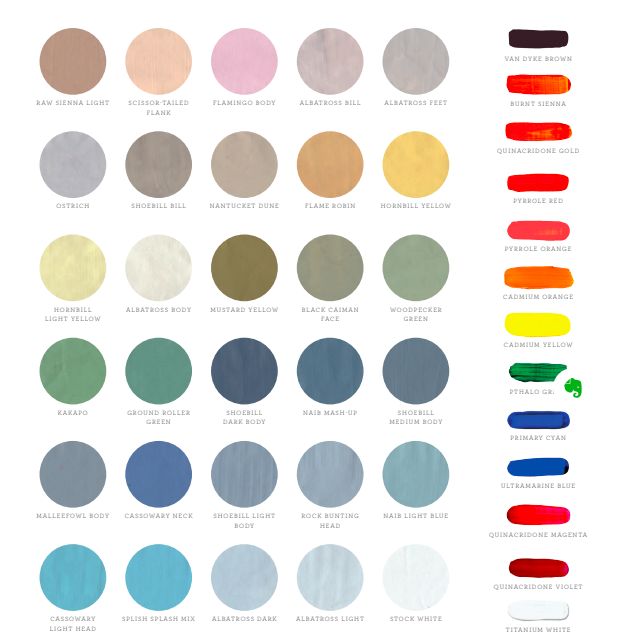
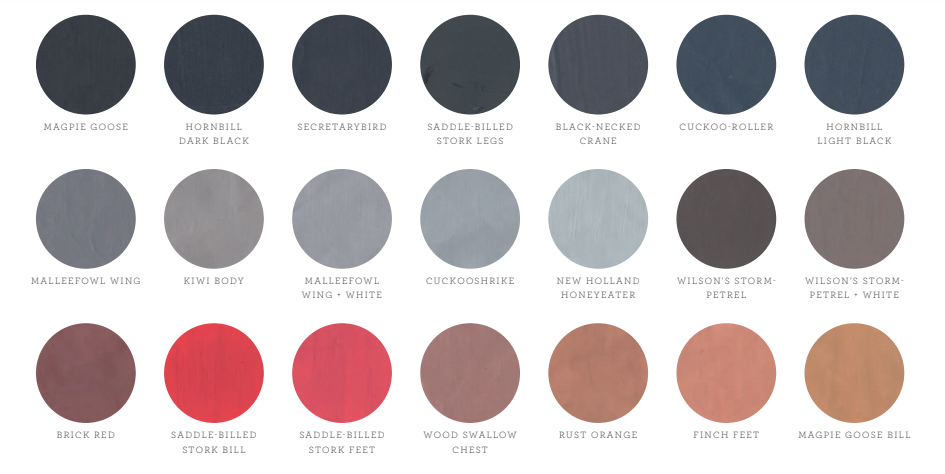
The custom chart’s fifty-one colors comprise about 90 percent of the finished work. A palette of thirteen Golden Fluid Acrylics supplied the jewel-toned accents so thrilling to birdwatchers.
Along the way, Kim absorbed a tremendous amount of information about the how and why of bird feather coloration:
The iridescence on the neck and back of the Superb Starling comes not from pigment,
but from structural color. The starling’s outer feathers are constructed in a way
that refracts light like myriad prisms, making the bird appear to shimmer. The eponymous
coloring of the Lilac-breasted Roller results from a different kind of structural
color, created when woven microstructures in the feathers, called barbs and barbules,
reflect only the shorter wavelengths of light like blue and violet.
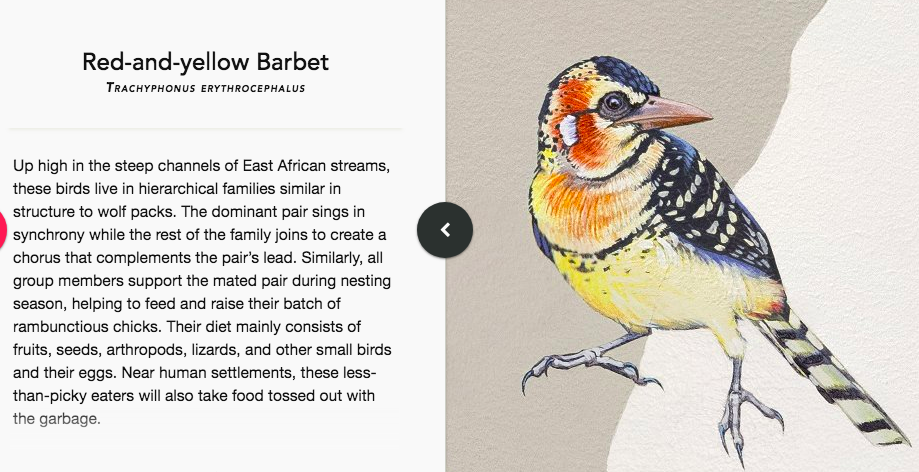
The primary colors that lend their name to the Red-and-yellow Barbet are
derived from a class of pigments called carotenoids that the bird absorbs in its diet.
These are the same compounds that turn flamingos’ feathers pink. As a member of
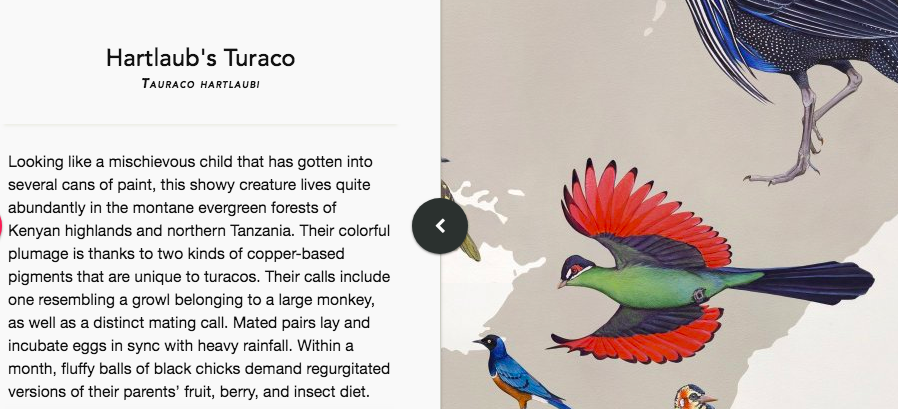
the family Musophagidae, the Hartlaub’s Turaco displays pigmentation unique in the
bird world. Birds have no green pigmentation; in most cases, verdant plumage is a
combination of yellow carotenoids and blue structural color. Turacos are an exception,
displaying a green, copper-based pigment called turacoverdin that they absorb
in their herbivorous diet. The flash of red on the Hartlaub’s underwings comes from
turacin, another copper-based pigment unique to the family.
She examined specimens from the center’s collection and reviewed centuries’ worth of field observations.
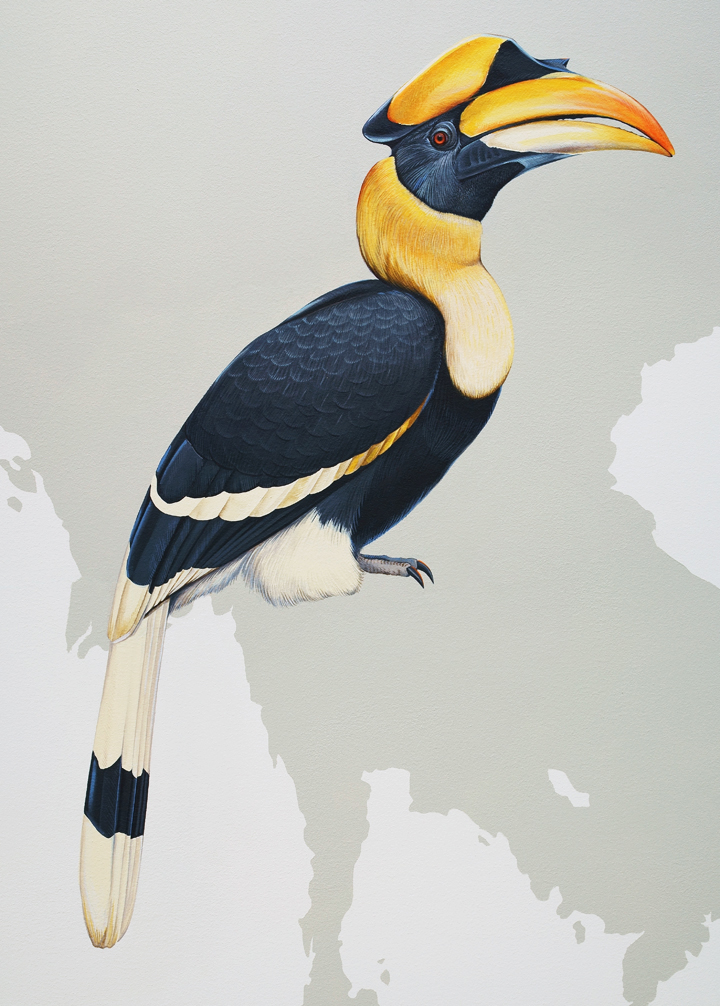
(The seventeenth-century English naturalist John Ray dismissed the hornbill family as having a “foul look,” a colonialism that ruffled Kim’s own feathers somewhat. In retaliation, she dubbed the Great Hornbill, “the Cyrano of the Jungle” owing to his “tequila-sunrise-hued facial phallus,” and selected him as the cover boy for her book about the mural.)
Research and preliminary sketching consumed an entire year, after which it took 17 months to inscribe 270 life-size creatures—some long extinct—onto the lab’s main wall. The birds are set against a greyscale map of the world, and while many are depicted in flight, every one save the Wandering Albatross has a foot touching its continent of origin.
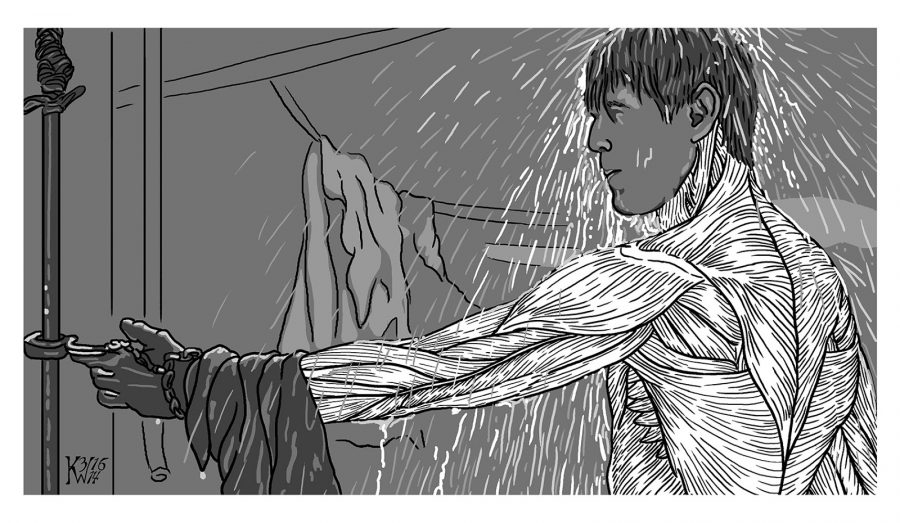
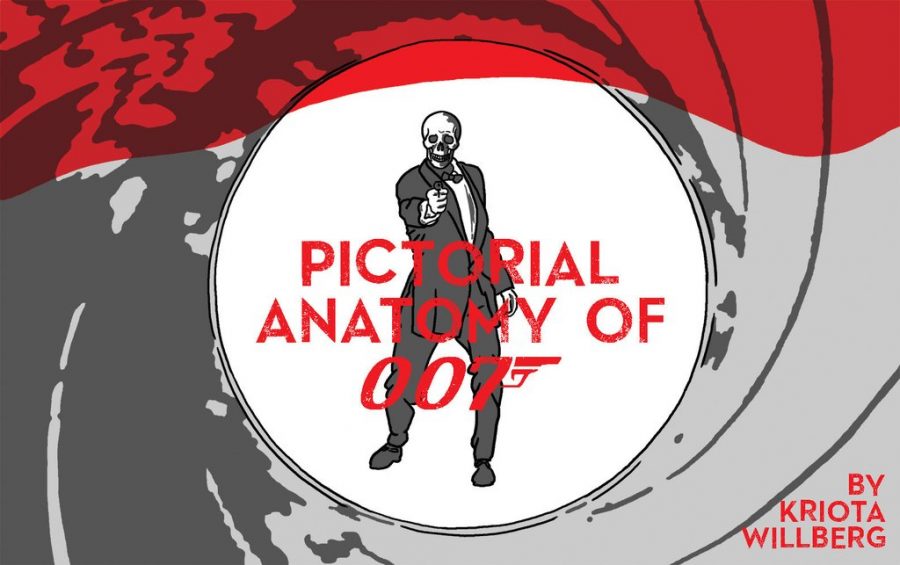
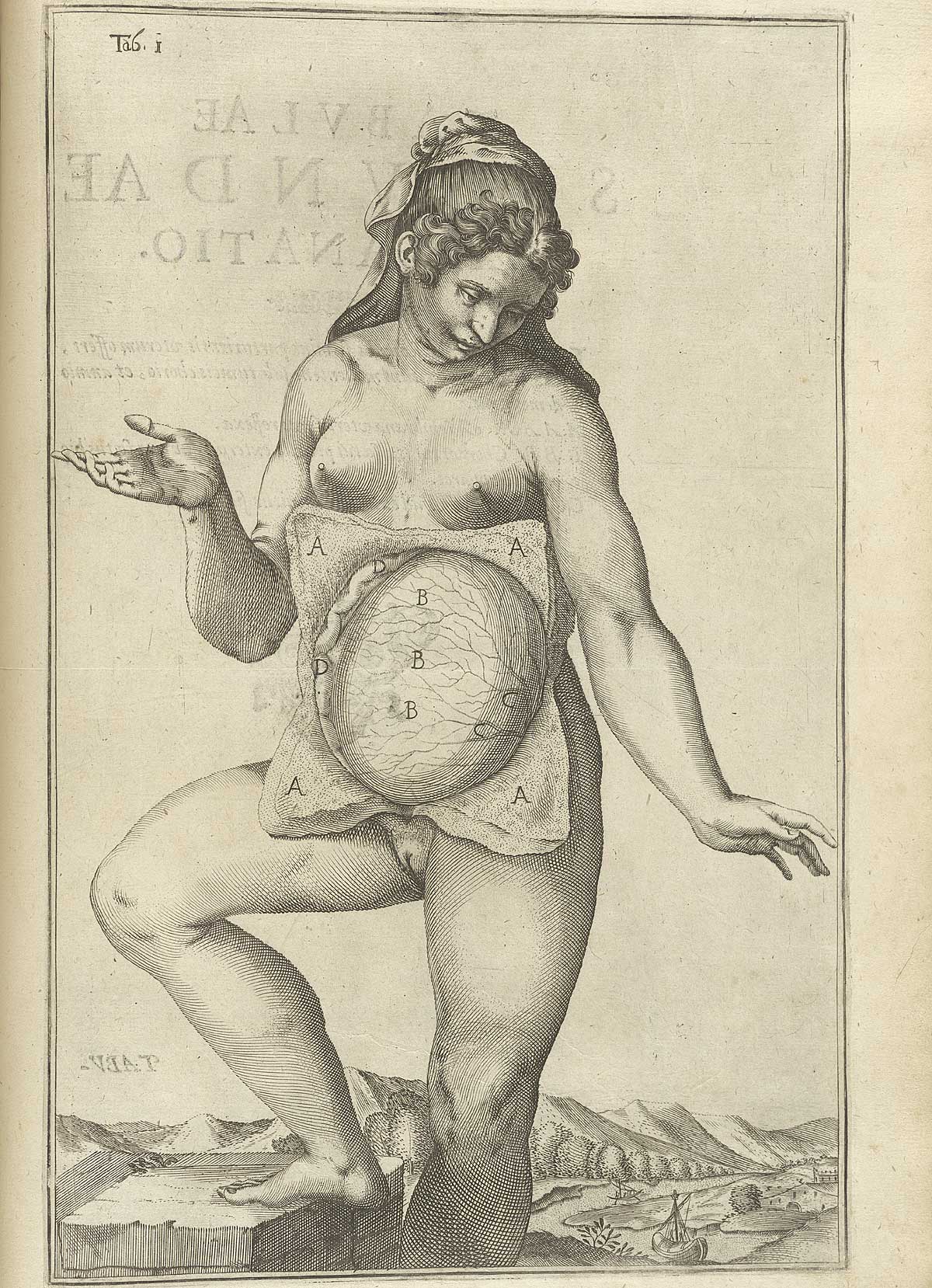
That shower scene is just one iconic moment that Willberg included in her mini-comic, Pictorial Anatomy of 007.
Agent Bond’s sartorial sense is a crucial aspect of his appeal, but Willberg, a Bond fan who’s seen every film in the canon at least five times, digs below that celebrated surface, peeling back skin to expose the structures that lie beneath.
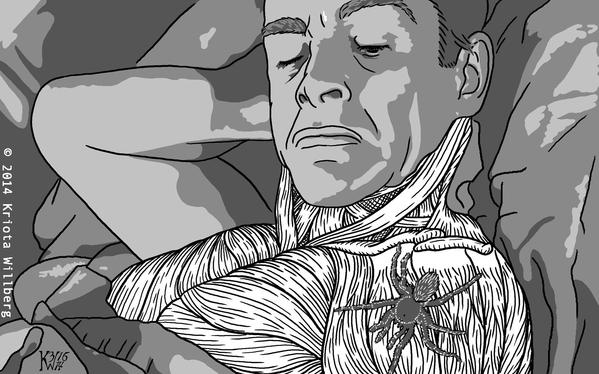
Sean Connery’s Bond exhibits a veteran artist’s model’s stillness waiting for the right time to make his move against Dr. No’s “eight-legged assassin.” Even before Willberg got involved, it was an excellent showcase for his pecs, delta, and sternocleitomastoid muscles.
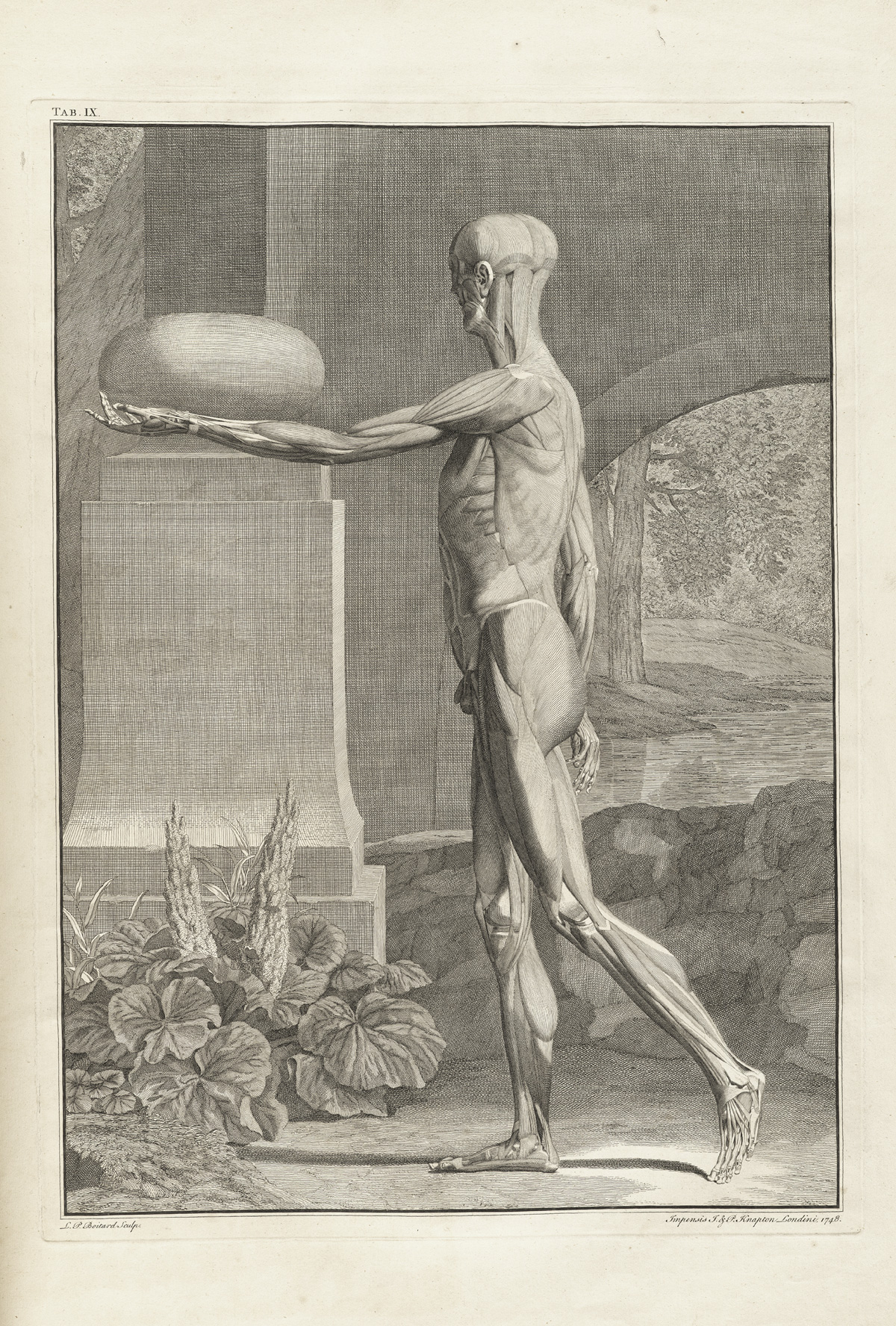
Leaving her flayed Bonds in their cinematic settings are a way of paying tribute to the antique anatomical illustrations Willberg admires for their dynamism:
…sitting in a chair, taking a stroll, holding its skin or organs out of the way so that the reader can get a better look at deeper structures. Some of the cadavers are very flirty. The pictures remind us that we are the organs we see on the page. They do stuff!
I didn’t think they’d have the balls! Sorry! Poor taste but I couldn’t resist. Although Timothy Dalton physically resembled Bond as described in the books, most of the movies make Bond out to be smarter than Fleming wrote him. I think Judy Dench called Daniel Craig, Casino Royale’s Bond, a “blunt instrument” which is pretty much how he’s written. He’s tough and lucky and that’s why he’s survived. Plus the machete fight is great.
Sometimes people get too prissy about the body. I am meat and liver and sausage and so are you. Your body is inescapable while you live. You should get to know it. Think about it in different contexts. It’s fun!
WhenFrom Russia With Love’s Rosa Klebb punches master assassin, Red Grant, in the stomach, she is squishing a living liver through living abdominal muscles.
Listen to an hour-long interview with Comics Alternative in which Willberg discusses her New York Academy of Medicine residency, anatomical research, and the ways in which humor informs her approach here.
Ayun Halliday is an author, illustrator, theater maker and Chief Primatologist of the East Village Inky zine. Her latest script, Fawnbook, is available in a digital edition from Indie Theater Now. Follow her @AyunHalliday.
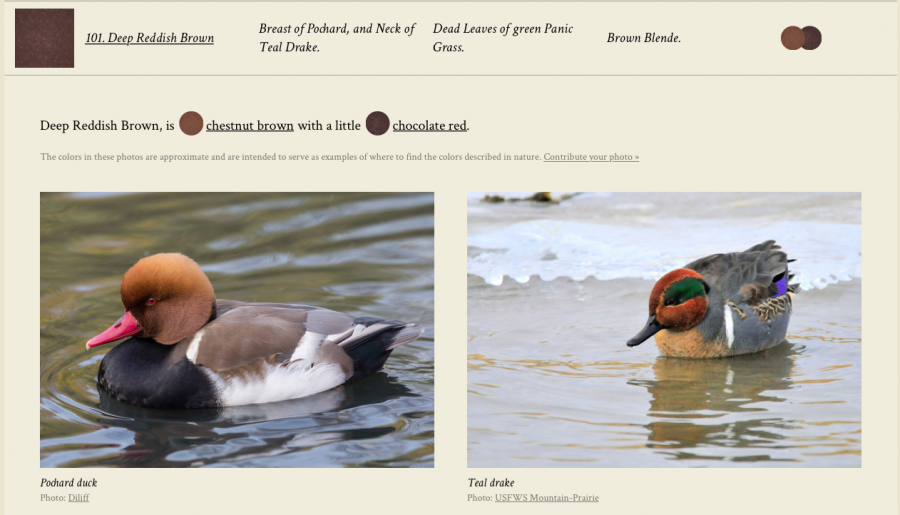
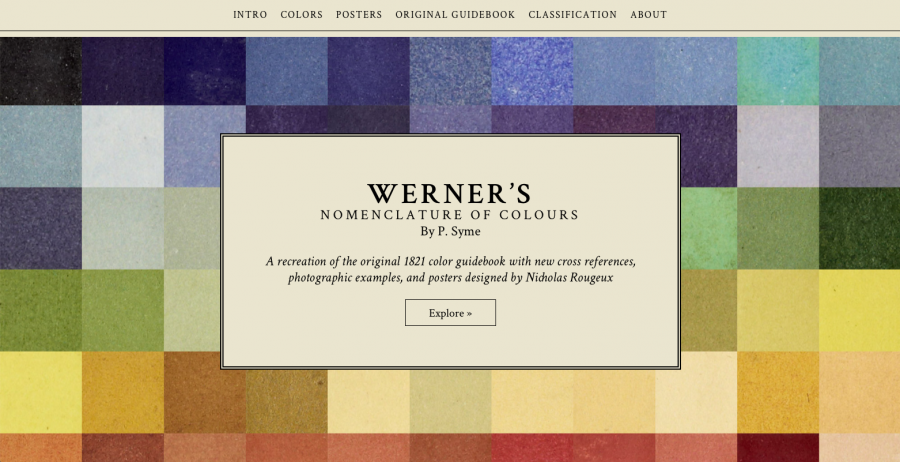
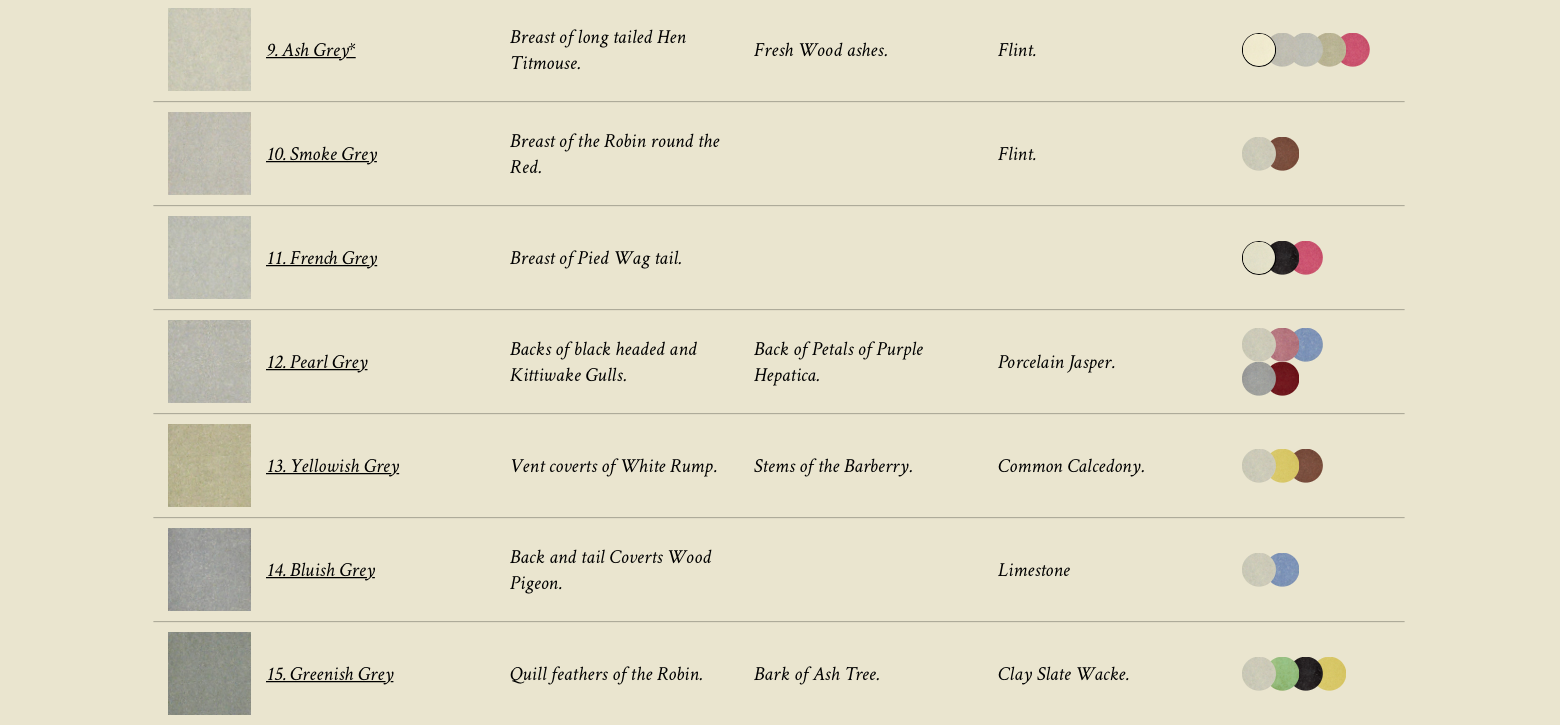
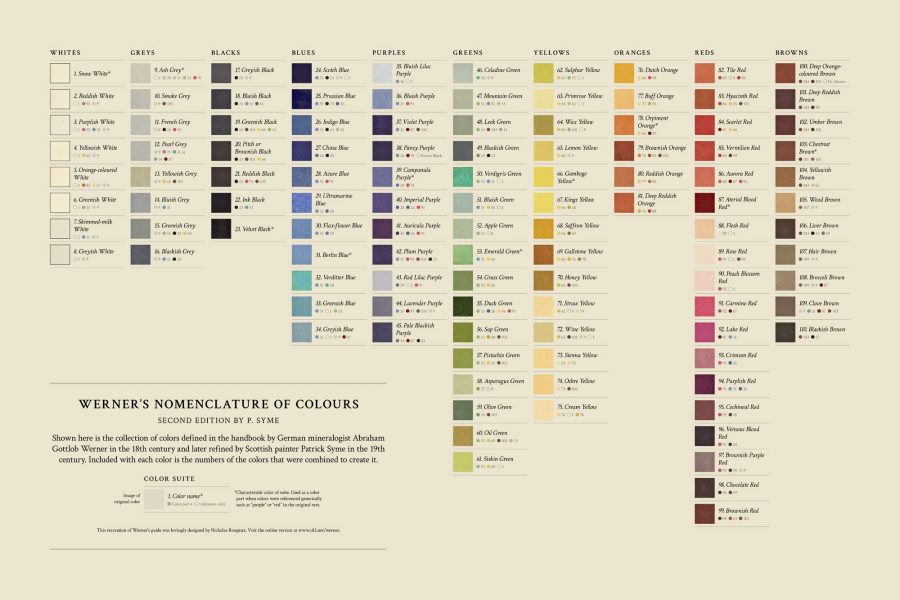
In a post earlier this year, we brought to your attention Werner’s Nomenclature of Colours. Used by artists and naturalists alike, the guide originally relied on written description alone, without any color to be found among its pages. Instead, in the late eighteenth century, German mineralogist Abraham Gottlob Werner painstakingly detailed the qualities of the 110 colors he surveyed, by reference to where they might be found on animals, vegetables, and minerals. The color “Pearl Gray,” for example, might be located on the “Backs of black headed and Kittwake Gulls,” the “Back of Petals of Purple Hetatica,” or on “Porcelain Jasper.”
The literary possibilities of this approach may seem vast. But its usefulness to those engaged in the visual arts—or in close observation of new species in, say, the Galapagos Islands—may have been somewhat lacking until Scottish painter Patrick Syme updated the guide in 1814 with color swatches, most of them using the very minerals Werner described.
It was the second edition of Syme’s guide that accompanied Charles Darwin on his 1831 voyage aboard the HMS Beagle, where he “used it to catalogue the flora and fauna that later inspired his theory of natural selection,” as historian Daniel Lewis writes at Smithsonian.
While we might think of taxonomies of color as principally guiding artists, web designers, and house painters, they have been indispensable for scientists. “They can indicate when a plant or animal is a different species or a subspecies,” Lewis notes; “in the 19th century, the use of color to differentiate species was important for what it said about evolution and how species changed over time and from region to region.” For historians of science, therefore, Werner’s Nomenclature of Colours represents an essential tool in the early development of evolutionary biology.
Other color dictionaries followed, “designed to give people around the world a common vocabulary to describe the colors of everything from rocks and flowers to stars, birds, and postage stamps.” Some of these were highly specialized, such as the two-volume set created by the French Society of Chrysanthemists in 1905. All of them, however, strove to meet the high bar set by Werner when it came to level of detailed description. These are guides that speak in human terms, in contrast to the nomenclature most often used today, which “is really a machine language,” Kelsey Cambell-Dollaghan writes at Fast Company, “numerical hex codes crafted to communicate with software on computers and printers.”
It’s true, viewing the book online has its drawbacks, related to how Syme’s paint swatches are translated into hex codes, then displayed differently depending on various screen settings. But Rougeux has tried to compensate for this difference between print and screen. On a publicly accessible Google Doc, he has provided the hex codes “for each of the 18th-century hues, from Skimmed Milk (#e6e1c9) to Veinous Blood Red (#3f3033).” Not nearly as poetic as Werner’s descriptions, but it’s what we have to work with these days when reference books get written for computers as much as they do for humans.
Romsai the elephant wore a red rope around his neck to warn approaching humans that he was a danger to both them and elephants. A dark patch on his head from a temporin secretion indicated that he was in the musth cycle, which only heightened his aggression. His mahouts at the ElephantsWorld sanctuary in Kanchanaburi, Thailand observed that the old, blind elephant was growing more dangerous with age.
And yet, he is the personification of sweetness, as pianist Paul Barton serenades him with a performance of Beethoven’s Sonata Pathétique, repeating the melody section several times “as he seems to like it.”
In lieu of applause, Romsai places his trunk over the top of Barton’s upright piano again and again, in no way aggressive, more the gesture of a grateful audience member.
As Barton, a Yorkshireman who went to Thailand over twenty years ago for what he thought would be a short piano teaching stint only to wind up marrying a local artist and animal rights activist, said in an interview with YourStory:
All animals like music. Dogs, cats, etc. But elephants are the closest to human beings in the sense that they have the same neurons in the brains as us. Also they have a very good memory. If you are treated badly as a child, you are going to remember that all your life. It’s the same with elephants. The elephant shares that part of the brain with us which has flashbacks. They can never forget the terrible things they have seen and suffered… If you play classical music to an elephant, something soft and beautiful, something that human beings have been listening to for hundreds for hundreds of years, something that is timeless—and you play that to an elephant that is blind and they’ve never heard music before—the reaction is priceless. There is a special bond between you and the elephant. You are communicating with them in a different language. That language is neither ours nor theirs. There is something infinitesimally wonderful in a piece of Beethoven that connects me to that elephant and that feeling is otherworldly.
The impulse to play live concerts for Romsai and other blind sanctuary dwellers was partly born from seeing the positive effect music had on some blind children with whom Barton worked.
He also wanted to make amends for the deforestation of the elephant’s homeland, and the way the teak industry exploited their labor. It was while thus employed that many of them suffered scratched corneas and other eye injuries that blinded them, rendering them doubly vulnerable when the Thai government enacted a ban on commercial timber logging in 1989:
The elephant has worked for humans for too long. It was used in wars, it was used to deforest its own home. What is the little thing I can do as a human to say sorry, for my species for what we have done to them? I’ll carry this heavy thing myself and play some music for the elephant while it is having some breakfast.
Removed from the plush seats of a concert hall, Ravel feels right at home. A rooster crows, a nearby child pipes up, and Romsai wanders in and out of the frame, at times appearing to keep time with his trunk.
Cicadas underscore Schubert’s Serenade.
Another ElephantsWorld resident, Lam Duan’s (aka “Tree with Yellow Flowers”) stillness as she listens to Bach is reminiscent of Barton’s first musical outing with the elephants:
Elephants eat a lot of food. A lot. It is exhausting trying to procure that much food for so many elephants. When an elephant gets to eat, it’s a bit like a dog. A dog will eat its food so quickly because it’s not sure if it will ever eat again. And elephants are the same. Once they get their hands on some juicy leaves, they will eat and eat and nothing can tear them away from their food. That morning I brought the piano in early to the sanctuary. Pla-Ra was taken to a field full of juicy bamboo shoots and she began eating with a single minded dedication. I started to play Beethoven and she stopped eating. There was this half eaten bamboo shoot sticking out of her trunk while she stared at me. That was a reaction never seen before. An elephant stopped eating because of music.
Barton’slatest recording features 80-year-old Ampan, blind in one eye and near blind in the other, enjoying Debussy’s Clair de Lune.
In recent years, sitting has become the new smoking. “Past studies have found,” declares a 2014 article in The New York Times, “the more hours that people spend sitting, the more likely they are to develop diabetes, heart disease and other conditions, and potentially to die prematurely — even if they exercise regularly.” What’s the science behind this alarming claim? The animated TED-ED video (watch above) begins to paint the picture. But it doesn’t get into the latest and perhaps most important research. According to science writer Gretchen Reynolds, a recent Swedish study published in the British Journal of Sports Medicine suggests that when you sit all day, your telomeres (the tiny caps on the ends of DNA strands) get shorter. Which is not a good thing. As telomeres get shorter, the rate at which the body ages and decays speeds up. Conversely, the study found “that the telomeres in [those] who were sitting the least had lengthened. Their cells seemed to be growing physiologically younger.”
Several years ago, KQED radio in San Francisco aired a program dedicated to this question, featuring medical and ergonomics experts. To delve deeper into it, listen below.
Note: An earlier version of this post appeared on our site in 2015.
If you would like to sign up for Open Culture’s free email newsletter, please find it here. It’s a great way to see our new posts, all bundled in one email, each day.
If you would like to support the mission of Open Culture, consider making a donation to our site. It’s hard to rely 100% on ads, and your contributions will help us continue providing the best free cultural and educational materials to learners everywhere. You can contribute through PayPal, Patreon, and Venmo (@openculture). Thanks!
Do you ever long for those not-so-long-ago days when you skipped through the world, breathless with the anticipation of catching Pokémon on your phone screen?
If so, you might enjoy bagging some of the Pokeverse’s real world counterparts using Seek, iNaturalist’s new photo-identification app. It does for the natural world what Shazam does for music.
Aim your phone’s camera at a nondescript leaf or the grasshopper-ish-looking creature who’s camped on your porch light. With a bit of luck, Seek will pull up the relevant Wikipedia entry to help the two of you get better acquainted.
Registered users can pin their finds to their personal collections, provided the app’s recognition technology produces a match.
(Several early adopters suggest it’s still a few houseplants shy of true functionality…)
Seek’s protective stance with regard to privacy settings is well suited to junior specimen collectors, as are the virtual badges with which it rewards energetic uploaders.
While it doesn’t hang onto user data, Seek is building a photo library, composed in part of user submissions.
Ask anyone who’s pursued a career in the sciences what first piqued their interest in what would become their field, and they’ll almost certainly have a story. Gazing at the stars on a camping trip, raising a pet frog, fooling around with computers and their components: an experience sparks a desire for knowledge and understanding, and the pursuit of that desire eventually delivers one to their specific area of specialization.
Or, as they say in science, at least it works that way in theory; the reality usually unrolls less smoothly. On such a journey, just like any other, it might help to have a map.
Enter the work of science writer and physicist Dominic Walliman, whose animated work on the Youtube channel Domain of Science we’ve previously featured here on Open Culture. (See the “Related Content” section below for the links.)
Walliman’s videos astutely explain how the subfields of biology, chemistry, mathematics, physics, and computer science relate to each other, but now he’s turned that same material into infographics readable at a glance: maps, essentially, of the intellectual territory. He’s made these maps, of biology, chemistry, mathematics, physics, and computer science, freely available on his Flickr account: you can view them all on a single page here along with a few more of his infographics..
As much use as Walliman’s maps might be to science-minded youngsters looking for the best way to direct their fascinations into a proper course of study, they also offer a helpful reminder to those farther down the path — especially those who’ve struggled with the blinders of hyperspecialization — of where their work fits in the grand scheme of things. No matter one’s field, scientific or otherwise, one always labors under the threat of losing sight of the forest for the trees. Or the realm of life for the bioinformatics, biophysics, and biomathematics; the whole of mathematics for the number theory, the differential geometry, and the differential equations; the workings of computers for the scheduling, the optimization, and the boolean satisfiability.
Based in Seoul, Colin Marshall writes and broadcasts on cities and culture. His projects include the book The Stateless City: a Walk through 21st-Century Los Angeles and the video series The City in Cinema. Follow him on Twitter at @colinmarshall or on Facebook.
We're hoping to rely on loyal readers, rather than erratic ads. Please click the Donate button and support Open Culture. You can use Paypal, Venmo, Patreon, even Crypto! We thank you!
Open Culture scours the web for the best educational media. We find the free courses and audio books you need, the language lessons & educational videos you want, and plenty of enlightenment in between.