The Paris Review blog, which just gets better and better each week, posted Andrew David Watson’s lovely video yesterday about Michael Seidenberg, who moved his shop, Brazenhead Books, into his New York City apartment after his bookshop rent skyrocketed. “It’s a continuation of just me being a bookseller in the way that I want to be… If it’s all about money, there’s just better things to sell. Just sell crack. That’s a much better business.” As for where he’s located, he says “My name is in the phonebook, and anyone can call me… I’m hiding in plain sight. Come find me, visit me, and I’m yours.”
A special h/t to Rachel Rosenfelt and The New Inquiry for first introducing Watson (and us) to Brazenwood Books.
Sheerly Avni is a San Francisco-based arts and culture writer. Her work has appeared in Salon, LA Weekly, Mother Jones, and many other publications. You can follow her on twitter at @sheerly.
Last week, we asked Open Culture readers to write in with your favorite non-fiction titles of all time, and you didn’t disappoint. We had a hard time culling from the more than 100 suggestions, but we did have a few criteria to guide us:
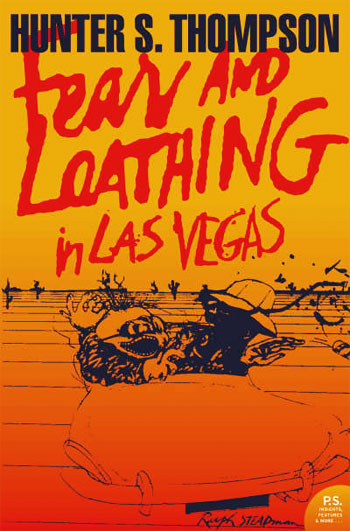
1. Priority went to repeat nominees (Bill Bryson, Hunter S. Thompson, and Richard Dawkins, to name a few).
2. We leaned toward books that are available for free online.
3. When all else failed, we relied on our own preferences — or prejudices.
Thanks again for all of your recommendations, and may we congratulate you on your excellent taste in non-fiction, equalled by only your excellent taste in websites.
Lastly, and only in part because we’ve been warned that we would be roundly scolded for the omission: The Elements of Style, by William Strunk and E.B. White
Thanks again, and happy reading!
Sheerly Avni is a San Francisco-based arts and culture writer. Her work has appeared in Salon, LA Weekly, Mother Jones, and many other publications. You can follow her on twitter at @sheerly.
The Franz Kafka Society announced yesterday that it was awarding the prestigious Franz Kafka Prize for 2011 to the Irish writer John Banville, who has built a reputation for being one of the finest prose stylists working in English–and for being a bit difficult.
First, there are the books themselves. “In their architecture and their style,” wrote Belinda McKeon in the introduction to Banville’s 2009 Paris Review interview, “his books are like baroque cathedrals, filled with elaborate passages and sometimes overwhelming to the casual tourist.” And then there is the personality. When Banville won the 2005 Man Booker Prize for his novel The Sea, he proclaimed, “it is nice to see a work of art win the Booker Prize.” As he explained later to The Village Voice, “the Booker Prize and literary prizes in general are for middle-ground, middlebrow work, which is as it should be. The Booker Prize is a prize to keep people interested in fiction, in buying fiction. If they gave it to my kind of book every year, it would rapidly die.”
Art may not be for everyone, but for those who have read his books–16 novels published under his own name, four crime novels under the pen name Benjamin Black, and one collection of short stories–there is no doubt that Banville is an artist. “It all starts with rhythm for me,” Banville told the Paris Review. “I love Nabokov’s work, and I love his style. But I always thought there was something odd about it that I couldn’t quite put my finger on. Then I read an interview in which he admitted he was tone deaf. And I thought, that’s it–there’s no music in Nabokov, it’s all pictorial, it’s all image-based. It’s not any worse for that, but the prose doesn’t sing. For me, a line has to sing before it does anything else. The great thrill is when a sentence that starts out being completely plain suddenly begins to sing, rising far above any expectation I might have had for it. That’s what keeps me going on those dark December days when I think about how I could be living instead of writing.”
For an example of Banville’s singing prose, we leave off where The Sea begins:
They departed, the gods, on the day of the strange tide. All morning under a milky sky the waters in the bay had swelled and swelled, rising to unheard-of heights, the small waves creeping over parched sand that for years had known no wetting save for rain and lapping the very bases of the dunes. The rusted hulk of the freighter that had run aground at the far end of the bay longer ago than any of us could remember must have thought it was being granted a relaunch. I would not swim again, after that day. The seabirds mewled and swooped, unnerved, it seemed, by the spectacle of that vast bowl of water bulging like a blister, lead-blue and malignantly agleam. They looked unnaturally white, that day, those birds. The waves were depositing a fringe of soiled yellow foam along the waterline. No sail marred the high horizon. I would not swim, no, not ever again.
To date, Google Books has scanned 50,000 books from the 16th and 17th centuries. And by working with great European libraries (Oxford University Library and the National Libraries of Florence and Rome, to name a few), the Mountain View-based company expects to index hundreds of thousands of pre-1800 titles in the coming years.
Traditionally, most historical texts have been scanned in black & white. But these newfangled scans are being made in color, giving readers anywhere the chance to read older books “as they actually appear” and to appreciate the “great flowering of experimentation in typography that took place in the 16th and 17th centuries.”
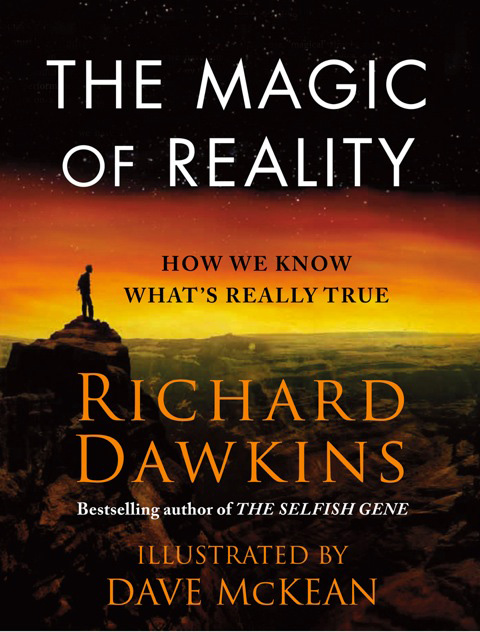
Richard Dawkins, the Oxford evolutionary biologist, has a new book coming out this fall. This time, it’s a children’s book called The Magic of Reality: How We Know What’s Really True. Interviewed in Der Spiegel in March, Dawkins talked a little about what he hoped to accomplish here, saying:
Each chapter is a question like: What is an earthquake? What is a rainbow? What is the sun? Each chapter begins with a series of myths seemingly answering those questions, and then I counter that with explanations about the true nature of things. There is something very cheap about magic in the supernatural sense, like turning a frog into a prince with a magic wand. Reality has a grander, poetic magic of its own, which I hope I can get across.
Already you can see some preliminary artwork for the book. We have one cover design above, and another one here. We’ll have more on the book when it comes out…
What can we say about Gary Shteyngart? The novelist appeared last year in The New Yorker’s 20 Under 40 Fiction Issue (which listed authors “who capture the inventiveness and the vitality of contemporary American fiction.”) He teaches writing at Columbia University and counts James Franco as one of his students. And he’s willing to hustle a little to sell a book. When his novel Super Sad True Love Story came out last summer (find NYTimes review here), the quirky Leningrad-born author (key to understanding what comes next) released a satirical, self-deprecating trailer to promote his book. Jeffrey Eugenides, Jay McInerney, Edmund White, Mary Gaitskill and Franco himself all get in on the joke … which gets better as it goes along.
Shteyngart’s book just came out in paperback last week. To mark the occasion, Fresh Air re-aired an interview with him (sans accent) last week. His book is also available as an audio download via Audible.com, and here’s how you can snag a free copy…
There will be a day — maybe it’s already here; maybe it was always here — when the Kindle will look incredibly retro. Mike Matas, once a designer of user interfaces at Apple and now co-founder of Push Pop Press, may make that day of visual reckoning come sooner rather than later. The demo above (which is easily worth a thousand words) lets you peer into the near future.. Text, images, audio, video and interactive graphics — they’ll come together in a seamless reading experience, making the traditional ebook look entirely one dimensional. You can download the book on display, Al Gore’s “Our Choice,” on iTunes here.
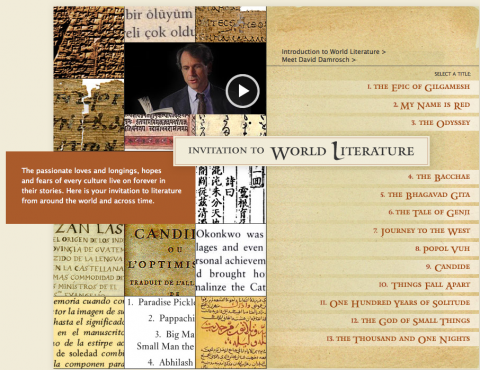
Love and longing, hope and fear — these threads run throughout all literature, whether we’re talking about the great ancient epics, or contemporary novels written in the East or the West. That’s the main premise of Invitation to World Literature, a multimedia program organized by David Damrosch (Harvard University), and made with the backing of WGBH and Annenberg Media.
The program features 13 half-hour videos, which move from The Epic of Gilgamesh (circa 2500 BCE) through García Márquez’s One Hundred Years of Solitude(1967). And, collectively, these videos highlight over 100+ writers, scholars, artists, and performers with a personal connection to world literature. Philip Glass, Francine Prose, Harold Ramis, Robert Thurman, Kwame Anthony Appiah — they all make an appearance.
We're hoping to rely on loyal readers, rather than erratic ads. Please click the Donate button and support Open Culture. You can use Paypal, Venmo, Patreon, even Crypto! We thank you!
Open Culture scours the web for the best educational media. We find the free courses and audio books you need, the language lessons & educational videos you want, and plenty of enlightenment in between.