Having recently turned 60, Christopher Hitchens decided it was time to write a memoir. Hence Hitch-22, his new book published earlier this month. For a moment, the publicity machine got rolling. (Above, we have him talking with Anthony Layser in a short video called “Drinking with Hitchens.” Watch Part 2 here.) But, for whatever reason, things have now come to a halt. Multiple speaking engagements on the West coast (my neck of the woods) have suddenly been canceled, as True/Slant notes. And, rightly or wrongly, there’s now speculation about Hitchens’s health. Neither Hitchens nor his representatives have offered any official explanation. Dailyhitchens.com will inevitably keep monitoring the situation.
There’s a lot of talk about “vooks” these days. Usually vooks are all about moving traditional books over to digital environments (e.g., the iPad) and surrounding them with supporting web media. But one company, Ubimark, is taking a different approach. They’re keeping the printed word and putting the web inside the traditional book. Kind of. Using smart phones, readers can take pictures of “2D codes” embedded in print books. And, from there, the smart phone will launch maps, video, and other web media that will collectively enrich the words on the page. The video above, using Jules Verne’s Around the World in 80 Days as an example, shows what this all looks like in action.
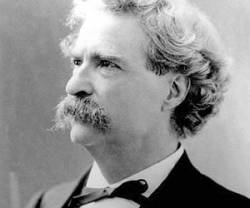
File this under “better late than never.” Mark Twain spent his last decade writing his memoirs, producing some 5,000 unedited pages. However, he stipulated that they couldn’t be published for at least a century following his death. (Apropos see this very rare footage recorded by Thomas Edison showing Twain in his last year.) Fast forward to 2010. We have now clocked 100 years. And this November, UC Berkeley will publish the first volume of Twain’s manuscript. The Independent tells you more about this literary event, and suggests why Twain wanted to keep his autobiography under wraps. Get the full article here.
HuffPo has pulled together a list of The 12 Greatest Literary One-Hit Wonders. And it’s a strange list indeed. When you think of “one-hit wonders,” you think of memorable songs recorded by very unmemorable artists – artists who got their 15 minutes of fame and then fell right off the radar. Meanwhile, the HuffPo list includes some of the most enduring names in American literature – F. Scott Fitzgerald, J.D. Salinger, and Herman Melville. They gave us their big novels – The Great Gatsby, The Catcher in the Rye, and Moby Dick – then wrote some other lasting pieces of fiction, both short and long. They hardly faded into oblivion. And, years later, we’re certainly not asking, “what ever happened to old what’s his name?”
He was Argentina’s favorite son, one of the great South American writers of the last century (along with Gabriel Garcia Marquez, Carlos Fuentes, and Mario Vargas Llosa), and the winner of 46 national and international literary prizes. We’re talking about Jorge Luis Borges, the master of the postmodern short story. Borges was born in 1899, and to celebrate his 100th birthday (though he died in 1986), Philippe Molins directed the documentary, Jorge Luis Borges: The Mirror Man. The film’s major strength (as one reviewer put it) is that it’s a “bit of everything – part biography, part literary criticism, part hero-worship, part book reading, and part psychology.” It runs 47 minutes and includes a fair amount of archival footage. (You can watch it in a larger format on Vimeo here.)
A big thanks goes to Mike for sending The Mirror Man our way. If you have your own great piece of cultural media to share with us and your fellow OC readers, please feel free to send it along.
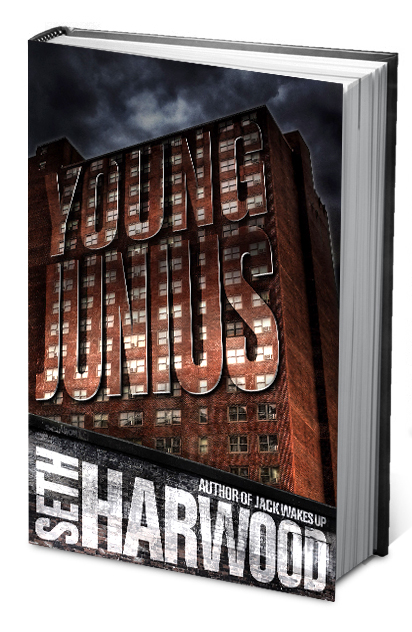
OC contributor Seth Harwood has something exciting going on over at his site today: he’s launching the pre-order sales of his new novel YOUNG JUNIUS, which is due out this fall. This is partly worth noting because Seth’s path to publication involves giving away his work for free as MP3 audiobooks. You can even listen to all of YOUNG JUNIUS before you make a buy. If you’re a fan of crime or mystery fiction, or you dig The Wire, you’ll love this book!
Now, Seth is partnering with independent publisher Tyrus Books to break new ground in publishing strategies. To read the full description of what he’s up to, go here. The brief version involves the pre-order of special, limited edition copies of the book that feature cloth binding, fan-created cover art, photos of the story’s locations, signed personalization and more. By offering these for a limited time via his site, he and Tyrus are able to print just the quantity sold and balance some of the cost (reduce the risk) of the book’s full print run–hardcover, paperback AND special edition.
If you’d like to read more about this or order a copy, head over to sethharwood.com. When you do, use the code OC to save $3 off the cover price of the book! Enjoy!!
Seth Harwood is a voracious reader, subversive publishing maven and crime novelist.
This year, Tim Burton’s production of Alice In Wonderland was welcomed by a flurry of media buzz and a rather polarized public response debating whether the iconic director had butchered or reinvented the even more iconic children’s classic. But discussion of the film’s creative merits aside, one thing it did do brilliantly was rekindle the public’s interest in what’s easily the most beloved work of children’s literature of the past two centuries.
So beloved, in fact, that Lewis Carroll’s 1865 novel has generated hundreds of reprints, film adaptations and various derivative works over the years. Many of these works are now available in the public domain — even a simple search in the Internet Archive sends you down a rabbit hole of adaptations and remakes, spanning from landmark early cinema treasures to offbeat products of contemporary digital culture.
Today, we’ve curated a selection of the most interesting and culturally significant — the “curiouser and curiouser,” if you will — free versions of, tributes to, and derivatives of Alice’s Adventures In Wonderland.
The fundamentals: A Project Gutenberg free digital copy of Carroll’s original Alice’s Adventures In Wonderland text
A 1916 abridged version intended for younger children, digitized by the Library of Congress, is available from the International Children’s Digital Library and features some wonderful illustration — though, regrettably, it lacks the Cheshire Cat
For a classic with a spin, try this audio version read by blogger extraordinaire, BoingBoing co-editor, Popular Science columnist and vocal free content advocate Cory Doctorow
The earliest cinematic adaptation of the book, directed by Cecil Hepworth in 1903, is a silent film gem, clocking in at just 8 minutes and 19 seconds. Watch above.
In 1915, W. W. Young directed the second American adaptation of Alice — a massive six-reel production that showcased the rapid evolution of filmmaking in just a decade since the first production. Though much of the film is now lost, 42 minutes of it can be seen at the Internet Archive for free
A 1966 British adaptation by director Jonathan Miller for the BBC features an ambitious cast — including Peter Sellers as the King of Hearts, Sir John Gielguld as Mock Turtle, Michael Redgrave as The Caterpillar and Peter Cook as the Mad Hatter — and its soundtrack, scored by the legendary Ravi Shankar, exudes the borderline folk-psychedelia sound of the Woodstock era. The film, divided into seven parts, is available for free on YouTube.
This 2‑minute version of Alice In Wonderland shot in the virtual world Second Life is an eerie testament to just how widely Carroll’s classic resonates.
Perhaps the biggest treasure of all, Lewis Carroll’s original manuscript, available from the British Library — 91 pages of precious literary history, with original illustrations from artist John Tenniel. The online gallery also features a preface telling the fascinating story of the Oxford mathematician’s real-life inspiration for the book and the fate of the real Alice
Maria Popova is the founder and editor in chief of Brain Pickings, a curated inventory of eclectic interestingness and indiscriminate curiosity. She writes for Wired UK, GOOD Magazine and Huffington Post, and spends a disturbing amount of time curating interestingness on Twitter.
We're hoping to rely on loyal readers, rather than erratic ads. Please click the Donate button and support Open Culture. You can use Paypal, Venmo, Patreon, even Crypto! We thank you!
Open Culture scours the web for the best educational media. We find the free courses and audio books you need, the language lessons & educational videos you want, and plenty of enlightenment in between.
 Details here.