Jack Kerouac’s “On the Road” is turning 50 this month, something we recently noted. And to commemorate the event, Viking has just published the original draft of the novel (check it out here) that Kerouac banged out in three quick weeks, in a New York apartment, on eight long sheets of tracing paper, which he later taped together to create a 120-foot scroll (see photo). This new publication offers a reproduction of Kerouac’s first draft and lets you see how the beat classic changed from initial draft to publication. In the scroll, Kerouac uses the real names of friends instead of pseudonyms, and some of the details are a little more graphic. If you want to see footage of Kerouac reading from “On the Road,” feel free to refer back to our post on August 15.
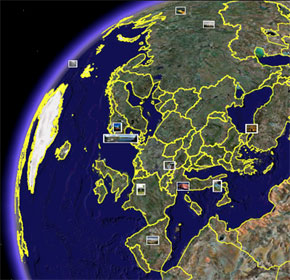
Google Earth added new functionality this week that lets you search the world by geographical location and find books that reference that location. So, for example, if you open Google Earth and type “London,” you will be presented with numerous yellow book icons. Click on any one of them, and Google will show you instances where books specifically reference “London.” (In this case, I found works by Thomas Hobbes and John Locke, two of England’s most important political thinkers.) All of the books presented here are in the public domain, which means that you can continue to explore the complete text, courtesy of Google, should you want to. A nice touch.
There is a certain “gee whiz” factor to this new application, no doubt. But how widely it will be used is another story. Search for “Boston” and you will get more book icons than you can handle. And will you want to mouse over each one to find a potentially useful text? Doubtful. And the problem will only get worse as Google Book Search, a partner in the project, digitizes more texts. A more effective solution, it seems, is simply to head over to Google Book Search and conduct a good, old fashioned search, then read through the more legibly-presented and ranked search results. That’s so 1990s, I know.
Please note that to use this new functionality, you should download a recent version of Google Earth, and check off “Google Book Search” in the “Featured Content” section under “Layers.” You can get more information from Google here and here.
If I am missing something important about this new feature — that is, if I’m wrong about its utility — feel free to say so. The Google folks are smart, and I wouldn’t be surprised if they’re seeing something that I’m not. The jury on GeoMapping books remains out for now.
William Gibson, who launched the cyberpunk genre with the 1984 classic Neuromancer, hasn’t lost any steam. Pattern Recognition, published a good 20+ years later, won wide praise in 2005. Now, he’s come out with Spook Country, and it’s currently #66 on the Amazon bestseller list. Below, you can catch Gibson reading from his new work in Second Life. What can be more fitting?Also, you may want to check out BoingBoing’s “nerdgasmic” interview with Gibson (iTunes — Feed — MP3 Stream), plus Cory Doctorrow’s reverential review of the new work. And finally, if you need more, you can watch Gibson give a book talk at Cody’s in Berkeley CA, courtesy of Fora.Tv.For your daily dose of digital culture, subscribe to our feed.
We asked our readers what books made the biggest difference in their lives, and here’s what they had to say. The list below tells you what books shaped their lives and why.
1984 “was the first book I actually enjoyed reading. It completely blew my mind at the time (I was 16) and it opened my eyes to the power of ideas and to the joy of reading a good book.” — Tim
“Wow this book is incredible. At close to 500 pages Bryson covers everything from the moment the universe expanded from the intensely dense matter that was (aka the big bang) to man’s origin. Reading this book has impacted the way I look at everything from bacteria to asteroids.” — Alex
“After reading through these suggestions, I realized there’s a big hole: Poetry! So much poetry has affected my life: Sylvia Plath’s _Ariel_; Campbell McGrath’s _Road Atlas_; James Wright’s _Above the River_; Brenda Hillman’s _Cascadia_…Walt Whitman, Emily Dickinson, Robert Bly… Poetry may not be the “winning pick” here, but it definitely should be celebrated! And not just in April.” — Amanda
“This book reignited the pilot light of my imagination like no other book had done in quite awhile. The whimsy of its narrative, which ended with the utter destruction of our world thanks to mankind, was stark, shocking, yet refreshing when it seemed every other book I read was just an exercise towards getting to a happy ending. Great book!” — Spamboy
“Although I am not practicing Zen (yet), this book is like my Bible in that I plan to always read over it and reflect upon the messages therein. Suzuki had a humble vision that in order to change this world, we need to change the way people think and live, not just to change the symptoms of what is wrong. Not just to get rid of pop-prejudice and hatred, but to get rid of labels entirely, to ‘fight’ war and injustice with peace and understanding instead of anger.… That’s just some of the stuff that is shaping the way I think right now.” — Luella
“I read it as a junior in high school, picked up on the bargain pile at a B. Daltons. It impacted me because it illustrated the concept of learning throughout life and how people can live with dignity. I’ve loaned it out several times and re-bought it at least three times.” — Emmett
“…It’s as though that book has taken so much life from the past and made it all tangible to us here in the present. I love the emotional complexity that’s replicated in the grandmother’s and grandfather’s manuscript and letters, how they show how memory is fragmented, overwhelming, and sometimes incomprehensible. Seriously, I could go on and on. And I can think of hundreds of other books that have changed me just as much. It’s just this one has been at the forefront of my mind ever since I read it a couple of months ago.” — Amanda
“I think it was the first time I had felt such a bond with a character. I triumphed with [Pip’s] successes, felt the blow of failure in his defeats, and felt sorrow when he broke his own principles. I saw values in Pip that I wanted to emulate in my own life — a dedication to pursuing my dreams, overcoming my weaknesses, and treating others respectfully regardless of what frustrations I may have in my own life…” — Jamie
“A stellar book released last year that I believe will quietly grow to classic status on par with Victor Frankl and Elie Wiesel… Mollica’s thesis, radical for a professor of medicine, is that humans have the tools to heal themselves from even the worst imaginable traumas. He gently shows the recipe for self-recovery, and reveals that the survivor is, in fact, the greatest hero for us all.” — Megan
“Hersey retells what happens when an atomic bomb falls on your city. Culled from interviews with survivors of the atomic bomb attack, this narrative was originally published as an entire issue of The New Yorker magazine. Haunting.” — Morgan
It was the first “adult book that I read upon graduating to the adult section of the Municipal Library in Krakow. Having read all the classic science fiction on the shelves, Capote’s matter of fact prose was as disturbing to me as it was new. No aliens here among far away stars but a world almost ordinary and within reach, tangible and so totally frightening. Reading it felt like being caged with a wild animal, a quick fear followed repeatedly by the mind’s pangs of pride to subdue the brute. This was no fiction yet it read stranger than anything else up till then.”
A book that “provides a whole rationale for reading fiction that I have never forgotten. I grew up in a time and a household where reading fiction was analagous to wasting your time. Hayakawa writes of fiction as a tool to increase your experience of life, to increase the number and variety of experiences in your life, your appreciation of those experiences, to understand others and so much more!” — Terry
–“It’s for me ‘life imitates art’ because an old lover appeared in my life after 31 years. And if I hadn’t read that book I think I would have refused him.” — Regina
–“Epic. Beautiful. My inspiration to become a writer.” — Valentina
“[It] is one of the best books I have read. The book describes the author’s imprisonment in several concentration camps. Faced with terrible suffering and loss he survives by finding meaning in the midst of this. He discovers that all of our freedoms can be taken from us….except one….the freedom to choose how we think and act under the very worst of circumstances.” — Andrea
“A quarter century ago, I set out on a bicycle trip across North America, and a friend stuck a paperback copy of Basho’s ‘Narrow Road to a Far Province’ in one of my panniers. ‘Narrow Road’ … is a diary kept by the Japanese poet Basho in 1689 as he made a journey into the northern provinces of Japan. When I was in the Sierras, delayed by snow, I read through ‘Narrow Road’ two or three times. I don’t know whether the book affected me more greatly because I was traveling or my traveling affected my perception of the book (one of those zenny questions), but I came away with a much better sense of the journey that we all make through life, both the physical and philosophical journey, and a more humble sense of my place among the sojourners.” — Charlie
“I’ve read this book 3 times over the past 2 years and it’s allowed me to overcome my fears, realize my dreams and start working toward new goals in my career, relationships, etc. It’s given me the courage to leave the things (marriage, career, etc.) that weren’t working for me and to face the fear of the unknown to start working toward a new future.” — Merlene
“One title that has had a big impact on me throughout my teaching career has been Neil Postman’s Teaching as a Subversive Activity. His concepts of helping kids develop their instincts for evaluating and analyzing all the messages tossed at them during their lives (he called it their crap detector) are more valid today than when he wrote the book in the 70’s.” — Tim
“As a teenager I was mystified by the audacity of the grand inquisitor. I’d never read such a succint indictment of faith. As I got to my twenties I read the whole book, but in my late twenties I began to appreciate it. I’ve never read a more powerful and realistic testament to faith in my life, and as I’ve grown, my reading of the book has grown with me.” — Don
“If the devil were alive he would be writing the works of James Purdy. ‘The Candles of Your Eyes’ changed my outlook on literature forever.” — John
–“I’m going to go back to high school and say that Catcher in the Rye had a big impact on my life. While the content of the book in terms of character and story were accessible to me at 16, that isn’t really what made the difference. It was only after reading some criticism and talking with others in school and out that I began to see all that was going on in a novel beyond the plot: symbolism, irony, language and the rest. When I saw how much could go on in a book, how many things were going on simultaneously, I became very impressed with the complexity of literature as art. From then on I was pretty well hooked on books.” — Jack
This book “arrived in my library, as part of our rental collection, in the mid-70s. Since then, I have given away at least half a dozen copies, bought it for other libraries I’ve worked at, and had a brief correspondence with David Bradley, the author. It’s about time for me to reread it…. If only one of you, reading this, gets the book, I’ll be satisfied. Even if you don’t get past the dissertation on long distance public transportation.” — Papermaven
“I read this book as a teenager. I remember being completely fascinated with the Jewish culture portrayed in the novel, but the main impact came in the way Potok emphasized the values of intelligence, intellectual achievement, and compassion for others. I was incredibly moved by the conflict between these values, and find myself re-reading this novel and the sequel “The Promise” almost yearly for over 20 years.” — Judy
“Short and punchy, his macabre tales pack a visual whollop that modern longer stories lack. He can create mood and tone in less than a page. When I need a break from student narratives, I read a short story by Poe. There is a reason the guy’s writing has survived.” — Chris
“I read The Grapes of Wrath in the 7th grade. That was 43 years ago. Steinbeck’s tender and loving prose and voice have never left me. I don’t think it’s too much to say that I actually, factually, love that book, and its author, very, very much.” — Fuzzo
“Both of these books philosophically ushered me into the modern world, changing the way I saw power, sex, sexuality, school, and nothing less than the Modern Self.” — Dragon Management
“The book that most influenced my life was “The Lord of the Rings” that I read when I was 15 years old. That book introduced me to the world of fantasy books. Ever since I keep reading this genre of books (plus a lot others of course), both in English and in Italian.” — Francesco
– “It’s chock full of free-thinking anarchism and did a lot to push me towards my current semi-libertarian view point.” — Dave
–“I would imagine this book had a similar effect on a lot of people who read it. This book really changed the way I think and introduced me to a lot of really great information. I went on to read almost all of Robert Anton Wilson’s books. He was a great philosopher who wasn’t afraid to state his mind. He recently passed away and I know a lot of people will and are missing him. His greatest effect on me was the introduction of ‘maybe logic.’” — Cyen
“A collection of assorted writings by a great scientist shows the full palette of a sharp intelligence animated by all-around curiosity.” — Davide
“I have two books that impacted my life; one from childhood and one from early adulthood. In the sixth grade, our teacher read The Secret Garden to us every day. I was captivated by the imagination, compassion, and touch of fantasy that this book awakened in me.” — Jan
–“Although I am not too much into philosophy, this book really made me see a lot of things differently!” — Harish
–“After 18 years exploring philosophies I still return to Pirsig for clarity. Although I see many parallels now with more “respectable” philosophers, such as Hume, there is also a very human dimension to these books which manages always to move me. There is a sensation for many who read Pirsig of re-connecting with some long-forgotten wellspring of wisdom long lost to the reductionism of our daily existences.” — David
Gregory Clarke, an economic historian at UC Davis, offers an unusual take on the Industrial Revolution in his upcoming book, A Farewell to Alms. Most scholars argue that the changing institutions of industrialization–factories, corporations, cities–worked together to drag us humans into the modern world. Clarke turns that idea on its head.
As the New York Times put it in a recent review, Clarke “believes that the Industrial Revolution — the surge in economic growth that occurred first in England around 1800 — occurred because of a change in the nature of the human population. The change was one in which people gradually developed the strange new behaviors required to make a modern economy work. The middle-class values of nonviolence, literacy, long working hours and a willingness to save emerged only recently in human history.”
The most fascinating part of the argument is that, according to Clarke, these values spread in part because the upper classes were more successful at breeding and making sure their offspring survived to adulthood. By examining historical wills and property exchange, Clarke determined that “[t]he modern population of the English is largely descended from the economic upper classes of the Middle Ages.” Generations of illegitimate offspring, profligate parents and non-inheriting progeny sallied forth and married into the lower classes, bringing their capitalist ways with them.
If this theory holds up, it might shed some light on the rise of the English novel. The great Victorian novel-writers have traced uncannily similar processes of social intermingling and dispersion, and it’s a truism that almost every story pivots around an inheritance. We might visualize the process as hundreds of characters circling a few well-guarded piles of money. Most of them end up settling for less, and most of the drama and tension in the plot arcs stem from these compromises. And, of course, the novels trace the spread of just the bourgeois virtues Clarke is researching.
Clarke’s work raises a disturbing larger question: is this a form of Darwinian selection at work? Is capitalism having an evolutionary impact on human progress? Or is that a ridiculous proposition? To see for yourself, you can check out the first couple of chapters for free on Clarke’s website, here.
This doesn’t need much in the way of an introduction. On July 21, J.K. Rowling presented a public reading of the first chapter of the newly-published Harry Potter and the Deathly Hallows. It took place at the Natural History Museum in London. Take it away J.K.
Bestselling writer Jonathan Lethem — author of one of my favorite novels Motherless Brooklyn — has put together an offer that’s hard to beat. He’ll sell you a story for a book, play, or screenplay for a mere $1. Then you can take the story idea, make it your own, and move it in new and unexpected directions.
This is obviously not a get-rich-quick scheme. It’s actually more about bringing Larry Lessig’s notion of free culture to the literary domain. You can get more on Lethem’s ideas here, but the upshot is that Lethem, being a fan of “adaptations, appropriations, collage, and sampling,” wants artists to “make material free and available for [creative] reuse.” (Some of this thinking informs a recent piece in Harper’s called “The ecstasy of influence: A plagiarism.”) The initiative, which he calls The Promiscuous Materials Project, offers a step in the right direction.
A couple of years ago I met Jason Epstein in passing and he excitedly described his new project: a machine to print On Demand Books. The plan is finally bearing fruit: the Espresso Book Machine was demonstrated at the New York Public Library on Wednesday. Three of the machines are out in the wild, and I suspect many more will appear if the prototypes live up to the hype.
The idea of books on demand is a little eerie but eminently efficient. Publishers and booksellers waste millions of dollars, tons of fuel and forests of paper shipping, returning and trashing unsold books every year. And if a machine like this isn’t too expensive to run, it could revolutionize education in less accessible or wealthy parts of the world. The real question is whether such a machine might do to bookstores what Netflix has done to video rental stores. The Espresso machine can only print paperbacks, so for now I think Barnes and Noble is safe. And even if the shelves are replaced with digital browsing displays one day, many customers will still want to enjoy their purchases with an overpriced latte and pastry. The social spaces of book-reading have yet to be destroyed by Amazon.com or the blogosphere, so I think they’ll survive a new kind of espresso machine.
What Book Changed Your Life? Participate in a Group Project. Tell Us and Become Eligible for a Prize .
We're hoping to rely on loyal readers, rather than erratic ads. Please click the Donate button and support Open Culture. You can use Paypal, Venmo, Patreon, even Crypto! We thank you!
Open Culture scours the web for the best educational media. We find the free courses and audio books you need, the language lessons & educational videos you want, and plenty of enlightenment in between.