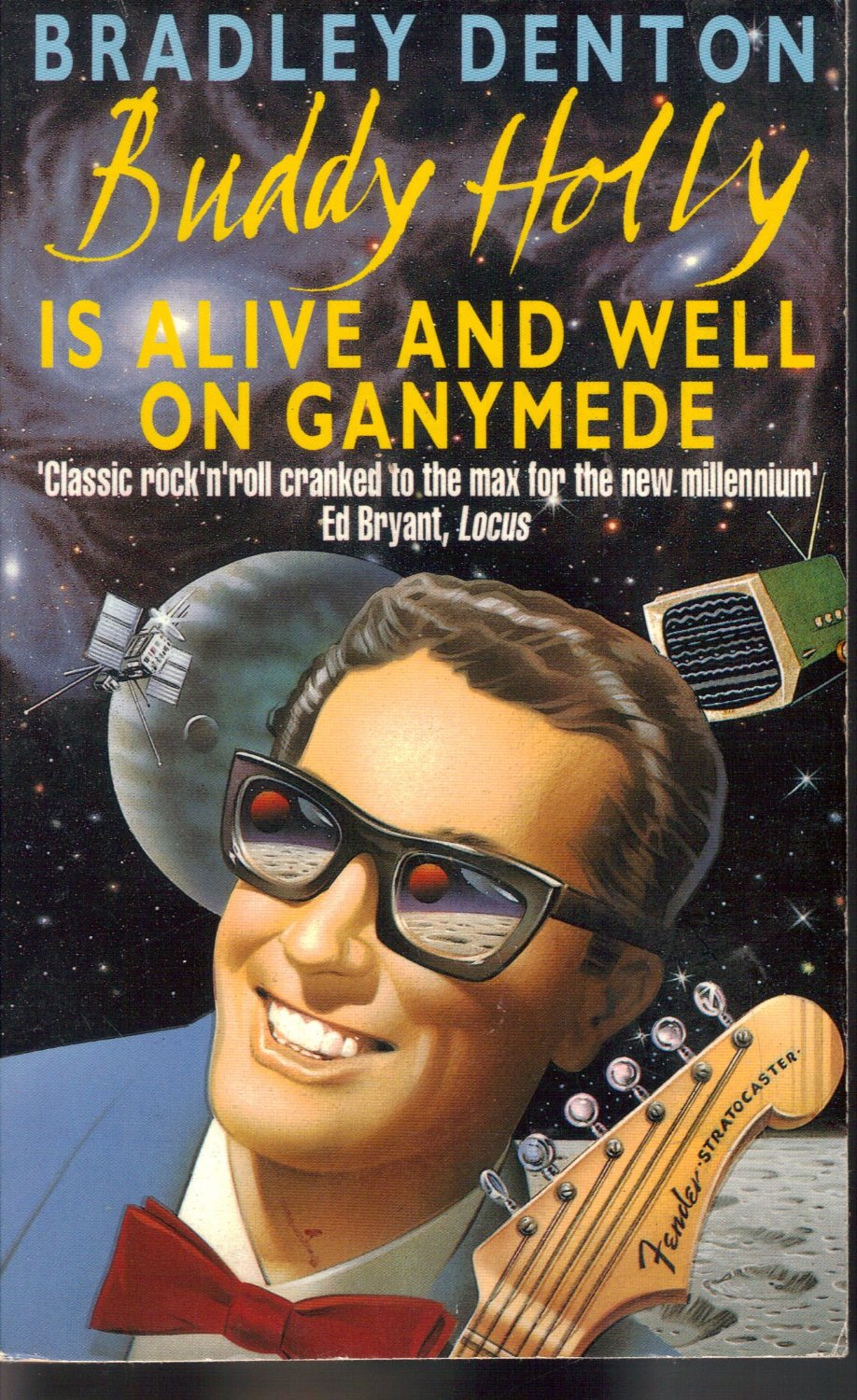
Back in 1991, Bradley Denton published Buddy Holly is Alive and Well on Ganymede. The next year, it won the John W. Campbell Memorial Award for Best Science Fiction Novel.
Writes Cory Doctorow on BoingBoing, Buddy Holly is Alive and Well on Ganymede “is the great American comic science fiction novel, a book about the quest to exhume Buddy Holly’s corpse from Lubbock, TX to prove that he can’t possibly be broadcasting an all-powerful jamming signal from a hermetically sealed bubble on a distant, airless moon.”
Taking advantage of new innovations (new since 1991), Denton has made the novel available for free download on his website, publishing it under a Creative Commons Attribution-NonCommercial-NoDerivatives license. You can access the text in four parts here: Part 1, Part 2, Part 3, Part 4.
If you become a fan, keep an eye out for a film adaptation of the novel starring Jon Heder. It’s been in development for some time, but you can watch a trailer online.
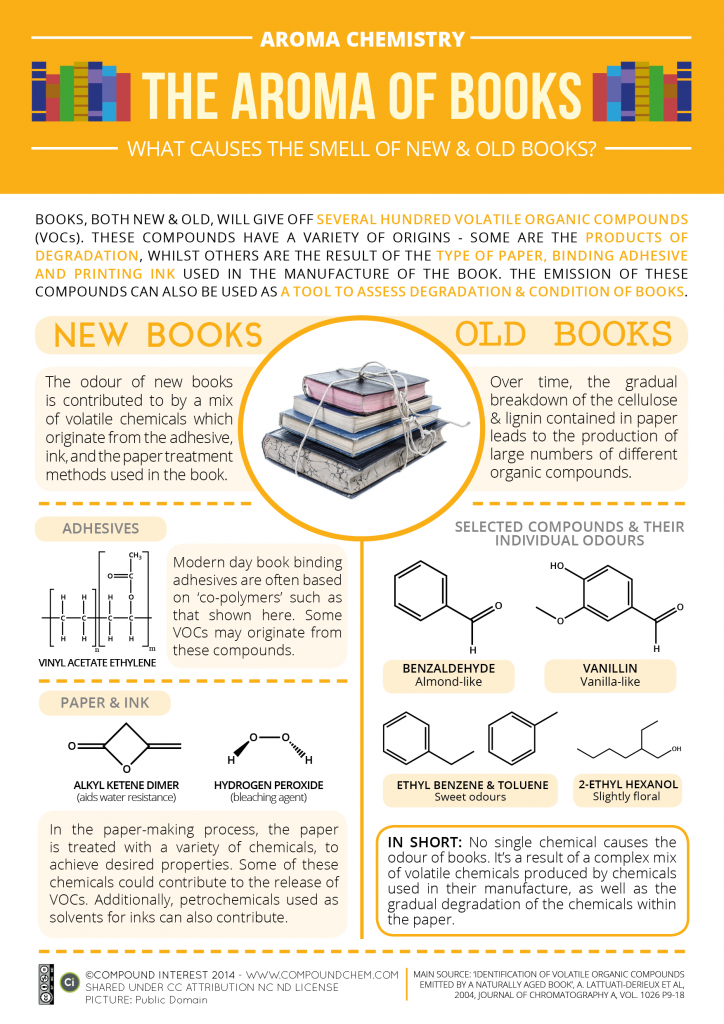
What gives old books that ever-so-distinctive smell? Andy Brunning, a chemistry teacher in the UK, gives us all a quick primer with this infographic posted on his web site, Compound Interest. The visual comes accompanied by this textual explanation. Writes Brunning:
Generally, it is the chemical breakdown of compounds within paper that leads to the production of ‘old book smell’. Paper contains, amongst other chemicals, cellulose, and smaller amounts of lignin – much less in more modern books than in books from more than one hundred years ago. Both of these originate from the trees the paper is made from; finer papers will contain much less lignin than, for example, newsprint. In trees, lignin helps bind cellulose fibres together, keeping the wood stiff; it’s also responsible for old paper’s yellowing with age, as oxidation reactions cause it to break down into acids, which then help break down cellulose.
‘Old book smell’ is derived from this chemical degradation. Modern, high quality papers will undergo chemical processing to remove lignin, but breakdown of cellulose in the paper can still occur (albeit at a much slower rate) due to the presence of acids in the surroundings. These reactions, referred to generally as ‘acid hydrolysis’, produce a wide range of volatile organic compounds, many of which are likely to contribute to the smell of old books. A selected number of compounds have had their contributions pinpointed: benzaldehyde adds an almond-like scent; vanillin adds a vanilla-like scent; ethyl benzene and toluene impart sweet odours; and 2‑ethyl hexanol has a ‘slightly floral’ contribution. Other aldehydes and alcohols produced by these reactions have low odour thresholds and also contribute.
The Aroma of Books infographic can be viewed in a larger format here. And because it has been released under a Creative Commons license, it can be downloaded for free. For another explanation of this phenomenon — this one in video — see this previous post in our archive: The Birth and Decline of a Book: Two Videos for Bibliophiles
If you would like to support the mission of Open Culture, consider making a donation to our site. It’s hard to rely 100% on ads, and your contributions will help us continue providing the best free cultural and educational materials to learners everywhere. You can contribute through PayPal, Patreon, and Venmo (@openculture). Thanks!
The “club,” a free floating, discussion-free group of New York City-based singer-songwriters, started in 2009, when Kurt Vonnegut’sBreakfast of Championswas celebrated with music and thematic drink specials. In the ensuing half-decade, they’ve met monthly to wrestle with such titles asThe Great Gatsby, Madame Bovaryand Dolly Parton’s autobiography.
Some contributions to these events do feel half-baked, as if the performer delayed starting work in case he or she might be able to finish the book on the bus ride to the show. Others are well crafted, as well as insightful.
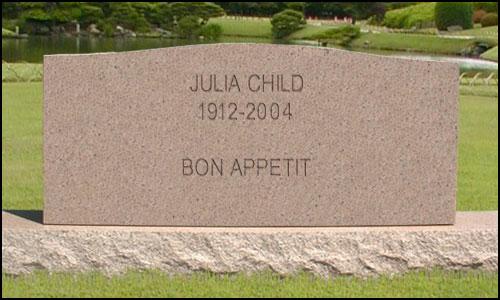
The link between stomach and heart underscores Hilary Downes’ bossa nova-inflected “Masters of the Table” and Shannon Pelcher’s gentle “Eating” which looks past Child’s towering culinary achievement to her yearning TV audience.
Stuff yourself on the entire evening’s songs using the link at the top of this page.
Or, should you crave a different sort of fare, join the Bushwick Book Club on the Frying Pan October 29, when they consider The Shining by Stephen King.
Even in our era of digital media — and even as a creator of digital media myself — I can’t help but evaluate each new city I visit, or the state of each old city I visit, in part by the quality and quantity of its bookstores. Toronto, where I’ve spent the past week or so, does surprisingly well on this count, though I hear from longtime locals that recent circumstances have forced a few beloved spots to shut down, relocate or downsize. A similar fate may loom over New York City’s Brazenhead Books, the by-appointment-only underground Upper East Side bookstore we featured back in 2011. New York still does pretty well in terms of bookstores, of course, but here we have a rare specimen in any city: a bookstore run almost in secret, a place where, according to Fodor’s, you’ll find three rooms of an apartment “crammed floor to ceiling with books, both new and used, including some rare titles,” where, “on Saturday nights, the city’s intellectuals can be found sipping whiskey and discussing classic and contemporary literature.”
If that sounds like an evening to you, you might want to pay a visit sooner than later. According to the website DNAInfo, Brazenhead’s owner, Michael Seidenberg, wrote on his Facebook page this summer, “Brazenhead Books turns its last page on October 31st.” “Lost our lease…lots of things must go.” If you can’t make it to New York before then, at least have a look at the video tour of Brazenhead at the top of the post.
As the bookselling industry has shifted over the past few decades, those omnipresent, large, orderly, utilitarian chain spaces meant for customers in search of a specific title — remember those? — have given way to smaller, more idiosyncratic bookstores, each of which provides a different set of textual and social experiences. Far at the latter end of the spectrum, we have Brazenhead, a one-man center of literary culture that you’ve got to know about just to enter. Hopefully it will survive, in some form, beyond October. But no matter what, the short video just above reminds us that what holds true about your favorite bookstore — whichever bookstore you call your favorite — holds especially for this one: you won’t find another place like it.
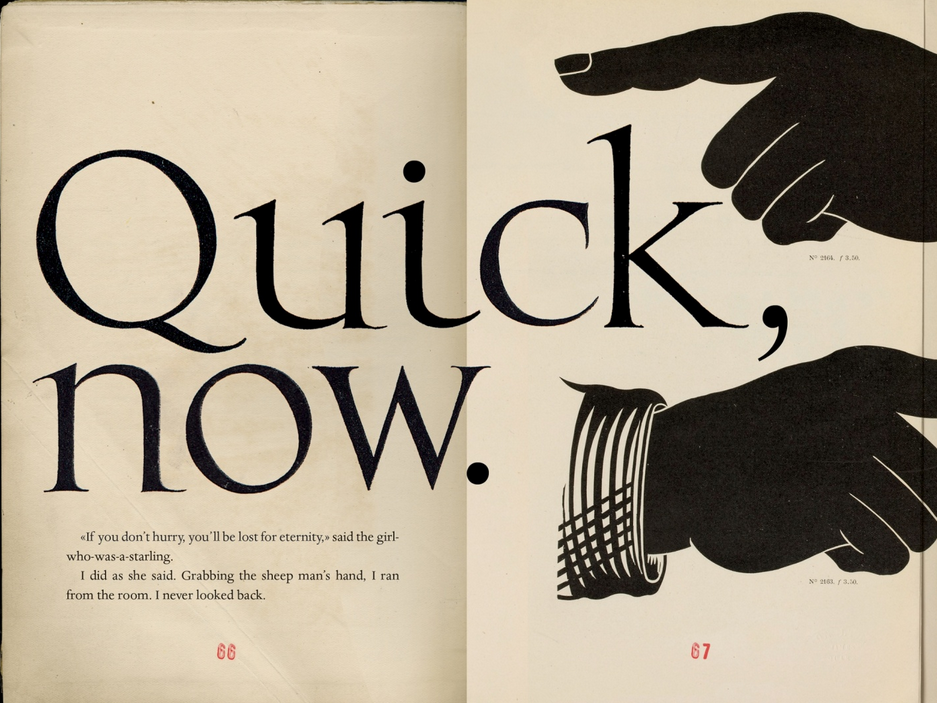
Quick note: If you just finished reading Colorless Tsukuru Tazaki and His Years of Pilgrimage, and if you’re now hankering for some more Murakami, you won’t have to wait very long. In December, his next book, a 96 page novella called The Strange Library, will be published by Knopf. And already, thanks to The Guardian, you can get a sneak preview of the illustrated edition. When you enter the Guardian gallery, make sure you click the arrows in the top right corner of the first image to see the illustrations in a larger format. The book can be pre-ordered here.
In the meantime, we have a few Murakami items (stories, music, film, etc.) to keep you busy this fall.
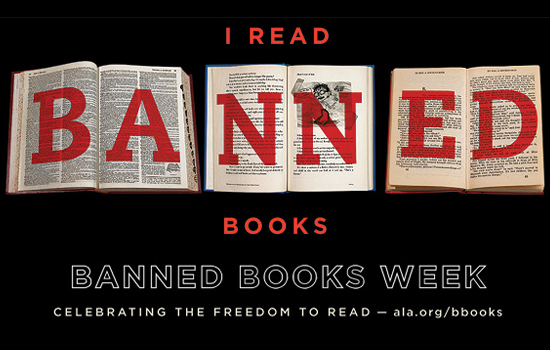
We well know of the most famous cases of banned books: James Joyce’s Ulysses, Henry Miller’s Tropic of Cancer, Allen Ginsberg’s Howl. In fact, a full 46 of Modern Library’s “100 Best Novels” have been suppressed or challenged in some way. The American Library Association maintains a page that details the charges against each one. Harper Lee’s To Kill a Mockingbird saw a challenge in the Vernon Verona Sherill, New York school district in 1980 as a “filthy, trashy novel” and in 1996, Lindale, Texas banned it from the advanced placement English reading list because it “conflicted with the values of the community.” Steinbeck’s Grapes of Wrath has a lengthy rap sheet, including total banning in Ireland (1953), Morris, Manitoba (1982), and all high school classes in Kanawha, Iowa (1980). The list of censored undisputed classics—every one of which surely has its own piece of giant store art in Barnes & Nobles nationwide—goes on.
In many ways this is typical. “The banned books lists you’ll find in many libraries and bookstores,” writes John Mark Ockerbloom at Everybody’s Libraries, “doesn’t [sic] focus much on the political samizdat, security exposés, or portrayals of Mohammed that are the objects of forcible suppression today. Instead, they’re often full of classics and popular titles sold widely in bookstores and online—or dominated by books written for young readers, or assigned for school reading.” Are these lists—and the banned books celebrations that occasion them—just “shameless propaganda” as conservative Thomas Sowell alleges? “Is it wrong to call these books banned?” asks Ockerbloom in his essay “Why Banned Books Week Matters.” Of course he answers in the negative; “not if you take readers seriously. An unread book, after all, has as little impact as an unpublished book.” Books that don’t pass muster with administrators, school boards, library associations, and legislators of all kinds, argues Ockerbloom, can be as inaccessible to young readers as those that get destroyed or fully suppressed in parts of the world without legal provisions for free speech.
This situation is in great part remediated by the free availability of texts on the internet, whether those currently under a ban or those that—even if they line the shelves in brick and mortar stores and Amazon warehouses—still meet with frequent challenges from community organizations eager to control what their citizens read. Today, in honor of this year’s Banned Books Week, we bring you free online texts of 14 banned books that appear on the Modern Library’s top 100 novels list. Next to each title, see some of the reasons these books were challenged, banned, or, in many cases, burned.
The Great Gatsby, by F. Scott Fitzgerald (Read Online)
This staple of high school English classes everywhere seems to mostly get a pass. It did, however, see a 1987 challenge at the Baptist College in Charleston, SC for “language and sexual references.”
Seized and burned by postal officials in New York when it arrived stateside in 1922, Joyce’s masterwork generally goes unread these days because of its legendary difficulty, but for ten years, until Judge John Woolsey’s decision in its favor in 1932, the novel was only available in the U.S. as a bootleg. Ulysses was also burned—and banned—in Ireland, Canada, and England.
Orwell’s totalitarian nightmare often seems like one of the very few things liberals and conservatives can agree on—no one wants to live in the future he imagines. Nonetheless, the novel was challenged in Jackson County, Florida in 1981 for its supposedly “pro-communist” message, in addition to its “explicit sexual matter.”
Again the target of right-wing ire, Orwell’s work was challenged in Wisconsin in 1963 by the John Birch Society, who objected to the words “masses will revolt.” A 1968 New Survey found that the novel regularly appeared on school lists of “problem books.” The reason most often cited: “Orwell was a communist.”
Slaughterhouse Five, by Kurt Vonnegut (Audio)
Vonnegut’s classic has been challenged by parents and school boards since 1973, when it was burned in Drake, North Dakota. Most recently, it’s been removed from a sophomore reading list at the Coventry, RI high school in 2000; challenged by an organization called LOVE (Livingstone Organization for Values in Education) in Howell, MI in 2007; and challenged, but retained, along with eight other books, in Arlington Heights, IL in 2006. In that case, a school board member, “elected amid promises to bring her Christian beliefs into all board decision-making, raised the controversy based on excerpts from the books she’d found on the internet.” Hear Vonnegut himself read the novel here.
The Call of the Wild, by Jack London (Read Online)
London’s most popular novel hasn’t seen any official suppression in the U.S., but it was banned in Italy and Yugoslavia in 1929. The book was burned in Nazi bonfires in 1933; something of a historical irony given London’s own racist politics.
The Nazis also burned Sinclair’s novel because of the author’s socialist views. In 1959, East Germany banned the book as “inimical to communism.”
Lady Chatterley’s Lover, by D.H. Lawrence (Read Online)
Lawrence courted controversy everywhere. Chatterly was banned by U.S. customs in 1929 and has since been banned in Ireland (1932), Poland (1932), Australia (1959), Japan (1959), India (1959), Canada (1960) and, most recently, China in 1987 because it “will corrupt the minds of young people and is also against the Chinese tradition.”
This true crime classic was banned, then reinstated, at Savannah, Georgia’s Windsor Forest High School in 2000 after a parent “complained about sex, violence, and profanity.”
Lawrence endured a great deal of persecution in his lifetime for his work, which was widely considered pornographic. Thirty years after his death, in 1961, a group in Oklahoma City calling itself Mothers Unite for Decency “hired a trailer, dubbed it ‘smutmobile,’ and displayed books deemed objectionable,” including Sons and Lovers.
If anyone belongs on a list of obscene authors, it’s Burroughs, which is only one reason of the many reasons he deserves to be read. In 1965, the Boston Superior Court banned Burroughs’ novel. The State Supreme Court reversed that decision the following year. Listen to Burroughs read the novel here.
Poor Lawrence could not catch a break. In one of many such acts against his work, the sensitive writer’s fifth novel was declared obscene in 1922 by the rather unimaginatively named New York Society for the Suppression of Vice.
An American Tragedy, by Theodore Dreiser (Read Online)
American literature’s foremost master of melodrama, Dreiser’s novel was banned in Boston in 1927 and burned by the Nazi bonfires because it “deals with low love affairs.”
You can learn much more about the many books that have been banned, suppressed, or censored at the University of Pennsylvania’s “Banned Books Online” page, and learn more about the many events and resources available for Banned Books Week at the American Library Association’s website.
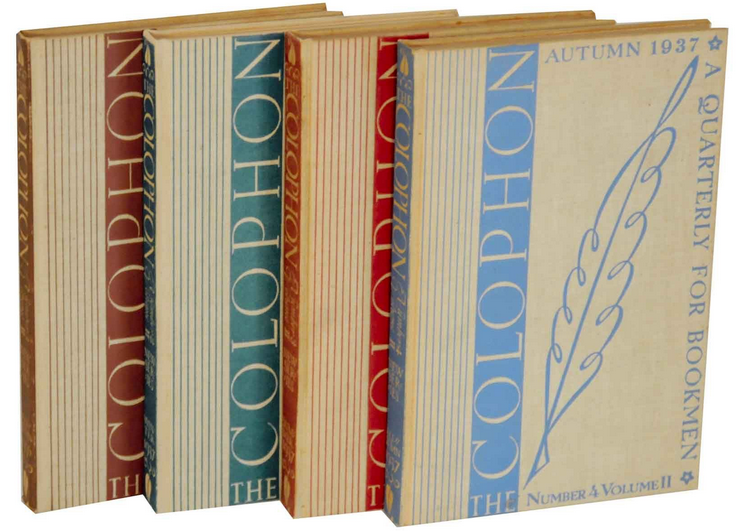
Few know as much about our incompetence at predicting our own future as Matt Novak, author of the site Paleofuture, “a blog that looks into the future that never was.” Not long ago, I interviewed him on my podcast Notebook on Cities and Culture; ever since, I’ve invariably found out that all the smartest dissections of just how little we understand about our future somehow involve him. And not just those — also the smartest dissections of how little we’ve always understood about our future. Take, for example, the year 1936, when, in Novak’s words, “a quarterly magazine for book collectors called The Colophon polled its readers to pick the ten authors whose works would be considered classics in the year 2000.” They named the following:
At first glance, this list might not look so embarrassing. Nobel laureate Sinclair Lewis remains oft-referenced, if much more so for Babbitt (Kindle + Other Formats – Read Online Now), his 1922 indictment of a business-blinkered America, than for It Can’t Happen Here, his bestselling Hitler satire from the year before the poll. Most Americans passing through high school English still bump into Willa Cather, Robert Frost (four of whose volumes you can find in our collection Free eBooks), and perhaps Eugene O’Neill (likewise) and Theodore Dreiser (especially through Sister Carrie: Kindle + Other Formats – Read Online Now) as well.
Some of us may also remember Stephen Vincent Benét’s epic Civil War poem John Brown’s Body from our school days, but it would take a well-read soul indeed to nod in agreement with such selections as New England historian James Truslow Adams and now little-read (though once Sinclair- and Dreiser-acclaimed) fantasist James Branch Cabell. The well-remembered George Santayana still looks like a judgment call to me, but what of absent famous names like F. Scott Fitzgerald, William Faulkner, Ernest Hemingway, or maybe James Joyce? The Colophon’s editors included Hemingway on their own list, but which writers do you think stand as the Fitzgeralds and Faulkners of today — or, more to the point, of the year 2078? Care to put your guess on record? Feel free to make your predictions in the comments section below.
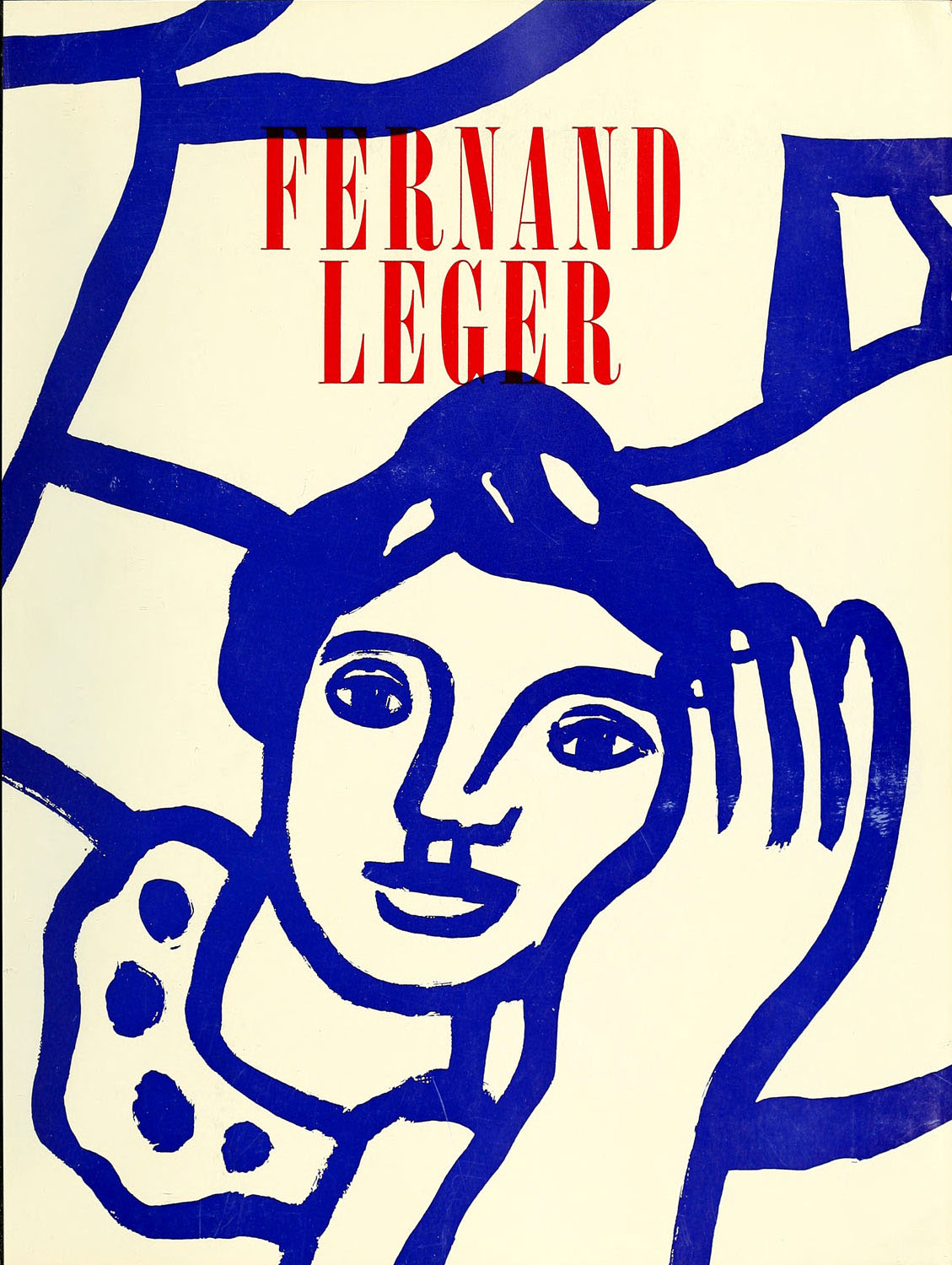
Anyone interested in the history of the Guggenheim will want to spend time with a collection called “The Syllabus.” It contains five books by Hilla Rebay, the museum’s first director and curator. Together, they let you take a close look at the art originally housed in the Guggenheim when the museum first opened its doors in 1939.
To read any of these 109 free art books, you will just need to follow these simple instructions. 1.) Select a text from the collection. 2.) Click the “Read Catalogue Online” button. 3.) Start reading the book in the pop-up browser, and use the controls at the very bottom of the pop-up browser to move through the book. 4.) If you have any problems accessing these texts, you can find alternate versions on Archive.org.
You can find many more free art books from the Getty and the Met below.
We're hoping to rely on loyal readers, rather than erratic ads. Please click the Donate button and support Open Culture. You can use Paypal, Venmo, Patreon, even Crypto! We thank you!
Open Culture scours the web for the best educational media. We find the free courses and audio books you need, the language lessons & educational videos you want, and plenty of enlightenment in between.