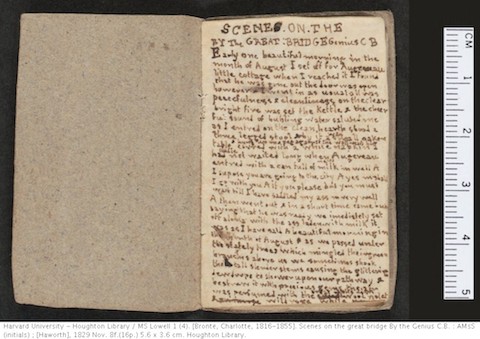
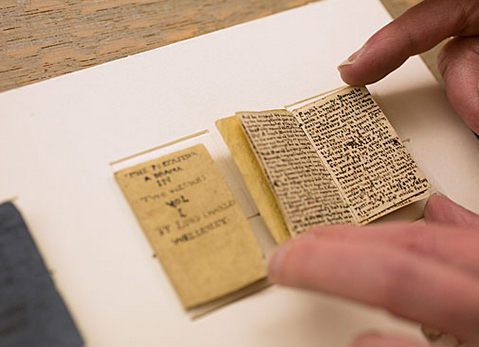
So you consider yourself a reader of the Brontës? Of course you’ve read Wuthering Heights, Jane Eyre, and The Tenant of Wildfell Hall. (Find these classics in our collection of Free eBooks and Free Audio Books.) You’ve probably even got on to the likes of The Green Dwarf and Agnes Grey. Surely you know details from the lives of Charlotte, Emily, and Anne. But have you read such lesser-known entries in the Brontë canon as Scenes on a Great Bridge, The Poetaster: A Drama in Two Volumes, or An Interesting Passage in the Lives of Some Eminent Personages of the Present Age? Do you know of Brontë brother Branwell, the ill-fated tutor, clerk, and artist, and have you seen his own literary output? Now you can, as Harvard University’s Houghton Library has put online nine very early works from Charlotte and Branwell Brontë — all of which measure less than one inch by two inches.
“In 1829 and 1830,” writes Harvard Library Communications’ Kate Kondayen, “Charlotte and Branwell cobbled pages together from printed waste and scrap paper, perhaps cut from margins of discarded pamphlets,” producing “tiny, hand-lettered, hand-bound books” in which “page after mini-page brims with poems, stories, songs, illustrations, maps, building plans, and dialogue. The books, lettered in minuscule, even script, tell of the ‘Glass Town Confederacy,’ a fictional world the siblings created for and around Branwell’s toy soldiers, which were both the protagonists of and audience for the little books.” A dedicated Brontë aficionado may settle for nothing less than seeing these in person, but a reader more interested in the avoidance of eyestrain will certainly prefer to read these digitally magnifiable editions on the web. The hat tip for these miniscule treasures of literary juvenalia goes to the Los Angeles Times’ Carolyn Kellogg, who provides a list of links to the individual works:
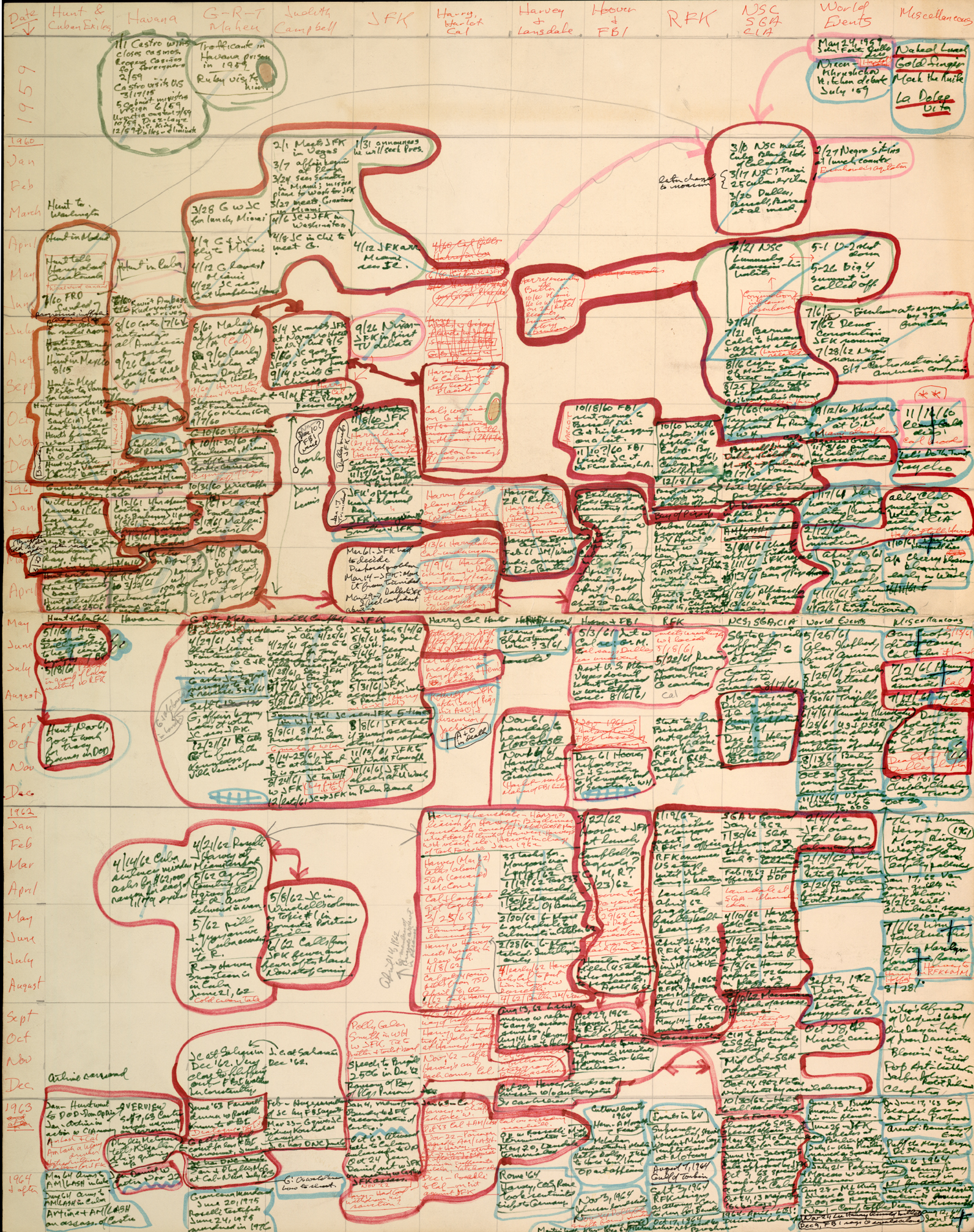
Norman Mailer wrote prolifically, but that didn’t mean cranking out insubstantial volumes. The books whose names we all remember always feel, when we take them down off the shelf, somewhat weightier than we remember: Advertisements for Myself at 532 pages, The Naked and the Dead at 731, The Executioner’s Song at 1072. But the ones with titles which don’t come to mind quite so readily can feel even more physically monumental, and deliberately crafted that way. “Mailer liked to think of his books as his children,” wrote Louis Menand in the author’s 2007 New Yorker obituary, “and, when asked which were his favorites, to name the least critically appreciated” — he answered, “Ancient Evenings and Harlot’s Ghost, great literary pyramids that no one visits any longer.” Ancient Evenings takes place in Egypt, among the actual pyramids, but if you want to visit the much more labyrinthine landmark of Harlot’s Ghost, you’d best take a map. Conveniently, Mailer drew one up himself, in the form of the outline above.
It would never before have seemed possible to me to reduce Mailer’s 1191-page novel of the CIA in the 1960s — a tale of the Mafia, the Cold War, the Cuban Revolution and Missile Crisis, the JFK assassination, and all those events’ attendant complications both real and imagined — to a single sheet, but here we have it. You can click on the image at the top of the post to enlarge it, and then click on the section you’d like to read in detail. Read Harlot’s Ghost with this outline handy, and perhaps you’ll find yourself not on the side of those (Menand included) who dismissed the book upon its publication in 1991, but of those who consider it Mailer’s masterpiece. Christopher Hitchens took the latter position in his own obituary for Mailer, calling the novel “a historic fictionalizing of the national-security state that came very near to realizing the Balzacian ambition that he had conceived for it. What a shame that it was so dismally received by the critics and that he never delivered the second volume of it that he had promised.” And imagine the size and complexity to which Mailer would have grown that book.
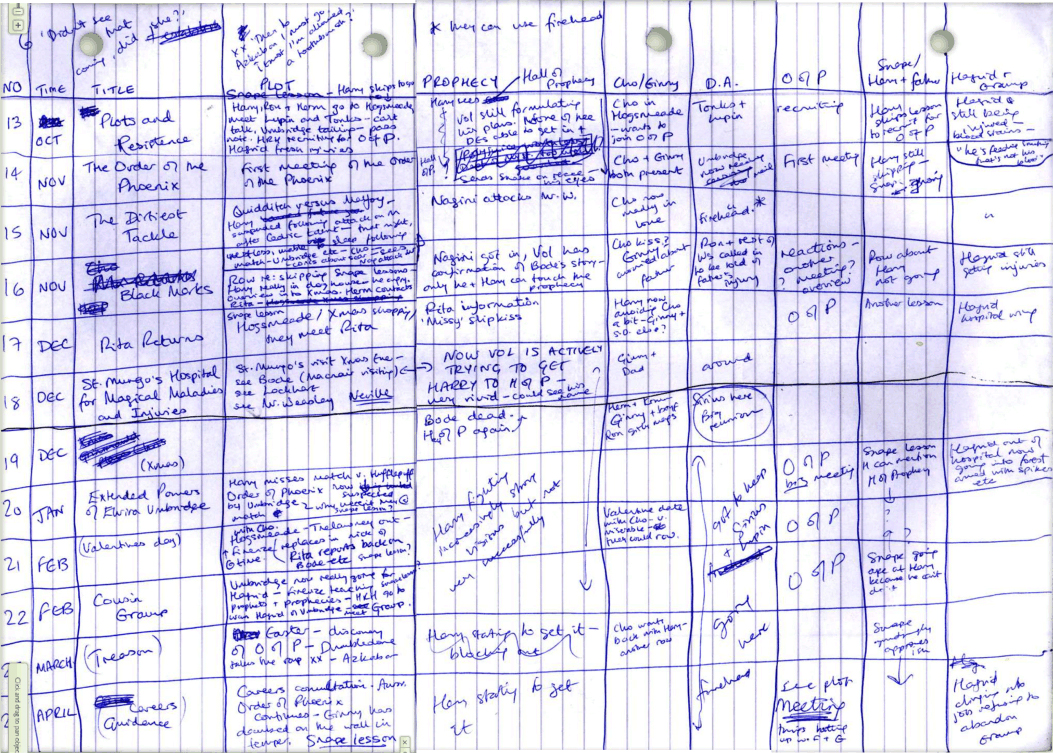
At the height of the Harry Potter novels’ popularity, I asked a number of people why those books in particular enjoyed such a devoted readership. Everyone gave almost the same answer: that author J.K. Rowling “tells a good story.” The response at once clarified everything and nothing; of course a “good story” can draw a large, enthusiastic (and, at that time, impatient) readership, but what does it take to actually tell a good story? People have probably made more money attempting, questionably, to pin down, define, and teach the best practices of storytelling, but at the top of this post, we have a revealing scrap of Rowling’s own process. And I do, almost literally, mean a scrap: this piece of lined paper contains part of the handwritten plot spreadsheet she used to write the fifth Harry Potter novel, Harry Potter and the Order of the Phoenix.
This particular page (click to view it in a larger format) covers chapters 13 through 24, during which even more happens than you may now remember. It may have amounted to more than Rowling, too, could remember, hence the spreadsheet itself. Endpaper explains some of her story notes as follows:
“Prophecy”: A subplot about the prophecy Harry finds himself concerned about all through the book
“Cho/Ginny”: The book’s romantic subplot
“D.A.”: What’s happening with the resistance army, or “Dumbledore’s Army”
“O of P”: What’s happening with the “Order of the Phoenix” group
“Snape/Harry”: What’s happening with Snape and Harry
“Hagrid and Grawp”: What’s happening with Hagrid and Grawp
“If you think about Harry Potter and the Order of the Phoenix, that’s it,” writes /Film’s Germain Lussier. “Those columns pretty much encompass the whole story.” Rowling, of course, hardly counts as the only novelist to write with such techniques, and based on this example, hers don’t get nearly as elaborate as some. (I recall once reading that Vikram Chandra had to bust out Microsoft Project to keep track of the complications of Sacred Games, his 900-page novel about the Mumbai underworld.) But Rowling must certainly rank as the most famous novelist to, quite literally, draw up spreadsheets like this. I suppose it does leave her books even more exposed to accusations of overplotting than before, but something tells me it won’t bother her.
Yesterday,E.O. Wilson’sLife on Earth was released asa free iBook on iTunes. It features “state-of-the-art digital media animations, video, and interactive modules in a comprehensive 41-chapter text covering standards-based biology curriculum.” Created under the direction of Pulitzer Prize-winning author and Harvard naturalist Edward O.Wilson, Life on Earth can be downloaded in 7 units on iTunes. The free book also comes with a free iTunesU course. In addition to reading assignments, the course “incorporates activities such as field observations, writing assignments, project-based learning exercises,” using apps and other materials. Combining information from the Smithsonian National Museum of Natural History, National Geographic, and the Encyclopedia of Life, the course covers a variety of important themes — citizen science, evolution, climate change, and protecting biodiversity. The first nine chapters of the iTunesU course are available now, and the remaining materials for the 41-chapter course will be released throughout 2014.
In the pages of The New York Times, David Brooks reeled off a list of Really Good Books. He prefaces the list with this: “People are always asking me what my favorite books are. I’ve held off listing them because it seems self-indulgent. But, with summer almost here, I thought I might spend a couple columns recommending eight books that have been pivotal in my life.” [He actually recommends more than 8 in the end.] Some of the books will help you think about living a life of “civilized ambition.” Others will nurture your inner spirit. And still others will help you think more intelligently about writing and politics. Along the way, he adds a quick caveat about what these books “can’t do.” “They can’t carve your convictions about the world. Only life can do that — only relationships, struggle, love, play and work. Books can give you vocabularies and frameworks to help you understand and decide, but life provides exactly the education you need.”
The list was published in two parts: Part 1 and Part 2. In each installment, Brooks explains why he selected each work. Where possible, we have provided links to texts available online. You can also find them listed in our collection, 800 Free eBooks for iPad, Kindle & Other Devices.
The look of this 1982 video magazine interview with Stephen King comes right out of a Laverne and Shirley episode, which makes it doubly charming. Broadcast at the time only in Bangor and Portland, this University of Maine production marks the first “up close and personal” TV interview with King, who represents one of the school’s “high achievers,” many of whom Henry Nevison interviewed for the local series. The interview takes place at King’s home in Bangor. Nevison describes the circumstances on his website:
At the time, King had just finished writing his novel “Christine” and one year earlier had starred in Creepshow, a campy horror/sci-fi movie based on several of his shorter stories. Initially, I conducted a radio interview and we discovered that we had a lot of similar interests, most importantly the same warped sense of humor. He then agreed to an extended “sit-down” television interview, even though he had avoided that concept up to this point. I think he did it because he knew it would be good for the university.
In his video intro, Nevison points out that King had published most of the horror novels that made his career—including Carrie, The Dead Zone, The Shining, The Stand, and Firestarter—and had already sold movie rights for those books. Which means he was a veritable pop-lit superstar even at this early point in his career. Through a bushy beard the size of a small woodchuck, King genially opines on whether leaving the light on at night keeps the monsters away (“bottom line,” it does) and how he keeps the scares fresh after so many stories and novels. We see him hunt and peck on an ancient, hulking word processor (perhaps composing “Word Processor of the Gods”) and look generally creepy but good-natured.
King and Nevison spend most of the nearly half-hour interview discussing the differences between books and film (they’re “diametrically opposed”). It’s a subject King has returned to several times over the years, often in complaint, venting for example over Stanley Kubrick’s 1980 take on The Shining. King glosses over his hatred of Kubrick’s film here, saying the book will outlive the movie (not likely, in this case). He also talks Hitchcock, and we see clips from a fairly decent student film production of his story “The Boogyman.” Much of the credit for this engaging interview should go to Nevison, who does what a good interviewer should: keeps the conversation going in new directions without getting in the way of it. It’s vintage King and sets the tone for the hundreds of televised interviews to come.
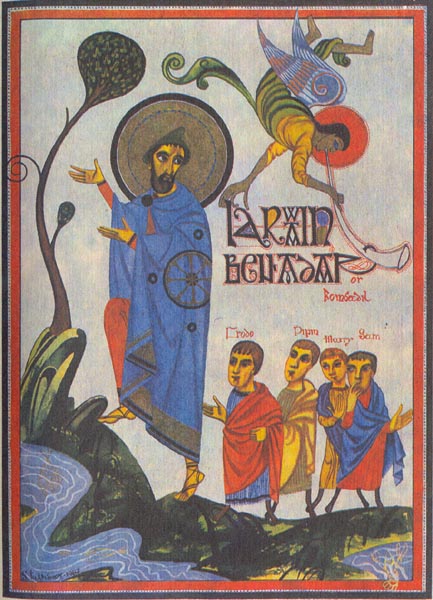
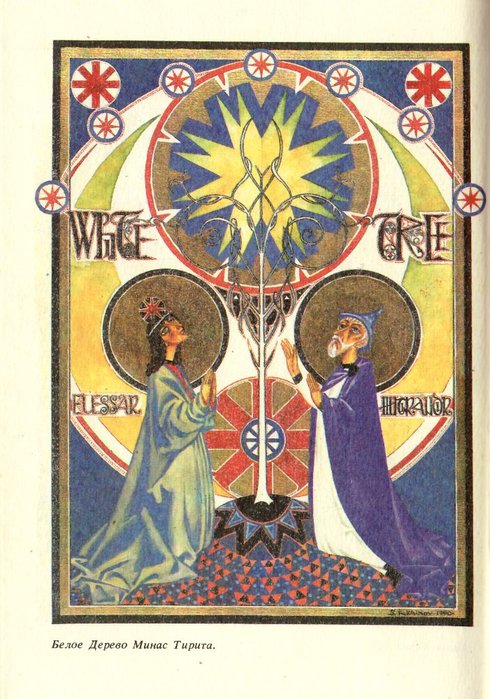
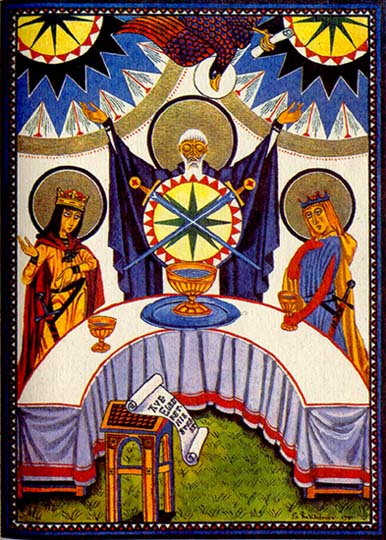
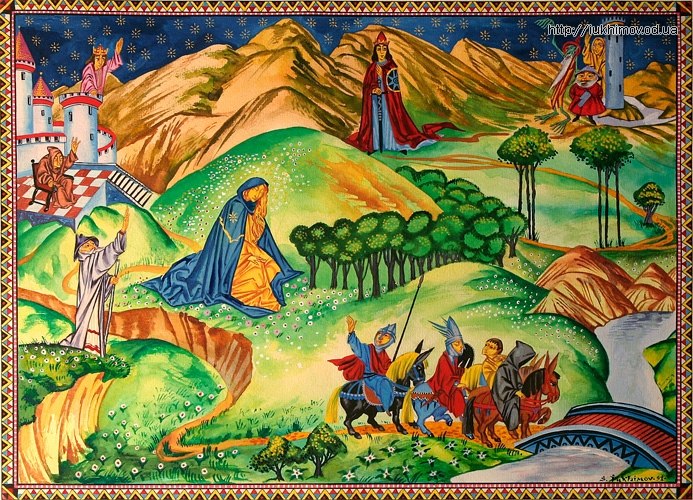
Given the detail with which J.R.R. Tolkien describes his fantastical yet earthily grounded characters and landscapes, you’d think illustrators would have an easy time putting pictures to the words. You might even assume that any artist who tried his or her hand at the job would produce more or less the same visual interpretation. And yet the history of illustrated editions of The Hobbit and the Lord of the Rings trilogy hasn’t gone that way at all. Different publishers at different times and different places have commissioned very stylistically different things. We have shown you examples of Tolkien’s Personal Book Cover Designs for The Lord of the Rings Trilogy as well as what Where the Wild Things Are author Maurice Sendak could come up with. And, in March, we featured a playfully visualized Soviet LOTR edition from 1976. Now, take a look at the large set of images here, pulled from a 1993 edition illustrated by Sergey Yuhimov (more information, albeit in Russian, here and here), and you’ll get the sense that the Russians may have a knack for visualizing the goings-on of Middle-Earth.
Still, the illustrations from Russia’s Hobbit and almost 30-years-newer Lord of the Rings could hardly share less of a sensibility. A Metafilter post on the latter draw a number of attempted descriptions by Tolkien fans: “LOTR translated almost as Christian iconography.” “They leap around about 1000 years of art history.” “Mad, but also charming.” “They would make great tarot cards.”
Objections may arise to the accuracy of the characters portrayed — as always — as well as the artist’s adherence (or lack thereof) to the traits of one period of art or another, but we can hardly ignore what an aesthetic impact these illustrations make even just on first glance. Some of the Metafilter commenters express their wishes for The Adventures of HuckleberryFinn (“used in Russian primary school curricula, or was during the Communist era”) illustrated this way, or maybe a Lord of the Rings “in the style of Hieronymus Bosch.” But from these vivid, stylistically Medieval, religious-icon-saturated images, I personally take away one conclusion: when the idea first came to find a director to bring Tolkien to the screen, they really should’ve hired Andrei Tarkovsky.
The gross and ever-increasing degree of economic inequality in the United States has become a phenomenon that even the country’s elites can no longer ignore since the explosive publication of Thomas Piketty’s Capital in the 21st Century. The book’s highly technical marshaling of data speaks primarily to economists and secondarily to liberal policymakers. Piketty’s calls for redistribution have lead to charges of “Marxism” from the other end of the political spectrum—due to some inevitable degree to the book’s provocative title. Yet in the reckoning of actual Marxist Slavoj Žižek, the French economist is still “a good Keynsian” who believes that “capitalism is ultimately the only game in town.” While the Marxist left may critique Piketty’s policy recommendations for their reliance on state capitalism, another fierce leftist thinker—Žižek’s sometime intellectual rival Noam Chomsky—might critique them for their acquiescence to state power.
Chomsky’s role as a public intellectual has placed him at the forefront of the left-anarchist fight against neoliberal political economy and the U.S. foreign and domestic policies that drive it. Whether those policies come from nominally liberal or conservative administrations, Chomsky asserts time and again that they ultimately serve the needs of elites at the expense of masses of people at home and abroad who pay the very dear cost of perpetual wars over resources and markets. In his 2013 book On Anarchism, Chomsky leaves little room for equivocation in his assessment of the role elites play in maintaining a state apparatus that suppresses popular movements:
If it is plausible that ideology will in general serve as a mask for self-interest, then it is a natural presumption that intellectuals, in interpreting history or formulating policy, will tend to adopt an elitist position, condemning popular movements and mass participation in decision making, and emphasizing rather the necessity for supervision by those who possess the knowledge and understanding that is required (so they claim) to manage society and control social change.
This excerpt is but one minute example of Chomsky’s fiercely independent stance against abuse of power in all its forms and his tireless advocacy for popular social movements. As Henry Giroux writes in a recent assessment of Chomsky’s voluminous body of work, what his many diverse books share is “a luminous theoretical, political, and forensic analysis of the functioning of the current global power structure, new and old modes of oppressive authority, and the ways in which neoliberal economic and social policies have produced more savage forms of global domination and corporate sovereignty.” And while he can sound like a doomsayer, Chomsky’s work also offers “the possibility of political and economic alternatives” and “a fresh language for a collective sense of agency and resistance.”
Today we offer a collection of Chomsky’s political books and interviews free to read online, courtesy of Znet. While these texts come from the 1990s, it’s surprising how fresh and relevant they still sound today. Chomsky’s granular parsing of economic, social, and military operations explains the engineering of the economic situation Piketty details, one ever more characterized by the title of a Chomsky interview, “The Prosperous Few and the Restless Many.” See links to nine books below. To read, click on links to either the “Content Overview” or “Table of Contents.” The books can also be found in our collection, 800 Free eBooks for iPad, Kindle & Other Devices.
Necessary Illusions: Thought Control in Democratic Societies (1989): Based on the Massey Lectures, delivered in Canada in November 1988, Necessary Illusions argues that, far from performing a watchdog role, the “free press” serves the needs of those in power.
Deterring Democracy (1991): Chomsky details the major shift in global politics that has left the United States unchallenged as the preeminent military power even as its economic might has declined drastically in the face of competition from Germany and Japan. Deterring Democracy points to the potentially catastrophic consequences of this new imbalance, and reveals a world in which the United States exploits its advantage ruthlessly to enforce its national interests — from Nicaragua to the Philippines, Panama to the Middle East.
Year 501: The Conquest Continues (1993): Analyzing Haiti, Latin America, Cuba, Indonesia, and even pockets of the Third World developing in the United States, Noam Chomsky draws parallels between the genocide of colonial times and the murder and exploitation associated with modern-day imperialism.
What Uncle Sam Really Wants (1993): A brilliant distillation of the real motivations behind U.S. foreign policy, compiled from talks and interviews completed between 1986 and 1991, with particular attention to Central America. [Note: If you have problems accessing this text, you can read it via this PDF.]
The Prosperous Few and the Restless Many (1994): A fascinating state-of-the-world report from the man the New York Times called “arguably the most important intellectual alive.”
We're hoping to rely on loyal readers, rather than erratic ads. Please click the Donate button and support Open Culture. You can use Paypal, Venmo, Patreon, even Crypto! We thank you!
Open Culture scours the web for the best educational media. We find the free courses and audio books you need, the language lessons & educational videos you want, and plenty of enlightenment in between.