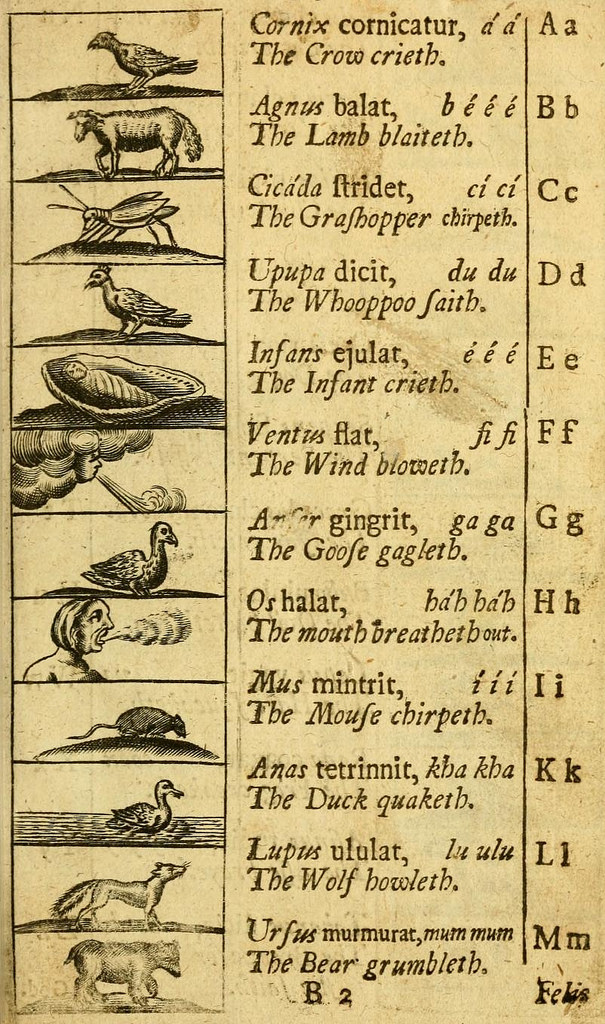
I’ve heard a fair few new parents agonizing about what children’s books to admit into the family canon. Many of the same names keep coming up: 1947’s Goodnight Moon, 1969’s The Very Hungry Caterpillar, 1977’s Everyone Poops — classics, all. Oddly, I’ve never heard any of them mention the earliest known children’s book, 1658’s Orbis Sensualium Pictus, or The World of Things Obvious to the Senses Drawn in Pictures. “With its 150 pictures showing everyday activities like brewing beer, tending gardens, and slaughtering animals,” writes Charles McNamara at The Public Domain review, the Orbis looks “immediately familiar as an ancestor of today’s children’s literature. This approach centered on the visual was a breakthrough in education for the young. [ … ] Unlike treatises on education and grammatical handbooks, it is aimed directly at the young and attempts to engage on their level.” In other words, its author, Czech-born school reformer John Comenius, accomplishes that still-rare feat of writing not down to children, but straight at them — albeit in Latin.
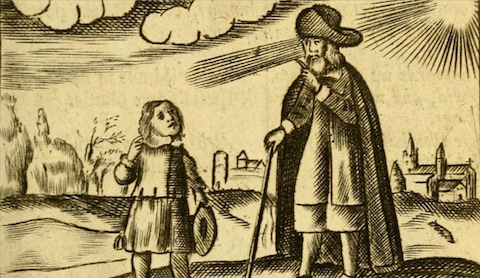
The Orbis holds not just the status of the first children’s book, but the first megahit in children’s publishing, receiving translations in a great many languages and becoming the most popular elementary textbook in Europe. It opens with a sentence that, in McNamara’s words, “would seem peculiar in today’s children’s books: ‘Come, boy, learn to be wise.’ We see above a teacher and student in dialogue, the former holding up his finger and sporting a cane and large hat, the latter listening in an emotional state somewhere between awe and anxiety. The student asks, ‘What doth this mean, to be wise?’ His teacher answers, ‘To understand rightly, to do rightly, and to speak out rightly all that are necessary.’ ” This leads into something like “an early version of ‘Old MacDonald Had a Farm,’ ” lessons on “the philosophical and the invisible,” “thirty-five chapters on theology, elements, plants, and animals,” and finally, an “extensive discussion” of religion which ends with “an admonition not to go out into the world at all.” After reading the Orbis, embedded in full at the top of this post, you can judge for yourself whether it belongs on the shelf. Perhaps you could file it alongside Richard Scarry’s Busytown books?
Green Reads has launched a crowd funding campaign on IndieGogo to build 15 eco-friendly, used book vending machines. Invented by Dana Clarke, the machines require no electricity and they’ll allow libraries, charities, and book retailers a way to sell used books and create a sustainable source of revenue. Green Reads is looking to raise $75,000 ($5000 per machine) by May 19. Once operational, the machines will be donated (not sold) to libraries and charities. You can get a lot more information and contribute to this worthy campaign right here.
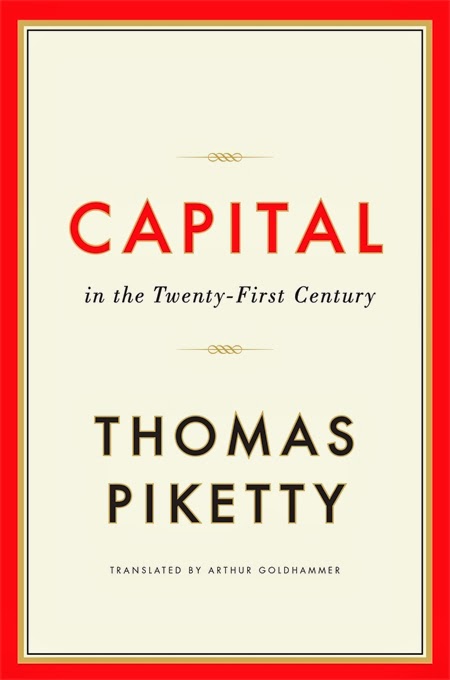
The distribution of wealth is one of today’s most widely discussed and controversial issues. But what do we really know about its evolution over the long term? Do the dynamics of private capital accumulation inevitably lead to the concentration of wealth in ever fewer hands, as Karl Marx believed in the nineteenth century? Or do the balancing forces of growth, competition, and technological progress lead in later stages of development to reduced inequality and greater harmony among the classes, as Simon Kuznets thought in the twentieth century? What do we really know about how wealth and income have evolved since the eighteenth century, and what lessons can we derive from that knowledge for the century now under way?
Capital (which by Piketty’s definition is pretty much the same thing as wealth) has tended over time to grow faster than the overall economy. Income from capital is invariably much less evenly distributed than labor income. Together these amount to a powerful force for increasing inequality. Piketty doesn’t take things as far as Marx, who saw capital’s growth eventually strangling the economy and bringing on its own collapse, and he’s witheringly disdainful of Marx’s data-collection techniques. But his real beef is with the mainstream economic teachings that more capital and lower taxes on capital bring faster growth and higher wages, and that economic dynamism will automatically keep inequality at bay. Over the two-plus centuries for which good records exist, the only major decline in capital’s economic share and in economic inequality was the result of World Wars I and II, which destroyed lots of capital and brought much higher taxes in the U.S. and Europe. This period of capital destruction was followed by a spectacular run of economic growth. Now, after decades of peace, slowing growth, and declining tax rates, capital and inequality are on the rise all over the developed world, and it’s not clear what if anything will alter that trajectory in the decades to come.
On this side of the Atlantic, wealth and income were less concentrated in the 19th century than in Europe. After a spike in top incomes that topped out in the late 1920s, the income distribution flattened out here again, albeit in less dramatic fashion than in Europe. Since the 1970s, though, the U.S. has seen a sharp and unparalleled increase in the percentage of income going to the top 1% and especially 0.1%. This has not been driven by the capital and inheritance dynamics at the heart of Piketty’s story. He attributes it instead to the rise of what he calls “supermanagers.” Piketty cites recent research that shows managers and financial professionals making up 60% of the top 0.1% of the income distribution in the U.S., and proposes that their skyrocketing pay is mainly the product of sharp declines in top marginal tax rates that made it worth managers’ while to bargain harder for raises. This isn’t the only explanation available, and Piketty’s discussion of U.S. inequality doesn’t carry the same historical authority as other parts of the book. But it surely is interesting that, as he and several co-authors report in a new article in the American Economic Journal: Economic Policy, the rise in the top-percentile income share in 13 countries was almost perfectly correlated with declines in top marginal tax rates in those countries. It’s also interesting that this huge rise in relative income inequality has brought no discernible economic benefit. Yes, the U.S. economy has grown a bit faster than those of other developed economies, but that’s purely because of population growth. Per-capita economic growth has been almost identical in the U.S. and Western Europe since 1980, and because of the skew towards the top here, U.S. median income has actually lost ground relative to other nations.
But why let HBR give you insight into Piketty’s thinking when Piketty can do it himself. Below we have a talk he gave at the Economic Policy Institute earlier this month. He starts speaking at the 5:30 mark.
And finally Paul Krugman’s review in the New York Review of Books — “We’re in a New Gilded Age” — is worth a read.
We were somewhere around Barstow on the edge of the desert when the drugs began to take hold. I remember saying something like “I feel a bit lightheaded; maybe you should drive. …” And suddenly there was a terrible roar all around us and the sky was full of what looked like huge bats, all swooping and screeching and diving around the car, which was going about 100 miles an hour with the top down to Las Vegas. And a voice was screaming: “Holy Jesus! What are these goddamn animals?”
If you would like to support the mission of Open Culture, consider making a donation to our site. It’s hard to rely 100% on ads, and your contributions will help us continue providing the best free cultural and educational materials to learners everywhere. You can contribute through PayPal, Patreon, and Venmo (@openculture). Thanks!
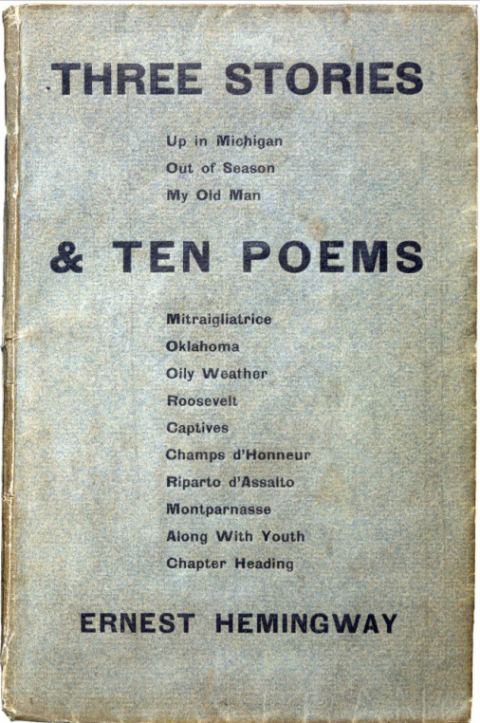
“I like the early stuff”: the classic masculine comment to make about the work of a well-known creator, demonstrating as it does the cultural consumer’s dedication, purism, judgmental rigor, and even endurance (given the relative accessibility, in the intellectual as well as the collector’s senses, of most “early stuff”). Now you have a chance to say it about that most ostensibly masculine of all 20th-century American writers, Ernest Hemingway. Above, see the cover of a coveted edition of the then-young “Papa“ ‘s very first book, 1923’s Three Stories & Ten Poems. The print run numbered only “300 copies, put out by friend and fellow expatriate, the writer- publisher Robert McAlmon,” writes Steve King at Today in Literature. “Both had arrived in Paris in 1921, Hemingway an unpublished twenty-two-year-old journalist with a recent bride, a handful of letters of introduction provided by Sherwood Anderson, and a clear imperative: ‘All you have to do is write one true sentence.’ ”
Instead of shelling out to a rare-book dealer for Three Stories & Ten Poems — admire the sacrifice involved though a true Hemingwayite may — you can read even more of the Old Man and the Sea author’s early stuff in the free e‑book embedded just above: 1946’s The First Forty Nine Stories. It contains not just “Up in Michigan,” “Out of Season,” and “My Old Man,” those three stories of Hemingway’s bound debut, but, yes, 46 more of his earliest published pieces of short-form fiction. Today in Literature quotes one notable contemporary reaction to Three Stories & Ten Poems, from a time before Hemingway had become Hemingway, much less Papa: “I should say that Hemingway should stick to poetry and intelligence and eschew the hotter emotions and the more turgid vision. Intelligence and a great deal of it is a good thing to use when you have it, it’s all for the best.” And who could have written such an astute early assessment of the ultimate literary man’s man? A certain Gertrude Stein.
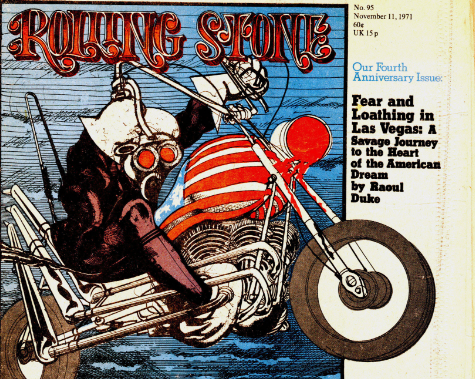
Of all his writing though, his book Fear and Loathing in Las Vegas, a journey through bat country and into the twisted dark heart of the American soul, is his most famous and beloved. And aside from perhaps the book’s opening line – “We were somewhere around Barstow on the edge of the desert when the drugs began to take hold” – the most memorable section of the work is his “wave speech” which shows up in the eighth chapter. It is a poetic, heartfelt monologue about the idealism and the crushed dreams of the 1960s. Thompson himself said that the passage is “one of the best things I’ve ever fucking written.”
You can see Johnny Depp — who has played Thompson twice on the silver screen — read an abbreviated version of the speech above. You can read along below. And make sure you turn up your speakers a bit.
Strange memories on this nervous night in Las Vegas. Five years later? Six? It seems like a lifetime, or at least a Main Era—the kind of peak that never comes again. San Francisco in the middle sixties was a very special time and place to be a part of. Maybe it meant something. Maybe not, in the long run… but no explanation, no mix of words or music or memories can touch that sense of knowing that you were there and alive in that corner of time and the world. Whatever it meant.…
History is hard to know, because of all the hired bullshit, but even without being sure of “history” it seems entirely reasonable to think that every now and then the energy of a whole generation comes to a head in a long fine flash, for reasons that nobody really understands at the time—and which never explain, in retrospect, what actually happened.
[…]
There was madness in any direction, at any hour. If not across the Bay, then up the Golden Gate or down 101 to Los Altos or La Honda.… You could strike sparks anywhere. There was a fantastic universal sense that whatever we were doing was right, that we were winning.…
And that, I think, was the handle—that sense of inevitable victory over the forces of Old and Evil. Not in any mean or military sense; we didn’t need that. Our energy would simply prevail. There was no point in fighting—on our side or theirs. We had all the momentum; we were riding the crest of a high and beautiful wave.…
So now, less than five years later, you can go up on a steep hill in Las Vegas and look West, and with the right kind of eyes you can almost see the high-water mark—that place where the wave finally broke and rolled back.
Fear and Loathing was, of course, adapted into a 1998 film starring Depp after a very long development stage. Alex Cox – who directed the punk cult hit Repo Man – was originally slated to make the movie until he made the mistake of proposing to turn the wave speech into an animated sequence. Thompson was extremely unimpressed. Cox got canned and soon after Terry Gilliam was given the reins to the film. You can see the Gilliam’s treatment of the wave speech sequence below.
Jonathan Crow is a Los Angeles-based writer and filmmaker whose work has appeared in Yahoo!, The Hollywood Reporter, and other publications. You can follow him at @jonccrow.
Humanity has long pondered the relative might of the pen and the sword. While one time-worn aphorism does grant the advantage to the pen, most of us have entertained doubts: the sword, metaphorically or literally, seems to have won out across an awfully wide swath of history. Still, the pen has scored some impressive victories, some even in living memory. Take, for example, the CIA’s recently revealed use of Boris Pasternak’s novel Doctor Zhivagoas a propaganda weapon. Repressed in Pasternak’s native Russia, the book first appeared in Italy in 1957. The following year, the British suggested to America’s Central Intelligence Agency that the book stood a decent chance of winning hearts and minds behind the Iron Curtain — if, of course, they could get a few copies in there. A CIA memo sent across its own Soviet Russia Division subsequently pronounced Doctor Zhivago as possessed of “great propaganda value, not only for its intrinsic message and thought-provoking nature, but also for the circumstances of its publication. We have the opportunity to make Soviet citizens wonder what is wrong with their government, when a fine literary work by the man acknowledged to be the greatest living Russian writer is not even available in his own country in his own language for his own people to read.”
That evaluation comes from one of the over 130 declassified documents used by Peter Finn and Petra Couvée in their brand new history of this act of real-life literary espionage, The Zhivago Affair: The Kremlin, the CIA and the Battle Over a Forbidden Book. You can read an in-depth article on some of the events involved in this operation — the CIA’s printing of both hardcover and miniature paperback Russian-language editions, the not-so-clandestine distribution of copies at 1958’s Brussels Universal and International Exposition, the CIA’s unexpected alliance with the Vatican in this mission, the inept probing by Soviet “researchers” — at the Washington Post.
You can also watch a CBS This Morning clip on the book just above. Dramatic though this “Zhivago Affair” sounds, it came as neither the first nor last American use of culture as a means of destabilizing the Soviet Union. We’ve even previously featured two others: secretly-funded abstract expressionist painting, and Louis Armstrong’s 1965 East Berlin and Budapest concerts. Cold War America may have had the sword, in the form of its vast nuclear arsenal, polished and ready, but clearly it retained a certain regard for the pen — and brush, and trumpet — as well.
For at least a decade now, the “death of print” has seemed all but inevitable. Amidst all the nostalgia for printed literature, it’s easy to forget that mass-produced books and media, and a literate population, are fairly recent phenomena in human history. Books—whether printed or hand-copied—had a totemic status for thousands of years, given that they were kept under the protection of an educated elite, who were among the few able to read and interpret them. Even after the age of printing, books were rare and hard to come by, largely too expensive for most people to afford until the advent of paperbacks.
A grisly reminder of the book’s status as an almost magical object surfaced in Harvard’s rare book collection a few years ago. In 2006, librarians discovered at least three volumes bound in human skin—and as travel site Roadtrippers reports, “in one case, skin harvested from a man who was flayed alive.” Gruesome as all this seems, the practice of skin-binding was apparently not the sole province of serial killers:
As it turns out, the practice of using human skin to bind books was actually pretty popular during the 17th century. It’s referred to as Anthropodermic bibliopegy and proved pretty common when it came to anatomical textbooks. Medical professionals would often use the flesh of cadavers they’d dissected during their research.
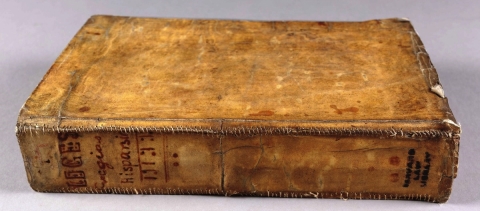
The book supposedly made of flayed skin is a Spanish law text from the seventeenth century titled Practicarum quaestionum circa leges regias (above). Despite an inscription naming the deceased and claiming his skin as the binding, this volume has actually just been identified as sheepskin—according to a Harvard Law Library blog post from yesterday—“thanks to a technique for identifying proteins that was developed in the last twenty years.” Speculates the Law Library post:
Perhaps before it arrived at HLS [Harvard Law School] in 1946, the book was bound in a different binding at some point in its history. Or perhaps the inscription was simply the product of someone’s macabre imagination.
Nevertheless, other human skin-bound books exist—as far as librarians and scientists can determine. Former director of libraries for the University of Kentucky Lawrence S. Thompson claims that the practice dates as far back as a 13th century French Bible and became more common in the 16th and 17th centuries. A 1933 Crimson article mentioned another skin-bound book in a collection of miniature books, including this graphic detail: “removal of 20 square inches of skin from his back failed to impair the health of its donor, who is still alive and in the best of condition.”
Another skin-bound volume, which Thompson calls “the most famous of all anthropodermic bindings,” resides across the river from Harvard at independent library the Boston Athenaeum. Called The Highwayman: Narrative of the Life of James Allen alias George Walton(above), the book is a memoir of the titular outlaw. The author, reports the Crimson, “was impressed by the courage of a man whom he once attacked, and when Walton was facing execution, he asked to have his memoir bound in his own skin and presented to the brave man.” Thumb through (so to speak) a digital copy of Walton’s 1837 memoir above, and imagine being the recipient of such a gift.
We're hoping to rely on loyal readers, rather than erratic ads. Please click the Donate button and support Open Culture. You can use Paypal, Venmo, Patreon, even Crypto! We thank you!
Open Culture scours the web for the best educational media. We find the free courses and audio books you need, the language lessons & educational videos you want, and plenty of enlightenment in between.