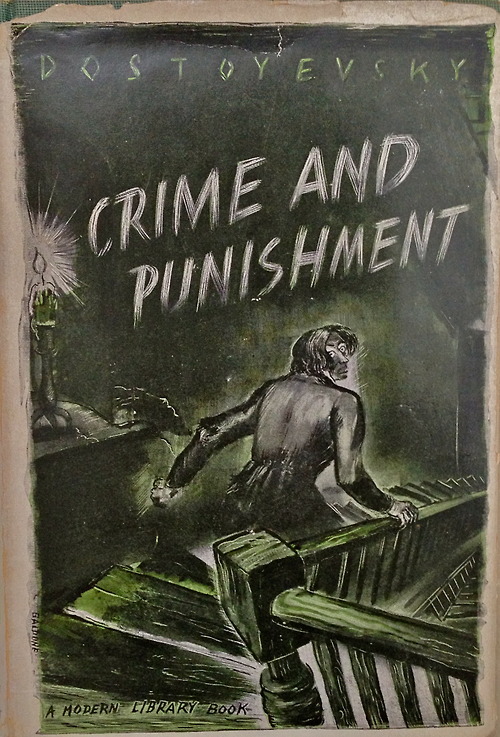
While I normally try not to get involved with comments on web sites (you know what I mean), I’d rather get involved with the comments of some web sites than others. I doubt that underneath any Youtube video, for example, you’d find dozens and dozens of well-considered suggestions for the canon of books every intelligent person should read, as we did here at Open Culture when we put the question to you on Wednesday. In the comments to that post as well as on our Facebook Page, we received a host of responses scattered satisfyingly across the textual map: everything from Michel Foucault to Foucault’s Pendulum, Gibbon’s History of the Decline and Fall of the Roman Empire to Bryson’s Short History of Nearly Everything, 18th-century German philosopher Immanuel Kant to reptilian conspiracy-envisioning ex-footballer David Icke. The top-ranking volume? Fyodor Dostoyevsky’s Crime and Punishment (available, incidentally, in our free eBook collection: Kindle from Amazon – Read Online), followed by Herman Melville’s Moby-Dick (available there too: iPad/iPhone — Kindle + Other Formats). Let none say that Open Culture readers shy away from weighty literature.
Other, shorter novels popularly suggested include Voltaire’s Candide (iPad/iPhone — Kindle + Other Formats), Joseph Conrad’s Heart of Darkness (iPad/iPhone – Kindle + Other Formats), and George Orwell’s 1984 (Read Online). We also received a number of votes for books famously pored over for thousands upon thousands of hours by their enthusiasts, such as the Bible, Dante’s Divine Comedy (iPad/iPhone – Kindle + Other Formats), and Ayn Rand’s Atlas Shrugged. (Given the formidable internet presence of Rand’s readers, I expected more of an inundation of her titles, but they must not have turned out in force this time.) Such classic and deceptively universal guides to strategy as Sun Tzu’s The Art of War (iPad/iPhone — Kindle + Other Formats – Read Online) and Niccolò Machiavelli’s The Prince (iPad/iPhone — Kindle + Other Formats) also placed well, as did books like Plato’s Republic (iPad/iPhone – Kindle + Other Formats — Read Online), Henry David Thoreau’s Walden (iPad/iPhone – Kindle + Other Formats), and Hermann Hesse’s Siddartha (Kindle + Other Formats) — the ones you probably got assigned once, but that you may not then have understood why you should actually read.
The recommendations fascinate, but so do their justifications. (My personal favorite: “It’s a book about shamanism, although it’s not what you would expect from a socially accepted description of shamanism.”) Jo Stafford calls Crime and Punishment and Moby-Dick, the two big winners, “perfect examples of how great fiction can pose the ‘big questions’, particularly around what it means to act morally.” Moira pitches Robert M. Pirsig’s Zen and the Art of Motorcycle Maintenance as a “modern study of the schism between classicist and romanticist thinking.” Nick Williams says Candide “still feeds the inner cynic,” and Jason considers Walden “a better lesson on capitalism than The Wealth of Nations.” Arthur McMillan recommends Julian Barnes’ A History of the World in 10½ Chapters by holding out the promise that it “encapsulates the sheer futility of everything[ness].” Another reader suggests William Godwin’s Political Enquiry “to be reminded what books inspired us to be: free.” Wise words indeed, Mr. Beer N. Hockey.
Related Content:
575 Free eBooks: Download Great Books for Free
What Books Should Every Intelligent Person Read?: Tell Us Your Picks; We’ll Tell You Ours
See Nobel Laureate Joseph Brodsky’s Reading List For Having an Intelligent Conversation
Colin Marshall hosts and produces Notebook on Cities and Culture and writes essays on cities, language, Asia, and men’s style. He’s at work on a book about Los Angeles, A Los Angeles Primer. Follow him on Twitter at @colinmarshall or on Facebook.