Perhaps they’d barricade themselves into separate rooms, hunched over their individual screens, cursing their roommates for slowing down their livestreams, but we prefer to think they’d busy themselves with projects such as Dzama’s short film, “Dance Floor Dracula, Prelude in C‑Sharp Minor.”
Much of the content seems germane to the world we find ourselves in now, when the creative playing field feels remarkably open to our participation, thanks to crowdsourced projects like the ongoing photo challenge wherein ordinary citizens are using their phones and household objects to recreate famous artworks at home.
Painter Tala Madani takes viewers through her sketchbook and talks about its value as a method of capturing ideas and as the “most immediate record of the thinking process.” The cartoonish quality of her sketches may help those who’d let a lack of confidence in their artistic ability stop them from attempting to document their observations of our changed reality visually. A sketchbook is also a great place for the seeds of future projects to germinate.
The preparations for Oakland’s Creative Growth Art Center’s annual fashion show, Beyond Trend, could send you scuttling to your closet or recycling bin, inspired by William Scott’s papier-mâché Frankenstein mask—a five day effort—or the patches Christine Szeto embroiders with titles of favorite Taylor Swift songs, then sews to her jeans in orderly columns.
This sort of wearable art doesn’t require advanced needle skills or knowledge of how garments are put together, making it perfectly tailored to those open to exploring new sides of themselves in isolation.
That said, we are sure the featured designers are anxiously awaiting the reopening of Creative Growth, which serves artists with developmental, mental, and physical disabilities.
Community and creativity are showing themselves to be equally essential to our wellbeing.
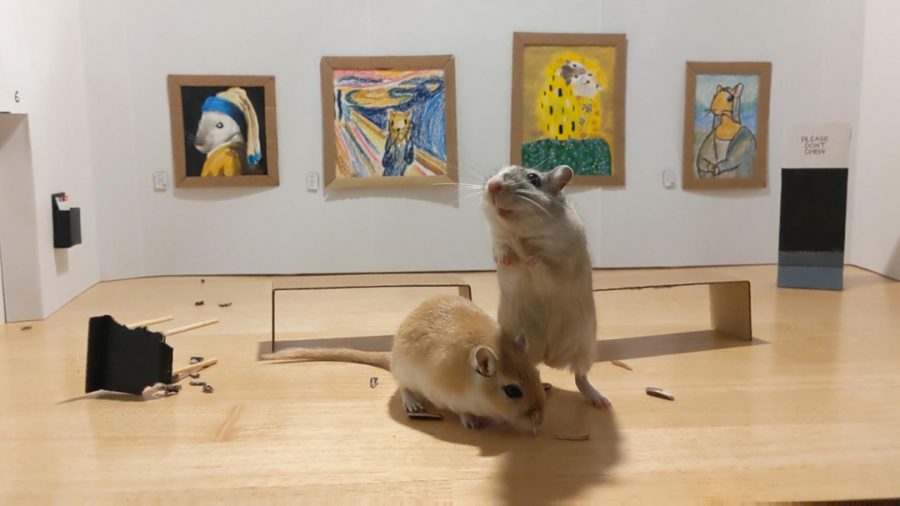
Scanga’s installation involved hanging mini-replicas of works from the Metropolitan Museum’s American collection on extremely long wires that traveled from under-ceiling picture rail to the baseboard, where a collection of art-loving taxidermied mice waited expectantly. One rested on a familiar-looking, black vinyl upholstered bench, a tiny blue shopping bag from the Met’s gift store parked near its dainty, shoeless feet.
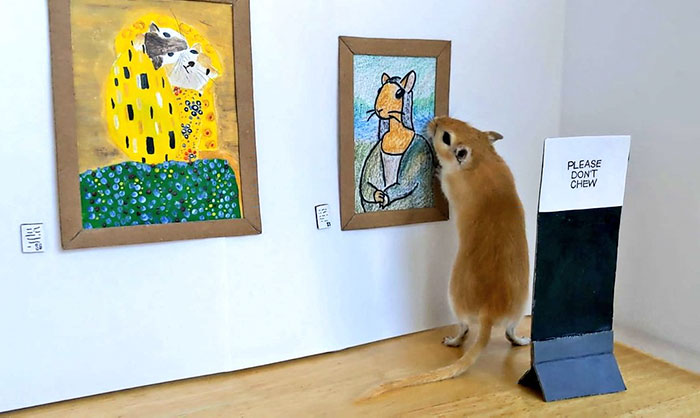
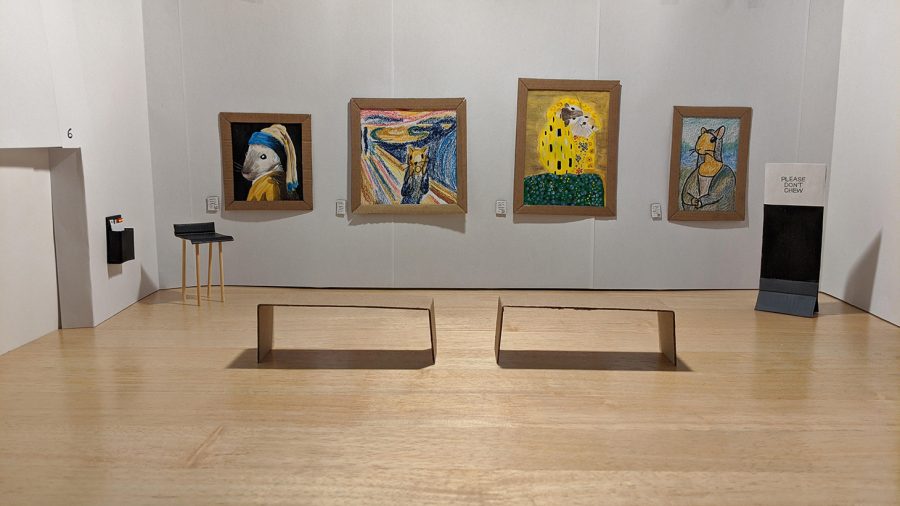
Filippo and Marianna’s art-loving rodents are gerbils, and unlike Scanga’s artfully stuffed models, theirs—9‑month-old brothers Pandoro and Tiramisù—are very much alive, as Tiramisù proved when he gnawed the unseen gallery assistant’s painstakingly assembled cardboard stool to bits under the watchful eye of the tiny Girl with a Pearl Earringfacsimile Marianna crafted for his cultural enrichment.
A video the couple published on Reddit, above, shows the furry museum goers scampering under the benches to the tune of “The Blue Danube” and placing their paws on the artwork, including an expert, gerbil-themed forgery of Gustav Klimt’s gold-flecked Symbolist masterpiece, The Kiss.
Not to be vulgar, but if this museum has a restroom, Pandoro and Tiramisù seem to have given it a miss, an impropriety surpassing any waged by the titular characters of Beatrix Potter’s Tale of Two Bad Mice.
Filippo and Marianna accepted the destruction of their exquisitely staged set with a cheer that suggests they’re not shut up for the duration with a small child… just gerbils, who can be deposited back into their Habitrail when the fun’s over.
The attention to detail—the gallery tags! The laminated cards in multiple languages in a wall-mounted holder!—captured the imagination of Reddit. Users jumped Marianna’s original post—(Quarantine, day 14. Me and my boyfriend spent the whole day setting up an art gallery for our gerbil)—with suggestions of other famous works to recreate in miniature and add to the collection. Rest assured no groan-worthy, pun-based, gerbil-centric title was left unexpressed.
With cultural institutions temporarily shuttered for the good of public health, many viewers also shared their yearning to get back inside favorite museums. (Marianna reports that Filippo is a museum worker.)
For now, we must be patient, and live vicariously through gerbils ’til the long wait is over.
One can only tolerate so many educational videos in self-isolation before the brain begins to rebel.
Hands-on learning. That’s what we’re craving.
And ultimately, that’s what the Getty provides with an addictive challenge to captive audiences on Twitter, Facebook, and Instagram to re-create iconic artworks using three household objects.
Participants are encouraged to look at the Getty’s downloadable, digitized collection and beyond for a piece that speaks to them, possibly because of their ability to match it by dint of hair color, physique or perfect prop.)
Certain works quickly emerged as favorites, with Johannes Vermeer’s Girl with a Pearl Earring (c. 1665) the clear front runner.
Girl with a Pearl Earring is Vermeer’s most famous painting. It is not a portrait, but a ‘tronie’ – a painting of an imaginary figure. Tronies depict a certain type or character; in this case a girl in exotic dress, wearing an oriental turban and an improbably large pearl in her ear.
Johannes Vermeer was the master of light. This is shown here in the softness of the girl’s face and the glimmers of light on her moist lips. And of course, the shining pearl.
Vermeer’s extraordinary application of light and shadow is a tall order for most amateurs, but it’s wonderful to see how much careful consideration has been given to the original subject’s expression, the cant of her head, the arrangement of her garments.
It seems the best way to study a work of art is to become that work of art… especially when one is trapped at home, seeking distraction, and forced to improvise with available objects.
Let us pray we’ll be set loose long before Halloween, but also that the challenge takers won’t forget how ingenious, easily sourced, and cost-effective their costumes were: a pillowcase, a button, an inverted party dress, the hem of a sibling’s blue t‑shirt, rescued from the rag bag still smelling faintly of vinegar from pre-coronavirus household cleaning.
That off-the-rack “sexy cat” won’t stand a chance.
No one’s disqualified if the number of items used in service of these recreations exceeds the originally stiuplated 3. As long as the participants are having (educational!) fun, this is one of those challenges where everybody wins… especially the baby, the dog, the guy with the mustache and the lady with the turkey on her head, even though the baby and the guy with the mustache forgot their earrings.
He’s not wrong about the therapeutic benefits of group singing. Ditto the imperative to resist gathering publicly, or even in the homes of extended family and close friends, until this crisis is in the rear view.
Choir! Choir! Choir!, an ongoing community sing that’s attained global renown thanks to its frequent tours, charitable work, and the support of such starry personages as Patti Smith and David Byrne, has had to put the kibosh on live group events. (Check out their 2014 singalong of Diamond’s “Sweet Caroline,” above, for a taste of the proceedings.)
With everyone staying home, founders Nobu Adilman and Daveed Goldman quickly implemented a digital work around, inviting fans and first-timers alike to weekly online sing-ins.
Their next Social Distan-Sing-Along is coming up this Saturday, April 4th at 3pm EDT, featuring a campfire-themed playlist:
“The Weight”
“Blowin’ In The Wind”
“Our House”
“Leaving On A Jet Plane”
“Redemption Song”
“Talkin Bout A Revolution”
“Dust In The Wind”
“Cats In The Cradle”
“Wild World”
(Sadly, no “Titanic,” but perhaps that one’s more summer camp than campfire, and these days, it’s probably best to sidestep any number, no matter how silly, that springs from mass casualties…)
Participants are instructed to print a file of the song lyrics in advance and show up to the digital campfire (live streaming on YouTube or Facebook) with a couple of devices—enough to follow along with Adilman and Goldman, while simultaneously Zooming in any friends you’ve pre-arranged to sing with.
(With 1000s attending, one of Choir! Choir! Choir!’s usual joys—lifting one’s voice with a vast chorus of mostly strangers—is a logistical and technological impossibility.)
Participants are also encouraged to share footage of themselves singing along, using the hashtag #NeverStopSinging—though we remind our non-performance-oriented readers that this is merely a suggestion.
Choir! Choir! Choir in isolation may well attract shower Sinatras who’d never dream of opening their mouths at an in-person event.
It’s a golden opportunity for the vocally shy to become part of one of the biggest choirs in history, secure in the knowledge that the only people to hear them croaking away will be the cat, the dog, any human co-inhabitants… and, oh dear, what about neighbors in the immediate vicinity?
Don’t worry about the neighbors. In fact, prick up your ears—you may hear them singing the exact same tunes.
To get you in the mood, here are some of our favorites from Choir! Choir! Choir!’s classic playlist:
When I became the Kennedy Center Education Artist-in-Residence, I didn’t realize the most impactful word in that title would be “Residence.” —illustrator Mo Willems
Even as schools regroup and online instruction gathers steam, the scramble continues to keep cooped-up kids engaged and happy.
These COVID-19-prompted online drawing lessons and activities might not hold much appeal for the single-minded sports nut or the junior Feynman who scoffs at the transformative properties of art, but for the art‑y kid, or fans of certain children’s illustrators, these are an excellent diversion.
Once the design is complete, he rolls the dice to advance both his piece and that of his home viewer. A 5 lands him on the crowd-pleasing directive “fart.” Clearly the online instructor enjoys certain liberties the classroom teacher would be ill-advised to attempt.
Check out the full playlist on the Kennedy Center’s YouTube channel and download activity pages for each episode here.
#MoLunchDoodles
If the daily LUNCHDOODLES leaves ‘em wanting more, there’s just enough time for a quick pee and snack break before Lunch Lady’sJarrett J. Krosoczka takes over with Draw Everyday with JJK, a basic illustration lesson every weekday at 2pm EST. These are a bit more nitty gritty, as JJK, the kid who loved to draw and grew up to be an artist, shares practical tips on penciling, inking, and drawing faces. Pro tip: resistant Star Wars fans will likely be hooked by the first episode’s Yoda, a character Krosoczka is well versed in as the author and illustrator of the Star Wars Jedi Academy series.
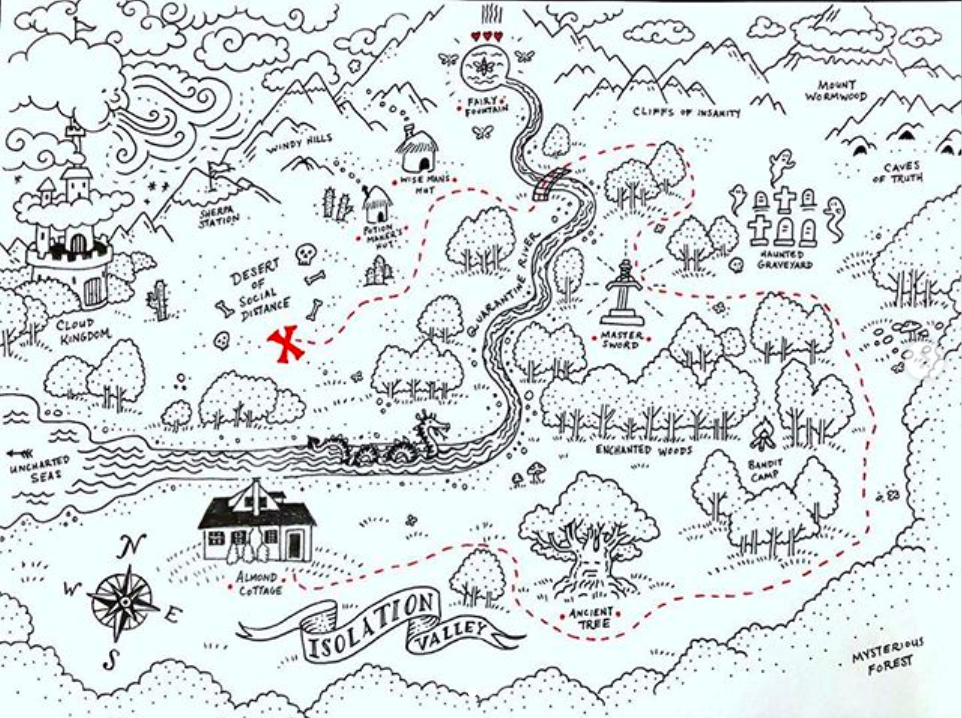
DRAW A MAP: When we think of treasure maps, we think of sea monsters, islands with palm trees, pirate ships, anthropomorphic clouds blowing gales upon white-capped seas. YOUR map can be of anywhere: an enchanted wood, a dystopian suburb, your backyard, your apartment that has never felt so small, all of the above, none of the above. Or your map can be a traditional treasure map leading to a pirate’s hoard. It’s totally up to you. Three things that you MUST include are: a compass rose (very important—look this up if you don’t know what it is), the name of the place you are mapping, and a red X.
DRAW THE TREASURE: The first part of this assignment is to draw a map with a red X to mark the location of hidden treasure. The second part of this assignment is to draw the treasure. I don’t know what the treasure is. Only you know what the treasure is. Draw it on a separate piece of paper from the map.
BONUS POINTS: If you’re going to post this on instagram, I recommend formatting it with two images. Post the map first, then the treasure which the viewer will swipe to see. This will create what we in the kids book world call AN IMPACTFUL PAGE TURN. That’s the thing that happens when you’re reading a picture book and you turn the page to discover something funny or surprising. It’s kind of hard to explain, but you know a good page turn when you’ve experienced one.
#QuarantineArtClub
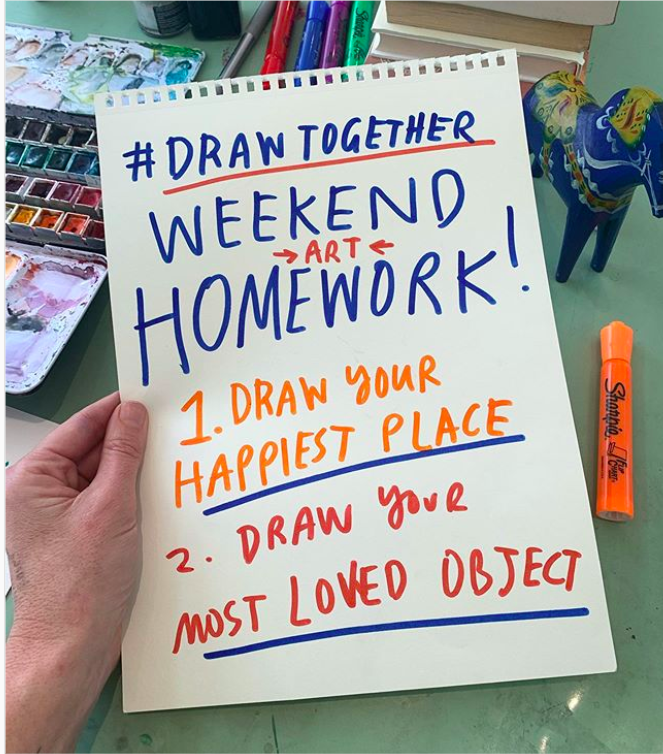
Wendy McNaughton, who specializes in drawn journalism, also likes the Instagram platform, hosting a live Draw Together session every school day, from 10–10.30 am PST. Her approach is a bit more freeform, with impromptu dance parties, special guests, and field trips to the backyard.
Her How to Watch Draw Together highlight is a hilarious crash course in Instagram Live, scrawled in magic marker by someone who’s possibly only now just getting a grip on the platform. Don’t see it? Maybe it’s the weekend, or “maybe ask a millennial for help?”
And bless E.B. Goodale, an illustrator, first time author and mother of a young son, who having counteracted the heartbreak of a cancelled book tour with a hastily launched week of daily Instagram Live Toddler Drawing Club meetings, made the decision to scale back to just Tuesdays and Thursdays:
It was fun doing it everyday but turned out to be a bit too much to handle given our family’s new schedule. We’re all figuring it out, right? I hope you will continue to join me in our unchartered territory next week as we draw to stay sane. Tune in live to make requests or watch it later and follow along at home.
(Her How to Draw a Cat tutorial, above, was likely intended for in-person bookstore events relating to her just published Under the Lilacs…)
#drawingwithtoddlers
Our personal favorite is Stickies Art School, whose online children’s classes are led not by multi-disciplinary artist Nina Katchadourian, whose Facebook page serves as the online institution’s home, but rather her senior tuxedo cat, Stickies.
Stickies, who comes to the gig with an impressive command of English, honed no doubt by frequent appearances on Katchadourian’s Instagram page, affects a diffident air to dole out assignments, the latest of which is above.
He allows his students ample time to complete their tasks—thus far all portraits of himself. The next one, to render Stickies in a costume of the artist’s choice, is due Wednesday by 9am, Berlin time.
There have been so many conversations at NYU Gallatin where I’m on the faculty about online teaching, how to do it, how to think of a studio course in this new form, etc, and I think perhaps that crossed over with the desire to cheer up some people with kids, many of whom are already Stickies fans, or so I have been told.
His child proteges are no doubt unaware that Stickies looked ready to leave the planet several weeks ago, a fact whose import will resonate with many pet owners in these dark days:
Maybe a third element was just being so glad he is still around, that having him actively “out there” feels good and life-affirming at the moment.
Stickies Art School is marvelous fun for adults to audit from afar, via Katchadourian’s public Facebook posts. If you are a parent whose child would like to participate, send her a friend request and mention that you’re doing so on behalf of your child artist.
Searching on the hashtag #artteachersofinstagram will yield many more resources.
Ayun Halliday is an author, illustrator, theater maker and Chief Primatologist of the East Village Inky zine. Given the cancellation of everything, she’s taken to Instagram to document her social distance strolls through New York City’s Central Park, using the hashtag #queenoftheapeswalk Follow her @AyunHalliday.
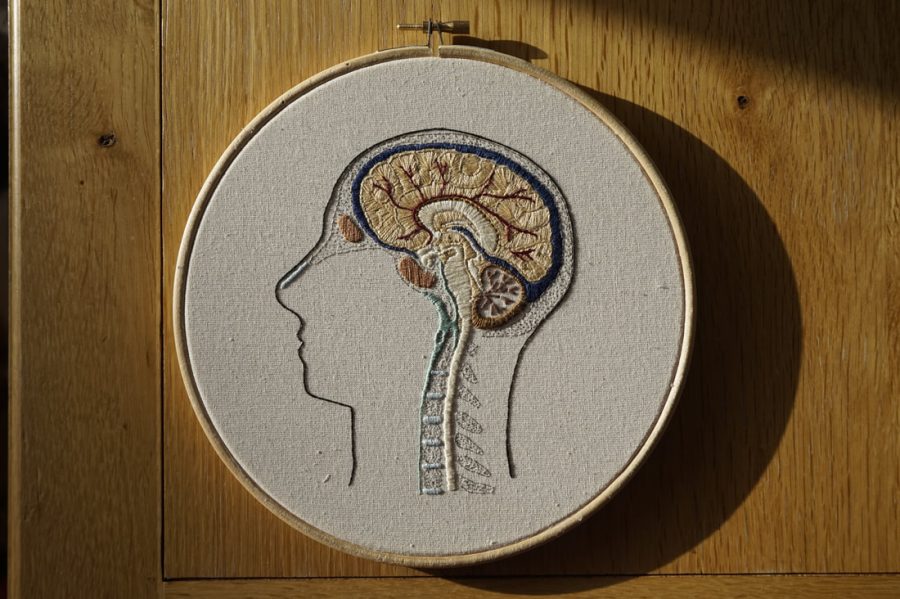
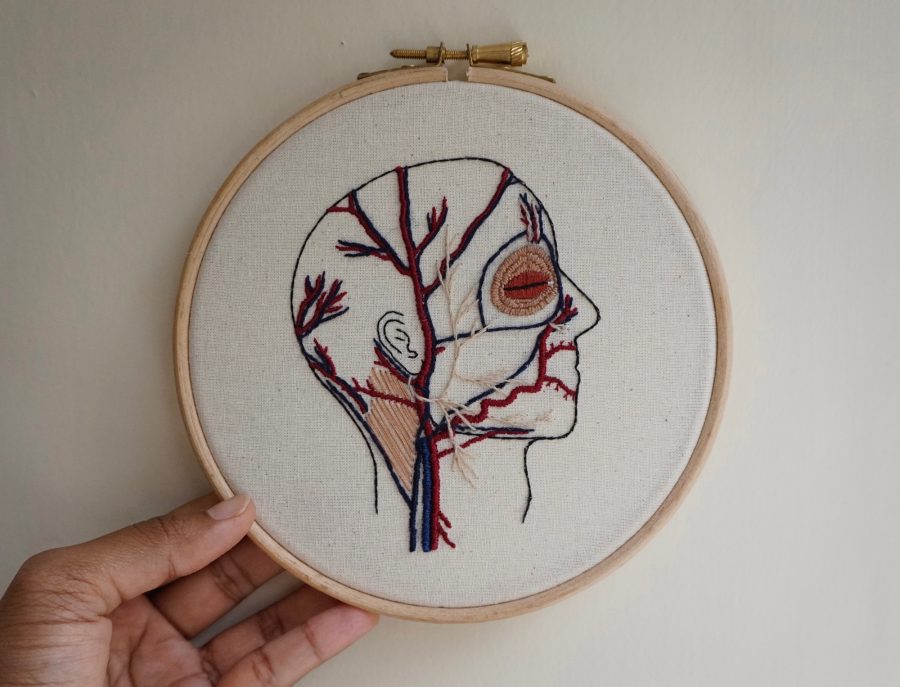
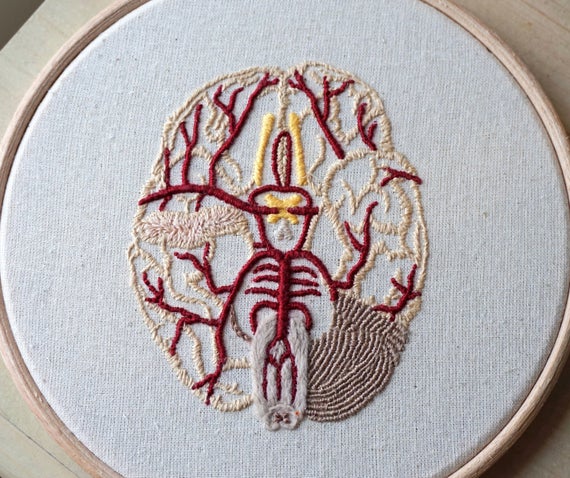
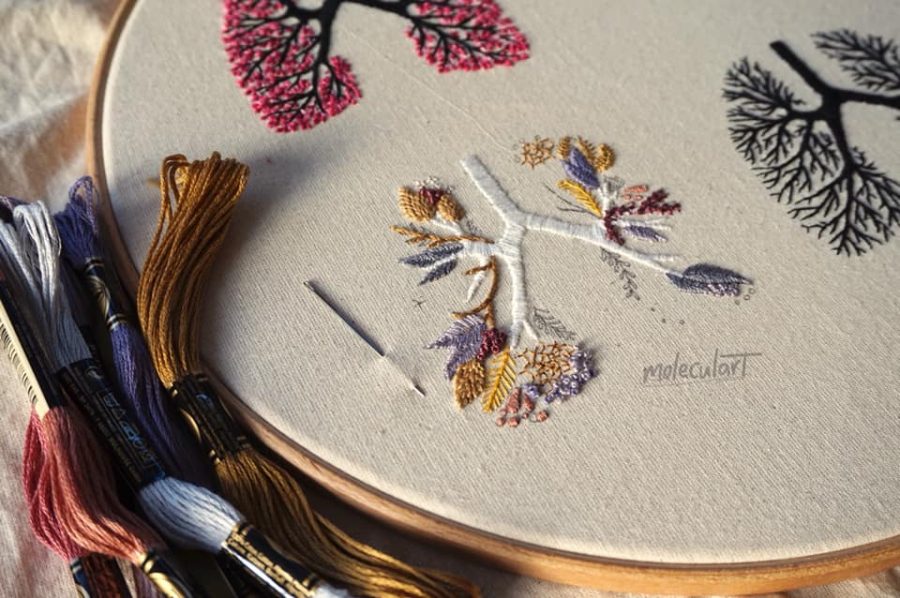
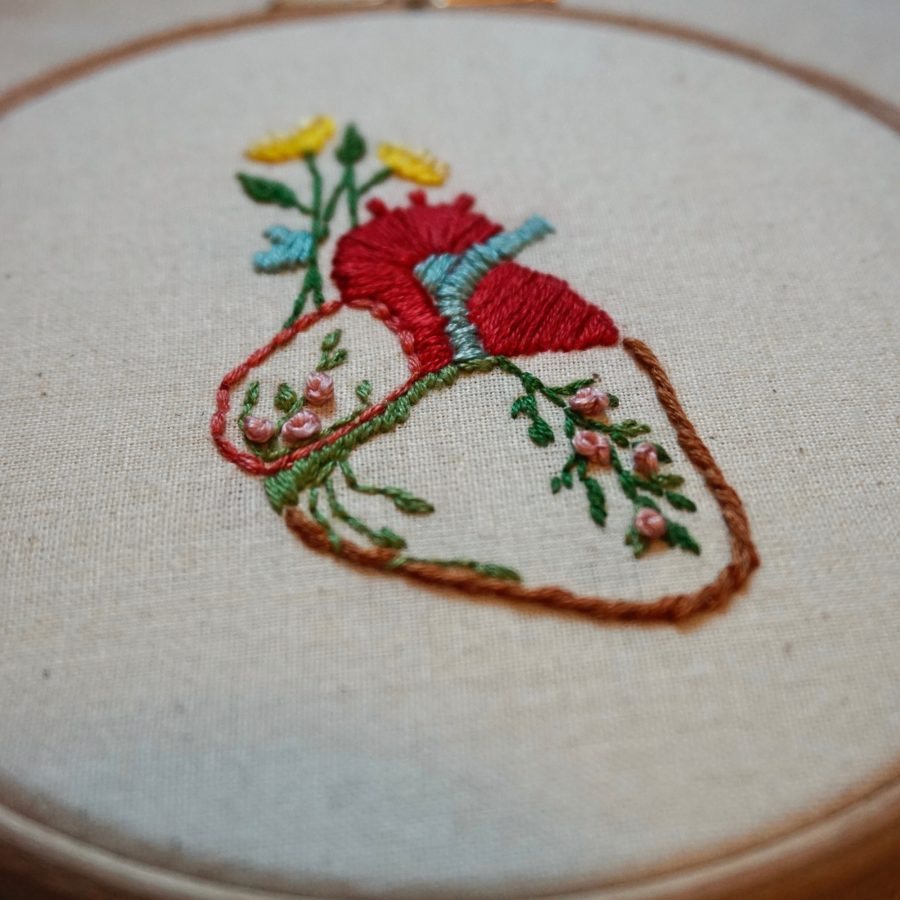
My first thought upon seeing the delicate, anatomy-based work of the 23-year-old embroidery artist and medical student Emmi Khan was that the Girl Scouts must have expanded the categories of skills eligible for merit badges.
(If memory serves, there was one for embroidery, but it certainly didn’t look like a cross-sectioned brain, or a sinus cavity.)
Closer inspection revealed that the circular views of Khan’s embroideries are not quite as tiny as the round badges stitched to high achieving Girl Scouts’ sashes, but rather still framed in the wooden hoops that are an essential tool of this artist’s trade.
Methods both scientific and artistic are a source of fascination for Khan, who began taking needlework inspiration from anatomy as an undergrad studying biomedical sciences. As she writes on her Moleculart website:
Science has particular methods: it is fundamentally objective, controlled, empirical. Similarly, art has particular methods: there is an emphasis on subjectivity and exploration, but there is also an element of regulation regarding how art is created… e.g. what type of needle to use to embroider or how to prime a canvas.
The procedures and techniques adopted by scientists and artists may be very different. Ultimately, however, they both have a common aim. Artists and scientists both want to 1) make sense of the vastness around them in new ways, and 2) present and communicate it to others through their own vision.
A glimpse at the flowers, intricate stitches, and other dainties that populate her Pinterest boards offers a further peek into Khan’s methods, and might prompt some readers to pick up a needle themselves, even those with no immediate plans to embroider a karyotype or The Circle of Willis, the circular anastomosis of arteries at the base of the brain.
The Cardiff-based medical student delights in embellishing her threaded observations of internal organs with the occasional decorative element—sunflowers, posies, and the like…
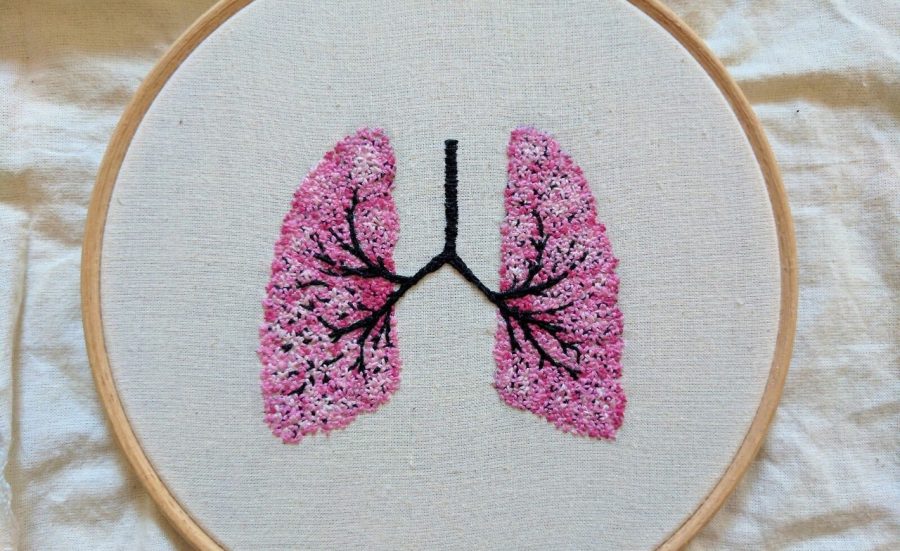
She makes herself available on social media to answer questions on subjects ranging from embroidery tips to her relationship to science as a devout Muslim, and to share works in progress, like a set of lungs that embody the Four Seasons, commissioned by a customer in the States.
Kintsugi, the Japanese art of joining broken pottery with gleaming seams of gold or silver, creates fine art objects we can see as symbols for the beauty of vulnerability. Surely, these bowls, cups, vases, etc. remind of us Leonard Cohen’s oft-quoted lyric from “Anthem” (“There is a crack in everything, that’s how the light gets in.”) Writer and artist Austin Kleon touches on this same sentiment in a recent post on his blog. “The thing I love the most about Kintsugi is the visible trace of healing and repair—the idea of highlighted, glowing scars.”
Kintsugi, which translates to “golden joinery,” has a history that dates back to the 15th century, as Colin Marshall explained in a previous post here. But it’s fascinating how much this art resonates with our contemporary discourse around trauma and healing.
“We all grow up believing we should emphasize the inherent positives about ourselves,” writes Marshall, “but what if we also emphasized the negatives, the parts we’ve had to work to fix or improve? If we did it just right, would the negatives still look so negative after all?”
A key idea here is “doing it just right.” Kintsugi is not a warts-and-all presentation, but a means of turning brokenness into art, a skillful realization of the Japanese idea of wabi-sabi, the “beauty of things imperfect, impermanent, and incomplete,” as Leonard Koren writes in Wabi-Sabi for Artists, Designers, Poets & Philosophers. Objects that represent wabi-sabi “may exhibit the effects of accident, like a broken bowl glued back together again.” In kintsugi, those effects are due to the artist’s craft rather than random chance.
When it comes to healing psychic wounds so that they shine like precious metals, there seems to be no one perfect method. But when we’re talking about the artistry of kintsugi, there are some—from the most refined artisanship to less rigorous do-it-yourself techniques—we can all adopt with some success. In the video at the top, learn DIY kintsugi from World Crafted’s Robert Mahar. Further up, we have an intensive, wordless demonstration from professional kintsugi artist Kyoko Ohwaki.
And just above, see psychologist Alexa Altman travel to Japan to learn kintsugi, then make it “accessible” with an explanation of both the physical process of kintsugi and its metaphorical dimensions. As Altman shows, kintsugi can just as well be made from things broken on purpose as by accident. When it comes to the beautifully flawed finished product, however, perhaps how a thing was broken matters far less than the amount of care and skill we use to join it back together.
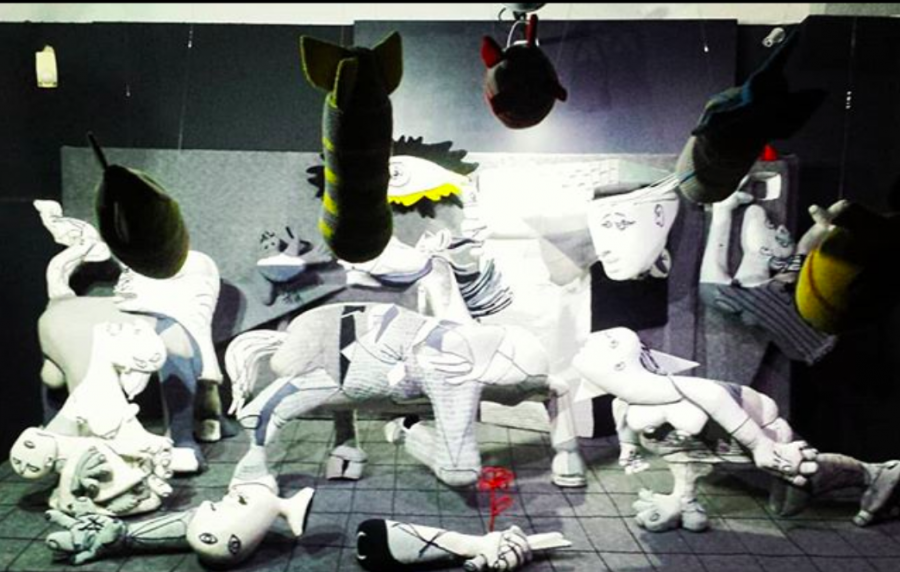
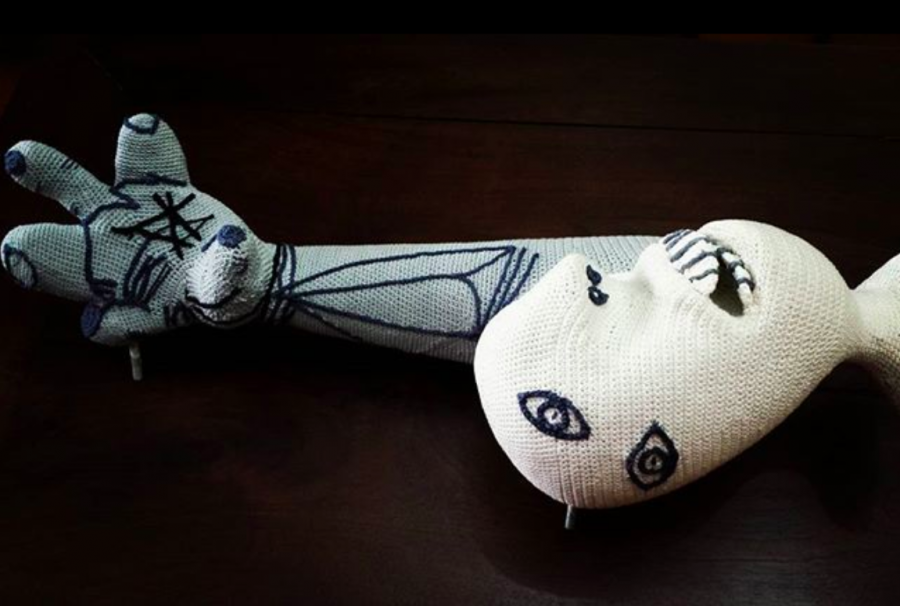
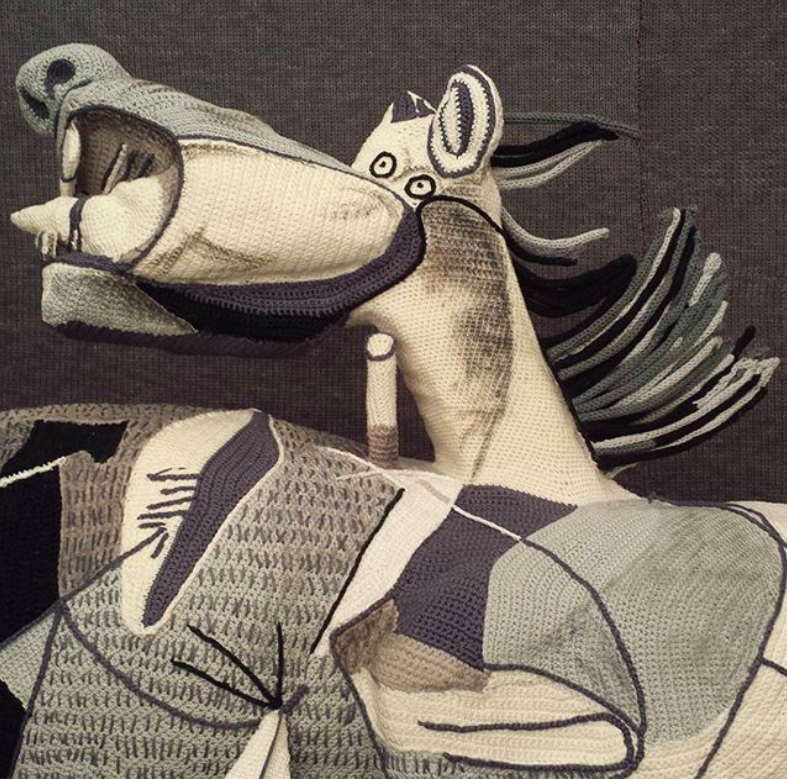
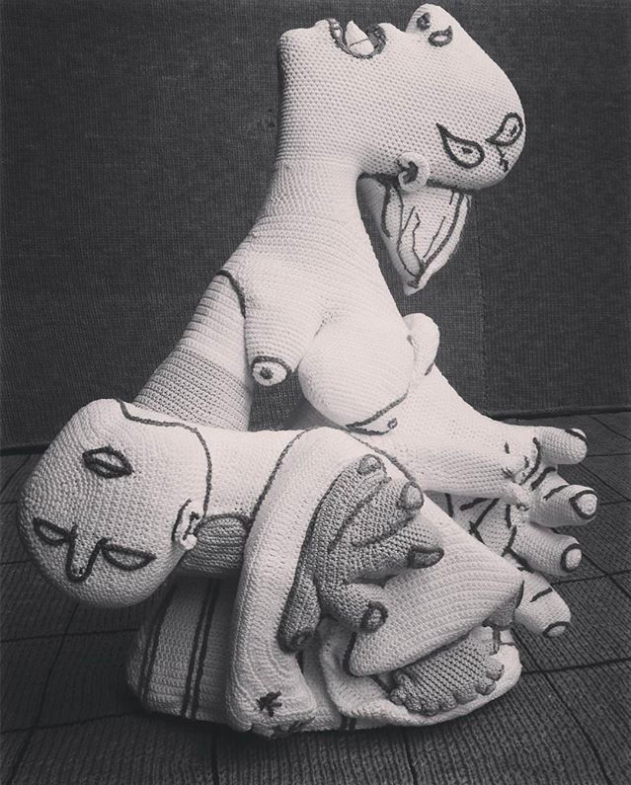
Softness is perhaps not the first quality that springs to mind when one imagines recreating the chaos and anguish of Picasso’s Guernica in a 3‑dimensional representation.
Though how else to describe the primary medium of the urban knitting group Sul filo dell’arte?
We're hoping to rely on loyal readers, rather than erratic ads. Please click the Donate button and support Open Culture. You can use Paypal, Venmo, Patreon, even Crypto! We thank you!
Open Culture scours the web for the best educational media. We find the free courses and audio books you need, the language lessons & educational videos you want, and plenty of enlightenment in between.