“Even in third world countries, like Senegal, it isn’t like this…”
Related Content:
The Splendid Book Design of the 1946 Edition of Gibbon’s Decline and Fall of the Roman Empire
“Even in third world countries, like Senegal, it isn’t like this…”
Related Content:
The Splendid Book Design of the 1946 Edition of Gibbon’s Decline and Fall of the Roman Empire
Bird-watching is having a moment, thanks to the pandemic.
As non-essential workers adjusted to spending more time at home, their ears adjusted to the increasingly non-foreign sound of birdsong outside their windows.
Those sweet tweets are no doubt largely responsible for the record breaking turnout at this year’s Global Big Day, the Cornell Lab of Ornithology’s annual birding event, held earlier this spring.
50,000 participants logged 2.1 million individual observations, and 6,479 species.
Apparently, there are even more birds in this world than there are sourdough starters…
…though for the immediate future, civic-minded birdwatchers will be confining their observations to the immediate vicinity, as a matter of public health.
We look forward to the day when bird enthusiasts residing outside of Belize, Mexico, or Guatemala can again travel to the Yucatán Peninsula in hopes of a face-to-face encounter with the Black Cat Bird.
Til then, the animated video above, in which a Black Catbird unwittingly duets with Belize’s Garifuna Collective, makes a soothing place holder.
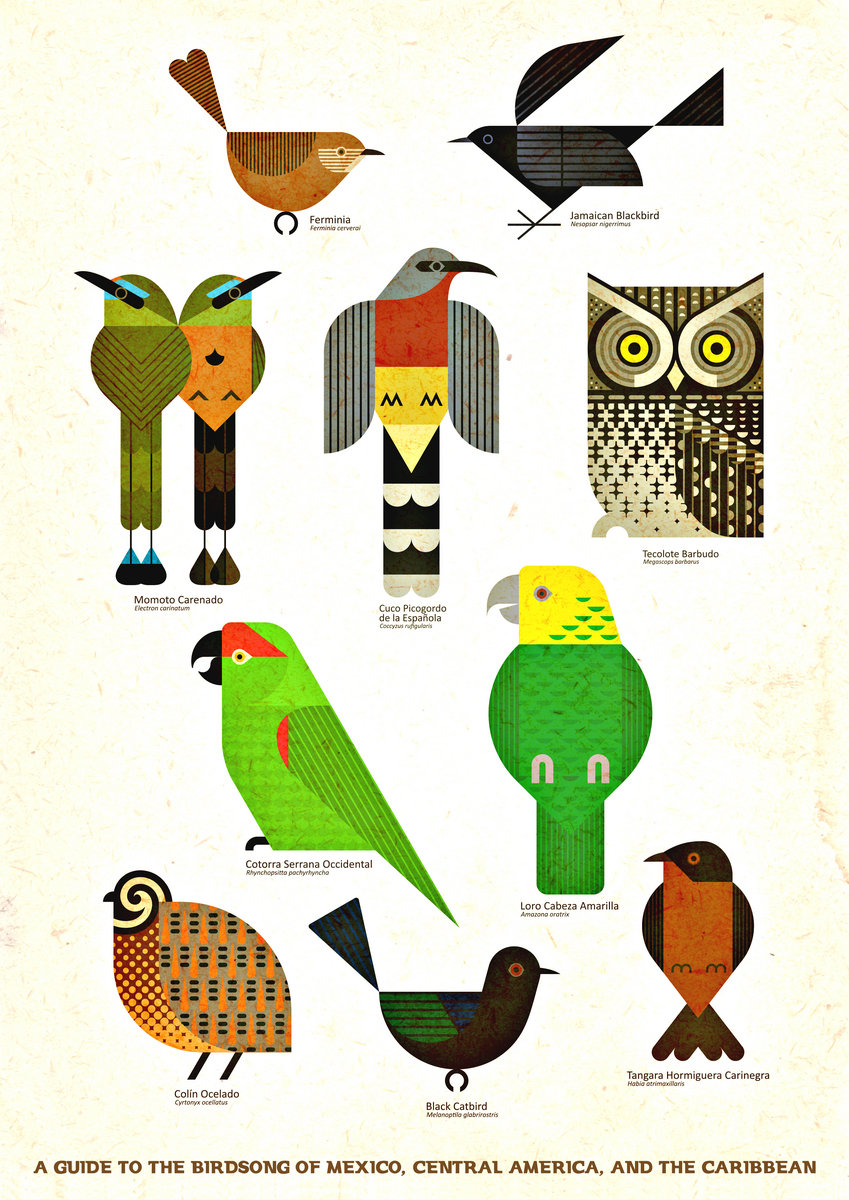
The catbird and the collective appear along with nine other electronic musician / endangered native bird teams on the fundraising album, A Guide to the Birdsong of Mexico, Central America & the Caribbean.
A Black-cheeked Ant-Tanager joins NILLO, a producer and DJ from Costa Rica who draws musical inspiration from the tribal communities around him.
Siete Catorce, a producer who helped popularize the popular border genre known as ruidosón—a mix of cumbia and prehispanic tribal sounds—is paired with a Yellow-headed Parrot.
Jordan “Time Cow” Chung of Equiknoxx seamlessly integrates a Jamaican Blackbird into his unique brand of organic, experimental dancehall.
The album follows 2015’s Guide to the Birdsong of South America, and as with its predecessor, 100% of the profits will be donated to regional organizations focused on birds and conservation—Birds Caribbean, La Asociación Ornitológica de Costa Rica, and Mexico’s Fundacion TXORI.
Birds, as the project’s founder, Robin Perkins, told Gizmodo’s Earther, are the most musical animals in the world:
There’s something really nice about focusing on endangered species and songs that are disappearing and not being preserved and to use music to raise awareness about the species. I believe music has a big power for social activism and social change and for environmental change.
Listen to A Guide to the Birdsong of Mexico, Central America & the Caribbean for free on Spotify.
Buy the album or individual tracks on Bandcamp to benefit the charities above.
Robin Perkins’ limited edition prints of the featured birds also benefit the bird-focused regional charities and can be purchased here.

Related Content:
The Bird Library: A Library Built Especially for Our Fine Feathered Friends
What Kind of Bird Is That?: A Free App From Cornell Will Give You the Answer
Download 435 High Resolution Images from John J. Audubon’s The Birds of America
Ayun Halliday is an author, illustrator, theater maker and Chief Primatologist of the East Village Inky zine. Follow her @AyunHalliday.
The current moment has forced the original cast and crew of Lin-Manuel Miranda’s massive hit musical Hamilton to revisit and reevaluate the story it tells about America’s founding. As Miranda himself told The Root’s Tonja Renée Stidhum, “All of these guys are complicit in the brutal practice of slavery, slavery is the third line of our show… that is just a prerequisite for the story we’re telling.” But he didn’t first set out to write history. “Originally, this was a concept album. I wanted to write a hip hop album, so I was never picturing the guys on the statues that are being torn down right now. I was picturing, ‘What are the voices that are best suited to tell the story.’”
Debuting in more optimistic times, when the country had its first Black president, Hamilton declared, says Leslie Odom, Jr. (who played Aaron Burr) that “if this history belongs to all of us… then we’re going to take it and we’re going to say it and use our own words to tell it!” Controversy and critique aside, there’s no denying Miranda’s tremendous gifts as a dramatist and songwriter, on display not only in Hamilton but in the Moana soundtrack.
How does he do it? Riding the wave of renewed Hamilton fandom after the Disney release of the original cast film, Miranda recently sat down with Rotten Tomatoes to discuss his process. When he gets to Hamilton, he gives us a detailed breakdown of “My Shot,” which, he says, took him a year to write.
“It was not only writing Hamilton’s ‘I want’ song,” says Miranda, “although it certainly is that. It was also proving my thesis that Hamilton’s intellect is what allows him to propel through the narrative of the story.” The play’s protagonist proves his intellectual worthiness by mastering and making his own the styles of Miranda’s favorite rappers, from Big Pun to Jay Z to Biggie to Mobb Deep. “I’m grabbing from the influences and paying homage to those influences. …I’m literally calling on the ancestors of this flow. …The ‘Whoah’ section, I’ll just say, is based on the AOL startup sound because I wanted it to feel like …his words are connecting with the world.”
Whether or not any of Hamilton’s younger viewers have ever heard the AOL startup sound, the detail reveals how Miranda’s mind works. His creations emerge from a matrix of references and allusions, each one chosen for its specific relation to the story. Many of these callbacks go over the audience’s heads, but they still have their intended effect, creating tension in “the densest couplets that I could write,” Miranda says. The message in “My Shot,” within the context of the musical itself, is that “Hamilton is the future within this group of friends.” But the message of Hamilton has nothing to do with the 18th century and everything to do with the 21st. Perhaps its most subversive idea is that the highest leadership in the U.S. might just as well look like Hamilton as Hamilton. See Miranda and the Hamilton cast perform “My Shot” at the White House just below.
via Laughing Squid
Related Content:
A Whiskey-Fueled Lin-Manuel Miranda Reimagines Hamilton as a Girl on Drunk History
The Muppets Sing the First Act of Hamilton
Josh Jones is a writer and musician based in Durham, NC. Follow him at @jdmagness

We hear the phrase “unprecedented times” every day now, but the truth is few calamities in human history are more precedented than plagues and pestilences. In Western history, at least, disease epidemics seem always to have been followed by Machiavellian opportunism and cultish conspiracy theories that only made things worse.
During the 14th century, almost six hundred years before Naomi Klein defined the shock doctrine, the Black Death “strengthened the power of the state and accelerated the domination of key markets by a handful of large companies,” write Eleanor Russell and Martin Parker at The Conversation (hello, Amazon). In their argument, disaster capitalism may have preceded actual capitalism, and it started with the plague.

In his history of the Great Plague of 1665, Daniel Defoe described how “everyone behaved badly, though the rich behaved the worst,” as Jill Lepore writes at The New Yorker, forcing their servants to put their lives at risk to provision the great houses. “This Necessity…,” writes Defoe, “was in a great Measure the Ruin of the whole City,” though few in London then understood how to slow transmission of the disease.
That was not the case when the Influenza epidemic took the lives of hundreds of millions around the world between 1918 and 1920. Doctors understood how the flu spread and recommended that everyone wear a mask in public. Cities passed ordinances and immediately resistance sprang up, leading to organizations like San Francisco’s Anti-Mask League, whose rhetoric sounds like that of anti-mask protestors of today.

The times may be unique—for the speed at which COVID-19 spread around the world, for instance, along with the disinformation—but humans have lived through many versions of pandemic, and many disastrously selfish, opportunistic, and short-sighted responses to it. We may contemplate these historical repetitions as we admire the Instagram creations of artist Genevieve Blais, who has been posting images of famous paintings, statues, and photographs with their subjects wearing masks.
More than novelty memes or highbrow public service announcements, Blais’ creations are part-whimsical/part-sobering reminders of the persistence of plagues throughout history—their influence on the rise and fall of dynasties and powerful patrons, and the ignorance and folly that led to so much preventable death. Technologically speaking, humans are better positioned than ever before to combat epidemics of disease. But it’s worth remembering the precedents for our current conditions. Plagues have shaped human history. We don’t always have to respond to them the same way. See all of Blais’s masked fine art images at her Plague History Instagram page. If you DM her, she will make you a print.


via Kottke
Related Content:
What Happened When Americans Had to Wear Masks During the 1918 Flu Pandemic
Download Classic Works of Plague Fiction: From Daniel Defoe & Mary Shelley, to Edgar Allan Poe
Josh Jones is a writer and musician based in Durham, NC. Follow him at @jdmagness

Photo via the National Institute of Allergy and Infectious Diseases
What are some qualities to look for in a leader?
Dr. Anthony Fauci brings these qualities to bear as Director of the National Institute of Allergy and Infectious Diseases at the National Institute of Health.
They’re also on display in his message to then-undergrad Luke Messac, now an emergency medicine resident at Brown University, whose research focuses on the histories of health policy in southern Africa and the US, and who recently tweeted:
13 years ago, I emailed Dr. Fauci out of the blue to ask if I might interview him for my undergrad thesis. He invited me to his office, where he answered all my questions. When I sent him the thesis, HE READ THE WHOLE THING (see his overly effusive review below). Who does that?!
Here’s what Fauci had to say to the young scientist:

It certainly reads like the work of a class act.
In addition to serving as one of the COVID-19 pandemic’s most recognizable faces, Dr. Fauci has acquired another duty—that of scapegoat for Donald Trump, the 6th president he has answered to in his long career.
He seems to be taking the administration’s potshots with a characteristically cool head, though compared to the furious criticisms AIDS activists directed his way in the 80s and 90s, he’s unlikely to find much of educational value in them.
Last March, The Body Pro, a newsletter for workers on the front lines of HIV education, prevention, care, and services quoted ACT UP NY’s Jim Eigo on the doctor’s response to a letter demanding parallel tracking, a policy revision that would put potentially life-saving drugs in the hands of those who tested positive far earlier than the existing clinical trial requirements’ schedule would have allowed:
Lo and behold, he read the letter and liked it, and the following year he started promoting the idea of a parallel track for AIDS drugs to the FDA. Had he not helped us push that through, we couldn’t have gotten a lot of the cousin drugs to AZT, such as ddC and ddI, approved so fast. They were problematic drugs, but without them, we couldn’t have kept so many people alive.
Fauci, despite being straight and Catholic, was not only not homophobic, which much of medical practice still was in the late 1980s, he also wouldn’t tolerate homophobia among his colleagues. He knew there was no place for that in a public-health crisis.
Speaking of correspondence, Dr Messac seems to have taken the “perpetual student” concept Dr. Fauci impressed upon him back in 2007 to heart, as evidenced by a recent tweet, regarding a lesson gleaned from Arnold Schwarzenegger in Pumping Iron, a 1977 documentary about bodybuilders:
Schwarzenegger explained how he would figure out what to work out every day by looking in a mirror and finding his weakest muscles. It’s pretty good advice for studying during residency. Every shift reveals a weakness, and greats never stop looking for their own.
In writing to Messac, Dr. Fauci alluded to his commencement speeches, so we thought it appropriate to leave you with one of his most recent ones, a virtual address to the graduating class of his alma mater, College of the Holy Cross:
“Now is the time, if ever there was one” he tells the Class of 2020, “to care selflessly about one another… Stay safe, and I look forward to the good work you will contribute in the years ahead.”
Related Content:
Real Women Talk About Their Careers in Science
Richard Feynman’s Technique for Learning Something New: An Animated Introduction
Ayun Halliday is an author, illustrator, theater maker and Chief Primatologist of the East Village Inky zine. Follow her @AyunHalliday.
It’s a great time to tune in to what scientists are trying to tell us.
It’s true that we’ve received a lot of conflicting information over the last four months with regard to how to best protect ourselves and others from COVID-19.
Scientists and health care professionals have a learning curve, too.
Their bulletins evolve as their understanding of the novel coronavirus grows, through research and hands-on experience.
There are still a lot of unknowns.
Some people take any evidence-based messaging updates regarding masks and re-opening as proof that scientists don’t know their asses from their elbows.
To which we might counter, “If that’s the case, please take a minute from berating the poor grocery store employee who asked you to follow clearly posted state mandated public health practices to educate us. Forget the economy. Forget the election. Blind us with some science. Pretend we don’t know anything and hit us with some hardcore facts about viruses. We’re listening.”
(Crickets…)
Science writer Dominic Walliman, founder of the Domain of Science Youtube channel, may have a PhD in quantum device physics, but he also had the humility to realize, earlier in the pandemic, that he didn’t know much about viruses:
So I did a load of research and have summarized what I learned in… nine images. This video (above) explains the key aspects of viruses: how big they are, how they infect and enter and exit cells, how viruses are classified, how they replicate, and subjects involving viral infections like how they spread from person to person, how our immune system detects and destroys them and how vaccines and anti-viral drugs work.
Walliman animates his 10-minute overview with the same bright infographics he uses to help students and laypeople wrap their heads around computer science, biology, chemistry, physics, and math.
The virus video has been fact-checked by immunologist Michael Bramhall and biologist Christoph von Arx.
And how refreshing to see transparency with regard to human error, published as a corrective:
In slide 9 toxin vaccines are for bacterial infections like tetanus, not viruses.
For those who’d like to learn more, Walliman has tacked a whopping 15 links onto the episode’s description, from sources such as Scientific American, Nature, Stanford Medicine’s Scope blog, and the National Center for Biotechnology Information.
Download a free poster of Domain of Science’s Viruses Explained in 9 Images here.
Related Content:
Spring Break vs. COVID-19: Mapping the Real Impact of Ignoring Social Distancing
The Case for a Universal Basic Income in the Time of COVID-19
Ayun Halliday is an author, illustrator, theater maker and Chief Primatologist of the East Village Inky zine. Her latest project is an animation and a series of free downloadable posters related to COVID-19 public health Follow her @AyunHalliday.

Medical professionals have had a particularly difficult time getting people in the United States to act in unison for the public good during the pandemic. This has been the case with every step that experts urge to curb the spread of COVID-19, from closing schools, churches, and other meeting places, to enforcing social distancing and wearing masks over the nose and mouth in public spaces.
The resistance may seem symptomatic of the contemporary political climate, but there is ample precedent for it during the spread of so-called Spanish Flu, which took the lives of 675,000 Americans a little over a hundred years ago. Even when forced to wear masks by law or face jail time, many Americans absolutely refused to do so.
“In 1918,” writes E. Thomas Ewing at Health Affairs, “US public health authorities recommended masks for doctors, nurses, and anyone taking care of influenza patients.” The advisory “gradually and inconsistently” spread to the general public, in a different cultural climate, in some important respects, than our own, as University of Michigan medical historian J. Alexander Navarro explains.
Nationwide, posters presented mask-wearing as a civic duty – social responsibility had been embedded into the social fabric by a massive wartime federal propaganda campaign launched in early 1917 when the U.S. entered the Great War. San Francisco Mayor James Rolph announced that “conscience, patriotism and self-protection demand immediate and rigid compliance” with mask wearing. In nearby Oakland, Mayor John Davie stated that “it is sensible and patriotic, no matter what our personal beliefs may be, to safeguard our fellow citizens by joining in this practice” of wearing a mask.
Despite the civic spirit and generalized public support for mask wearing, passing local mask ordinances was “frequently a contentious affair.” Debates that sound familiar raged in city councils in Los Angeles and Portland, both of which rejected mask orders. (One official declaring them “autocratic and unconstitutional.”) San Francisco, on the other hand, brought the police down on anyone who refused to wear a mask, imposing fines and jail time.
These measures were adopted by other cities, as well as abroad in Paris and Manchester. “Fines ranged,” Navarro writes, “from US$5 to $200,” a huge amount of money in 1918, and a good amount for many people out of work today. Even in cities that did not impose harsh penalties, “noncompliance and outright defiance quickly became a problem.” Much of the resistance to wearing masks, however, came later, after a first wave of flu infections subsided. When precautions were relaxed, cases rose once again, and new mask mandates went into effect in 1919.
San Francisco’s Anti-Mask League formed in protest, attracting somewhere between 4,000 and 5,000 unmasked attendees to a January meeting. Some of their objections rested on an early study that found scant evidence for the efficacy of compulsory mask-wearing. However, a later comprehensive 1921 study by Warren T. Vaughn, notes Ewing, found that the data was too sketchy to draw conclusions: “The problem was human behavior: Masks were used until they were filthy, worn in ways that offered little or no protection, and compulsory laws did not overcome the ‘failure of cooperation on the part of the public.’”
Vaughn concluded, “It is safe to say that the face mask as used was a failure.” Many behaviors contributed to this outcome. As we see in the photograph at the top of anonymous Californians wearing masks and holding a sign that reads, “Wear a mask or go to jail,” many did not wear masks properly, leaving their nose exposed, for example, like the woman in the center of the group. Notably, instead of social distancing, the group stands shoulder to shoulder, rendering their masks mostly ineffective.
The kind of masks most people wore were made of thin gauze. (“Obey the laws and wear the gauze. Protect your jaws from septic paws,” went a jingle at the time.) The material wasn’t at all effective at closer distances, where today’s quilted cotton masks, on the other hand, have been shown to stop the virus a few inches from the wearer’s face. Still, masks, when combined with other measures, were shown to be effective when compliance was high, though much of the evidence is anecdotal.
What can we learn from this history? Does it undermine the case for masks today? “We need to learn the right lessons from the failure of flu masks in 1918,” Ewing argues. The overwhelming scientific consensus is that masks are some of the most effective tools for slowing the spread of the coronavirus, and that, unlike in 1918, “Masks can work if we wear them correctly, modify behavior appropriately, and apply all available tools to control the spread of infectious disease.”
Related Content:
Josh Jones is a writer and musician based in Durham, NC. Follow him at @jdmagness

Deservedly or not, British care homes have acquired a reputation as especially dreary places, from Victorian novels to dystopian fiction to the flat affect of BBC documentaries. Martin Parr gave the world an especially moving example of the care home documentary in his 1972 photo series on Prestwich Asylum, outside Manchester. The compelling portraits humanize people who were neglected and ignored, yet their lives still look bleak in that austerely post-war British institution kind of way.
One cannot say anything of the kind of the photo series represented here, which casts residents of Sydmar Lodge Care Home in Edgeware, England as rock stars, digitally recreating some of the most famous album covers of all time. This is not, obviously, a candid look at residents’ day-to-day existence. But it suggests a pretty cheerful place. “The main aim was to show that care homes need not be a sad environment, even during this pandemic,” says the photos’ creator Robert Speker, the home’s activities manager.

“Speker tweeted side-by-side photos of the original covers and the Sydmar Lodge residents’ new takes, and the tweets quickly took off,” NPR’s Laurel Wamsley writes. He’s made it clear that the primary audience for the recreated covers is the residents themselves: Isolated in lockdown for the past four months; cut off from visits and outings; suffering from an indefinite suspension of familiar routines.
Speker does not deny the grim reality behind the inspiring images. “Elderly people will remain in lockdown for a long time,” he writes on a GoFundMe page he created to help support the home. “It could be months before the situation changes for them.”

But he is optimistic about his abilities to “make their time as happy and full of enjoyment and interest as possible.” Would that all nursing homes had such a dedicated, award-winning coordinator. Residents themselves, he wrote on Twitter, were “enthused and perhaps a bit bemused by the idea, but happy to participate.” When they saw the results—stunning Roma Cohen as Aladdin Sane, defiant Sheila Solomons as Elvis and The Clash’s Paul Simenon, casual Martin Steinberg as a “Born in England” Springsteen—they were delighted. Four of the home’s carers got their own cover, too, posed as Queen.

Residents, Speker said, were really “having a good giggle about it.” And we can too, as we bear in mind the many elderly people around us who have been locked in for months, with maybe many more months of isolation ahead. Not everyone is as talented as Robert Speker, who did the models’ makeup and tattoos himself (with hair by a care home manager), as well as taking all the photographs and editing the images to convincingly mimic the poses, composition, lighting, font, and color schemes of the originals. But let’s hope his work is a spark that lights up nursing homes and care facilities with all sorts of creative ideas to keep spirits up. See several more covers below and the rest on Twitter.

Related Content:
People Pose in Uncanny Alignment with Iconic Album Covers: Discover The Sleeveface Project
The History of the Fisheye Photo Album Cover
Dyson Creates 44 Free Engineering & Science Challenges for Kids Quarantined During COVID-19
Josh Jones is a writer and musician based in Durham, NC. Follow him at @jdmagness