Given the dominance YouTube has achieved over large swaths of world culture, we’d all expect to remember the first video we watched there. Yet many or most of us don’t: rather, we simply realized, one day in the mid-to-late two-thousands, that we’d developed a daily YouTube habit. Like as not, your own introduction to the platform came through a video too trivial to make much of an impression, assuming you could get it to load at all. (We forget, in this age of instantaneous streaming, how slow YouTube could be at first.) But perhaps the triviality was the point, a precedent set by the first YouTube video ever uploaded, “Me at the Zoo.”
“Alright, so here we are in front of the, uh, elephants,” says YouTube co-founder Jawed Karim, standing before those animals’ enclosure at the San Diego Zoo. “The cool thing about these guys is that, is that they have really, really, really long, um, trunks, and that’s, that’s cool. And that’s pretty much all there is to say.”
The runtime is 19 seconds. The upload date is April 24, 2005, two years before “Charlie Bit My Finger” and “Chocolate Rain,” four years before The Joe Rogan Experience, and seven years before “Gangnam Style.” The pop-cultural force that is MrBeast, then a child known only as Jimmy Donaldson, would have been anticipating his seventh birthday.
“After the zoo, the deluge,” wrote Virginia Heffernan in a 2009 NewYorkTimes piece on YouTube’s first four and a half years, when the site contained barely any of the content with which we associate it today. If you have a favorite YouTube channel, it probably didn’t exist then. Heffernan approached the “fail,” “haul,” and “unboxing” videos going viral at the time as new cultural forms, as indeed they were, but the conventions of the YouTube video as we now know them had yet to crystallize. Not everyone who saw the likes of “Me at the Zoo” would have understood the promise of YouTube. Perhaps it didn’t feel particularly revelatory to be informed that elephants have trunks — but then, that’s still more informative than many of the countless explainer videos being uploaded as we speak.
Based in Seoul, Colin Marshall writes and broadcasts on cities, language, and culture. His projects include the Substack newsletterBooks on Cities and the book The Stateless City: a Walk through 21st-Century Los Angeles. Follow him on the social network formerly known as Twitter at @colinmarshall.
Three Yale professors—Timothy Snyder, Jason Stanley and Marci Shore–have spent their careers studying fascism and authoritarianism. They know the signs of emerging authoritarianism when they see it. Now, they’re seeing those signs here in the United States, and they’re not sitting by idly. They’ve moved to the University of Toronto where they can speak freely, without fearing personal or institutional retribution. Above, they share their views in the NYTimes Op-Doc. It comes prefaced with the text below:
Legal residents of the United States sent to foreign prisons without due process. Students detained after voicing their opinions. Federal judges threatened with impeachment for ruling against the administration’s priorities.
In this Opinion video, Marci Shore, Timothy Snyder and Jason Stanley, all professors at Yale and experts in authoritarianism, explain why America is especially vulnerable to a democratic backsliding — and why they are leaving the United States to take up positions at the University of Toronto.
Professor Stanley is leaving the United States as an act of protest against the Trump administration’s attacks on civil liberties. “I want Americans to realize that this is a democratic emergency,” he said.
Professor Shore, who has spent two decades writing about the history of authoritarianism in Central and Eastern Europe, is leaving because of what she sees as the sharp regression of American democracy. “We’re like people on the Titanic saying our ship can’t sink,” she said. “And what you know as a historian is that there is no such thing as a ship that can’t sink.”
She borrows from political and apolitical Slavic motifs and expressions, arguing that the English language does not fully capture the democratic regression in this American moment.
Professor Snyder’s reasons are more complicated. Primarily, he’s leaving to support his wife, Professor Shore, and their children, and to teach at a large public university in Toronto, a place he says can host conversations about freedom. At the same time, he shares the concerns expressed by his colleagues and worries that those kinds of conversations will become ever harder to have in the United States.
“I did not leave Yale because of Donald Trump or because of Columbia or because of threats to Yale — but that would be a reasonable thing to do, and that is a decision that people will make,” he wrote in a Yale Daily News article explaining his decision to leave.
Their motives differ but their analysis is the same: ignoring or downplaying attacks on the rule of law, the courts and universities spells trouble for our democracy.
Until the end of his life, Carl Sagan (1934–1996) continued doing what he did all along — popularizing science and “enthusiastically conveying the wonders of the universe to millions of people on television and in books.” Whenever Sagan appeared on The Tonight Show with Johnny Carson during the 70s and 80s, his goal was to connect with everyday Americans — people who didn’t subscribe to Scientific American — and increase the public’s understanding and appreciation of science.
At the end of his life, Sagan still cared deeply about where science stood in the public imagination. But while losing a battle with myelodysplasia, Sagan also sensed that scientific thinking was losing ground in America, and even more ominously within the chambers of the Newt Gingrich-led Congress.
During his final interview, aired on May 27, 1996, Sagan issued a strong warning, telling Charlie Rose:
We’ve arranged a society on science and technology in which nobody understands anything about science and technology, and this combustible mixture of ignorance and power sooner or later is going to blow up in our faces. I mean, who is running the science and technology in a democracy if the people don’t know anything about it.
And he also went on to add:
And the second reason that I’m worried about this is that science is more than a body of knowledge. It’s a way of thinking. A way of skeptically interrogating the universe with a fine understanding of human fallibility. If we are not able to ask skeptical questions, to interrogate those who tell us that something is true, to be skeptical of those in authority, then we’re up for grabs for the next charlatan political or religious who comes ambling along.
Nearly 30 years later, we have reached that point. Under the second Trump administration, DOGE has rushed to dismantle the scientific infrastructure of our government, haphazardly cutting the National Science Foundation, the National Institutes of Health, and NASA. Next, they’re going after our leading research universities, intentionally weakening the research engine that has fueled the growth of American corporations—and the overall American economy—since World War II. And they’re replacing scientific leaders with charlatans like RFK Jr. who dabble in the very pseudoscience that Sagan warned us about. Needless to say, our competitors aren’t making the same mistakes. Few serious governments are stupid enough to cut off their nose to spite their face.
If you would like to support the mission of Open Culture, consider making a donation to our site. It’s hard to rely 100% on ads, and your contributions will help us continue providing the best free cultural and educational materials to learners everywhere. You can contribute through PayPal, Patreon, and Venmo (@openculture). Thanks!
In 2017, historian Timothy Snyder wrote the concise book On Tyranny: Twenty Lessons from the Twentieth Century, which went on to become a New York Times bestseller. A historian of fascism (then at Yale, now at U. Toronto), Snyder wanted to offer Americans a useful guide for resisting the country’s drift towards authoritarianism. It was handy then and even handier now–especially as the feds bear down on different institutions undergirding American civil society. Law firms, universities, corporations, media outlets–they’re all getting squeezed, and many have already violated the first of Snyder’s 20 lessons: “Do not obey in advance.” Above, you can hear actor John Lithgow read a condensed version of Snyder’s lessons. You can order a copy of his book online, or explore here a related video series that Snyder produced a few years back. Find a cheat sheet below.
1. Do not obey in advance
2. Defend institutions
3. Beware the one-party state
4. Take responsibility for the face of the world
5. Remember professional ethics
6. Be wary of paramilitaries
7. Be reflective if you must be armed
8. Stand out
9. Be kind to our language
10. Believe in truth
11. Investigate
12. Make eye contact and small talk
13. Practice corporeal politics
14. Establish a private life
15. Contribute to good causes
16. Learn from peers in other countries
17. Listen for dangerous words
18. Be calm when the unthinkable arrives
19. Be a patriot
20. Be as courageous as you can
Though certain generations may have grown up trained to take cover under their classroom desks in the case of a nuclear showdown between the United States and the Soviet Union, few of us today can believe that we’d stand much chance if we found ourselves anywhere near a detonated missile. Still, the probable effects of a nuclear blast do bear repeating, which the New York Times video above does not just convey verbally but also visually, deriving its information “from interviews of military officials and computer scientists who say we’re speeding toward the next nuclear arms race.”
The last nuclear arms race may have been bad enough, but the relevant technologies have greatly advanced since the Cold War — which, with the last major arms treaty between the U.S. and Russia set to expire within a year, looks set to re-open. Don’t bother worrying about a whole arsenal: just one missile is enough to do much more damage than you’re probably imagining. That’s the scenario envisioned in the video: “traveling at blistering speeds,” the nuke detonates over its target city, and “everyone in range is briefly blinded. Then comes the roar of 9,000 tons of TNT,” producing a fireball “hotter than the surface of the sun.” And that’s just the beginning of the trouble.
A destructive “blast wave” emanates from the site of the explosion, “and then… darkness.” The air is full of “dust and glass fragments,” making it difficult, even deadly, to breathe. What’s worse, “no help is on the way: medical workers in the immediate area are dead or injured.” For survivors, there begins the “radiation sickness, nausea, vomiting, and diarrhea”; some of the deadliest effects don’t even manifest for weeks. “The immediate toll of this one warhead: thousands dead, exponentially more wounded. Damage to the ecosystem will linger for years.” Indeed, the extent of the damage is too great to ponder without resort to gallows humor, as evidenced by the video’s current top comment: “My boss would still force me to come into the office the next day.”
Based in Seoul, Colin Marshall writes and broadcasts on cities, language, and culture. His projects include the Substack newsletterBooks on Cities and the book The Stateless City: a Walk through 21st-Century Los Angeles. Follow him on the social network formerly known as Twitter at @colinmarshall.
From WIRED comes this: NYU professor and “authoritarianism scholar Ruth Ben-Ghiat joins WIRED to answer the internet’s burning questions about dictators and fascism. Why do people support dictators? How do dictators come to power? What’s the difference between a dictatorship, an autocracy, and authoritarianism? What are the most common personality traits found in tyrants and dictators? Is Xi Jinping a dictator? How do dictators amass wealth? Professor Ben-Ghiat answers these questions and many more on Tech Support: Dictator Support.” Watch the video above and pick up a copy of Ben-Ghiat’s timely, bestselling book: Strongmen: Mussolini to the Present.
The epistemological nightmare we seem to be in, bombarded over our screens and speakers with so many moving-image messages per day, false and true, is at least in part due to the paralysis that we – scholars, journalists, and regulators, but also producers and consumers – are still exhibiting over how to anchor facts and truths and commonly accepted narratives in this seemingly most ephemeral of media. When you write a scientific paper, you cite the evidence to support your claims using notes and bibliographies visible to your readers. When you publish an article in a magazine or a journal or a book, you present your sources – and now when these are online often enough live links will take you there. But there is, as yet, no fully formed apparatus for how to cite sources within the online videos and television programs that have taken over our lives – no Chicago Manual of Style, no Associated Press Stylebook, no video Elements of Style. There is also no agreement on how to cite the moving image itself as a source in these other, older types of media.
The Moving Image: A User’s Manual, published by the MIT Press on February 25, 2025, looks to make some better sense of this new medium as it starts to inherit the mantle that print has been wearing for almost six hundred years. The book presents 34 QR codes that resolve to examples of iconic moving-image media, among them Abraham Zapruder’s film of the Kennedy assassination (1963); America’s poet laureate Ada Límon reading her work on Zoom; the first-ever YouTube video shot by some of the company founders at the San Francisco Zoo in 2005; Darnella Frazier’s video of George Floyd’s murder; Richard Feynman’s physics lectures at Cornell; courseware videos from MIT, Columbia, and Yale; PBS documentaries on race and music; Wikileaks footage of America at war; January 6 footage of the 2021 insurrection; interviews with Holocaust survivors; films and clips from films by and interviews with Sergei Eisenstein, John Ford, Alfred Hitchcock, Stanley Kubrick, Martin Scorsese, François Truffaut and others; footage of deep fake videos; and the video billboards on the screens now all over New York’s Times Square. The electronic edition takes you to their source platforms — YouTube, Vimeo, Wikipedia, the Internet Archive, others — at the click of a link. The videos that you can play facilitate deep-dive discussions about how to interrogate and authenticate the facts (and untruths!) in and around them.
At a time when Trump dismisses the director of our National Archives and the Orwellian putsch against memory by the most powerful men in the world begins in full force, is it not essential to equip ourselves with proper methods for being able to cite truths and prove lies more easily in what is now the medium of record? How essential will it become, in the face of systematic efforts of erasure, to protect the evidence of criminal human depravity – the record of Nazi concentration camps shot by U.S. and U.K. and Russian filmmakers; footage of war crimes, including our own from Wikileaks; video of the January 6th insurrection and attacks at the American Capitol – even as political leaders try to scrub it all and pretend it never happened? We have to learn not only how to watch and process these audiovisual materials, and how to keep this canon of media available to generations, but how to footnote dialogue recorded, say, in a combat gunship over Baghdad in our histories of American foreign policy, police bodycam footage from Minneapolis in our journalism about civil rights, and security camera footage of insurrectionists planning an attack on our Capitol in our books about the United States. And how should we cite within a documentary a music source or a local news clip in ways that the viewer can click on or visit?
Just like footnotes and embedded sources and bibliographies do for readable print, we have to develop an entire systematic apparatus for citation and verification for the moving image, to future-proof these truths.
* * *
At the very start of the 20th century, the early filmmaker D. W. Griffith had not yet prophesied his own vision of the film library:
Imagine a public library of the near future, for instance, there will be long rows of boxes or pillars, properly classified and indexed, of course. At each box a push button and before each box a seat. Suppose you wish to “read up” on a certain episode in Napoleon’s life. Instead of consulting all the authorities, wading laboriously through a host of books, and ending bewildered, without a clear idea of exactly what did happen and confused at every point by conflicting opinions about what did happen, you will merely seat yourself at a properly adjusted window, in a scientifically prepared room, press the button, and actually see what happened.
No one yet had said, as people would a century later, that video will become the new vernacular. But as radio and film quickly began to show their influence, some of our smartest critics began to sense their influence. In 1934, the art historian Erwin Panofsky, yet to write his major works on Leonardo da Vinci and Albrecht Dürer, could deliver a talk at Princeton and say:
Whether we like it or not, it is the movies that mold, more than any other single force, the opinions, the taste, the language, the dress, the behavior, and even the physical appearance of a public comprising more than 60 per cent of the population of the earth. If all the serious lyrical poets, composers, painters and sculptors were forced by law to stop their activities, a rather small fraction of the general public would become aware of the fact and a still smaller fraction would seriously regret it. If the same thing were to happen with the movies, the social consequences would be catastrophic.
And in 1935, media scholars like Rudolf Arnheim and Walter Benjamin, alert to the darkening forces of politics in Europe, would begin to notice the strange and sometimes nefarious power of the moving image to shape political power itself. Benjamin would write in exile from Hitler’s Germany:
The crisis of democracies can be understood as a crisis in the conditions governing the public presentation of politicians. Democracies [used to] exhibit the politician directly, in person, before elected representatives. The parliament is his public. But innovations in recording equipment now enable the speaker to be heard by an unlimited number of people while he is speaking, and to be seen by an unlimited number shortly afterward. This means that priority is given to presenting the politician before the recording equipment. […] This results in a new form of selection—selection before an apparatus—from which the champion, the star, and the dictator emerge as victors.
At this current moment of champions and stars – and dictators again – it’s time for us to understand the power of video better and more deeply. Indeed, part of the reason that we sense such epistemic chaos, mayhem, disorder in our world today may be that we haven’t come to terms with the fact of video’s primacy. We are still relying on print as if it were, in a word, the last word, and suffering through life in the absence of citation and bibliographic mechanisms and sorting indices for the one medium that is governing more and more of our information ecosystem every day. Look at the home page of any news source and of our leading publishers. Not just MIT from its pole position producing video knowledge through MIT OpenCourseWare, but all knowledge institutions, and many if not most journals and radio stations feature video front and center now. We are living at a moment when authors, publishers, journalists, scholars, students, corporations, knowledge institutions, and the public are involving more video in their self-expression. Yet like 1906, before the Chicago Manual, or 1919 before Strunk’s little guidebook, we have had no published guidelines for conversing about the bigger picture, no statement about the importance of the moving-image world we are building, and no collective approach to understanding the medium more systematically and from all sides. We are transforming at the modern pace that print exploded in the sixteenth century, but still without the apparatus to grapple with it that we developed, again for print, in the early twentieth.
* * *
Public access to knowledge always faces barriers that are easy for us to see, but also many that are invisible. Video is maturing now as a field. Could we say that it’s still young? That it still needs to be saved – constantly saved – from commercial forces encroaching upon it that, if left unregulated, could soon strip it of any remaining mandate to serve society? Could we say that we need to save ourselves, in fact, from “surrendering,” as Marshall McLuhan wrote some 60 years ago now, “our senses and nervous systems to the private manipulation of those who would try to benefit from taking a lease on our eyes and ears and nerves, [such that] we don’t really have any rights left”? Before we have irrevocably and permanently “leased our central nervous systems to various corporations”?
You bet we can say it, and we should. For most of the 130 years of the moving image, its producers and controllers have been elites—and way too often they’ve attempted with their control of the medium to make us think what they want us to think. We’ve been scared over most of these years into believing that the moving image rightfully belongs under the purview of large private or state interests, that the screen is something that others should control. That’s just nonsense. Unlike the early pioneers of print, their successors who formulated copyright law, and their successors who’ve gotten us into a world where so much print knowledge is under the control of so few, we – in the age of video – can study centuries of squandered opportunities for freeing knowledge, centuries of mistakes, scores of hotfooted missteps and wrong turns, and learn from them. Once we understand that there are other options, other roads not taken, we can begin to imagine that a very different media system is – was and is – eminently possible. As one of our great media historians has written, “[T]he American media system’s development was the direct result of political struggle that involved suppressing those who agitated for creating less market-dominated media institutions. . . . [That this] current commercial media system is contingent on past repression calls into question its very legitimacy.”
The moving image is likely to facilitate the most extraordinary advances ever in education, scholarly communication, and knowledge dissemination. Imagine what will happen once we realize the promise of artificial intelligence to generate mass quantities of scholarly video about knowledge – video summaries by experts and machines of every book and article ever written and of every movie and TV program ever produced.
We just have to make sure we get there. We had better think as a collective how to climb out of what journalist Hanna Rosin calls this “epistemic chasm of cuckoo.” And it doesn’t help – although it might help our sense of urgency – that the American president has turned the White House Oval Office into a television studio. Recall that Trump ended his February meeting with Volodymyr Zelenskyy by saying to all the cameras there, “This’ll make great television.”
The Moving Image: A User’s Manual exists for all these reasons, and it addresses these challenges. And these challenges have everything to do with the general epistemic chaos we find ourselves in, with so many people believing anything and so much out there that is untrue. We have to solve for it.
As the poets like to say, the only way out is through.
–Peter B. Kaufman works at MIT Open Learning. He is the author of The New Enlightenment and the Fight to Free Knowledge and founder of Intelligent Television, a video production company that works with cultural and educational institutions around the world. His new book, The Moving Image: A User’s Manual, is just out from the MIT Press.
How did we get to the point where we’ve come to believe so many lies that 77 million Americans voted into the White House a criminal reality TV star from NBC, one groomed by a reality TV producer from CBS, who then appointed his Cabinet from Fox and X and World Wrestling Entertainment?
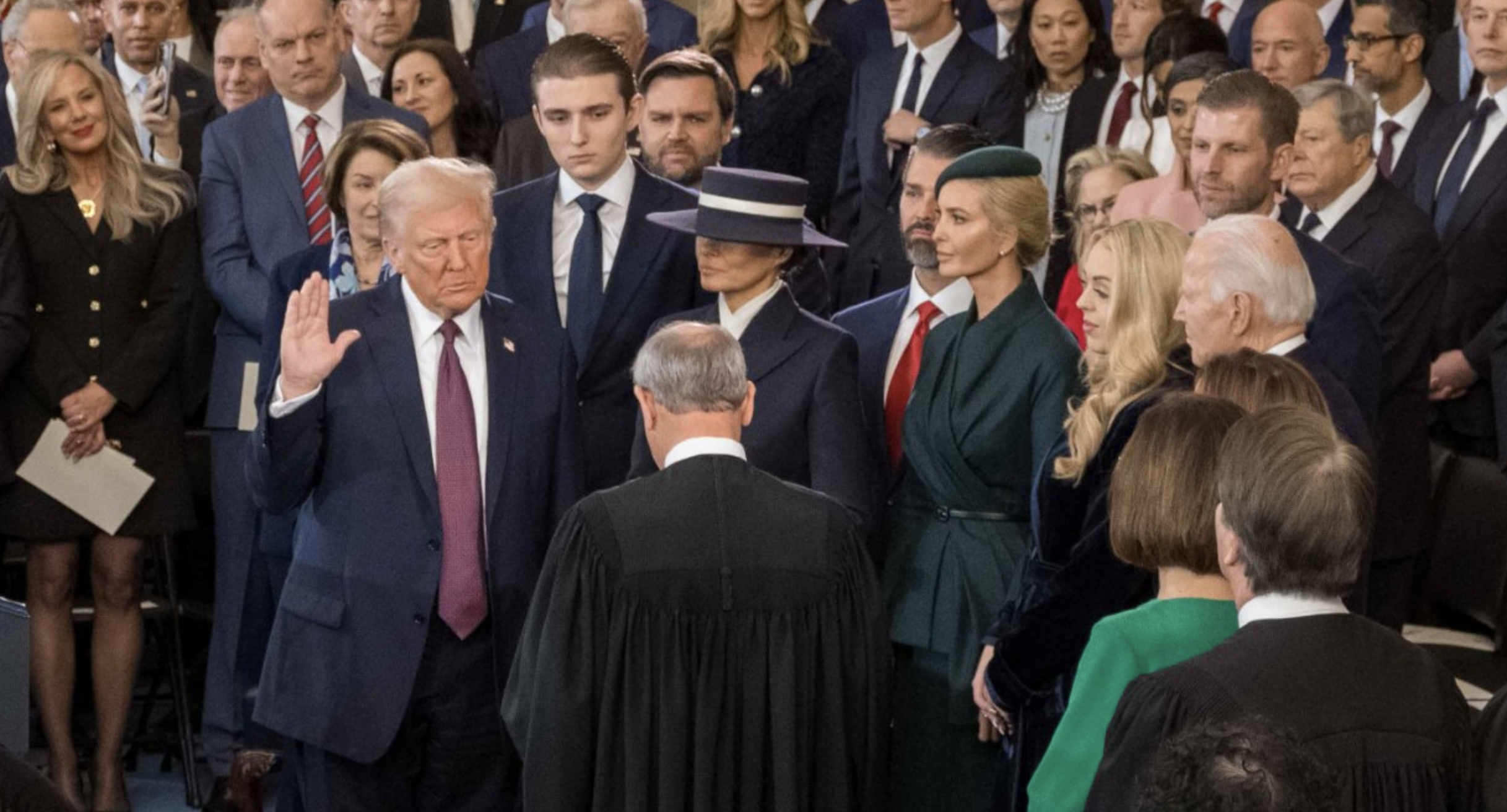
It’s a long story, but the moving image had something to do with it – which is to say, the way we have let television, video, and screen culture run almost entirely unregulated, purely for profit, and without regard to its impact on the minds of our citizens. And it’s no accident that the media and technology tycoons surrounding the President at his White House inauguration – from Alphabet, Amazon, Apple, Facebook, TikTok, X, you name it – control the screens, networks, and technologies that propagate the lies we’re forced to inhale every day. He invited them.
What’s worse is that they accepted.
* * *
It’s a long story indeed – one that stretches back to the dawn of man, back tens of thousands of years to the time when our predecessors existed on Earth without a single written word between them. “Literacy,” the philosopher, Jesuit priest, and professor of literature Walter Ong has written, “is imperious.” It “tends to arrogate to itself supreme power by taking itself as normative for human expression and thought.” This arrogance, for Ong, is so overreaching because the written word – writing, text, and print generally – is actually such a brand-new phenomenon in the long history of man. Our species of Homo sapiens, Ong reminds us, has been around only for some 30,000 years; the oldest script, not even 6,000; the alphabet, less than four. Mesopotamian cuneiform dates from 3,500 BC; the original Semitic alphabet from only around 1,500 BC; Latin script, or the Roman alphabet that you’re reading now, from the seventh century BC. “Only after being on earth some 500,000 years (to take a fairly good working figure) did man move from his original oral culture, in which written records were unknown and unthought of to literacy.”
For most of human existence, we’ve communicated without print— and even without text. We’ve been speaking to one another. Not writing anything, not drawing a whole lot, but speaking, one to one, one to several, several to one, one to many, many to one. Those who consider writing, text, and print as “the paradigm of all discourse” thus need to “face the fact,” Ong says, that only the tiniest fraction of human languages has ever been written down – or ever will be. We communicate in other ways besides writing. Always have. Always will. Ong presses us to develop a deeper understanding and appreciation of the “normal oral or oral- aural consciousness” and the original “noetic economy” of humankind, which conditioned our brains for our first 500,000 years – and which is at it once again. Sound and human movement around sound and pictures sustained us “long before writing came along.” “To say that language is writing is, at best, uninformed,” Ong says (a bit imperiously himself). “It provides egregious evidence of the unreflective chirographic and/or typographic squint that haunts us all.”
The unreflective chirographic squint. We squint, and we see only writing. Up to now, we’ve found truth and authority only in text versions of the word. But writing, when it, too, first appeared, was a brand-new technology, much as we regard cameras and microphones as brand- new technologies today. It was a new technology because it called for the use of new “tools and other equipment,” “styli or brushes or pens,” “carefully prepared surfaces such as paper, animal skins, strips of wood,” “as well as inks or paints, and much more.” It seemed so complicated and time- consuming, we even used to outsource it. “In the West through the Middle Ages and earlier” almost all those devoted to writing regularly used the services of a scribe because the physical labor writing involved – scraping and polishing the animal skin or parchment, whitening it with chalk, resharpening goose-quill pens with what we still call a pen-knife, mixing ink, and all the rest – interfered with thought and composition.
The 1400s changed all that. Gutenberg started printing on his press in Germany, in 1455. The great historians of print – Robert Darnton, Elizabeth Eisenstein, Lucien Febvre, Anthony Grafton – tell us about how printing passed through patches of explosive growth, and how that growth was unnoticed at the time. Thirty years after Gutenberg cranked up his shop in Mainz, Germany had printers in only forty towns. By 1500, a thousand printing presses were in operation in Western Europe, and they had produced roughly 8 million books. But by the end of the 1500s, between 150 and 200 million books were circulating there.
Like ours, those early years, now 500 years ago, were full of chaos – the new technology seemed overwhelming. Harvard University Librarian Emeritus Robert Darnton has written, “When the printed word first appeared in France in 1470, it was so brand new, the state did not know what to make of it.” The monarchy (keep this in mind) “reacted at first by attempting to extinguish it. On January 13, 1535, Francis I decreed that anyone who printed anything would be hanged.” For the moving image today, with all of us on our iPhones, the modern cognate of hanging everyone recording or sharing video might seem extreme. But in the long view, we too, comparatively speaking, don’t yet know what to “make” of this new medium of ours.
That’s partly because it, too, is so young. The Lumiere brothers showed the first movie to public customers in France in 1895 – only 130 years ago. But today video is becoming the dominant medium in human communication. It accounts for most of our consumer internet traffic worldwide. The gigabyte equivalent of all the movies ever made now crosses the global internet every two minutes. Nearly a million minutes of video content cross global IP networks every sixty seconds. It would take someone – anyone – 5 million years to watch the amount of video that scoots across the internet each month. YouTube – YouTube alone – sees more than 1 billion viewers watching more than 5 billion videos on its platform every day. Video is here, and everywhere. It’s part of every sporting event, it’s at every traffic stop, it’s at every concert and in every courtroom. Twenty network cameras actively film the Super Bowl. The same number work Centre Court at Wimbledon. It’s in every bank, in every car, plane, and train. It’s in every pocket. It’s everywhere. For whatever you need. Dog training. Changing a tire. Solving a differential equation. Changing your mood.
It’s taken control. It’s just us who’ve been slow to realize it. Some 130 years into the life of the moving image, we are in what Elizabeth Eisenstein, writing about print, called the elusive transformation: it’s hard to see, but it’s there. If you picture an airplane flight across an ocean at night, you can sense it. As the sky darkens and dinner is served, the most noticeable thing about the plane is that almost everyone is sitting illuminated by the video screens in front of them. The screen and the speaker are now at the heart of how world citizens communicate. In many ways we are the passengers on this plane, relying no longer on the printed page, but on the screen and its moving images for much of the information we are receiving (and, increasingly, transmitting) about our world. The corruption and malfeasance and occasional achievements of our modern politicians; scientific experiments; technological developments; newscasts; athletic feats – the whole public record of the twenty-first century, in short – is all being recorded and then distributed through the lens, the screen, the microphone, and the speaker. Now text may be losing its hold (short as that hold has been) on our noetic imagination – especially its hold as the most authoritative medium, the most trustworthy medium, the medium of the contract, the last word, as it were.
Donald Trump and the greedy, cowardly technologists that surround him know it. They have the data; but they also intuit it. And they are clamping down on our access to knowledge even as the opposite seems true – which is that Apple, Netflix, Tiktok, and YouTube are making video ever freer, and more ubiquitous.
This marks the end of Part 1 of Peter Kaufman’s essay. You can now find Part 2 here.
–Peter B. Kaufman works at MIT Open Learning. He is the author of The New Enlightenment and the Fight to Free Knowledge and founder of Intelligent Television, a video production company that works with cultural and educational institutions around the world. His new book, The Moving Image: A User’s Manual, is just out from the MIT Press.
We're hoping to rely on loyal readers, rather than erratic ads. Please click the Donate button and support Open Culture. You can use Paypal, Venmo, Patreon, even Crypto! We thank you!
Open Culture scours the web for the best educational media. We find the free courses and audio books you need, the language lessons & educational videos you want, and plenty of enlightenment in between.





.jpg#/media/File:Donald_Trump_takes_the_oath_of_office_(2025)_(cropped).jpg)