Since the release of An Inconvenient Truth, Al Gore has had quite a run. He first won himself an Emmy, then an Oscar, and now the Nobel Peace Prize. Although the film represents Gore’s most well known work on the environment, it’s hardly where his environmental efforts began. His campaign goes back to the late 1970s, when he held congressional hearings on climate change and greenhouse gases. And it moves through the 1980s and then the 1990s, when he occupied the Vice Presidency. In 1992, while other political leaders quibbled over the pros and cons of NAFTA, Gore put the environment on the national agenda, really for the first time, when he published Earth in the Balance: Ecology and the Human Spirit. (The Bush administration then took it off the agenda, regrettably.) Gore’s book became a national bestseller, and it has since gone through several new editions, the latest having been issued just last year. You could buy the book, but the good news is that Google serves up large portions of the book online for free. It’s at a price you can’t beat, and it goes easy on the pulp. Have a good look. And also see below Gore’s comments upon learning about the Nobel Prize.

A Photographer’s Chronicle of the War in Iraq
Australian photographer Ashley Gilbertson documented for The New York Times the US invasion of Iraq, capturing the lightning fast overthrow of Saddam’s regime and then the slow lapse into civil war. His new book, Whiskey Tango Foxtrot: A Photographer’s Chronicle of the Iraq War, collects some of his best work. Combined, the printed photographs offer what he calls a visual “testament to what war actually is.” They let you see how decisions made by the Pentagon have real human costs on the ground in Iraq; or, put a little differently, the photos illustrate in stark detail “what foreign policy looks like from the ground up.” Below, you can watch a video that features an intelligent interview with Gilbertson and offers a good glimpse into his photographic work. Definitely give it some of your time.
Special Note: Support an Independent Press
We all know that an independent press is absolutely essential to preserving a democratic and open culture. Unfortunately, more than 80 percent of people live in countries without a free press. That means more than 5 billion people can’t trust what they read in the newspaper, hear on the radio or see on TV. Here is a very tangible way to empower independent journalists. Contributing $100 to the Media Development Loan Fund will provide independent journalists with printing presses and broadcasting equipment, tools that are essential to overcoming censorship and giving a voice to the unheard. Click here to get more information.

Satirizing Ahmadinejad: The New Yorker Picks Up Where SNL Left Off
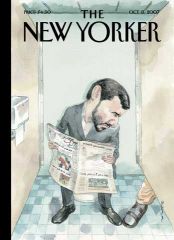
The satirists are getting a lot mileage out of Mahmoud Ahmadinejad’s declaration that Iran is gay-free. Last week, Saturday Night Live spoofed Ahmadinejad, as we noted. Then, The New Yorker parodied Ahmadinejad on the magazine’s cover with one of its famed cartoons. (The image included a not-so-oblique reference to Larry Craig, the conservative US Senator who recently got caught up in some mens’ room high jinks. Unfamiliar readers can get the scoop on Craig here.) Of all the inane comments Ahmadinejad has made, and there are many, it’s interesting that the satirists have chosen to focus on this one. Denying the existence of gays in Iran is no more empirically absurd than denying the Holocaust. So why the emphasis on the sexuality comment? Because Ahmadinejad has been playing the anti-semitism card for some time, but the homophobia card is relatively new, hence making it worthy of attention? Or is it because sexuality offers an always convenient way to take a political enemy down a peg? Or since there’s no good way to satirize a genocide, perhaps sexuality becomes a good default. Ok, I’m stumped. Note to self: think twice next time before over-analyzing jokes. Speaking of jokes, make you check out the footage we posted of Woody Allen doing standup in 1965.
Ahmadinejad Spoofed on Saturday Night Live
Ahmadinejad’s recent appearance at Columbia University generated a lot of serious press (watch his speech here), and, quite rightly, journalists and commentators seized on his more outlandish assertions — that the Holocaust is not a historical given, and that homosexuals actually don’t exist in Iran. After all of the serious reporting was done, Saturday Night Live got to work and aired this clip that continued its tradition of biting political satire. Here it goes:
The World Without Us: Author Interview
Earlier this week I spoke on the phone with Alan Weisman, the author of The World Without Us. (See our initial piece on his book.) Alan was gracious enough to take some time out of his publicity schedule to share his thoughts on the book, the world, his writing process, and more. What follows is an edited transcript of our conversation.
Ed: This book addresses what on the surface seems to be a pretty far-fetched hypothetical: that humanity might suddenly disappear. What drew you to this premise in the first place?
Alan: Well, precisely that. Most great environmental writing does not get read by a lot of the people who ought to be learning about it because the nearer-term possibilities just seem sometimes so frightening, or so depressing, that nobody really wants to pick up a book to read it.
By structuring the book the way that I did, I disarm the automatic fear that repels a lot of people from reading about the environment. People don’t want to read something that seems too threatening. On a subconscious or even a conscious level, they don’t want to be worried we’re all going to die. In my book, killing us off in the first couple of pages means people don’t have to worry about dying because we’re already dead, and that’s a relief in a sense. The idea of glimpsing the future is irresistible to all of us and I establish pretty quickly that is not going to just be me speculating, it’s going to be some hard science writing based on a lot of reporting, of talking to experts or eyewitnesses whose guesses will be far more interesting than most peoples’.
The fact that it is far-fetched is really useful because on the one hand really it’s a remote possibility that we would leave, that we would disappear tomorrow. So people don’t go into a panic over this book, and it really gives people enough time to think about these things without panicking about it. So that’s how this device works, and I think it’s been proven to be very effective. I’m getting a lot more people to read it than just people who are hung up on the environment.
Kasparov, The Chess Master, Takes on Putin: A New Yorker Podcast
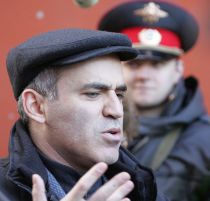 David Remnick, the editor of the New Yorker and author of the Pulitzer Prize-winning book, Lenin’s Tomb, has recently revisited the country he knows so well. And what he has to show for it is an extensive piece on Garry Kasparov, arguably the best chess player in history, and his dangerous move into the political arena. In Vladimir Putin’s Russia, neither political dissent nor political opposition goes over terribly well. Since he took the reins of power in 2000, more than a dozen journalists critical of Putin have turned up dead. So have some politicians. Then there was the dramatic case of Alexander Litvinenko, the former KGB agent turned Putin critic, who died of radiation poisoning in London last fall. All of the cases remain “unresolved.”
At great personal and financial cost, Kasparov is trying to lay the foundation for a legitimate political opposition. Getting there, however, won’t be easy. For one, Putin, having shored up Russia’s economy and national psyche, is immensely popular, having upwards to an 80% popularity rating. Even the old dissident Aleksandr Solzhenitsyn likes him. Then, there’s the fact that Putin has almost a tsarist, “L’État, c’est moi” kind of grip on power. In a podcasted interview (iTunes — Feed — Web Site) that grew out of Remnick’s article, Kasparov talks about his expectations for the next presidential election in Russia, when Putin is constitutionally required to cede presidential powers to another politician. Here, he tells Remnick that Putin will continue calling the shots because, as he puts it, Russia’s political elite is so feckless that they would “vote to make Putin’s dog the prime minister.” This strikes the listener as a strange but timely comment, especially in light of Putin’s announcement yesterday that he may seek to become Russia’s prime minister, which would essentially give him the chance to continue exercising power from what one diplomat has called “a parallel structure.” That’s a move that should prove hard for Kasparov or any other Putin opponent to parry.
Related Content:
- The New Yorker Magazine Crosses the Digital Divide
- The New Yorker Magazine’s Famous Cartoons Now Available on Podcast
- My Trip to Al Qaeda: A New Yorker Video

Support Monks’ Protest in Burma on Facebook
 Social networking is doing some good. In a matter of days, over 110,000 users have joined the Support the Monks’ Protest in Burma group on Facebook, with the larger goal of mobilizing support for the Buddhist monks who have launched a peaceful, “saffron” protest against the military regime that seized power in 1962 and has held on ever since. As expected, the government is cracking down on the peaceful protesters, breaking into monasteries at night, torturing monks and throwing them in jail. The Facebook Group offers a specific action plan, and it’s effectively bringing visibility to this human rights issue. Log into Facebook (or create an account), join the group here and support democracy in Burma.
For a more general account of the human rights abuses in Burma, click here; for daily accounts of what’s currently happening in Burma right now, click here.
Also please note: International bloggers are preparing an action to support the peaceful revolution in Burma. On October 4, bloggers will refrain from posting to their blogs and just put up one Banner underlined with the words “Free Burma!” Get more information at www.free-burma.org, and if you’re a blogger participate and help turn up the pressure.
Newly Minted Genius: 2007 MacArthur Fellows
The MacArthur Foundation recently announced its latest crop of “genius grant” recipients. Each winner receives $500,000 “with no strings attached” and they can use the money to live, to fund research, or to buy a very modest condo in the Bay Area. As usual, the recipients come from a wide range of fields and backgrounds. Reviewing the bios and multimedia clips of these incredibly gifted people, I can’t help but be reminded of a great Tom Lehrer quote: “When Mozart was my age, he had been dead for two years.”
Support Us
We're hoping to rely on loyal readers, rather than erratic ads. Please click the Donate button and support Open Culture. You can use Paypal, Venmo, Patreon, even Crypto! We thank you!

About Us

Open Culture scours the web for the best educational media. We find the free courses and audio books you need, the language lessons & educational videos you want, and plenty of enlightenment in between.
Advertise With Us

