You may remember that when we featured the favorite films of Federico Fellini, the 8 1/2 director’s top-ten list included… well, 8 1/2. But then, no filmmaker before Fellini or after him has had quite the same sensibility, so if Fellini made the kind of movies he himself wanted to watch — and I suspect he made only that kind of movie — then we might wonder why his list didn’t include even more of his own work. And maybe we should wonder the same about this list of favorites from Luis Buñuel, the Spanish surrealist who started doing for vivid, dreamlike, and grotesque European cinema in the 1920s what Fellini kept doing for it until the 1990s:
I Am a Fugitive from a Chain Gang (1932, Mervyn LeRoy)
At the top of the post, you can watch Buñuel’s number-one pick, Josef von Sternberg’s silent proto-gangster picture Underworld. Just above, you’ll find his number-nine pick, and the one he had a hand in himself: L’Age d’Or, the 1930 societal satire on which he collaborated with the Spanish artist Salvador Dalí. It came as the follow-up to their 1929 silent short Un Chien Andalou, a work widely recognized as the foundation stone of surrealist cinema (see also our post on both films), and it came with much greater ambitions.
Neither Buñuel’s own directorial style nor the medium of cinema itself had quite found their form yet; those conditions produced a film that still retains many striking and even cutting qualities today, albeit not, perhaps, to the same degree that they caused contemporary right-wingers to toss ink at the screen and start brawls in the aisles. Watch the pre-1930 films on the list, like Battleship Potemkin and The Gold Rush, to understand what formed Buñuel’s cinematic sensibility; watch L’Age d’Or to understand why, when it comes to his own work, he prefers the early stuff.
Origin stories are all the rage these days given the ubiquity of superhero films and television series. But for all their smash-em-up spectacle and breakneck pacing, they generally feel overstuffed and disposable. As with the Age of Ultron, there is an age, every summer, of some Marvel or DC hero or other. Or all of them at once, at this point, in a perpetual onslaught. On the other hand, we still have the quietly ominous, thoughtful science fiction film, the offspring of Nicolas Roeg and Andrei Tarkovsky, in movies like Ex Machina. These come and go, some better than others, but also always with us. Different as these two types of films can be, in style and tone, neither would likely look and feel the way they do without Stanley Kubrick’s intensely introspective and profoundly epic 2001: A Space Odyssey.
The origin story of this incredible 1968 film begins on March 31, 1964 when Kubrick wrote the letter below to Arthur C. Clarke, proposing that the two collaborate on “the proverbial ‘really good’ science fiction film.” “I had been a great admirer of your books for quite a time,” writes Kubrick, and gives Clarke three “broad areas” of interest, “naturally assuming great plot and character.” Naturally.
“Clarke’s response,” writes BFI, “was immediately enthusiastic, expressing a mutual admiration.” Kubrick, Clarke told their mutual friend Roger Caras, “is obviously an astonishing man.” In his response to the director himself, Clarke wrote on April 8, ““For my part, I am absolutely dying to see Dr. Strangelove; Lolita is one of the few films I have seen twice – the first time to enjoy it, the second time to see how it was done.” The two met in New York and talked for hours, and from Clarke’s short story “The Sentinel of Eternity” was born perhaps the best “really good” science fiction film ever made.
Clarke would compare the differences between the story and the film to those between an acorn and an oak tree, according to Italian Kubrick site 2001Italia. After that meeting, the two would spend almost four years writing the screenplay together and envisioning the harrowing voyage to Jupiter that ends so tragically—and strangely—for the two astronauts left to experience it. It’s a collaborative success Kubrick clearly foresaw when he approached Clarke, but in his letter, above, with transcript below—courtesy of Letters of Note—he plays it cool, using the pretext of a telescope Clarke owned to slip in discussion about the film project. We are almost led to believe,” writes 2001Italia, “that the movie was an excuse” to discuss the gadget. But of course we know better.
Dear Mr Clarke:
It’s a very interesting coincidence that our mutual friend Caras mentioned you in a conversation we were having about a Questar telescope. I had been a great admirer of your books for quite a time and had always wanted to discuss with you the possibility of doing the proverbial “really good” science-fiction movie.
My main interest lies along these broad areas, naturally assuming great plot and character:
The reasons for believing in the existence of intelligent extra-terrestrial life.
The impact (and perhaps even lack of impact in some quarters) such discovery would have on Earth in the near future.
A space probe with a landing and exploration of the Moon and Mars.
Roger [Caras ]tells me you are planning to come to New York this summer. Do you have an inflexible schedule? If not, would you consider coming sooner with a view to a meeting, the purpose of which would be to determine whether an idea might exist or arise which could sufficiently interest both of us enough to want to collaborate on a screenplay?
Incidentally, “Sky & Telescope” advertise a number of scopes. If one has the room for a medium size scope on a pedestal, say the size of a camera tripod, is there any particular model in a class by itself, as the Questar is for small portable scopes?
Best regards,
Kubrick pursued his projects very deliberately and passionately, motivated by great personal interest. Though his films can feel detached and cold, and he himself seems like a very aloof character, the opposite was true, according to those who knew him best. Below, see a short video from The University of the Arts London’s Stanley Kubrick Archive profiling the way Kubrick went about choosing his films, best summed up by Jan Harlon, Kubrick’s brother-in-law and producer: “No love, no quality, and in Stanley’s case, no love, no film.”
Once in a lifetime there comes a motion picture which changes the whole history of motion pictures. A picture so stunning in its effect, so vast in its impact that it profoundly affects the lives of all who see it.
But then comes the self-effacing punchline delivered by another narrator in Japanese:
One such film is Kurosawa’s “The Seven Samurai.” Another was “Ivan the Terrible.” Then there are more run-of-the mill films like “Herbie Rides Again,” “La Notte” and “Monty Python and the Holy Grail.”
… So, if you’re an intellectual midget and you feel like giggling, you could do worse than see Monty Python and the Holy Grail.
Classic Python!
Now, if want a Python trailer that takes itself seriously, look no further than the clip above. Created last year, this trailer re-imagines Monty Python and the Holy Grail as a mainstream Hollywood film. No wit. All cheese. If you dig the concept, you can see similar reworkings of Stanley Kubrick films here.
The modal experimentation in Miles Davis’ classic albums Milestones and, especially, 1959’s Kind of Blue seemed to come out of nowhere. Along with similarly groundbreaking releases at the end of the fifties, these records irrevocably changed the sound of jazz. But hardcore jazz fans, and cinephiles, would have seen the development coming, having heard Davis’ soundtrack to Louis Malle’s 1958 crime thriller Elevator to the Gallows (Ascenseur pour l’Echafaud—trailer below). As the story goes, Davis happened to be in Paris in 1957 during the film’s postproduction to perform at the Club Saint-Germain. Malle’s assistant—perhaps inspired by the moody jazz soundtracks of films like Roger Vadim’s Does One Ever Know and Alexander Mackendrick’s Sweet Smell of Success—suggested Davis to the director. After a private screening of the film, the trumpeter and composer agreed to take the gig. It was Davis’ first soundtrack and Malle’s first feature film.
At the top of the post, we have the great privilege of seeing—and hearing—Miles and his four sidemen record the soundtrack, live. The two-day session took place at Le Post Parisien Studio in Paris on December 4th and 5th. According to Discogs, “Davis only gave the musicians a few rudimentary harmonic sequences he had assembled in his hotel room, and once the plot was explained, the band improvised without any precomposed theme, while edited loops of the musically relevant film sequences were projected in the background.”
The filmed session is captivating; Davis and band stare intently at the screen and, on the spot, create the film’s mood. (In the second half of the clip, the filmmakers banter in French about the production while Davis plays in the background.) Seeing this footage, writes Dangerous Minds, is akin to “watching Picasso paint.” Furthermore, “it could be argued that Malle’s cinematic style and the unique pacing and character of this particular film—which Miles obviously had to conform to in order to score it properly—had a noticeable influence on his music.”
Miles would say as much, claims his biographer Ian Carr, telling Malle “a year or two later” that “the experience of making the music for the film had enriched him.” Critic Jean-Louis Ginibre wrote in Jazz magazine at the time that Davis “raised himself to greater heights” during the sessions, “and became aware of the tragic character of his music which, until then, had been only dimly expressed.” For his part, Malle remarked, “Miles’s commentary—which is of extreme simplicity—gives a really extraordinary dimension to the visual image.” Fans of the film will surely agree. Fans of Miles Davis may want to rush out and get their hands of a copy of the score. (You can find a diminished copy on Youtube here). It was never released in the U.S., but ten songs appeared stateside on an album called Jazz Track. While the soundtrack may not work as well without the images (Allmusic describes some numbers as “rather sterile”), it nonetheless provides us with a kind of missing link between Davis’ fifties hard bop and the cool jazz he pioneered the following decade in his most-lauded, best-selling album, Kind of Blue.
The Henson Rarities site on YouTube keeps giving and giving. Not only has it given us access to some of Jim Henson’s earliest (and delightfully violent) commercials, but it has discovered this: a pilot of The Orson Welles Show from 1979. The show was never aired, and you might be able to discern why from checking it out.
It’s the height of ‘70s excess with wide collars, polyester shirts, various forms of pre-show indulgences, and it’s all underlit like a nightclub, not a talk show set. Orson Welles doesn’t interview his first guest Burt Reynolds, but instead immediately throws the questions to the audience, turning the first half of the show into an ur-Actors Studio episode. (An eagle eyed YouTube commentator points out a young–but unverified–Joe Dante in the audience.) And the entire show has the feeling of very, very rough footage saved by editing and heaping on tablespoons of canned laughter.
Eventually Welles introduces “a little company of cloth headed comedians” that was already in its third season of the Muppet Show and about to premiere its first movie. (That first Muppet Movie, by the way, features Welles near the end as a movie executive.)
Welles, who calls himself a magician more often than a director in this episode, no doubt loves the magic behind the Muppets. Even when the lights are fully upon Henson and his frog puppet, we never question that Kermit is not real. In the 50th minute, Welles introduces both Henson (“picture Rasputin as an Eagle Scout” says the director) and Frank Oz (“A man who truly fits his name.”)
The show peters out with a magic trick, an appearance by Angie Dickinson (more tricks!) and a final Welles monolog, who reads Jenny Kissed Me by James Leigh Hunt. Like the poem, there’s a shadow of maudlin mortality hanging over all of Welles’ lines throughout the show. Six years later Welles would pass away with his final movie unfinished, still waiting for the cash that he hoped programs like The Orson Welles Show would bring.
Ted Mills is a freelance writer on the arts who currently hosts the FunkZone Podcast. You can also follow him on Twitter at @tedmills, read his other arts writing at tedmills.com and/or watch his films here.
You don’t rile up as many people as Michael Moore has without mastering the art of button pushing. Clint Eastwood threatened to kill him (allegedly). Christopher Hitchens, echoing the sentiments of many Iraq war supporters, called his work “dishonest and demagogic.” And the State Department—opponents of both socialized healthcare and the Cuban government—attempted to discredit Moore with lies about his film Sicko. Those are some powerful enemies, especially for a “comedian and a populist” whose only weapons are cameras, microphones, and bestselling topical rants. On the other hand, Moore inspires millions of regular folks. As far back as 2004, a profile in TheNew Yorker described the simultaneously angry and jovial documentarian as “a political hero” to millions who “revere” him.
How does a documentary filmmaker create such passion? Moore, writes The New Yorker, intentionally provokes; but he is also “exquisitely sensitive to his audience’s mood and response. The harshness of his comedy, the proportion of comedy to political anger, the flattery or mockery of the audience, the number and type of swearwords he uses….” All carefully controlled. And all of it adds up to something more than documentary. Moore treats the term almost as a pejorative, as he told an audience in his keynote speech at the 2014 Toronto International Film Festival’s Doc Conference. Typical documentarians, Moore said, “sound like a scold. Like you’re Mother Superior with a wooden ruler in your hand.”
Some critics of Moore make this very charge against him. Nonetheless, his ability to move people, both in theaters and live audiences, to tears, peals of laughter, and fits of rage, speaks of much more than humorless moralism. Documentarians, Moore says in the 13-point “manifesto” of his speech, should aspire to more. Hence his first rule, which he derives partly from Fight Club. Below it, see abridgments of the other twelve guidelines, and read Moore’s speech in its entirety at Indiewire. If he repeats himself, and he does, a lot, I suppose it’s because he feels the point is important enough to drive home many times:
1. The first rule of documentaries is: Don’t make a documentary — make a MOVIE.
…the audience, the people who’ve worked hard all week — it’s Friday night, and they want to go to the movies. They want the lights to go down and be taken somewhere. They don’t care whether you make them cry, whether you make them laugh, whether you even challenge them to think — but damn it, they don’t want to be lectured, they don’t want to see our invisible wagging finger popping out of the screen. They want to be entertained.
2. Don’t tell me shit I already know.
Oh, I see — you made the movie because there are so many people who DON’T know about genetically modified foods. And you’re right. There are. And they just can’t wait to give up their Saturday to learn about it
3. The modern documentary sadly has morphed into what looks like a college lecture, the college lecture mode of telling a story.
That has to stop. We have to invent a different way, a different kind of model.
4. I don’t like Castor Oil…. Too many of your documentaries feel like medicine.
The people don’t want medicine. If they need medicine, they go to the doctor. They don’t want medicine in the movie theaters. They want Goobers, they want popcorn, and they want to see a great movie.
5. The Left is boring.
…we’ve lost our sense of humor and we need to be less boring. We used to be funny. The Left was funny in the 60s, and then we got really too damn serious. I don’t think it did us any good.
6. Why don’t more of your films go after the real villains — and I mean the REAL villains?
Why aren’t you naming names? Why don’t we have more documentaries that are going after corporations by name? Why don’t we have more documentaries going after the Koch Brothers and naming them by name?
7. I think it’s important to make your films personal.
I don’t mean to put yourself necessarily in the film or in front of the camera. Some of you, the camera does not like you. Do not go in front of the camera. And I would count myself as one of those. … But people want to hear the voice of a person. The vast majority of these documentary films that have had the most success are the ones with a personal voice.
8. Point your cameras at the cameras.
Show the people why the mainstream media isn’t telling them what is going on.
9. Books and TV have nonfiction figured out. People love to watch Stewart and Colbert. Why don’t you make films that come from that same spirit?
Why wouldn’t you want the same huge audience they have? Why is it that the American audience says, I love nonfiction books and I love nonfiction TV — but there’s no way you’re dragging me into a nonfiction movie! Yet, they want the truth AND they want to be entertained. Yes, repeat after me, they want to be entertained!
10. As much as possible, try to film only the people who disagree with you.
That is what is really interesting. We learn so much more by you training your camera on the guy from Exxon or General Motors and getting him to just blab on.
11. The audience is part of the film.
While you are filming a scene for your documentary, are you getting mad at what you are seeing? Are you crying? Are you cracking up so much that you are afraid that the microphone is going to pick it up? If that is happening while you are filming it, then there is a very good chance that’s how the audience is going to respond, too. Trust that. You are the audience, too.
12. Less is more. You already know that one.
Edit. Cut. Make it shorter. Say it with fewer words. Fewer scenes. Don’t think your shit smells like perfume. It doesn’t.
13. Finally… Sound is more important than picture.
Pay your sound woman or sound man the same as you pay the DP, especially now with documentaries. Sound carries the story. It’s true in a fiction film, too.
So there you have it aspiring filmmakers. Should you to wish to galvanize, polarize, move, and inspire your audience as you tell them the truth (as you see it), you’d do well to take a few pointers from Michael Moore. Political differences—and homicidal urges—aside, even particularly right-leaning documentary directors might consider taking a few pages from Moore’s playbook. A few media personalities, it seems, already have, at least when it comes to defining their purpose. One last time, with feeling, for the TL;DR crowd: “Yes, repeat after me, [audiences] want to be entertained! If you can’t accept that you are an entertainer with your truth, then please get out of the business.”
Every ten years, film journal Sight and Sound conducts a worldwide survey of film critics to decide which films are considered the best ever made. Started in 1952, the poll is now widely regarded as the most important and respected out there.
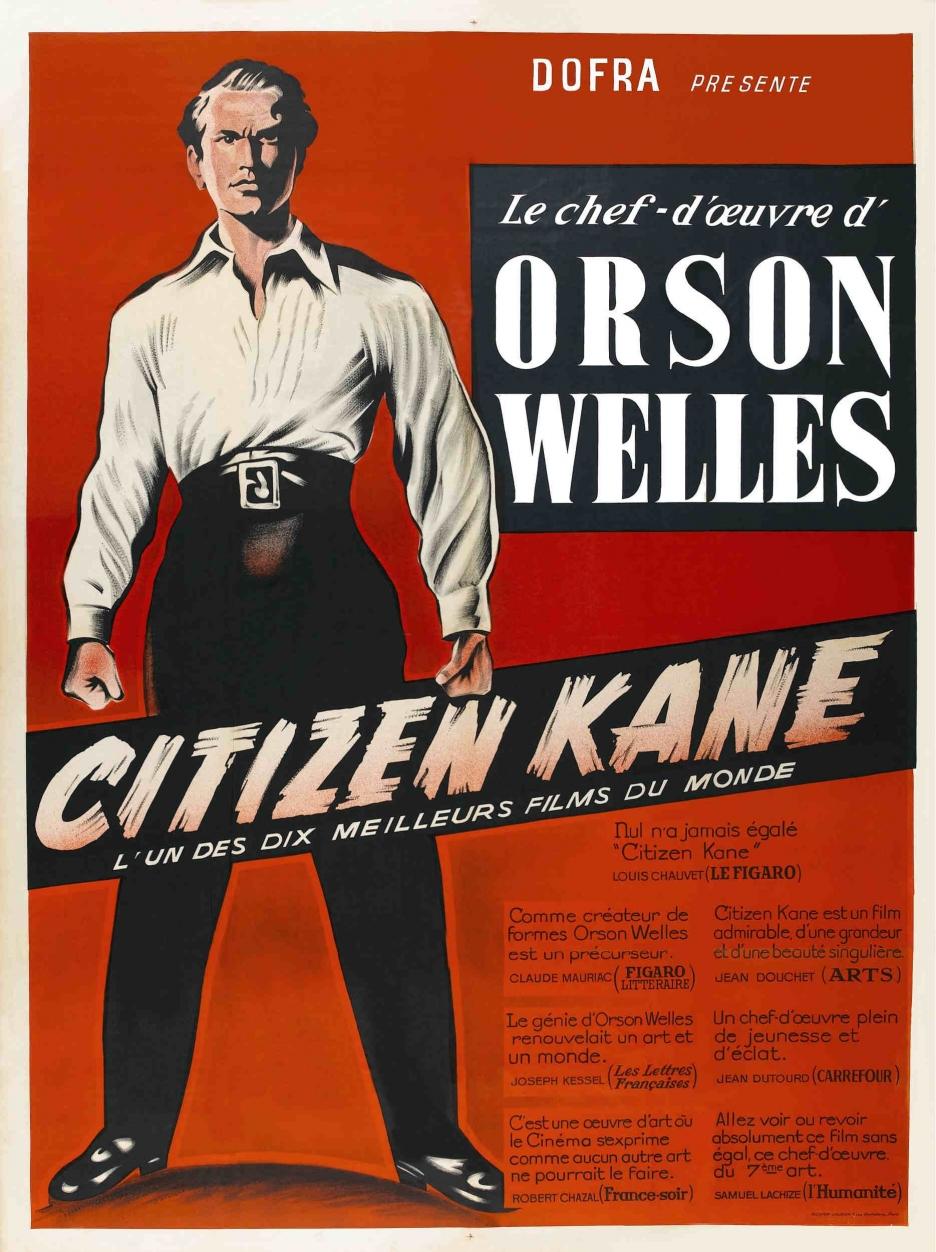
And the critical consensus for a long time was that the masterpiece Citizen Kane by Orson Welles (born 100 years ago today, by the way) is the best of the best. The film topped the list for five decades from 1962 until 2002. Then in 2012, perhaps out of Kane fatigue, Alfred Hitchcock’s Vertigo muscled its way to the top.
That’s what the critics think. But what about the filmmakers?
Beginning in 1992, Sight and Sound started to poll famed directors about their opinions. People like Martin Scorsese, Francis Ford Coppola, Mike Leigh and Michael Mann. So what is the best movie ever made according to 358 directors polled in 2012? Kane? Vertigo? Perhaps Jean Renoir’s brilliant Rules of the Game, the only movie to appear in the top ten for all seven critics polls? No.
It’s a surprising, an enlightened, choice. Ozu’s work is miles away from the flash of Kane and the psychosexual weirdness of Vertigo. Tokyo Story is a gentle, nuanced portrait of a family whose bonds are slowly, inexorably being frayed by the demands of modernization. The movie’s emotional power is restrained and cumulative; by the final credits you’ll be overwhelmed both with a Buddhist sense of the impermanence of all things and a strong urge to call your mother.
But perhaps the reason filmmakers picked Tokyo Story of all the other cinematic masterpieces out there is because of Ozu’s unique approach to film. Since the days of D. W. Griffith, almost every filmmaker under the sun, even cinematic rebels like Jean-Luc Godard, followed some basic conventions of the form like continuity editing, the 180-degree rule and matching eyelines. Ozu discarded all of that. Instead, he constructed a highly idiosyncratic cinematic language revolving around match cuts and rigorously composed shots. His film form was radical but his stories were universal. That is the paradox of Ozu. You can see the trailer of the movie above.
Citizen Kane does make number two on the list but the film is tied with another formally rigorous masterpiece – Stanley Kubrick’s 2001: A Space Odyssey. Next on the list is perhaps the best movie ever about making a movie – Federico Fellini’s 8 ½. And Ozu’s film might be number one, but Francis Ford Coppola is the only filmmaker to have two movies on the list – The Godfather and Apocalypse Now. And that’s no mean feat.
Jonathan Crow is a Los Angeles-based writer and filmmaker whose work has appeared in Yahoo!, The Hollywood Reporter, and other publications. You can follow him at @jonccrow. And check out his blog Veeptopus, featuring lots of pictures of badgers and even more pictures of vice presidents with octopuses on their heads. The Veeptopus store is here.
The documentary form, like every other kind of onscreen storytelling, is a very recent development in human history. Yet we tend to take for granted the way in which it constructs our sense of reality—from not only much-maligned reality TV, but also endless loops of cable news and Netflix channels. But the man widely credited with the invention of documentary film, Dziga Vertov, made decidedly anti-story movies, particularly his Man With a Movie Camera(watch it online here)—a film that jars contemporary sensibilities. With no narrative to speak of, the movie contains roughly 1,775 separate shots from three cities, shot over four years time, and edited together by his wife. Its viewing is indeed a dizzying experience, and its director Vertov—born David Kaufman—truly illustrates the aesthetic of his pseudonym, which means “spinning top.”
Vertov’s radical experimentation did not begin and end with Man With a Movie Camera or his other avant-garde documentaries and animations. (Find eight of Vertov’s films here.) Once a psychology student in Petrograd, the future filmmaker started his artistic career as a writer of futurist poetry and science fiction. Entranced by emerging recording technology and committed to disrupting traditional forms, in 1916 Vertov began, writes Monoskop, “experimenting with the perception and arrangement of sound.”
He created “sound poems,” and produced “verbal montage structures.” Of his audio art, Vertov remarked, “I had an idea about the need to enlarge our ability for organized hearing. Not limiting this ability to the boundaries of usual music. I decided to include the entire audible world into the concept of ‘Hearing.’”
After the Russian Revolution, Vertov embraced Bolshevist agit-prop; his “Kino-Pravda,” or “truth films,” celebrated industrialization and the Russian worker. His first sound film, Enthusiasm! The Donbass Symphony (1930)—a “paean to coal and steel workers”—integrates his experiments with sound recording in an entirely novel way. Ubuweb describes the film and its accompanying soundtrack as “Vertov’s most revolutionary achievement: a symphony of abstract industrial noise for which a specially designed giant mobile recoding system was constructed (it weighed over a ton) in order to capture the din of mines, furnaces and factories. For Vertov, the introduction of sound film didn’t mean talkies, but the opportunity to collage, montage and splice together constructions of pure environmental noise.”
You can hear three excerpts of this industrial sound collage above and the remaining seven at Ubuweb. Listen to them first as examples of “sound poems,” then watch Enthusiasm: The Donbass Symphony at the top for a better understanding of why Vertov remains such an influential, indeed essential, film—and audio—artist widely credited with freeing new media from the aesthetic confines of the stage and the page. Just below, listen to one of Vertov’s early experiments with documentary sound art, from 1916. Just as he sought to create an international worker’s visual language through film, “Through radio, he attempted to establish auditory communication across the whole of the world’s proletariat by way of recording the sounds of workplaces and of life itself.”
We're hoping to rely on loyal readers, rather than erratic ads. Please click the Donate button and support Open Culture. You can use Paypal, Venmo, Patreon, even Crypto! We thank you!
Open Culture scours the web for the best educational media. We find the free courses and audio books you need, the language lessons & educational videos you want, and plenty of enlightenment in between.