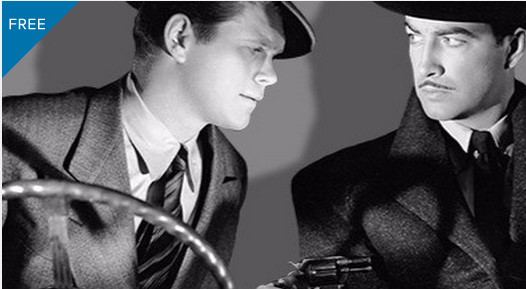
Cinephiles, if you have some spare time in the coming months and feel like watching, say, over 100 film noir movies from the Turner Classic Movie (TCM) vaults, then you will be delighted with Summer of Darkness, which will devote every Friday, from June through July, to 24 hours of noir classics and rarities. And suppose you’d like a reward, like a certificate that proves you not only watched those movies, but properly studied them? Well TCM has that covered too, offering a free nine-week course in “The Case of Film Noir” to run concurrent with the series. It’s free to sign up, and the course runs June 1 — August 4. Says TCM:
This is the deepest catalog of film noir ever presented by the network (and perhaps any network), and provides an unprecedented opportunity for those interested in learning more to watch over 100 classic movies as they investigate “The Case of Film Noir.”
For those who don’t have TCM, or even cable, don’t worry. The network promises to post links to online public domain films. Or, better yet, you could jump right into our collection of 60 Free Noir Films Online, which features public domain classics by Orson Welles, Fritz Lang, John Huston, and many more.
Have a hazy, dangerous summer and watch out for femme fatales!
Ted Mills is a freelance writer on the arts who currently hosts the FunkZone Podcast. You can also follow him on Twitter at @tedmills, read his other arts writing at tedmills.com and/or watch his films here.
From National Geographic comes this: A short timelapse film that lets you watch “the eerily beautiful growth of larvae into bees.” Shot by photographer Anand Varma, the mesmerizing video starts with the larvae of worker bees just hatching from eggs, then follows their maturation into adult bees. The video covers an 11-day process in one short minute.
As Zhou notes, comedies are boring these days. In movies like Bridesmaids and The Hangover, the camera oftentimes just records the actors riffing. The humor is almost entirely dependent on the dialogue. And while that might yield some yuks, in terms of moviemaking, these movies are woefully limited. Film is a visual medium after all.
Wright, on the other hand, is a terrifically inventive filmmaker who knows how to tell jokes visually. One of the reasons Shaun of the Dead and his other films are so damned funny is because he is able to cram jokes into moments where other movies would be content with just pushing the plot forward. “This is what separates mediocre directors from great ones,” says Zhou. “The ability to take the most simple, mundane scenes and find new ways to do them.”
Like Eisenstein and Ozu and just about every other cinematic master out there, Wright is keenly aware of not just what is in the frame but what is not in the frame. Unlike Eisenstein — who, let’s face it, is not funny – Wright knows how to mine the comic potential of the frame.
Zhou ends his spiel with a challenge to Hollywood directors out there. He rattles off eight things that Wright does with picture and sound that he would like other filmmakers to work into their movies.
1. Things entering the frame in funny ways
2. People leaving the frame in funny ways.
3. There and back again.
4. Matching scene transitions.
5. The perfectly timed sound effect.
6. Action synchronized to the music.
7. Super-dramatic lighting cues.
8. Fence gags
Jonathan Crow is a Los Angeles-based writer and filmmaker whose work has appeared in Yahoo!, The Hollywood Reporter, and other publications. You can follow him at @jonccrow. And check out his blog Veeptopus, featuring lots of pictures of badgers and even more pictures of vice presidents with octopuses on their heads. The Veeptopus store is here.
You may remember that when we featured the favorite films of Federico Fellini, the 8 1/2 director’s top-ten list included… well, 8 1/2. But then, no filmmaker before Fellini or after him has had quite the same sensibility, so if Fellini made the kind of movies he himself wanted to watch — and I suspect he made only that kind of movie — then we might wonder why his list didn’t include even more of his own work. And maybe we should wonder the same about this list of favorites from Luis Buñuel, the Spanish surrealist who started doing for vivid, dreamlike, and grotesque European cinema in the 1920s what Fellini kept doing for it until the 1990s:
I Am a Fugitive from a Chain Gang (1932, Mervyn LeRoy)
At the top of the post, you can watch Buñuel’s number-one pick, Josef von Sternberg’s silent proto-gangster picture Underworld. Just above, you’ll find his number-nine pick, and the one he had a hand in himself: L’Age d’Or, the 1930 societal satire on which he collaborated with the Spanish artist Salvador Dalí. It came as the follow-up to their 1929 silent short Un Chien Andalou, a work widely recognized as the foundation stone of surrealist cinema (see also our post on both films), and it came with much greater ambitions.
Neither Buñuel’s own directorial style nor the medium of cinema itself had quite found their form yet; those conditions produced a film that still retains many striking and even cutting qualities today, albeit not, perhaps, to the same degree that they caused contemporary right-wingers to toss ink at the screen and start brawls in the aisles. Watch the pre-1930 films on the list, like Battleship Potemkin and The Gold Rush, to understand what formed Buñuel’s cinematic sensibility; watch L’Age d’Or to understand why, when it comes to his own work, he prefers the early stuff.
Origin stories are all the rage these days given the ubiquity of superhero films and television series. But for all their smash-em-up spectacle and breakneck pacing, they generally feel overstuffed and disposable. As with the Age of Ultron, there is an age, every summer, of some Marvel or DC hero or other. Or all of them at once, at this point, in a perpetual onslaught. On the other hand, we still have the quietly ominous, thoughtful science fiction film, the offspring of Nicolas Roeg and Andrei Tarkovsky, in movies like Ex Machina. These come and go, some better than others, but also always with us. Different as these two types of films can be, in style and tone, neither would likely look and feel the way they do without Stanley Kubrick’s intensely introspective and profoundly epic 2001: A Space Odyssey.
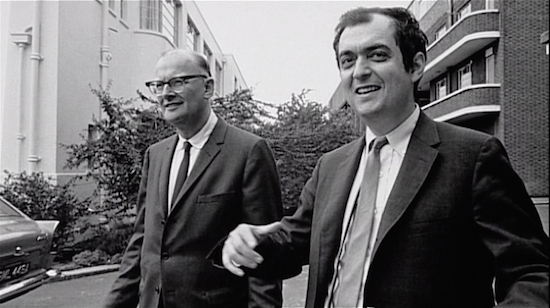
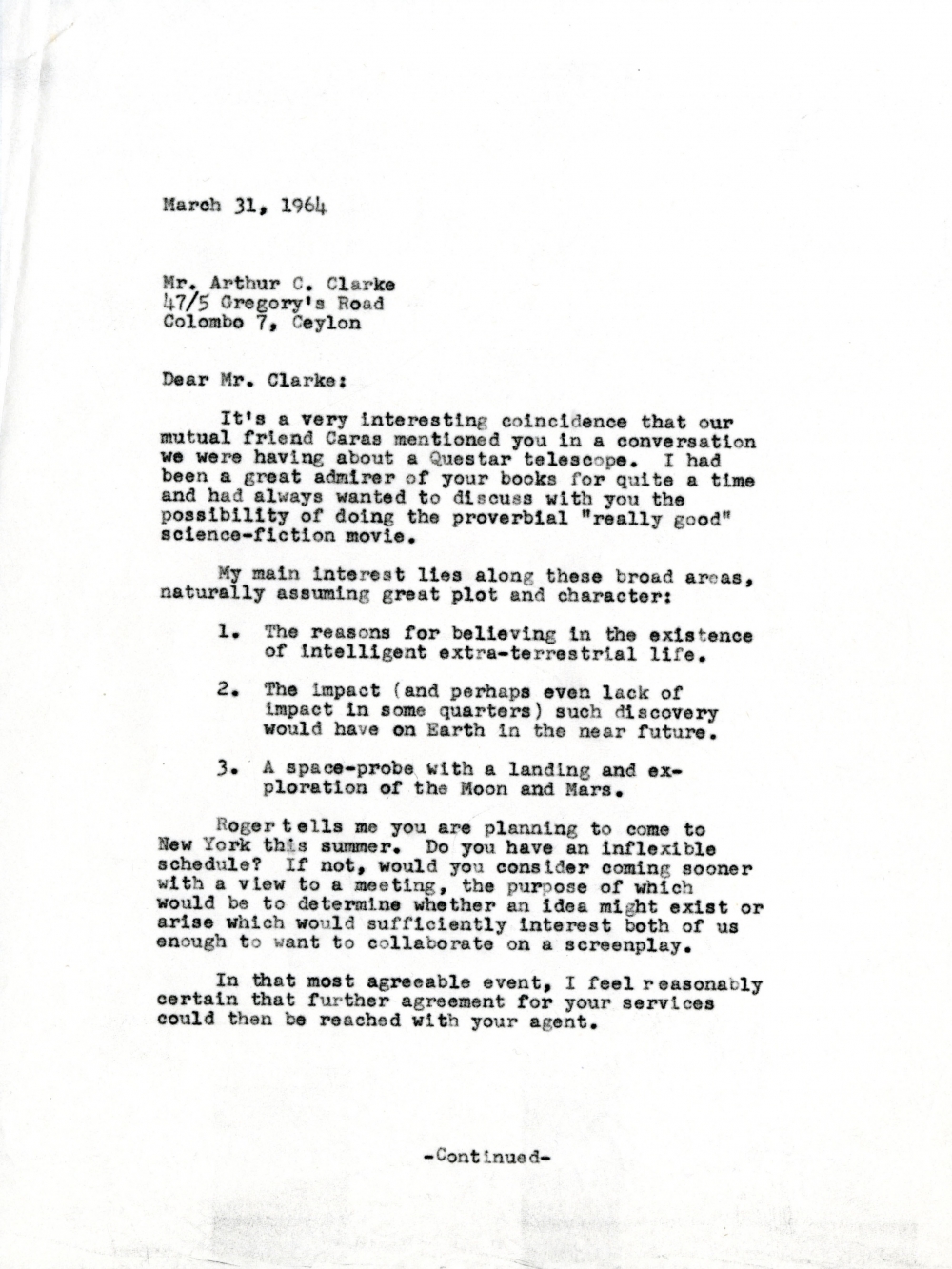
The origin story of this incredible 1968 film begins on March 31, 1964 when Kubrick wrote the letter below to Arthur C. Clarke, proposing that the two collaborate on “the proverbial ‘really good’ science fiction film.” “I had been a great admirer of your books for quite a time,” writes Kubrick, and gives Clarke three “broad areas” of interest, “naturally assuming great plot and character.” Naturally.
“Clarke’s response,” writes BFI, “was immediately enthusiastic, expressing a mutual admiration.” Kubrick, Clarke told their mutual friend Roger Caras, “is obviously an astonishing man.” In his response to the director himself, Clarke wrote on April 8, ““For my part, I am absolutely dying to see Dr. Strangelove; Lolita is one of the few films I have seen twice – the first time to enjoy it, the second time to see how it was done.” The two met in New York and talked for hours, and from Clarke’s short story “The Sentinel of Eternity” was born perhaps the best “really good” science fiction film ever made.
Clarke would compare the differences between the story and the film to those between an acorn and an oak tree, according to Italian Kubrick site 2001Italia. After that meeting, the two would spend almost four years writing the screenplay together and envisioning the harrowing voyage to Jupiter that ends so tragically—and strangely—for the two astronauts left to experience it. It’s a collaborative success Kubrick clearly foresaw when he approached Clarke, but in his letter, above, with transcript below—courtesy of Letters of Note—he plays it cool, using the pretext of a telescope Clarke owned to slip in discussion about the film project. We are almost led to believe,” writes 2001Italia, “that the movie was an excuse” to discuss the gadget. But of course we know better.
Dear Mr Clarke:
It’s a very interesting coincidence that our mutual friend Caras mentioned you in a conversation we were having about a Questar telescope. I had been a great admirer of your books for quite a time and had always wanted to discuss with you the possibility of doing the proverbial “really good” science-fiction movie.
My main interest lies along these broad areas, naturally assuming great plot and character:
The reasons for believing in the existence of intelligent extra-terrestrial life.
The impact (and perhaps even lack of impact in some quarters) such discovery would have on Earth in the near future.
A space probe with a landing and exploration of the Moon and Mars.
Roger [Caras ]tells me you are planning to come to New York this summer. Do you have an inflexible schedule? If not, would you consider coming sooner with a view to a meeting, the purpose of which would be to determine whether an idea might exist or arise which could sufficiently interest both of us enough to want to collaborate on a screenplay?
Incidentally, “Sky & Telescope” advertise a number of scopes. If one has the room for a medium size scope on a pedestal, say the size of a camera tripod, is there any particular model in a class by itself, as the Questar is for small portable scopes?
Best regards,
Kubrick pursued his projects very deliberately and passionately, motivated by great personal interest. Though his films can feel detached and cold, and he himself seems like a very aloof character, the opposite was true, according to those who knew him best. Below, see a short video from The University of the Arts London’s Stanley Kubrick Archive profiling the way Kubrick went about choosing his films, best summed up by Jan Harlon, Kubrick’s brother-in-law and producer: “No love, no quality, and in Stanley’s case, no love, no film.”
Once in a lifetime there comes a motion picture which changes the whole history of motion pictures. A picture so stunning in its effect, so vast in its impact that it profoundly affects the lives of all who see it.
But then comes the self-effacing punchline delivered by another narrator in Japanese:
One such film is Kurosawa’s “The Seven Samurai.” Another was “Ivan the Terrible.” Then there are more run-of-the mill films like “Herbie Rides Again,” “La Notte” and “Monty Python and the Holy Grail.”
… So, if you’re an intellectual midget and you feel like giggling, you could do worse than see Monty Python and the Holy Grail.
Classic Python!
Now, if want a Python trailer that takes itself seriously, look no further than the clip above. Created last year, this trailer re-imagines Monty Python and the Holy Grail as a mainstream Hollywood film. No wit. All cheese. If you dig the concept, you can see similar reworkings of Stanley Kubrick films here.
The modal experimentation in Miles Davis’ classic albums Milestones and, especially, 1959’s Kind of Blue seemed to come out of nowhere. Along with similarly groundbreaking releases at the end of the fifties, these records irrevocably changed the sound of jazz. But hardcore jazz fans, and cinephiles, would have seen the development coming, having heard Davis’ soundtrack to Louis Malle’s 1958 crime thriller Elevator to the Gallows (Ascenseur pour l’Echafaud—trailer below). As the story goes, Davis happened to be in Paris in 1957 during the film’s postproduction to perform at the Club Saint-Germain. Malle’s assistant—perhaps inspired by the moody jazz soundtracks of films like Roger Vadim’s Does One Ever Know and Alexander Mackendrick’s Sweet Smell of Success—suggested Davis to the director. After a private screening of the film, the trumpeter and composer agreed to take the gig. It was Davis’ first soundtrack and Malle’s first feature film.
At the top of the post, we have the great privilege of seeing—and hearing—Miles and his four sidemen record the soundtrack, live. The two-day session took place at Le Post Parisien Studio in Paris on December 4th and 5th. According to Discogs, “Davis only gave the musicians a few rudimentary harmonic sequences he had assembled in his hotel room, and once the plot was explained, the band improvised without any precomposed theme, while edited loops of the musically relevant film sequences were projected in the background.”
The filmed session is captivating; Davis and band stare intently at the screen and, on the spot, create the film’s mood. (In the second half of the clip, the filmmakers banter in French about the production while Davis plays in the background.) Seeing this footage, writes Dangerous Minds, is akin to “watching Picasso paint.” Furthermore, “it could be argued that Malle’s cinematic style and the unique pacing and character of this particular film—which Miles obviously had to conform to in order to score it properly—had a noticeable influence on his music.”
Miles would say as much, claims his biographer Ian Carr, telling Malle “a year or two later” that “the experience of making the music for the film had enriched him.” Critic Jean-Louis Ginibre wrote in Jazz magazine at the time that Davis “raised himself to greater heights” during the sessions, “and became aware of the tragic character of his music which, until then, had been only dimly expressed.” For his part, Malle remarked, “Miles’s commentary—which is of extreme simplicity—gives a really extraordinary dimension to the visual image.” Fans of the film will surely agree. Fans of Miles Davis may want to rush out and get their hands of a copy of the score. (You can find a diminished copy on Youtube here). It was never released in the U.S., but ten songs appeared stateside on an album called Jazz Track. While the soundtrack may not work as well without the images (Allmusic describes some numbers as “rather sterile”), it nonetheless provides us with a kind of missing link between Davis’ fifties hard bop and the cool jazz he pioneered the following decade in his most-lauded, best-selling album, Kind of Blue.
The Henson Rarities site on YouTube keeps giving and giving. Not only has it given us access to some of Jim Henson’s earliest (and delightfully violent) commercials, but it has discovered this: a pilot of The Orson Welles Show from 1979. The show was never aired, and you might be able to discern why from checking it out.
It’s the height of ‘70s excess with wide collars, polyester shirts, various forms of pre-show indulgences, and it’s all underlit like a nightclub, not a talk show set. Orson Welles doesn’t interview his first guest Burt Reynolds, but instead immediately throws the questions to the audience, turning the first half of the show into an ur-Actors Studio episode. (An eagle eyed YouTube commentator points out a young–but unverified–Joe Dante in the audience.) And the entire show has the feeling of very, very rough footage saved by editing and heaping on tablespoons of canned laughter.
Eventually Welles introduces “a little company of cloth headed comedians” that was already in its third season of the Muppet Show and about to premiere its first movie. (That first Muppet Movie, by the way, features Welles near the end as a movie executive.)
Welles, who calls himself a magician more often than a director in this episode, no doubt loves the magic behind the Muppets. Even when the lights are fully upon Henson and his frog puppet, we never question that Kermit is not real. In the 50th minute, Welles introduces both Henson (“picture Rasputin as an Eagle Scout” says the director) and Frank Oz (“A man who truly fits his name.”)
The show peters out with a magic trick, an appearance by Angie Dickinson (more tricks!) and a final Welles monolog, who reads Jenny Kissed Me by James Leigh Hunt. Like the poem, there’s a shadow of maudlin mortality hanging over all of Welles’ lines throughout the show. Six years later Welles would pass away with his final movie unfinished, still waiting for the cash that he hoped programs like The Orson Welles Show would bring.
Ted Mills is a freelance writer on the arts who currently hosts the FunkZone Podcast. You can also follow him on Twitter at @tedmills, read his other arts writing at tedmills.com and/or watch his films here.
We're hoping to rely on loyal readers, rather than erratic ads. Please click the Donate button and support Open Culture. You can use Paypal, Venmo, Patreon, even Crypto! We thank you!
Open Culture scours the web for the best educational media. We find the free courses and audio books you need, the language lessons & educational videos you want, and plenty of enlightenment in between.