If you call yourself a Tolkien fanboy or fangirl, you’ve almost certainly kept up with the various film and television adaptations of not just the Lord of the Rings trilogy, but of its predecessor, The Hobbit, or There and Back Again. Tolkien’s first children’s novel (or so the literary world first received it). The story it tells of the reluctant hero Bilbo Baggins and the band of raffish compatriots who drag him out to claim some treasure from Smaug the dragon offers understandably irresistible material for adaptation: the richly detailed, often funny high-fantasy adventure has, over the decades, made for numerous productions on the stage, radio, and screen.
Known in English as The Fairytale Journey of Mr. Bilbo Baggins, The Hobbit and in Russian, in full, as Сказочное путешествие мистера Бильбо Бэггинса, Хоббита, через дикий край, чёрный лес, за туманные горы. Туда и обратно. По сказочной повести Джона Толкина “Хоббит,”the hourlong TV movie debuted on the Leningrad TV Channel’s children’s showTale After Tale in 1985. This unlicensed adaptation frames itself with the words of a Tolkien stand-in called “the Professor,” using live actors to play the main characters like Bilbo, Thorin, Gandalf, and Gollum, portraying the more exotic ones with either puppets or, according to Tolkien Gateway, dancers from the Leningrad State Academic Opera and Ballet Theatre. The fact that this version of The Hobbitonly recently became available with real English subtitles (as opposed to goofy parody ones) goes to show just how seriously the Tolkien fandom has taken it, but it does retain a kind of handcrafted charm. Plus, it gives the internet the chance to indulge in the obligatory Yakov Smirnoff gag: in Soviet Russia, ring finds you.
Jim Jarmusch is the anti-MTV filmmaker. Most music videos, from the dawn of MTV in 1981 on, are slick and facile, long on visual spectacle and short on things like depth or, you know, coherence. Jarmusch, who started making movies in the East Village in the 1970s when the DIY-spirit of the No Wave movement was at its zenith, made movies that were deliberately slow and spare, recalling Bertolt Brecht and Yasujiro Ozu.
“I don’t generally like music videos because they provide you images to go with the songs rather than you providing your own,” he said in an interview with Film Comment back in 1992. “You lose the beauty of music by not bringing your own mental images or recollections or associations. Music videos obliterate that.”
Yet he did direct a handful of videos. As much as he dislikes the medium, Jarmusch gets music in a way that few other directors do. It is an integral element of all Jarmusch’s work. Check out the opening to his third feature Down By Law:
He uses Tom Waits’s “Jockey Full of Bourbon” to animate those gorgeous tracking shots of New Orleans to set up the characters and evoke a mood of retro-cool. Jarmusch’s brilliant editing and camera work create new associations with the music. I can’t listen to Tom Waits’ song now without thinking of Down By Law.
The problem that Jarmusch really had with music videos, it seems, is the end purpose. The music in Down By Law serves the story. A music video serves commerce. Jarmusch admitted as much when he butted heads with Waits over making a video for “It’s All Right By Me,” which you can see above.
“I had a big fight years ago with Tom Waits,” he recalled in an interview with The Guardian. “He said: ‘Look, it’s not your film. It’s a promo for my song.’ It was after Down By Law, and it was about the editing. But he was right….I remember I locked him outside in the parking lot, and he’s hammering at the door, and he’s shouting through ‘Jim! I’m gonna glue your head to the wall!’ He didn’t glue my head to the wall. But they’re not really films of mine, they’re films for a song. I learned that a long time ago.”
Jarmusch’s first music video was “The Lady Don’t Mind” by the Talking Heads off, of their album Little Creatures. It features some lonely shots of New York City and an empty apartment that looks very reminiscent of Jarmusch’s early ‘80s works.
Here’s a music video for Neil Young’s “Dead Man” which is essentially a montage of shots from Jarmusch’s same-named 1996 masterpiece. One suspects he had less trouble with this video than the others.
Finally, over at Dangerous Minds, you can see a video that Jarmusch shot for Big Audio Dynamite’s song “Sightsee M.C.!.” BAD was, of course, the band formed by the guitarist and singer of the Clash, Mick Jones.
If you would like to support the mission of Open Culture, consider making a donation to our site. It’s hard to rely 100% on ads, and your contributions will help us continue providing the best free cultural and educational materials to learners everywhere. You can contribute through PayPal, Patreon, and Venmo (@openculture). Thanks!
Jonathan Crow is a Los Angeles-based writer and filmmaker whose work has appeared in Yahoo!, The Hollywood Reporter, and other publications. You can follow him at @jonccrow. And check out his blog Veeptopus, featuring one new drawing of a vice president with an octopus on his head daily.
Yesterday we featured Jorge Luis Borges’ review of Citizen Kane. But as a film critic, the writer of such influential short fictions as “The Aleph,” “The Garden of Forking Paths,” and “Pierre Menard, Author of the Quixote” didn’t start there, with perhaps the most influential motion picture ever produced. Flicker has more on the movies that caught Borges’ critical eye:
He was a passionate admirer of Charlie Chaplin. In a wonderful sentence that typifies his writing style, Borges writes, “Would anyone dare ignore that Charlie Chaplin is one of the established gods in the mythology of our time, a cohort of de Chirico’s motionless nightmares, of Scarface Al’s ardent machine guns, of the finite yet unlimited universe of Greta Garbo’s lofty shoulders, of the goggled eyes of Gandhi?”
Borges’ film reviews were often quite humorous. When discussing Josef von Sternberg’s version of Crime and Punishment (1935), he writes, “Indoctrinated by the populous memory of The Scarlet Empress, I was expecting a vast flood of false beards, miters, samovars, masks, surly faces, wrought-iron gates, vineyards, chess pieces, balalaikas, prominent cheekbones, and horses. In short, I was expecting the usual von Sternberg nightmare, the suffocation and the madness.”
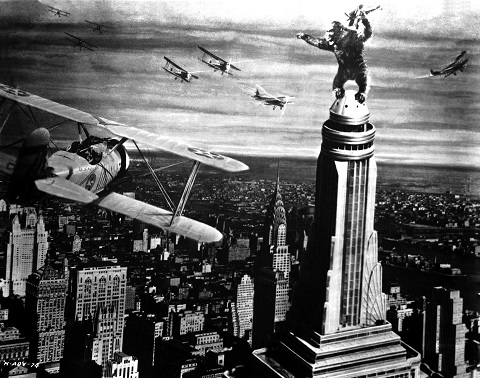
But the film-reviewing Borges’ masterpiece of dismissal takes on King Kong, Merian C. Cooper and Ernest B. Schoedsack’s most iconic giant-ape disaster movie of them all:
A monkey, forty feet tall (some fans say forty-five) may have obvious charms, but those charms have not convinced this viewer. King Kong is no full-blooded ape but rather a rusty, desiccated machine whose movements are downright clumsy. His only virtue, his height, did not impress the cinematographer, who persisted in photographing him from above rather than from below — the wrong angle, as it neutralizes and even diminishes the ape’s overpraised stature. He is actually hunchbacked and bowlegged, attributes that serve only to reduce him in the spectator’s eye. To keep him from looking the least bit extraordinary, they make him do battle with far more unusual monsters and have him reside in caves of false cathedral splendor, where his infamous size again loses all proportion. But what finally demolishes both the gorilla and the film is his romantic love — or lust — for Fay Wray.
As Mourdaunt Hall’s contemporary New York Times review of this “Fantastic Film in Which a Monstrous Ape Uses Automobiles for Missiles and Climbs a Skyscraper” put it, “Through multiple exposures, processed ‘shots’ and a variety of angles of camera wizardry the producers set forth an adequate story and furnish enough thrills for any devotee of such tales,” but “it is when the enormous ape, called Kong, is brought to this city that the excitement reaches its highest pitch. Imagine a 50-foot beast with a girl in one paw climbing up the outside of the Empire State Building, and after putting the girl on a ledge, clutching at airplanes, the pilots of which are pouring bullets from machine guns into the monster’s body.” That sight must have struck the (still not overly thrilled) Hall as more impressive than it did Borges, but then, Borges, that visionary of dizzying labyrinths, eternities, and infinitudes, had already seen true visions of enormousness — and enormity.
“With deep sorrow, yet with great gratitude for her amazing life, we confirm the passing of Lauren Bacall.” So tweeted The Humphrey Bogart Estate today, letting cinephiles everywhere know that Hollywood lost yet another great one this week. She was 89.
Bacall, of course, met Humphrey Bogart on the set of To Have and Have Not in 1943. And they became one of Hollywood’s legendary couples, starring together in The Big Sleep (1946), Dark Passage (1947), and Key Largo (1948). Above you can watch Bogie and Bacall share some light moments together during a costume test for Melville Goodwin, USA, a film the couple never ultimately made. The footage was shot on February 20, 1956, just after Bogart learned that he had esophageal cancer. He passed away less than a year later, on January 14, 1957. May Bogie & Bacall rest in peace.
Note: The costume test, like many from the period, doesn’t have sound. As you’ll see, you hardly need sound to appreciate the scene that unfolds. Don’t miss the part where the camera zooms in.
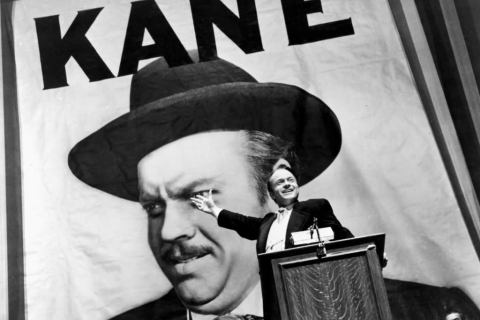
When we discover Jorge Luis Borges, we usually discover him through his short stories — or at least through his own highly distinctive uses of the short story form. Those many of us who thereupon decide to read everything the man ever wrote sooner or later find that he ventured into other realms of short text as well. Borges spent time as a poet, an essayist, and even as something of a film critic, a period of his career that will delight the sizable cinephilic segment of his readership. “I’m almost a century late to this party,” writes one such fan, Brendan Kiley at TheStranger, “but I recently stumbled into the movie reviews of Jorge Luis Borges (in his Selected Non-Fictions) and they’re fantastic: gloomy, sometimes bitchy, hilarious.” He first highlights Borges’ 1941 assessment of Citizen Kane, which Interrelevant provides in its incisive, unsparing, referential, and very brief entirety:
AN OVERWHELMING FILM
Citizen Kane (called The Citizen in Argentina) has at least two plots. The first, pointlessly banal, attempts to milk applause from dimwits: a vain millionaire collects statues, gardens, palaces, swimming pools, diamonds, cars, libraries, man and women. Like an earlier collector (whose observations are usually ascribed to the Holy Ghost), he discovers that this cornucopia of miscellany is a vanity of vanities: all is vanity. At the point of death, he yearns for one single thing in the universe, the humble sled he played with as a child!
The second plot is far superior. It links the Koheleth to the memory of another nihilist, Franz Kafka. A kind of metaphysical detective story, its subject (both psychological and allegorical) is the investigation of a man’s inner self, through the works he has wrought, the words he has spoken, the many lives he has ruined. The same technique was used by Joseph Conrad in Chance (1914) and in that beautiful film The Power and the Glory: a rhapsody of miscellaneous scenes without chronological order. Overwhelmingly, endlessly, Orson Welles shows fragments of the life of the man, Charles Foster Kane, and invites us to combine them and to reconstruct him.
Form of multiplicity and incongruity abound in the film: the first scenes record the treasures amassed by Kane; in one of the last, a poor woman, luxuriant and suffering, plays with an enormous jigsaw puzzle on the floor of a palace that is also a museum. At the end we realize that the fragments are not governed by any secret unity: the detested Charles Foster Kane is a simulacrum, a chaos of appearances. (A possible corollary, foreseen by David Hume, Ernst Mach, and our own Macedonio Fernandez: no man knows who he is, no man is anyone.) In a story by Chesterton — “The Head of Caesar,” I think — the hero observes that nothing is so frightening as a labyrinth with no center. This film is precisely that labyrinth.
We all know that a party, a palace, a great undertaking, a lunch for writers and journalists, an atmosphere of cordial and spontaneous camaraderie, are essentially horrendous. Citizen Kane is the first film to show such things with an awareness of this truth.
The production is, in general, worthy of its vast subject. The cinematography has a striking depth, and there are shots whose farthest planes (like Pre-Raphaelite paintings) are as precise and detailed as the close-ups. I venture to guess, nonetheless, that Citizen Kane will endure as a certain Griffith or Pudovkin films have “endured”—films whose historical value is undeniable but which no one cares to see again. It is too gigantic, pedantic, tedious. It is not intelligent, though it is the work of genius—in the most nocturnal and Germanic sense of that bad word.
“A kind of metaphysical detective story,” “a labyrinth with no center,” “the work of a genius” — why, if I didn’t know better, I’d think Borges here describes his own work. Welles himself didn’t go ignorant of his film’s Borgesian nature, or at least of the tendency of others to point out its Borgesian nature, not always in a positive light. “Some people called it warmed-over Borges,” Welles recalled in a conversation 42 years later with the filmmaker Henry Jaglom. Nor did he forget Borges’ own critique: “He said that it was pedantic, which is a very strange thing to say about it, and that it was a labyrinth. And that the worst thing about a labyrinth is that there’s no way out. And this is a labyrinth of a movie with no way out. Borges is half-blind. Never forget that. But you know, I could take it that he and Sartre” — who thought the film’s image “too much in love with itself” — “simply hated Kane. In their minds, they were seeing— and attacking — something else. It’s them, not my work.” Defensive though this may sound, it identifies the impulse that had the author of Labyrinths seeing all those labyrinths in the movie: to quote Anaïs Nin, a writer contemporary though not often brought into the same context with Borges, “We don’t see things as they are, we see them as we are.”
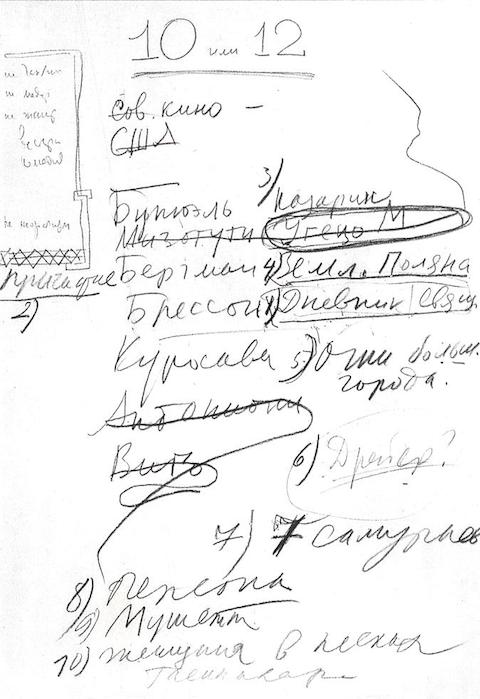
If you, as a filmgoer, have anything in common with me — and if you happen to live in Los Angeles as well — you’ve spent the past few weeks excited about the Andrei Tarkovsky double-bill coming up at the Quentin Tarantino-owned New Beverly Cinema. We’ve previously featured the famously (and extremely) cinephilic Tarantino’s listsoffavoritefilms, but what about Tarkovsky? What movies did the man who made The Mirror and Nostalghia — to name only two of his most strikingly personal films, not to mention the same ones coming up at the New Beverly — look to for inspiration? Nostalghia.com has one set of answers in the form of a list Tarkovsky once gave film critic Leonid Kozlov. “I remember that wet, grey day in April 1972 very well,” writes Kozlov in a Sight and Sound article re-posted there. “We were sitting by an open window and talking about various things when the conversation turned to Otar Ioseliani’s film Once Upon a Time There Lived a Singing Blackbird.”
Tarkovsky struggled toward an assessment of that picture, eventually deeming it “a very good film.” Kozlov then asked the filmmaker to draw up a list of his favorites. “He took my proposition very seriously and for a few minutes sat deep in thought with his head bent over a piece of paper,” the critic recalls. “Then he began to write down a list of directors’ names — Buñuel, Mizoguchi, Bergman, Bresson, Kurosawa, Antonioni, Vigo. One more, Dreyer, followed after a pause. Next he made a list of films and put them carefully in a numbered order. The list, it seemed, was ready, but suddenly and unexpectedly Tarkovsky added another title — City Lights.” The fruit of his internal deliberations reads as follows:
Among respected directors’ greatest-films lists, Tarkovsky’s must rank as, while certainly one of the most considered, also one of the least diverse. “With the exception of City Lights,” Kozlov notes, “it does not contain a single silent film or any from the 30s or 40s. The reason for this is simply that Tarkovsky saw the cinema’s first 50 years as a prelude to what he considered to be real film-making.” And the lack of Soviet films “is perhaps indicative of the fact that he saw real film-making as something that went on elsewhere.” Overall, we have here “not only a list of Tarkovsky’s favorite films, but equally one of his favorite directors,” especially Ingmar Bergman, who places no fewer than three times. The esteem went both ways; you may remember how Bergman once described Tarkovsky as “the greatest of them all.” Still, as cinematic mutual appreciation societies go, I suppose you couldn’t ask for two more qualified members.
No Eli Roth gorefest or low-budget video nasty, no Hubert Selby or Thomas Hardy adaptation, no Michael Hanecke gutpunch nor the bleakest noir can compare with the work of Werner Herzog when it comes to existential dread. His documentaries and absurdist tragicomedies reach into the heart of human darkness and doomed obsessive weirdness. Even his turns as an actor and producer take him into shadowy, amoral places where grim, sure death awaits. Do you, dear reader, dare follow him there?
If so, you must first brave the application for Herzog’s Rogue Film School. Lessons include “the art of lock-picking, traveling on foot, the exhilaration of being shot at unsuccessfully, the athletic side of filmmaking, the creation of one’s own shooting permits, the neutralization of bureaucracy, and guerilla filmmaking.” Have technical questions? “For this purpose,” Herzog writes in his 12-point description of Rogue, “please enroll at your local film school.” This is no beginner’s workshop; it is “about a way of life. It is about a climate, the excitement that makes film possible.” This being Herzog, “excitement” likely involves death-defying danger. Prepare for the worst.
But you who are applying for the Rogue Film School know this already. You are up for the challenge. You also know that Herzog doesn’t put himself bodily and psychologically close to—and over—the edge of civilization just for the sake of a thrill. This is art—raw, confrontational, and utterly uncompromising. And so, Rogue Film School will also “be about poetry, films, music, images, literature.” There is a required, eclectic reading list: J.A. Baker’s document of hawk life, The Peregrine, Hemingway’s The Short Happy Life of Francis Macomber & Other Stories, Virgil’s Georgics. Suggested readings include The Poetic Edda, The Conquest of New Spain by Bernal Diaz del Castillo, and—somewhat unexpectedly—The Warren Report.
And of course, there is film, “which could include your submitted films,” but will also include a required viewing list: John Huston’s The Treasure of the Sierra Madre, Elia Kazan’s Viva Zapata, Gillo Pontecorvo’s The Battle of Algiers, Satyajit Ray’s The Apu Trilogy, and Abbas Kiarostami’s Where is the Friend’s Home? (if available, he writes—watch it here)—an Iranian coming-of-age movie on BFI’s “Top fifty films for children up the age of 14” list. You will discover ways to “create illumination and an ecstasy of truth.” But do not for a moment think this will involve some middlebrow New Age brand of self-discovery. “Censorship will be enforced,” Herzog warns, “There will be no talk of shamans, of yoga classes, nutritional values, herbal teas, discovering your Boundaries, and Inner Growth.” You will probably eat meat raw from a predatory beast you’ve killed with your bare hands.
Alternately, you may have canapés and drinks at a secluded bar in the UK while Herzog chats you up about your latest project and his. So began the orientation to Rogue Film School for filmmaker and sound designer Marcelo de Oliveira, who chronicled his experience as a Herzog apprentice in a two-part write up on the Scottish Documentary Institute’s Blog. On day one, Herzog advised his pupils to “be prepared to step across the borders.” De Oliveira quotes the master saying “Film school will not teach you that we have a natural right as filmmakers to steal a camera or steal certain documents.” And though Herzog does not explicitly advocate such activities, he strongly implies they may be justified, referring to his own act of stealing a camera from the Munich Film School—the same camera with which he shot the crazed and visionary Fitzcarraldo. The theft, Herzog has said, was no crime, but “a necessity.”
Herzog is not a guru, transmitting instructions for enlightenment to cross-legged disciples. He is a catalyst, encouraging his students to “go absolutely and completely wild” for the sake of their individual vision. His film school sounds like the kind of opportunity no daring filmmaker should pass up, but should you apply and get rejected, you can still learn a thing or two from the great German director. Just watch the video above, “Werner Herzog’s Masterclass.” Herzog shared his wisdom and experience with a rapt audience at last year’s Locarno Film Festival. Among the many pieces of advice were the following, compiled by Indiewire. See their post for more essential highlights from this fascinating session.
It’s a very dangerous thing to have a video village, a video output. Avoid it. Shut it down. Throw it into the next river. You have an actor, and people that close all staring at the monitor gives a false feeling; that ‘feel good’ feeling of security. It’s always misleading. You have to avoid it.
I always do the slate board; I want to be the last one from the actors on one side and the technical apparatus on the other side. I’m the last one and then things roll. You don’t have to be a dictator.
Never show anyone in a documentary, rushes. They’ll become self-conscious. Never ever do that.
Sometimes it’s good to leave your character alone so no one can predict what is going to happen next. Sometimes these moments are very telling and moving.
Dismiss the culture of complaint you hear everywhere.
You should always try to find a way deep into someone.
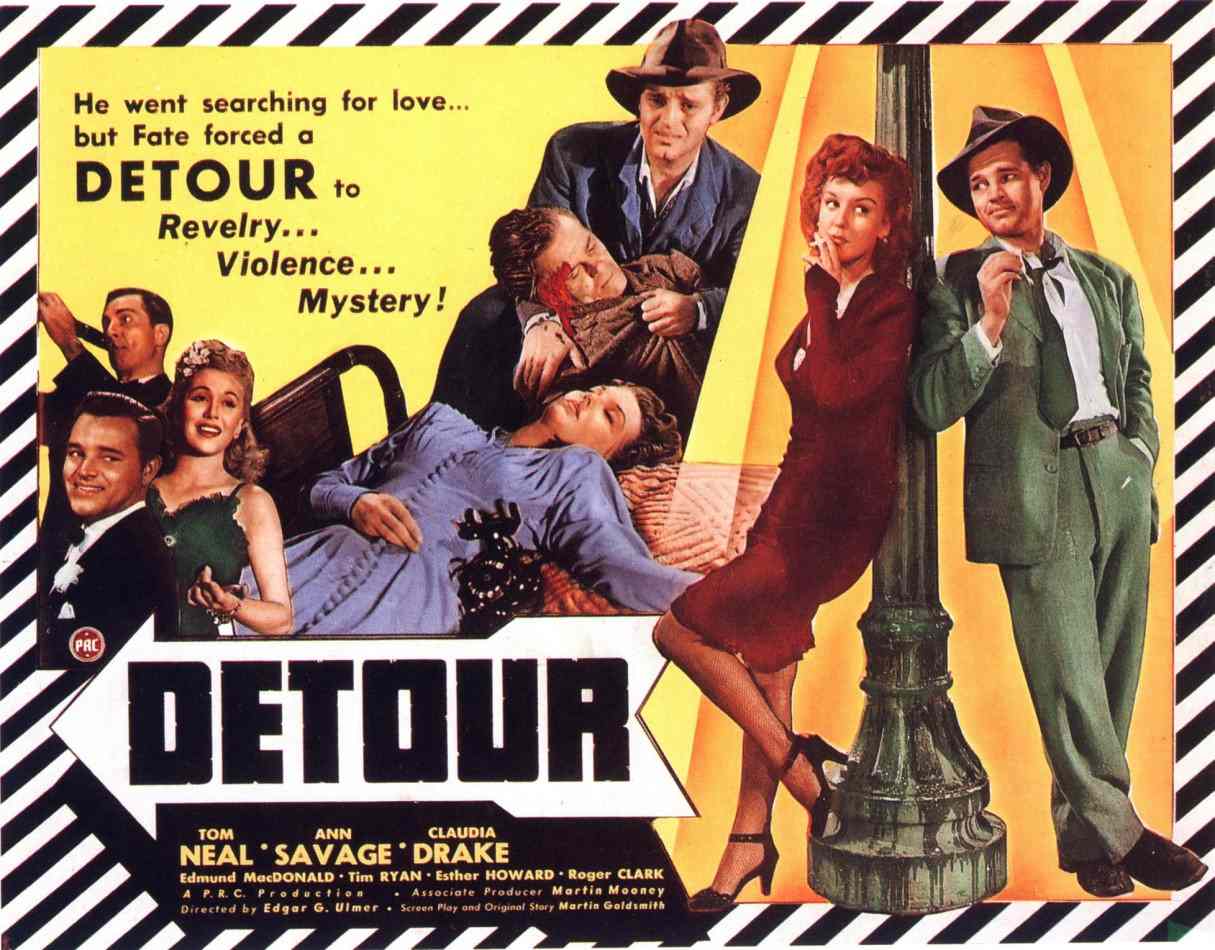
What is Film Noir? Ask that question to the Film Noir Foundation and this is what they’ll tell you:
Film noir is one of Hollywood’s only organic artistic movements. Beginning in the early 1940s, numerous screenplays inspired by hardboiled American crime fiction were brought to the screen, primarily by European émigré directors who shared a certain storytelling sensibility: highly stylized, overtly theatrical, with imagery often drawn from an earlier era of German “expressionist” cinema. Fritz Lang, Robert Siodmak, Billy Wilder, and Otto Preminger, among others, were among this Hollywood vanguard.
During and immediately following World War II, movie audiences responded to this fresh, vivid, adult-oriented type of film — as did many writers, directors, cameramen and actors eager to bring a more mature world-view to Hollywood product. Largely fueled by the financial and artistic success of Billy Wilder’s adaptation of James M. Cain’s novella Double Indemnity(1944), the studios began cranking out crime thrillers and murder dramas with a particularly dark and venomous view of existence.
In 1946 a Paris retrospective of American films embargoed during the war clearly revealed this trend toward visibly darker, more cynical crime melodramas. It was noted by several Gallic critics who christened this new type of Hollywood product “film noir,” or black film, in literal translation.
Few, if any of the artists in Hollywood who made these films called them “noir” at the time. But the vivid co-mingling of lost innocence, doomed romanticism, hard-edged cynicism, desperate desire, and shadowy sexuality that was unleashed in those immediate post-war years proved hugely influential, both among industry peers in the original era, and to future generation of storytellers, both literary and cinematic.
If you want to get another angle on the question, you can always take into consideration Roger Ebert’s 10 Essential Characteristics of Noir Films. But our suggestion, especially on a long Sunday afternoon, is to spend some time watching the classic movies gathered in our collection of 50 Free Noir Films. The collection features public domain films by John Huston, Fritz Lang, Orson Welles and other celebrated directors. Here’s a quick sample of what’s in the archive:
Beat the Devil – Free – Directed by John Huston and starring Humphrey Bogart, the film is something of a comic and dramatic spoof of the film noir tradition. (1953)
D.O.A. — Free — Rudolph Maté’s classic noir film. Called “one of the most accomplished, innovative, and downright twisted entrants to the film noir genre.” (1950) Five Minutes to Live — Free — Memorable bank heist movie stars Johnny Cash, Vic Tayback, Ron Howard, and country music great, Merle Travis. (1961)
Quicksand - Free — Peter Lorre and Mickey Rooney star in a story about a garage mechanic’s descent into crime. (1950)
Scarlet Street — Free — Directed by Fritz Lang with Edward G. Robinson. A film noir great. (1945)
The Hitch-Hiker - Free — The first noir film made by a woman noir director, Ida Lupino. (1953)
The Stranger - Free — Directed by Orson Welles with Edward G. Robinson. One of Welles’s major commercial successes. (1946)
We recently added another 15 films to the collection of free noir films. So even if you’ve perused the list in the past, there’s now something new to enjoy.
We're hoping to rely on loyal readers, rather than erratic ads. Please click the Donate button and support Open Culture. You can use Paypal, Venmo, Patreon, even Crypto! We thank you!
Open Culture scours the web for the best educational media. We find the free courses and audio books you need, the language lessons & educational videos you want, and plenty of enlightenment in between.