At the 1984 Cannes Film Festival, disco trailblazer and Oscar-winning composer Giorgio Moroder unveiled a restored version of Fritz Lang’s 1927 silent epic Metropolis — the first time that the groundbreaking movie had been restored since it premiered. Though Moroder labored for years with some of the leading archivists in the world to create the most complete version of the film to date, his adaptation also streamlined the movie’s storyline, added sound effects, colorized the movie’s monochrome picture and, most controversially, added a synth pop soundtrack featuring music by Pat Benatar, Billy Squier, Adam Ant and Freddie Mercury. You can watch it above.
The resulting film, as you might expect, is a profoundly odd collision between pop and art. Lang’s pungent imagery exists uneasily alongside Moroder’s MTV treatment. Critic Thomas Elsaesser in his BFI booklet on the movie called Moroder’s version “somewhere between a remake and a post-modern appropriation.” And though the songs are uniformly cringe-inducing – to say that they didn’t age well is a big understatement — Moroder’s version still works.
The reason that Lang’s movie influenced filmmakers from George Lucas to Terry Gilliam to Stanley Kubrick is because of its visual brilliance, not because of its story. The script, penned by Lang’s wife and future Nazi Party propagandist, Thea von Harbou, is stuffed full of allusions to Frankenstein and German folktales along with plenty of maudlin melodrama. But Lang’s high modernist visuals – evoking both the Bauhaus movement and Henry Ford’s new brand of industrialism – transcended the movie’s story, becoming a lasting vision of totalitarian dystopia.
In 2010, a painstakingly researched “complete” version of Metropolis came out, clocking in at almost three hours. It might be an achievement of film preservation but, compared to Moroder’s version, it shows how bloated and meandering Von Harbou’s script was. Moroder’s more svelte version might be cheesy, but at least it’s fun. The great film critic Pauline Kael described Lang’s movie as “a wonderful, stupefying folly.” Moroder’s version is a folly on top of a folly.
Related Content:
Metropolis Restored: Watch a New Version of Fritz Lang’s Masterpiece
Jonathan Crow is a Los Angeles-based writer and filmmaker whose work has appeared in Yahoo!, The Hollywood Reporter, and other publications. You can follow him at @jonccrow. And check out his blog Veeptopus, featuring pictures of vice presidents with octopuses on their heads.
Slavoj Žižek must make a tempting documentary subject; you have only to fire up the camera and let him do his thing. Or at least the Slovenian academic provocateur and intellectual performance artist, in films like The Pervert’s Guide to Cinema, The Pervert’s Guide to Ideology, and Žižek!, has given the impression that he can effortlessly carry a film all by himself. The directors of those aforementioned movies did a bit more than sit Žižek down before a rolling camera, but Ben Wright, maker of The Reality of the Virtual, seems to have taken the man’s raw oratorical value as the very premise of his project. This 74-minute documentary — if even the word “documentary” suits such a radically simplified form — simply has Žižek sit at a table, in front of some bookshelves, and talk, ostensibly about “real effects produced by something which does not yet fully exist,” as he identifies them in the realms of psychoanalysis, politics, sociology, physics, and popular culture.
“Shot by Ben Wright over the course of a single day,” writes the New York Times’ Nathan Lee, “here is the apotheosis of the talking-head movie, made up entirely of seven long, static takes of Mr. Žižek,” animated only by his own “habitual repertory of twitches, spasms and uncontrolled perspiration, an alarming frenzy of exuberance that contributes to his reputation as a rock star of philosophy.” The theme at hand, which certainly has something to do with belief and truth, possibility and impossibility, the reality within the unreal and the unreal within reality, takes him through the widest possible range of associated subjects. Those who appreciate Žižek primarily as a master of focused digression — and I have to imagine his fan base contains many such people — will find no purer expression of that particular skill. Then again, to truly experience Žižek, maybe you have to take an actual class taught by him. If The Reality of the Virtual inspires you to do so, count yourself as braver than I.
This week is the anniversary of the Apollo 11 journey to the moon. And while most people will celebrate the event by acknowledging the abilities and courage of Neil Armstrong and company in this landmark of human endeavor, a small, though vocal, group of people will decry the moon landing as a fraud.
In that spirit, French filmmaker William Karel spins an elaborate tale of intrigue in Dark Side of the Moon. (See outtakes above.) The 2002 film posits that the Apollo 11 moon landing was staged by none other than Stanley Kubrick. How else did the director get his hands on a super advanced lens from NASA to shoot those gorgeous candle-lit scenes in Barry Lyndon? The film is slickly produced and features an impressive array of interviewees from Henry Kissinger, to Buzz Aldrin to Christiane Kubrick. Some of the other people interviewed include Jack Torrance and David Bowman. If that’s not a tip off that the whole movie is fake, then the blooper reel at the end drives the point home. Only a lot of people didn’t get the joke. Conspiracy enthusiasts Wayne Green cited the movie as further proof that the moon landing was faked.
Moon hoaxers like to point to The Shining as a confession by Kubrick that he was forced into a Big Lie. In the documentary Room 237, Jay Weidner claims as much. And Michael Wysmierski argues the same in The Shining Code 2.0, a feature length video that you can watch below. Or get right to the meat of things here.
And just in case you get swept up in Wysmierski’s loony logic, filmmaker S. G. Collins makes the very compelling argument that the technology simply didn’t exist to fake the moon landing in 1969. Case closed.
Jonathan Crow is a Los Angeles-based writer and filmmaker whose work has appeared in Yahoo!, The Hollywood Reporter, and other publications. You can follow him at @jonccrow.
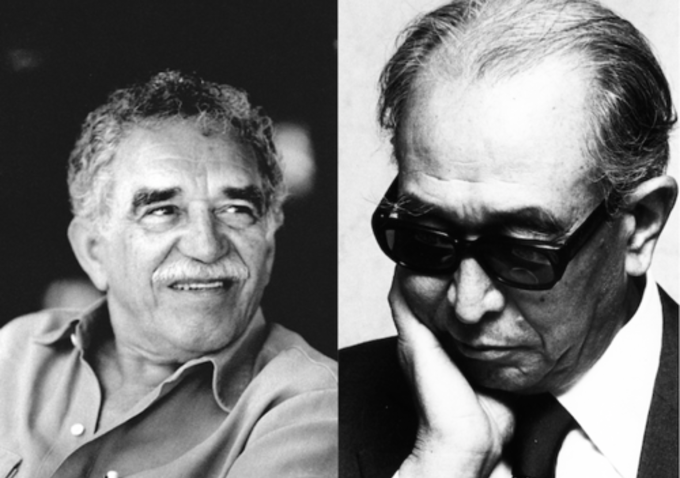
You know you’re doing something right in your life if the Nobel Prize-winning author of 100 Years of Solitude talks to you like a giddy fan boy.
Back in October 1990, Gabriel García Márquez sat down with Akira Kurosawa in Tokyo as the Japanese master director was shooting his penultimate movie Rhapsody in August — the only Kurosawa movie I can think of that features Richard Gere. The six hour interview, which was published in The Los Angeles Times in 1991, spanned a range of topics but the author’s love of the director’s movies was evident all the way through. At one point, while discussing Kurosawa’s 1965 film Red Beard, García Márquez said this: “I have seen it six times in 20 years and I talked about it to my children almost every day until they were able to see it. So not only is it the one among your films best liked by my family and me, but also one of my favorites in the whole history of cinema.”
One natural topic discussed was adapting literature to film. The history of cinema is littered with some truly dreadful adaptations and even more that are simply inert and lifeless. One of the Kurosawa’s true gifts as a filmmaker was turning the written word into a vital, memorable image. In movies like Throne of Blood and Ran, he has proved himself to be arguably the finest adapter of Shakespeare in the history of cinema.
García Márquez: Has your method also been that intuitive when you have adapted Shakespeare or Gorky or Dostoevsky?
Kurosawa: Directors who make films halfway may not realize that it is very difficult to convey literary images to the audience through cinematic images. For instance, in adapting a detective novel in which a body was found next to the railroad tracks, a young director insisted that a certain spot corresponded perfectly with the one in the book. “You are wrong,” I said. “The problem is that you have already read the novel and you know that a body was found next to the tracks. But for the people who have not read it there is nothing special about the place.” That young director was captivated by the magical power of literature without realizing that cinematic images must be expressed in a different way.
García Márquez: Can you remember any image from real life that you consider impossible to express on film?
Kurosawa: Yes. That of a mining town named Ilidachi [sic], where I worked as an assistant director when I was very young. The director had declared at first glance that the atmosphere was magnificent and strange, and that’s the reason we filmed it. But the images showed only a run-of-the-mill town, for they were missing something that was known to us: that the working conditions in (the town) are very dangerous, and that the women and children of the miners live in eternal fear for their safety. When one looks at the village one confuses the landscape with that feeling, and one perceives it as stranger than it actually is. But the camera does not see it with the same eyes.
When Kurosawa and García Márquez talked about Rhapsody in August, the mood of the interview darkened. The film is about one old woman struggling with the horrors of surviving the atomic attack on Nagasaki. When it came out, American critics bristled at the movie because it had the audacity to point out that many Japanese weren’t all that pleased with getting nuked. This is especially the case with Nagasaki. While Hiroshima had numerous factories and therefore could be considered a military target, Nagasaki had none. In fact, on August 9, 1945, the original target for the world’s second nuclear attack was the industrial town of Kita Kyushu. But that town was covered in clouds. So the pilots cast about looking for some place, any place, to bomb. That place proved to Nagasaki.
Below, Kurosawa talks passionately about the legacy of the bombing. Interestingly, García Márquez, who had often been a vociferous critic of American foreign policy, sort of defends America’s actions at the end of the war.
Kurosawa: The full death toll for Hiroshima and Nagasaki has been officially published at 230,000. But in actual fact there were over half a million dead. And even now there are still 2,700 patients at the Atomic Bomb Hospital waiting to die from the after-effects of the radiation after 45 years of agony. In other words, the atomic bomb is still killing Japanese.
García Márquez: The most rational explanation seems to be that the U.S. rushed in to end it with the bomb for fear that the Soviets would take Japan before they did.
Kurosawa: Yes, but why did they do it in a city inhabited only by civilians who had nothing to do with the war? There were military concentrations that were in fact waging war.
García Márquez: Nor did they drop it on the Imperial Palace, which must have been a very vulnerable spot in the heart of Tokyo. And I think that this is all explained by the fact that they wanted to leave the political power and the military power intact in order to carry out a speedy negotiation without having to share the booty with their allies. It’s something no other country has ever experienced in all of human history. Now then: Had Japan surrendered without the atomic bomb, would it be the same Japan it is today?
Kurosawa: It’s hard to say. The people who survived Nagasaki don’t want to remember their experience because the majority of them, in order to survive, had to abandon their parents, their children, their brothers and sisters. They still can’t stop feeling guilty. Afterwards, the U.S. forces that occupied the country for six years influenced by various means the acceleration of forgetfulness, and the Japanese government collaborated with them. I would even be willing to understand all this as part of the inevitable tragedy generated by war. But I think that, at the very least, the country that dropped the bomb should apologize to the Japanese people. Until that happens this drama will not be over.
The whole interview is fascinating. They continue to talk about historical memory, nuclear power and the difficulty of filming rose-eating ants. You can read the entire thing here. It’s well worth you time.
Jonathan Crow is a Los Angeles-based writer and filmmaker whose work has appeared in Yahoo!, The Hollywood Reporter, and other publications. You can follow him at @jonccrow.
It’s entirely possible that James Franco has a doppelganger. Or maybe access to some alien space/time bending technology. Otherwise, I really can’t figure out how Franco manages to do all the things he does. On top of starring in movies like Milk, Spring Breakers and Pineapple Expressandgetting nominated for an Academy Award for 127 Hours, Franco is also a published novelist and poet, an artist and, as an odd performance art routine, a guest on General Hospital. He received an MFA in writing from Columbia, and is currently a PhD student in English at Yale.
And, of course, he’s a film director. His first feature was an adaptation of William Faulkner’s As I Lay Dying and his second directorial effort, which comes out next month, is based on Cormac McCarthy’s novel Child of God. Clearly, Franco is not interested in making light-hearted family fare. Yet perhaps his darkest, most disturbing movie is Herbert White, a short he did while a film student at NYU. (Oh yeah, he went there too.) You can watch it above. Warning: while not graphic, it probably is NSFW.
Based on a poem by Frank Bidart, Herbert White is a glimpse into the life of a dedicated family man and secret necrophile. The film stars Oscar-nominated actor Michael Shannon, and Franco lets him do what he does best – look pensive, haunted and like he’s on the brink of committing an unspeakable act. If you’ve seen his powerhouse performance in Jeff Nichol’s Take Shelter, you know what I mean. The movie is shot in an understated, elliptical sort of way that slowly gets under your skin. This is particularly the case in the film’s climatic scene, shot in one single take, where Shannon circles his intended victim while he argues with himself over whether or not to succumb to his dark urges. It is deeply unnerving.
In an interview with Vice — he finds the time to be a regular correspondent for that uber-cool publication too, by the way – he talks about that scene.
I thought Herbert’s struggle with himself would be best captured if we didn’t cut away from him. The racing around the block along with Michael’s screeches and curses (ad-libbed) adds to the depiction of the inner struggle. We shot it three times, racing around the block. I was in the back with my DP. We were both pinching each other because the scene was so intense.
Franco was so moved by the experience of directing the movie that he published a book of poems about the experience (of course) called Directing Herbert White. You can watch him read some of those poems below.
Jonathan Crow is a Los Angeles-based writer and filmmaker whose work has appeared in Yahoo!, The Hollywood Reporter, and other publications. You can follow him at @jonccrow.
If there’s ever a Mad Men: The Next Generation, count on a 40-ish Sally Draper to psych a conference room full of BMW execs out of the tried-and-true formula for luxury automobile ads in favor of a groundbreaking, nightmarish, pre-YouTube web series.
As fictional scenarios go, it’s about as likely as having the Hardest Working Man in Show Business James Brown place a winner-take-all bet with the devil (Gary Oldman) that his driver Clive Owen can out-drag perennial movie bad guy Danny Trejo. (In other words, very likely.)
The prize?
Another 50 years of hip-shaking, leg-splitting soul for the Godfather of.
Can’t wait for the soon-to-be released James Brown biopicto find out who wins?
Check out “Beat the Devil,” above, the final installment of BMW Films’ 8‑episode series, The Hire. One of the new millennium’s earliest examples of branded content, each frenetic segment found Owen’s nameless driver going up against a roster of big name guest stars, including Don Cheadle, Mickey Rourke, Marilyn Manson, and an uncredited, pee-soaked Madonna. (You heard me.)
Brown’s episode, directed by the late Tony Scott, quickly ventures into David Lynch territory. Oldman’s Prince of Darkness gets laughs with a prop fluorescent tube and striped suspender tights, but the scene’s not without menace. (Recall Dean Stockwell lip-synching Candy Colored Clown in Blue Velvet…)
The dialogue calls to mind Jim Jarmusch’s blunt snap.
Devil: Stick your face in the hole!
James Brown: My face?
Devil: Stick it in the hole!
James Brown: My face?
Devil: Face in the hole!
James Brown: My face?
Devil: Face in the- oh, shit!”
Elsewhere, Brown’s line delivery gets a boost from same-language subtitles, without which one could easily mishear his concerns about aging as an unexpected, late-in-life racial identification switch. (Say it loud, I’m Asian and proud?)
If the clip above leaves you hungry for more, the complete BMW series, featuring the testosterone-rich work of such high octane directors as John Frankenheimer, Guy Ritchie, and John Woo is available on the playlist below.
There’s an old truism in Hollywood that a movie shouldn’t last much longer than the endurance of the average audience member’s bladder. Most feature films run around an hour and a half to two hours, though summer blockbusters can last longer. Studios generally resist making long movies for the simple reason that they can’t pack as many screenings per day. While some art house auteurs have made movies that extend to bladder-busting lengths – Bela Tarr’s brilliant Satantango clocks in at seven and a half hours – the place to find truly long movies is in the art world.
Christian Marclay’s masterpiece The Clock is a 24-hour montage of watches, clocks and other timepieces from iconic movies synced to the actual time the film is running. Another incredibly long movie is the aptly named A Cure for Insomnia, which features artist Lee Groban reading a really long poem intercut with clips of porn and heavy metal music. That movie lasts over 3 days. And if you wanted to watch the entirety of Chinese artist Ai Weiwei’s movie Beijing 2003– which documents every single street within Beijing’s inner ring – it would take you over a week.
But those films have nothing on Swedish artist and filmmaker Anders Weberg, who is making Ambiancé, which is, at 720 hours, the longest movie in the history of cinema. 720 hours. That’s 30 days. To put this into perspective, you can watch the entire special extended cut of the Lord of the Rings trilogy over 60 times in the time it takes for Ambiancé to unspool just once. The first trailer came out July 4th, and it clocks in at 72 minutes long, making it almost a feature unto itself. You can see it above. If this seems lengthy – most trailers are three or so minutes after all – note that Weberg promises that the next trailer will last seven hours and 20 minutes.
Weberg describes Ambiancé as a movie where space and time intertwine “into a surreal dream-like journey beyond places and [it] is an abstract nonlinear narrative summary of the artist’s time spent with the moving image. A sort of memoir movie.” As you can see above, the movie features densely layered images with a haunting, minimal score. Weberg plans to screen the entirety of the movie in 2020 on every continent simultaneously just once before destroying it. The trailer is only going to be available until July 20th, so watch it while you can.
Jonathan Crow is a Los Angeles-based writer and filmmaker whose work has appeared in Yahoo!, The Hollywood Reporter, and other publications. You can follow him at @jonccrow.
Living, as many do, in Los Angeles, and loving, as many do, the films of Stanley Kubrick, I managed to attend last year’s acclaimed Kubrick exhibit at the Los Angeles County Museum of Art more than once. The first time there, I marveled at all the artifacts they’d collected from the production of my favorite Kubrick films, the ones I’ve seen seven, eight, nine times: Dr. Strangelove, Barry Lyndon, 2001: A Space Odyssey, etc. But the second time, I focused on the rooms dedicated to the Kubrick films I’d never seen — the ones, in fact, that nobody has ever seen.
Several of his unfinished projects got far enough into pre-production to leave behind a considerable amount of intriguing research materials, script notes, shooting schedules, design sketches, and screen tests. The story of each project’s origin and demise reveals qualities of not just Kubrick’s much-examined working methods, but of his personality. “He was a man of such varied interests that he was always busy,” says former Warner Brothers executive John Calley in the short documentary above, Lost Kubrick. And if Kubrick had an interest, he instinctively threw himself into the making of a motion picture to do with it.
“Napoleon was one of the abiding interests of Stanley’s life,” says Anthony Frewin, Kubrick’s assistant on 2001, “along with extraterrestrial intelligence, the Holocaust, concentration camps, Julius Caesar, English place name etymology, and three thousand other things.” We’ve featured Kubrick’s Napoleon before, but Lost Kubrick also includes an examination of The Aryan Papers, his abandoned Holcaust project from the 1990s. I do wonder how it would have compared to Schindler’s List, Steven Spielberg’s completed Holocaust project from the 1990s, which itself had an influence on Kubrick’s dropping The Aryan Papers. But Jurassic Park, Spielberg’s dinosaur project from that same time, convinced Kubrick that special effects technology had come far enough for him to move forward on A.I., which he would later hand over to Spielberg himself. The younger director seems to have fallen into the role of executor of Kubrick’s many ideas; just last year, he even announced plans to turn Kubrick’s Napoleon script into a television series. Personally, it makes me wonder less what Spielberg will do with the story of Napoleon than what Kubrick could have accomplished in this age of the television-series auteur.
We're hoping to rely on loyal readers, rather than erratic ads. Please click the Donate button and support Open Culture. You can use Paypal, Venmo, Patreon, even Crypto! We thank you!
Open Culture scours the web for the best educational media. We find the free courses and audio books you need, the language lessons & educational videos you want, and plenty of enlightenment in between.