The March on Washington for Jobs and Freedom, one of the largest human rights rallies in American history, took place 50 years ago today in Washington, D.C.. Martin Luther King Jr. spoke that day, delivering his famous “I Have a Dream” speech. Joan Baez sang “We Shall Overcome,” the anthem of the civil rights movement, while Bob Dylan performed “When the Ship Comes In” and Odetta sang “I’m On My Way.”
In 1964, the director James Blue released a documentary called The March. Produced under the auspices of the United States Information Agency, the film proved to be a “visually stunning, moving, and arresting documentary of the hope, determination, and camaraderie embodied by the demonstration.” And while the film initially sparked some controversy (read the account here), it has had a big impact on audiences inside and outside the US throughout the decades.
In 2008, The March was selected for preservation in the United States National Film Registry by the Library of Congress. To celebrate the 50th anniversary of the The March for Jobs and Freedom, the US National Archives has completed a full digital restoration of the film. You can watch it free above, or find it in the Free Documentaries section of our collection of 550 Free Movies Online.
In 2011 a group of film scholars developed MHDL, an updated resource for historians used to reading through microfilm archives of cinema and broadcast journals. At the time, their archive was a goldmine, pulling together the bounty of printed material chronicling the film industry. Now they’ve made it better, with more refined search, filtering and sorting tools. Plus you can download images and texts.
It may have been a rite of passage for film students to sequester themselves in a dark library carrel and scroll through microfiche reels of Moving Picture World, an influential trade journal until 1927, but Lantern brings venerable movie magazines dating up to the early ’70s into the light of day where anyone can access the images and articles of major trade and fan magazines, free of charge.
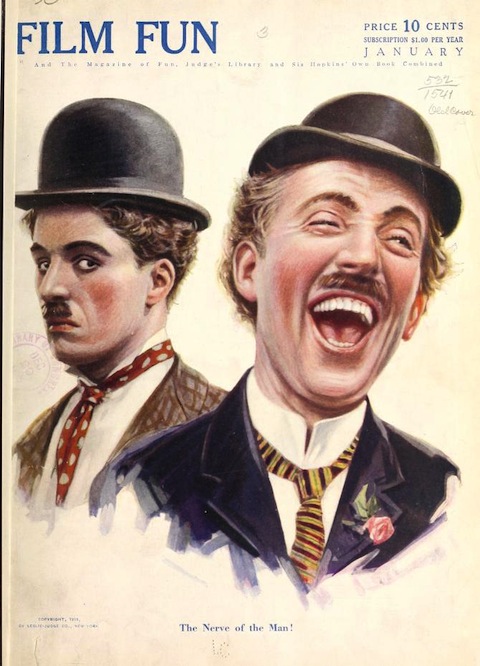
An early on-set chat rag, Film Fun, a magazine about “the happy side of the movies,” brought readers “intimate gossip of the profession told by the actors and actresses ‘between the reels.’” The images are gorgeous.
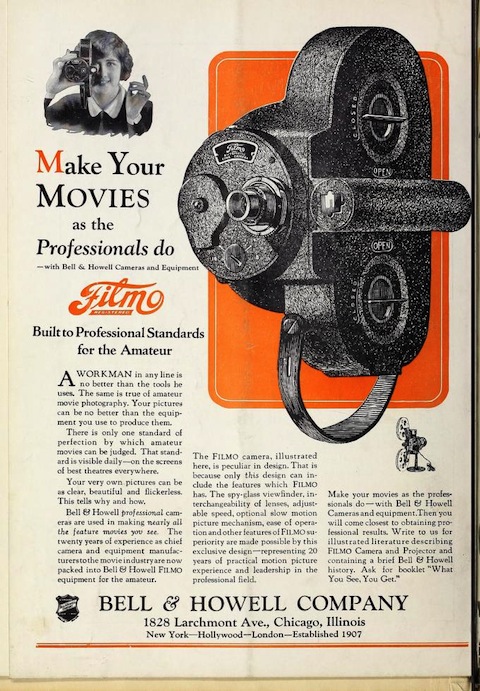
In the twenties a new amateur movie making industry thrived, with equipment and even tour packages available for buffs who wanted to tour exotic locales like Cuba with cameras and learn to shoot and preserve 16 mm motion pictures. A boom in DIY film magazines like Amateur Movie Makers targeted the early adopters.
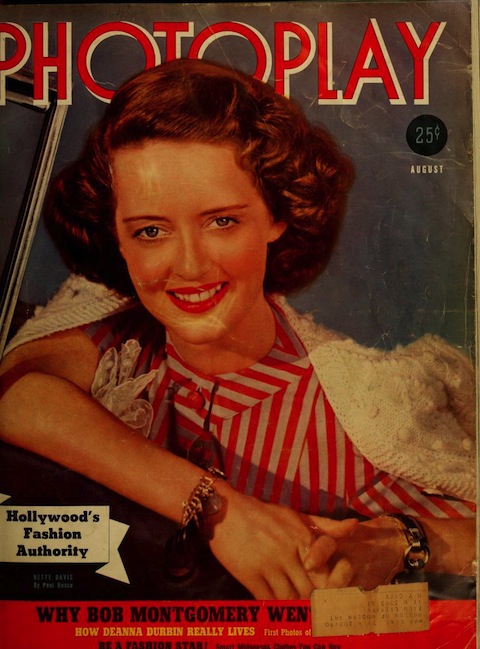
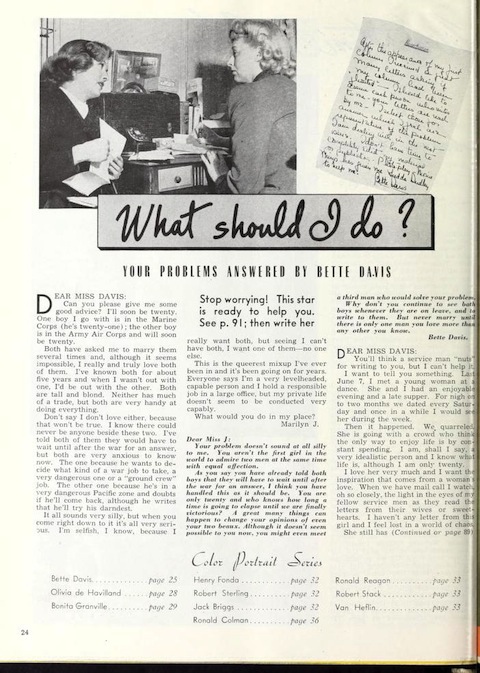
And lest we think that pulp celebrity mags like People and Us are lower brow than those of yesteryear, we should think again. I’m not sure about you, but I’m not sure four-times-married Bette Davis makes the best love advice columnist. But apparently Photoplay magazine did.
Johann Wolfgang von Goethe — the very name bespeaks literary mastery of the widest range. Not only did this best-known of all eighteenth- and — nineteenth-century German writers reach into poetry, the novel, the memoir, autobiography, criticism, science, philosophy, and even politics, but he did a bit of interpretation of classic folktales as well. The Faust and Sorrows of Young Werther author wrote a particularly lasting rendition of the adventures of Reynard the Fox, a trickster from medieval European myth. Had Goethe himself lived into the 20th century to experience the golden age of puppet animation, I feel certain his artistic mandate would have compelled him to film a version of The Tale of the Fox. Alas, the literary legend passed away in 1832, leaving the job, nearly a century later, to Russian animator Ladislas Starevich (also spelled Wladyslaw Starewicz).
Having pioneered the form of puppet animation with his 1912 film The Beautiful Lukanida, Starevich remains well-known among animation enthusiasts for shooting his pictures with animals playing the protagonists, or bugs, or seemingly whatever he happened to have at hand. The Tale of the Fox, by contrast, presented him with a comparatively vast set of resources. Produced in Paris over eighteen months in 1929 and 1930, the 65-minute animated feature, Starevich’s first and only the sixth ever made in the world at the time, tells the story of Reynard the Fox’s attempts to live his life of tomfoolery even as the lion king of this animal kingdom struggles to bring him to justice. When, seven years after completing photography, the film still lacked music, Germany’s National Socialist government, no doubt swollen with their version of Teutonic pride at seeing an adaptation of an adaptation penned by a German icon, provided a score and arranged for a Berlin premiere. But try not to think about that. Concentrate instead on the animation style used here by Starevich which, though he shot in stop-motion and used puppets, surely resembles no stop-motion animation or puppet show you’ve ever seen.
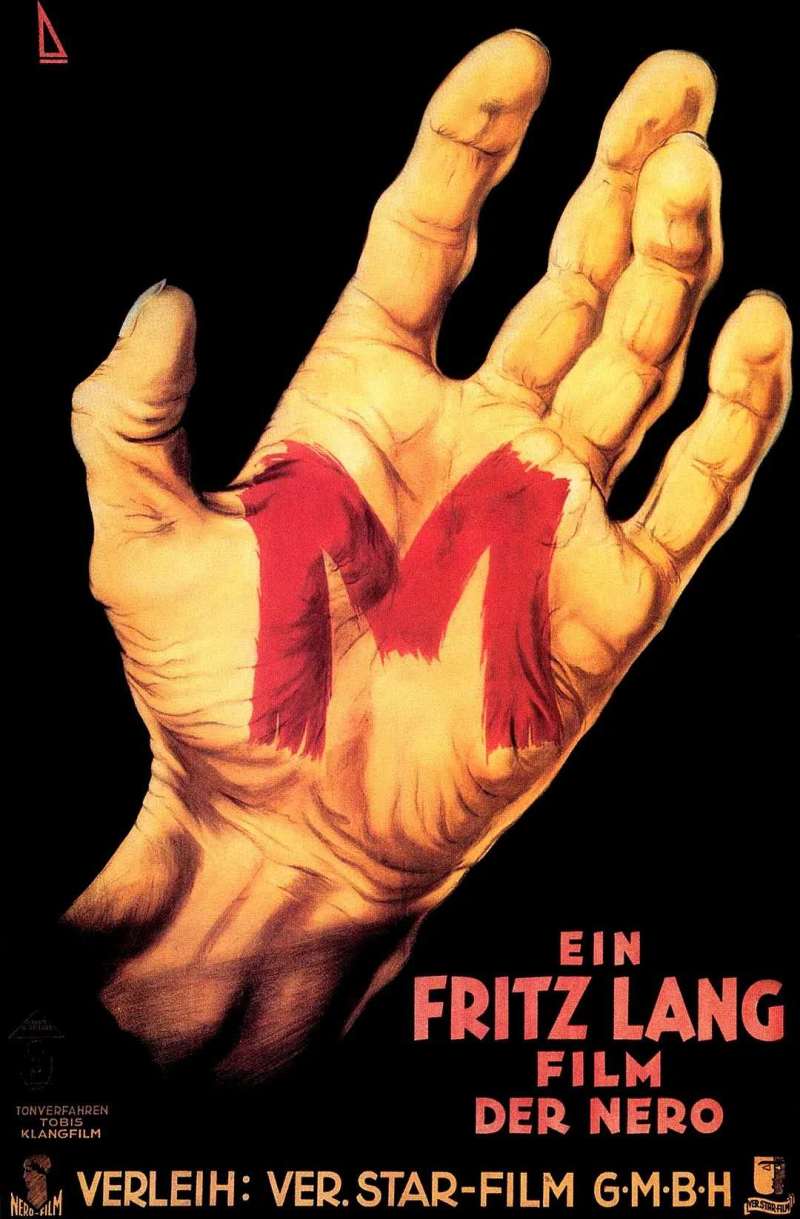
When Jean-Luc Godard asked the Austrian filmmaker Fritz Lang in 1961 to name his greatest film, the one most likely to last, Lang did not hesitate.
“M,” he said.
Made in 1931, near the end of the Weimar Republic, M is Lang’s brilliant link between silent film and talkies, and between German Expressionism and what would eventually be called Film Noir. It tells the story of a Berlin society caught up in hysteria over a series of child murders, and of the massive mobilization — by police and criminals alike — to catch the killer.
The Hungarian actor Peter Lorre plays Hans Beckert, the mentally disturbed murderer. Lorre worked on the film in the daytime while performing onstage in Bertolt Brecht’s production of Mann ist Mann in the evenings. His striking performance in M would catapult him to international stardom.
The script was written by Lang and his wife, Thea Von Harbou. It was inspired by a series of mass murders, culminating in a sensational case of serial child killings in Düsseldorf. In a 1931 article, Lang wrote:
The epidemic series of mass murders of the last decade with their manifold and dark side effects had constantly absorbed me, as unappealing as their study may have been. It made me think of demonstrating, within the framework of a film story, the typical characteristics of this immense danger for the daily order and the ways of effectively fighting them. I found the prototype in the person of the Düsseldorf serial murderer and I also saw how here the side effects exactly repeated themselves, i.e. how they took on a typical form. I have distilled all typical events from the plethora of materials and combined them with the help of my wife into a self-contained film story. The film M should be a document and an extract of facts and in that way an authentic representation of a mass murder complex.
Although M was not a great box office success when it was released in Germany in 1931, the film gradually grew in stature and is now firmly established as one of the masterpieces of 20th century cinema. The brilliance of the film’s narrative structure, its classic visual images (the killer’s shadow appearing on a poster announcing a reward for his capture, a child’s balloon caught in a power line, Lorre’s bulging eyes as he discovers a chalk “M” on his shoulder) and its inventive use of sound, for example in the serial killer’s ominous whistling of Grieg’s Peer Gynt, have made M one of the most studied and imitated films ever made.
In 1959 M was re-released in truncated form, and for several decades afterward audiences were shown a badly altered 89-minute version. A restoration project was mounted in the 1990s. The 109-minute version above, a result of that project, is closer to Lang’s original film. It’s now housed in our collection, 4,000+ Free Movies Online: Great Classics, Indies, Noir, Westerns, Documentaries & More
In the acclaimed 1986 film Round Midnight, the great tenor saxophonist Dexter Gordon plays an aging American jazzman living in Paris in the late 1950s, struggling to control his addiction to alcohol so he can keep playing every night at the Blue Note in Saint-Germain-des-Prés.
The role came naturally to Gordon, whose own struggle with heroin addiction in the 1950s resulted in prison time and a loss of his New York City cabaret card. Unable to play in the clubs of New York, Gordon moved to Europe in the early 1960s and stayed there for 14 years. But while Dale Turner, his character in Round Midnight, is a worn-down man nearing death, Gordon’s European exile was a period of rebirth.
By the time the French film director and jazz enthusiast Bertrand Tavernier tracked Gordon down in 1984, though, the saxophone player had been back in America for a decade and was, after 40 years on the jazz circuit, becoming a bit worn down himself. The Dale Turner character is based partly on tenor saxophonist Lester Young, who was Gordon’s friend and mentor and a major influence in his life, and partly on pianist Bud Powell, whom Gordon knew and worked with in Paris. Tavernier was looking for authenticity and he found it in Gordon, a man with a direct link to the golden age of bebop. As the filmmaker told People in 1986, “I could not think of anyone else doing the part.”
Round Midnight was a critical success. Gordon received an Academy Award nomination for best actor in a leading role. The film was noted for “its lovely, elegiac pacing and its tremendous depth of feeling” by Janet Maslin of the New York Times. “No actor could do what the great jazz saxophonist Dexter Gordon does in ‘Round Midnight,’ ” writes Maslin, who describes Gordon’s screen presence as the very embodiment of the music itself. “It’s in his heavy-lidded eyes, in his hoarse, smoky voice, in the way his long, graceful fingers seem to be playing silent accompaniment to his conversation. It’s even in the way he habitually calls anyone or anything ‘Lady,’ as in ‘Well, Lady Sweets, are you ready for tonight?’ ”
Those are the words Turner addresses to his saxophone at the beginning of the scene above. The film then cuts to the Blue Note, where the musician’s young admirer Francis (played by François Cluzet) is transfixed as the old man gives a melancholy, world-weary performance of the Johnny Green standard “Body and Soul.” Like all of the music in the film, “Body and Soul” was recorded live on the set. Gordon is accompanied by Herbie Hancock on piano, John McLaughlin on guitar, Pierre Michelot on bass and Billy Higgins on drums.
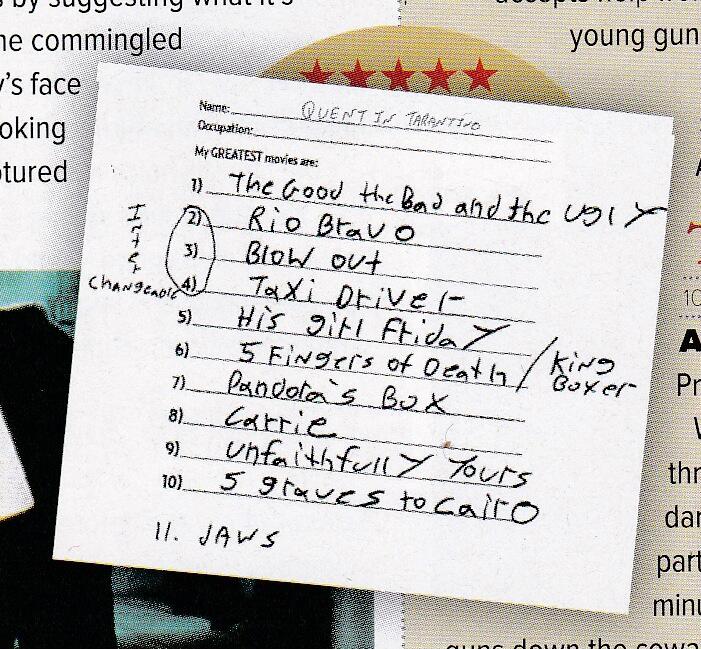
Earlier this week, we featured a list of Quentin Tarantino’s 12 Favorite Films of All Time, given in response to Sight & Sound’s 2012 poll. This morning, one of our friendly followers on Twitter (@LoSceicco1976) made us aware of another list — a handwritten list that Tarantino apparently submitted in 2008, to Empire Magazine. Do the two lists have some commonalities? Yup, Taxi Driver, His Girl Friday, The Good, the Bad, and the Ugly, etc. But this handwritten list also includes a number of new titles — take for example, Chang-hwa Jeong’s Five Fingers of Death, Brian De Palma’s Blow Out, and Howard Hawks’ Rio Bravo, starring John Wayne. (See our collection of 21 Free John Wayne Westerns here.) And, sorry to say, The Bad News Bears didn’t make the cut.
It just goes to show, if you ask directors to jot down their favorite movies, the list can change from day to day, and year to year. Speaking of, you might also want to see a video where Tarantino Lists His Favorite Films Since 1992. Yet more new films to save for a rainy day.
If you would like to support the mission of Open Culture, consider making a donation to our site. It’s hard to rely 100% on ads, and your contributions will help us continue providing the best free cultural and educational materials to learners everywhere. You can contribute through PayPal, Patreon, and Venmo (@openculture). Thanks!
Many film fans wish we could have a director like Ingmar Bergman working today. Just as many television fans surely wish we could have a talk show host like Dick Cavett working today. But both Bergman, who died in 2007, and Cavett, who still writes but seems to have put televisual pursuits behind him, produced substantial bodies of work. And, thanks to the internet, you can experience their films and broadcasts even more easily than when they first appeared. Take, for instance, this 1971 Dick Cavett Show episode featuring the curious and dry-witted conversationalist’s interview with the Swedish maker of such pictures still viewed widely and enthusiastically as The Seventh Seal, The Virgin Spring, Persona, and Fanny and Alexander. No enthusiast of serious conversation about film would want to miss the hour when these two men’s worlds collide. But we get an insight into more than these men’s worlds: partway through the episode, and to the delight of Bergman’s fans, actress Bibi Andersson turns up.
Eventually to star in more than ten Bergman pictures, including Persona, The Magician, and The Passion of Anna, Andersson appears ostensibly in promotion of her and Bergman’s then-most recent collaboration, The Touch. “Does he understand women?” Cavett suddenly asks Andersson, who replies with every interviewer’s bête noire, the one-word answer: “Yes.” Bergman then explains his conviction that women possess greater natural acting ability and comfort with the craft than men do. “Acting,” he says, “is a very special woman’s profession.” The full conversation reveals more about the filmmaker’s surprising feminism, as well as his childhood fear of movies, his lifelong fear of drugs, his views on punctuality, his on-set temper, his struggles with restless leg syndrome, the pride he takes in his soap commercials, his homeland’s supposed preponderance of beautiful women, and how many more films he intends to make. “Five, maybe six,” the director guesses. “Make it six, could you?” asks the host. He ended up making twelve.
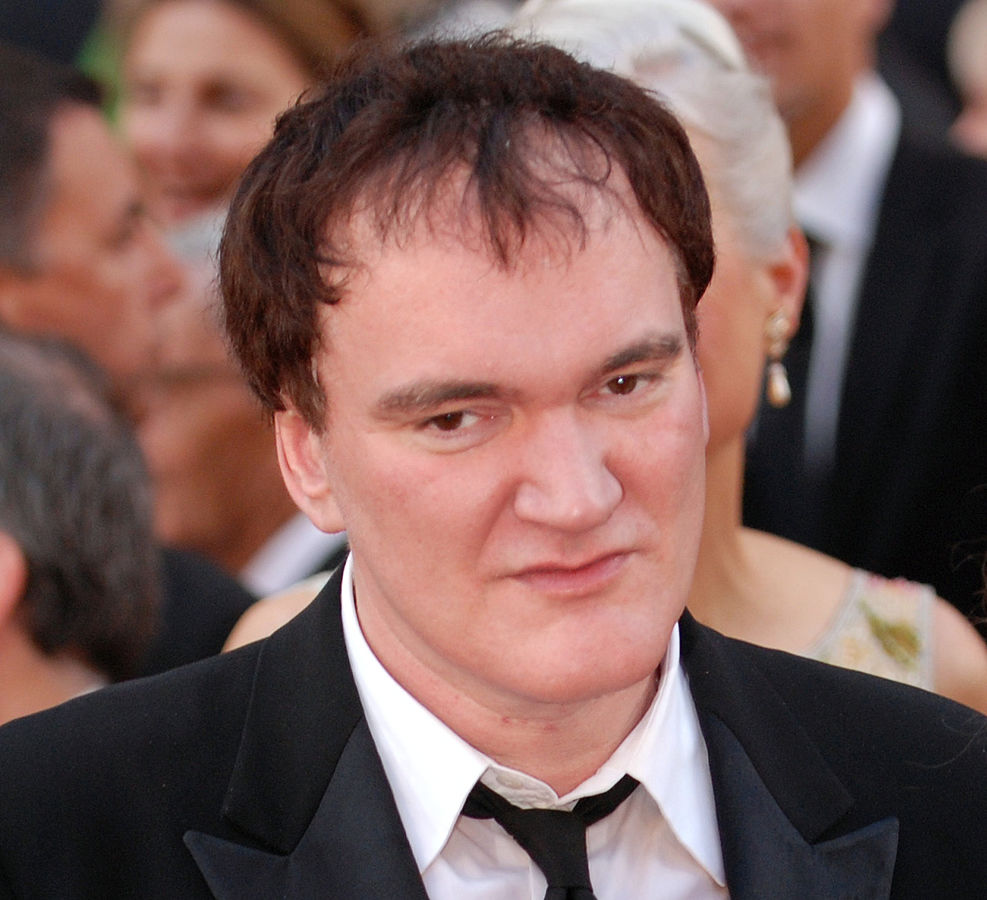
Any list of the most respected American filmmakers of the past half-century would have to include Stanley Kubrick, Woody Allen, and Martin Scorsese. The latter two have kept creating, and prolifically, but that doesn’t delay those heated debates about who will most proudly carry the auteur’s tradition into the next few decades. Much smart money bets on Quentin Tarantino, who, at age 50, has already racked up over twenty years (and if you count My Best Friend’s Birthday, over 25) of demonstrating his distinctive cinematic sensibility.
That sensibility has made him a director of renown, but it comes in large part from his equally formidable stature as a film fan: his beginnings as a highly curatorial video-store clerk, his ownership of the revival theater the New Beverly Cinema (which I myself frequent), his cinephile’s-dream home theater and large collection of prints. Having featured top-movie lists from Kubrick, Allen, and Scorsese, let’s take a look at one from Tarantino:
Apocalypse Now (Francis Ford Coppola, 1979)
The Bad News Bears (Michael Ritchie, 1976)
Carrie (Brian de Palma, 1976)
Dazed and Confused (Richard Linklater, 1993)
The Good, the Bad, and the Ugly (Sergio Leone, 1966)
The Great Escape (John Sturges, 1963)
His Girl Friday (Howard Hawks, 1939)
Jaws (Steven Spielberg, 1975)
Pretty Maids All in a Row (Roger Vadim, 1971)
Rolling Thunder (John Flynn, 1997)
Sorcerer (William Friedkin, 1977)
Taxi Driver (Martin Scorsese, 1976)
The director of Pulp Fiction, Jackie Brown, and Django Unchained voted for these pictures in Sight & Sound’s 2012 poll. Not only does this high-profile auteur select several other high-profile auteurs, he favors ones who show a similar enthusiasm for genre: de Palma, Leone, Hawks, Spielberg, Friedkin. Other selections, like Apocalypse Now and Taxi Driver, come from filmmakers associated with the “New Hollywood” movement of the seventies, the last major burst of creative filmmaking in the American mainstream before — you guessed it — the “Indiewood” boom of the late eighties and nineties which launched the career of not only Tarantino himself but also Richard Linklater, whose breakout Slacker you can watch online. You can also catch, free on the internet, one of the classic Hollywood productions Tarantino includes: His Girl Friday. As for the seemingly inexplicable presence of the 1976 kids’ sports comedy The Bad News Bears, I haven’t found it free online yet, but everybody tells me you really do need to see it to truly appreciate it.
We're hoping to rely on loyal readers, rather than erratic ads. Please click the Donate button and support Open Culture. You can use Paypal, Venmo, Patreon, even Crypto! We thank you!
Open Culture scours the web for the best educational media. We find the free courses and audio books you need, the language lessons & educational videos you want, and plenty of enlightenment in between.