Is the most popular writer of our time actually a good writer? Or maybe he used to be good but has long since run out of inspiration? What are the most effective ways to adapt these very readable short stories and novels? Does showing us the evil in a film lessen its impact? While you’ve been thinking about those questions, King has already written another book.
Mark Linsenmayer, Erica Spyres, and Brian Hirt share their experiences with and opinions about King’s oeuvre and the films and shows that have come out of it, including It, “The Body” (aka Stand By Me), The Shining, In the Tall Grass, The Dark Tower,The Stand, Children of the Corn, From a Buick 8, Under the Dome, The Outsider, Mr. Mercedes, Castle Rock, Pet Sematary, Misery, The Shawshank Redemption, and more.
Some articles we read to prepare for this discussion include:
FYI: If you sign up for a MasterClass course by clicking on the affiliate links in this post, Open Culture will receive a small fee that helps support our operation.
To have watched some of the greatest film and television in the last thirty-five years is to have been immersed in the music of Mark Mothersbaugh and Danny Elfman—two artists who have scored Hollywood blockbusters and indie hits alike since the mid-eighties when they started on TV’s Pee-wee’s Playhouse and Tim Burton’s 1985 comedy Pee-wee’s Big Adventure, respectively. They also happen to have played in two of the 1980’s weirdest, most experimental New Wave bands, Devo and Oingo Boingo.
Mothersbough went on to score everything from Rugrats to Thor: Ragnarok, but he’s maybe best known for his work with Wes Anderson. Likewise, Elfman—who has worked with everyone from Gus Van Sant to Brian De Palma to Peter Jackson to Ang Lee—formed a creative bond with Burton, to such a degree that it’s near impossible to imagine a Tim Burton film without a Danny Elfman score.
When Burton first approached him for Pee-wee’s Big Adventure, the Oingo Boingo frontman was just about to release “Weird Science,” for the infamous John Hughes film of the same name. Already a band with a massive cult following, they became pop stars, and Elfman became one of the most distinctive film composers of the last several decades.
He scored Beetlejuice, Batman, Edward Scissorhands, Batman Returns, Sleepy Hollow, The Nightmare Before Christmas, Corpse Bride, and, most recently, Burton’s Dumbo. Now he’s sharing his secrets for aspiring film composers everywhere with his very own Masterclass. “I’m going to tell you from my perspective,” he says in the trailer above, “how I do these things”: things including instrumentation, orchestration, melody, and tone—“the most important thing you’re going to capture in a film score.”
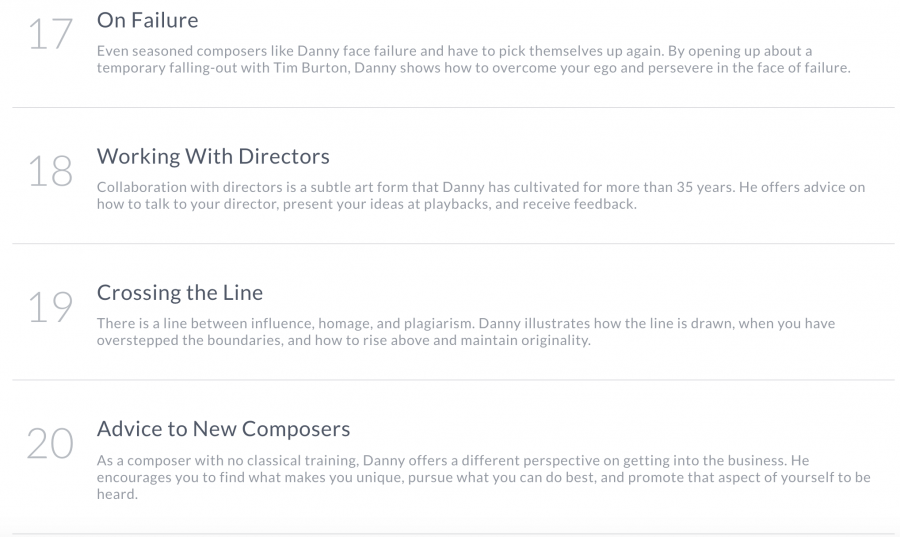
In the screenshots here, see excerpts of the course topics, which include units on the films Milk, The Unknown Known, and The Nightmare Before Christmas, an example of “writing specifically for a character”—a character, Jack Skellington, whose singing voice Elfman also provided.
For those who feel they’ll never measure up to a career like Danny Elfman’s, he introduces all important units on insecurity and failure. Perhaps the most important lesson of all, he says above, with infectious enthusiasm, is learning that “it’s okay to fail, to feel insecure. Doubting yourself, finding confidence and moving forward, and then doubting what you’ve just done…. I think this is the life of a composer. I think it’s the life of an artist.”
Can such things be taught, or can they only be lived? Each teacher and student of the arts must at some point ask themselves this question. Perhaps they only learn the answer when they try, and fail, and try again anyway. Sign up for Elman’s course here.
You can take this class by signing up for a MasterClass’ All Access Pass. The AllAccessPass will give you instant access to this course and 85 others for a 12-month period.
When we throw our clothes away in the West, they don’t all go to a thrift store or to a recycling center or a local landfill. Instead, every year 100,000 tons of clothes make their way across the ocean to India. In this awareness raising short doc from UK-based filmmaker Meghna Gupta, we see the end point of these bales and bales of Western fashion, and the women and men who turn our waste back into thread. The thread then begins its own journey, inevitably winding back up as cheap imported clothes. And the cycle begins again.
Gupta lets the women speak for themselves, in particular Reshma, a young mother and wife who works in one such recycling center in Panipat, North India. We see her daily life as well as the process turning our castoffs into thread. Upon entering the country, the clothes are cut so they can’t be re-sold. Then women like Reshma remove buttons, zippers, and any other non-cloth component.
Far, far away from even a passing encounter with a Westerner (apart from what they’ve seen on the Discovery Channel), Reshma and her co-workers create a narrative and an image of the people sending all these clothes. The West must have a water shortage, Reshma says, that is stopping people from washing their clothes. The West also must have a very strange diet to produce the plus-size garments they keep coming across.
Now, the West doesn’t have a water shortage, but according to EDGE (Emerging Designers Get Exposed), the clothing and textile industry is the second largest polluter in the world, second only to oil, producing 20 percent of global waste water, and a global waste total of nearly 13 million tons of fabric. Producing cotton is water-intensive—with 5,000 gallons needed just to make a pair of jeans and a t‑shirt.
Recycling is important—it’s been a constant message to the public since the 1970s. But the global footprint that this film hints at, all those cargo ships, all those trucks, all that fuel and those miles traveled…is this really a solution? How do we stop the demand and the disposability?
The doc doesn’t answer those questions, and doesn’t mean to do so. It just wants you to see a small family in the middle of a large global machine. They seem happy enough. But they also see their fate as God-given, at least in this life this time ’round.
“You tend to get dressed for other people,” Reshma’s husband says. “But at the end of the day you’ll be as beautiful as God made you. All people have a natural beauty.”
Ted Mills is a freelance writer on the arts who currently hosts the FunkZone Podcast. You can also follow him on Twitter at @tedmills, read his other arts writing at tedmills.com and/or watch his films here.
How does a movie become a “classic”? Explanations, never less than utterly subjective, will vary from cinephile to cinephile, but I would submit that classic-film status, as traditionally understood, requires that all elements of the production work in at least near-perfect harmony: the cinematography, the casting, the editing, the design, the setting, the score. Outside first-year film studies seminars and deliberately contrarian culture columns, the label of classic, once attained, goes practically undisputed. Even those who actively dislike Stanley Kubrick’s 2001: A Space Odyssey, for instance, would surely agree that its every last audiovisual nuance serves its distinctive, bold vision — especially that opening use of “Thus Spake Zarathustra.”
But Kubrick didn’t always intend to use that piece, nor the other orchestral works we’ve come to closely associate with mankind’s ventures into realms beyond Earth and struggles with intelligence of its own invention. According to Jason Kottke, Kubrick had commissioned an original score from A Streetcar Named Desire, Spartacus, Cleopatra, and Who’s Afraid of Virginia Woolf composer Alex North.
At the top of the post, you can see 2001’s opening with North’s music, and below you can hear 38 minutes of his score on Spotify. As to the question of why Kubrick stuck instead with the temporary score of Strauss, Ligeti, and Khatchaturian he’d used in editing, Kottke quotes from Michel Ciment’s interview with the filmmaker:
However good our best film composers may be, they are not a Beethoven, a Mozart or a Brahms. Why use music which is less good when there is such a multitude of great orchestral music available from the past and from our own time? [ … ] Although [North] and I went over the picture very carefully, and he listened to these temporary tracks and agreed that they worked fine and would serve as a guide to the musical objectives of each sequence he, nevertheless, wrote and recorded a score which could not have been more alien to the music we had listened to, and much more serious than that, a score which, in my opinion, was completely inadequate for the film.
North didn’t find out about Kubrick’s choice until 2001’s New York City premiere. Not an enviable situation, certainly, but not the worst thing that ever happened to a collaborator who failed to rise to the director’s expectations.
Note: An earlier version of this post appeared on our site in December 2014.
If you would like to support the mission of Open Culture, consider making a donation to our site. It’s hard to rely 100% on ads, and your contributions will help us continue providing the best free cultural and educational materials to learners everywhere. You can contribute through PayPal, Patreon, and Venmo (@openculture). Thanks!
As a famous first, Frank Zappa’s 1971 film 200 Motels set a standard for hundreds of wacky experimental, B‑movies to come. The first full-length film shot entirely on videotape, the cheap alternative to film that had thus far been used primarily for TV shows and news broadcasts, the movie exploited the medium’s every possibility. “If there is more that can be done with videotape,” wrote Roger Ebert in his review at the time, “I do not want to be there when they do it.”
The movie is not only a “joyous, fanatic, slightly weird experiment in the uses of the color videotape process”; it is also a visual encapsulation of Zappa’s most comically juvenile, most musically virtuosic sensibilities, with Ringo Star playing “Zappa as ‘a very large dwarf,’” the Mothers of Invention playing themselves, Keith Moon appearing as a nun, the Royal Philharmonic Orchestra taking abuse from Zappa, and a series of rowdy, raunchy misadventures piled one atop the other.
“It assaults the mind with everything on hand,” Ebert both marveled and half-complained. “Videotape reportedly allowed Zappa to film the entire movie in about a week, to do a lot of the editing and montage in the camera and to use cheap videotape for his final editing before transferring the whole thing to a surprisingly high-quality 35mm image.” As the making-of documentary below notes, the movie was edited without “the use of computer facilities,” and its layers of effects helped invent new aesthetic forms which now feel quite familiar.
Hyperkinetic, surrealist, and bizarre, 200 Motels is a mélange of animation, musical performance, crude jokes, and “a kind of magical mystery trip,” wrote Ebert, “through all the motels, concert halls, cities, states and groupies of a road tour.” It was not beloved by critics then (though Ebert gave it 3 out of 4 stars) and still gets a mixed reception. It may or may not be the “kind of movie you have to see more than once,” given its full-on sensory assault.
But Zappa’s experimental tour de force is essential viewing for Zappa fans, and also for students of the videotape aesthetic that has become an almost classic style in its own right. We can see in 200 Motels the roots of the music video—Zappa was a decade ahead of MTV—though, for better or worse, its “whimsically impenetrable plotline and absurdist sub-Monty Python humor,” as Ian Gittens writes at The Guardian, “were met with widespread bafflement and it sank without a trace.”
In the 80s, however, 200 Motels found new life in a format that seemed well suited to its look, VHS. Then it found a home on the internet, that Valhalla of ancient video of every kind. A touted DVD boxset, it appears, will not be coming. (Seems the distributer has been slapped with a “winding up order” of some kind.) But you can find it on disc, “intact and with the correct aspect ratio” as one happy reviewer notes.
Whatever medium you happen to watch 200 Motels on, your experience of it will very much depend on your tolerance for Zappa’s brand of scatological satire. But if you’re willing to take Roger Ebert’s word for such things, you should try to see this oddball piece of movie history at least once.
The American West has never been a place so much as a constellation of events—incursion, settlement, seizure, war, containment, and extermination in one order or another. These bloody histories, sanitized and seen through anti-indigenous ideology, formed the backdrop for the American Western—a genre that depends for its existence on creating a convincing sense of place.
But where most Westerns are supposed to be set—Colorado, California, Texas, Kansas, or Montana—seems less important than that their scenery conform to a stereotype of what The West should look like. That image has, in film after film, been supplied by the towering buttes of Monument Valley. The Vox video above tells the story of how this particular place became the symbol of the American West, beginning with the ironic fact that Monument Valley isn’t actually part of the U.S., but a tribal park on the Navajo Nation reservation, inside the states of Utah and Arizona.
“For centuries, only Native Americans, specifically the Paiute and Navajo, occupied this remote landscape, fielding conflicts with the U.S. government.” That would change when settlers and sheep traders Harry and Leone “Mike” Goulding set up a trading post right outside Navajo territory on the Utah side. Goulding tried tirelessly to attract tourists to Monument Valley during the Great Depression but didn’t get any traction until he took photos of the landscape to Hollywood.
The movie world immediately saw potential, and Western directing legend John Ford chose the stunning location for his 1939 film Stagecoach. It would be the first of scores of films shot in Monument Valley and the origin of cinematic iconography now inseparable from our idea of the rugged American West. The landscape, and Ford’s vision, elevated the Western from low-budget pulp to “one of Hollywood’s most popular genres for the next 20 years.”
Stagecoach provided the “breakout role for American icon John Wayne” (who once declared that Native people “selfishly tried to keep their land” for themselves and thus deserved to be dispossessed.) And just as Wayne became the face of the Western hero, Monument Valley became the central icon of its mythos. Ford used Monument Valley seven more times in his films, most notably in The Searchers, set in Texas, widely praised as one of the best Westerns ever made.
Ford’s final film to feature the landscape takes place all over the country, appropriately, given its title, How the West Was Won. Its all-star cast, including Wayne, sold this major 1962 epic, marketed with the tagline “24 great stars in the mightiest adventure ever filmed.” But it wouldn’t have been a true Western at that point, or not a true John Ford Western, without Monument Valley as one of its many landscapes. The imagery may have become cliché, but “clichés are useful for storytelling,” signaling to audiences “what kind of story this is.”
From Stagecoach to Marlboro Ads to Thelma and Louise to The Lego Movie to the Cohen Brothers’ comic classic Western tribute The Ballad of Buster Scruggs, the image of Monument Valley has become shorthand for freedom, adventure, and the risks of the frontier. But like other iconic places in other forbidding landscapes around the world, the myth of Monument Valley covers over the historical and present-day struggles of real people. We get a little bit of that story in the Vox explainer, but mostly we learn how Monument Valley became an endlessly repeating “backdrop” that “could be anywhere in the West.”
“Whatever you find weird, ugly, or nasty about a medium will surely become its signature,” writes Brian Eno in his published diary A Year with Swollen Appendices. “CD distortion, the jitteriness of digital video, the crap sound of 8‑bit — all these will be cherished as soon as they can be avoided.” Eno wrote that in 1995, when digital audio and video were still cutting-edge enough to look, sound, and feel not quite right yet. But when DVD players hit the market not long thereafter, making it possible to watch movies in flawless digital clarity, few consumers with the means hesitated to make the switch from VHS. Could any of them have imagined that we’d one day look back on those chunky tapes and their wobbly, muddy images with fondness?
Anyone with much experience watching Youtube has sensed the lengths to which its creators go in order to deliberately introduce into their videos the visual and sonic artifacts of a pre-digital age, from VHS color bleed and film-surface scratches to vinyl-record pops and tape hiss. “Why do we gravitate to the flaws that we’ve spent more than a century trying to remove from our media?” asks Noah Lefevre, creator of the Youtube channel Polyphonic, in his video essay “The Beauty of Degraded Media.” He finds examples everywhere online, even far away from his platform of choice: take the many faux-analog filters of Instagram, an app “built around artificially adding in the blemishes and discolorations that disappeared with the switch to digital photography.”
Lefevre even traces humanity’s love of degraded media to works and forms of art long predating the internet: take now-monochromatic ancient Greek statues, which “were originally painted with bold, bright colors, but as the paints faded, the art took on a new meaning. The pure white seems to carry an immaculate beauty to it that speaks to our perception of Greek philosophies and myths centuries later.” He likens what he and other digital-media creators do today to a kind of reverse kintsugi, the traditional Japanese art of repairing broken pottery with conspicuous gold and silver seams: “Instead of filling in flaws in imperfect objects, we’re creating artificial flaws in perfect objects.” Whether we’re streaming video essays and vaporwave mixes or watching VHS tapes and spinning vinyl records, “we want our media to feel lived in.”
Or as Eno puts it, we want to hear “the sound of failure.” And we’ve always wanted to hear it: “The distorted guitar is the sound of something too loud for the medium supposed to carry it. The blues singer with the cracked voice is the sound of an emotional cry too powerful for the throat that releases it. The excitement of grainy film, of bleached-out black and white, is the excitement of witnessing events too momentous for the medium assigned to it.” This leads into advice for artists, something that Eno — who has made as much use of deliberate imperfection in his role as a producer for acts like U2 and David Bowie as he has in his own music and visual art — has long excelled at giving: “When the medium fails conspicuously, and especially if it fails in new ways, the listener believes something is happening beyond its limits.” It was true of art in the 90s, and it’s even truer of art today.
Based in Seoul, Colin Marshall writes and broadcasts on cities, language, and culture. His projects include the book The Stateless City: a Walk through 21st-Century Los Angeles and the video series The City in Cinema. Follow him on Twitter at @colinmarshall or on Facebook.
There are few filmmakers alive today who have the mystique of Werner Herzog. His feature films and his documentaries are brilliant and messy, depicting both the ecstasies and the agonies of life in a chaotic and fundamentally hostile universe. And his movies seem very much to reflect his personality – uncompromising, enigmatic and quite possibly crazy. How else can you explain his willingness to risk life and limb to shoot in such forbidding places as the Amazonian rain forest or Antarctica?
In perhaps his greatest film, Fitzcarraldo — which is about a dreamer who hatches a scheme to drag a riverboat over a mountain — Herzog decides, for the purposes of realism, to actually drag a boat over a mountain. No special effects. No studios. In the middle of the Peruvian jungle.
The production, perhaps the most miserable in the history of film, is the subject of the documentary The Burden of Dreams. After six punishing months, a weary-looking Herzog described his surroundings:
I see it more full of obscenity. It’s just — Nature here is vile and base. I wouldn’t see anything erotical here. I would see fornication and asphyxiation and choking and fighting for survival and… growing and… just rotting away. Of course, there’s a lot of misery. But it is the same misery that is all around us. The trees here are in misery, and the birds are in misery. I don’t think they — they sing. They just screech in pain. […] But when I say this, I say this all full of admiration for the jungle. It is not that I hate it, I love it. I love it very much. But I love it against my better judgment.
His worldview brims with a heroic pessimism that is pulled straight out of the German Romantic poets. Nature is not some harmonious anthropomorphized playground. It is instead nothing but “chaos, hostility and murder.” For those sick of the cynical dishonesty of Hollywood’s current crop of Award-ready fare (hello, The Imitation Game), Herzog comes as a bracing tonic. An icon of what independent cinema should be rather than what it has largely become.
Below is Herzog’s list of advice for filmmakers, found on the back of his latest book Werner Herzog – A Guide for the Perplexed. (Hat tip goes to Jason Kottke for bringing it to our attention.) Some maxims are pretty specific to the world of moviemaking – “That roll of unexposed celluloid you have in your hand might be the last in existence, so do something impressive with it.” Other points are just plain good lessons for life — “Always take the initiative,” “Learn to live with your mistakes.” Read along and you can almost hear Herzog’s malevolent Teutonic lilt.
1. Always take the initiative.
2. There is nothing wrong with spending a night in jail if it means getting the shot you need.
3. Send out all your dogs and one might return with prey.
4. Never wallow in your troubles; despair must be kept private and brief.
5. Learn to live with your mistakes.
6. Expand your knowledge and understanding of music and literature, old and modern.
7. That roll of unexposed celluloid you have in your hand might be the last in existence, so do something impressive with it.
8. There is never an excuse not to finish a film.
9. Carry bolt cutters everywhere.
10. Thwart institutional cowardice.
11. Ask for forgiveness, not permission.
12. Take your fate into your own hands.
13. Learn to read the inner essence of a landscape.
14. Ignite the fire within and explore unknown territory.
15. Walk straight ahead, never detour.
16. Manoeuvre and mislead, but always deliver.
17. Don’t be fearful of rejection.
18. Develop your own voice.
19. Day one is the point of no return.
20. A badge of honor is to fail a film theory class.
21. Chance is the lifeblood of cinema.
22. Guerrilla tactics are best.
23. Take revenge if need be.
24. Get used to the bear behind you.
Note: An earlier version of this post appeared on our site in January 2015.
Jonathan Crow is a Los Angeles-based writer and filmmaker whose work has appeared in Yahoo!, The Hollywood Reporter, and other publications. You can follow him at @jonccrow. And check out his blog Veeptopus, featuring lots of pictures of badgers and even more pictures of vice presidents with octopuses on their heads. The Veeptopus store is here.
We're hoping to rely on loyal readers, rather than erratic ads. Please click the Donate button and support Open Culture. You can use Paypal, Venmo, Patreon, even Crypto! We thank you!
Open Culture scours the web for the best educational media. We find the free courses and audio books you need, the language lessons & educational videos you want, and plenty of enlightenment in between.