Chef turned restaurateur Alain Ducasse has rather a lot to say on the subject of chocolate.
On the website of Le Manufacture, the small-batch chocolate factory he founded in a former Renault Garage, he waxes poetic, sharing wide-eyed childhood memories of the “terribly sensual and bewitching substance.”
He’s a bit more mercenary in the pages of the The Wall Street Journal and Harvard Business Review, noting that the chocolate operation grew out of his desire to control the process from cacao beans to dessert plates in his numerous fine dining establishments.
His involvement in the day-to-day operations is likely ceremonial, but in a chocolate making stint early in his career, he found the “olfactory universe” pleasurable and “intoxicating to the point of being disturbing.”
Take that, Hersheys!
His fondness for vintage machinery and traditional methods opens the door to some serious cacao porn, above, starring former executive pastry chef Nicolas Berger.
The word “meticulous” comes up more than once in the voiceover narration. Hopefully, Saturday Night Live will take note. Tasked by Epicurious to identify a guilty pleasure on the order of chocolate or wine, Ducasse named BLT sandwiches, but he musters the requisite, parody-worthy romanticism for director Simon Pénochet:
Beyond gourmandise, we are seeking truth, a quest which is more primal than original.
From “eudicotyledon” on Reddit comes a holiday project you, too, can maybe try at home. He says: “My family made a gingerbread rendition of the Overlook Hotel from Kubrick’s “The Shining,” complete with a Rice Krispies treat maze and interior rooms depicting famous scenes.” You can flip through 29 images in the gallery above, showing the edible creation from different points of view. Then see a “making-of” gallery here. Enjoy.
What do I want for Christmas? I’ll settle for a little more insight into how to make the perfect cappuccino, the stuff that has reliably kept this site running day in, day out, for the past 9 years.
Enter Michael Phillips, Director for Education at Blue Bottle Coffee and the 2010 World Barista Champion, who, in this video produced by Munchies, offers a six minute primer on cappuccino-making. When all is said and done, what’s my takeaway? To achieve coffee Nirvana, maybe I need some better gear, like a La Marzocco. Or maybe, really, I need to take my love of coffee to another level, as Phillips clearly does in a nearly x‑rated moment at the very end. As with so many things, it’s not the gear, but the love and dedication, that makes the difference.
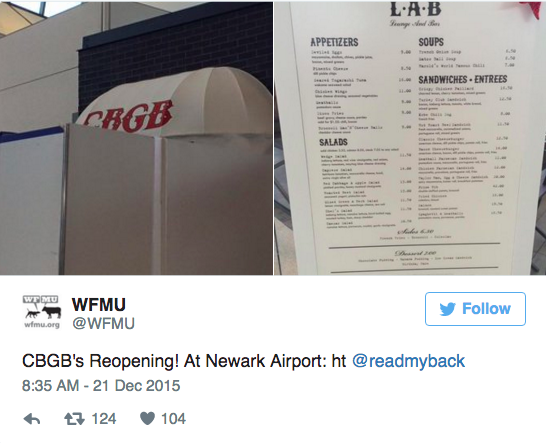
CBGB, the birthplace of New York’s 1970s punk scene, closed in 2006, with Patti Smith headlining the final show. It was the end of an era, another great New York institution shutting its doors.
As the tweet above from indie radio station WFMU suggests, CBGB will be reincarnated apparently as a restaurant in a Newark Airport terminal, with a menu offering Cheeseburgers, Chicken Wings, Caprese Salads, Seared Togarashi Tuna, and Kobe Chili Dogs. The menu doesn’t seem to be shooting for authenticity, but maybe, hopefully the bathrooms will.
Diageo, the distiller of single malt whiskies including Lagavulin and Oban, has teamed up with Nick Offerman (actor, author, woodworker and scotch enthusiast) to create a new video series called “My Tales of Whisky.” Apparently the video series will be made in different styles, with different kinds of story lines. This one is pretty straightforward–just Nick sitting in front of a fire drinking single malt scotch (Lagavulin) for 45 minutes straight, simply staring and saying nary a word. Tonight, maybe you can grab your own favorite libation, stare right back, and try not to blink.
I think we’ve all had moments when, bellying up to our favorite sushi bar, we’ve watched the chef in action behind the counter and thought, “I wonder if I could do that?” Then we see a documentary like Jiro Dreams of Sushi and think, “Well, no, I probably couldn’t do that.” Still, you don’t have to live, breathe, and dream sushi yourself to get something out of practicing the craft, and if you want to get a handle on its basics right now, you could do much worse than watching the video series Diaries of a Master Sushi Chef.
Hiroyuki Terada, the master sushi chef in question, first learned the basics himself at home from his father, then continued his studies in Kōchi, on the Japanese island of Shikoku, then made a name for himself in America, at NoVe Kitchen and Bar in Miami.
If you really want to start from square one, Terada has also put together a four-part miniseries on making sushi at home from grocery store ingredients. When you get those teachings down, you have only to practice — and practice, and practice, and practice some more. From there, you can also move on to Terada’s roll-specific videos, which teach how to make some of his more elaborate creations: the crazy salmon roll, the uni tempura monster roll, even something called the meat lover’s roll. Would Jiro approve? Maybe not, but the Miami nightlife crowd certainly seems to.
These days, I’m feeling pretty good about my last remaining vice. But, as always, too much of anything is not a good thing. And that includes coffee too. Just ask Honoré de Balzac, who, according to legend, met an untimely death by drinking 50 cups per day. Or ask the fellow featured in the French animation called Le café–or simply Coffee in English. Up top, you can find a subtitled version of the riotous film directed by Stephanie Marguerite and Emilie Tarascou. Beneath, we have a non-subtitled but higher resolution version. Enjoy, and remember to drink coffee responsibly.
“The Depression was not fun,” the late YouTube star, Clara Cannucciari, states in the very first episode of her Great Depression Cooking web series, above. Her first recipe—Pasta with Peas—would likely give your average urbane foodie hives, as would her knife skills, but Clara, who started making these videos when she was 93, takes obvious satisfaction in the outcome.
Her filmmaker grandson Christopher Cannucciari wisely kept Clara in her own kitchen, rather than relocating her to a more sanitized kitchen set. Her plastic paper towel holder, linoleum lined cabinets, and teapot-shaped spoon rest kept things real for several years worth of step-by-step, low budget, mostly vegetarian recipes.
Her fruit-and-gingham ceramic salt and pepper shakers remained consistent throughout.
How many television chefs can you name who would allow the camera crew to film the stained tinfoil lining the bottom of their ovens?
Nonagenarian Clara apparently had nothing to hide. Each episode includes a couple of anecdotes about life during the Great Depression, the period in which she learned to cook from her thrifty Italian mother.
To what did she attribute her youthful appearance?
Clean living and large quantities of olive oil (poured from a vessel the size and shape of a coffee pot).
How to avoid another Great Depression?
“At my age, I don’t really care,” Clara admitted, “But for the younger generation it’s bad.” In the worst case scenario, she counsels sticking together, and not wishing for too much. The Depression, as we’ve mentioned, was not fun, but she got through it, and so, she implies, would you.
The series can be enjoyed on the strength of Clara’s personality alone, but Great Depression Cooking has a lot to offer college students, undiscovered artists, and other fledgling chefs.
Her recipes may not be professionally styled, but they’re simple, nutritious, and undeniably cheap (especially Dandelion Salad).
Homemade Pizza—Clara’s favorite—is the antithesis of a 99¢ slice.
Those on a lean Thanksgiving budget might consider making Clara’s Poor Man’s Feast: lentils and rice, thinly sliced fried steak, plain salad and bread.
Right up until her final, touching appearance below at the age of 96, her hands were nimble enough to shell almonds, purchased that way to save money, though cracking also put her in a holiday mood. Foodies who shudder at Pasta with Peas should find no fault with her wholesome recipe for her mother’s homemade tomato sauce (and by extension, paste).
Ayun Halliday is an author, illustrator, and Chief Primatologist of the East Village Inky zine. She recently co-authored a comic about epilepsy with her 18-year-old daughter. Follow her @AyunHalliday
We're hoping to rely on loyal readers, rather than erratic ads. Please click the Donate button and support Open Culture. You can use Paypal, Venmo, Patreon, even Crypto! We thank you!
Open Culture scours the web for the best educational media. We find the free courses and audio books you need, the language lessons & educational videos you want, and plenty of enlightenment in between.