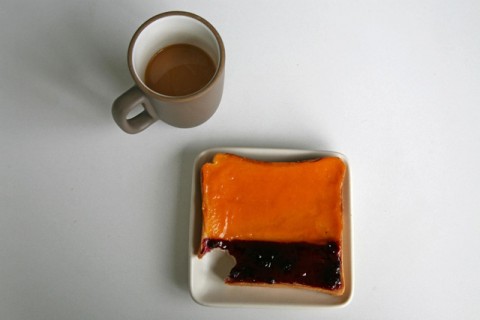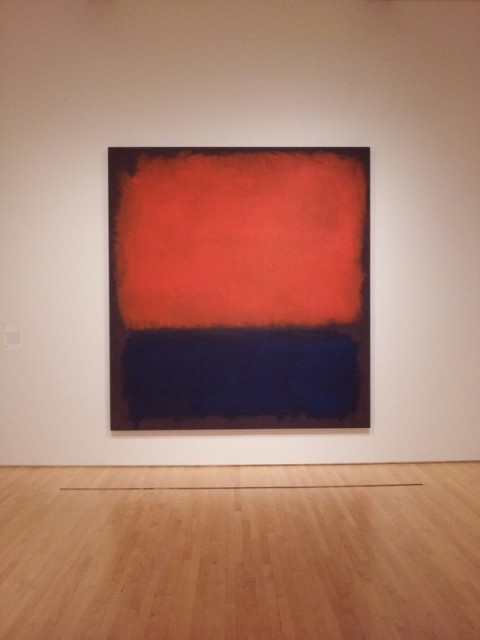
If you head to SFMOMA’s café on Third Street in San Francisco, you can order up some Damien Hirst “Amylamine” lemon velvet cake, Donald Judd tomato soup, and Mark Rothko Toast. The Rothko Toast comes painted with apricot butter along the top, and wild blueberry jam along the bottom, creating an edible imitation of Rothko’s painting known as “No. 14, 1960.” The painting (see below) hangs at SFMOMA, the West Coast’s first museum devoted to 20th century art.
Blank died April 7 at his home in Berkeley, California. He leaves behind a catalog of films that seem small but in fact take on the biggest subjects: humanity, love, commitment, joy and individualism.
In Gap-Toothed Women, Blank creates a singular love letter to women who shun orthodontics and embrace their diastema (the gap between the two front teeth). The film explores the origins of the belief that women with this feature are unusually lusty (think of Chaucer’s “gap-toothed wife of Bath”) and ends up celebrating unconventional beauty.
One of his most interesting works developed out of an inside joke. Blank was a friend of the director Werner Herzog. Herzog, in turn, had mentored the young filmmaker Errol Morris, who was making his first film, Gates of Heaven. In a characteristically dark attempt to be encouraging, Herzog quipped that he would eat his shoe if Morris completed the film.
A man of his word, Herzog later ate the shoe in front of an audience inside Berkeley’s U.C. Theater. Food pioneer Alice Waters cooked the shoe for five hours in garlic and wine. Blank filmed the event in 1980 and, true to his style, stepped back from the subject and created a film about making honest art. You can watch it above.
Kate Rix writes about digital media and education. Visit her website: .
If you would like to sign up for Open Culture’s free email newsletter, please find it here. It’s a great way to see our new posts, all bundled in one email, each day.
If you would like to support the mission of Open Culture, consider making a donation to our site. It’s hard to rely 100% on ads, and your contributions will help us continue providing the best free cultural and educational materials to learners everywhere. You can contribute through PayPal, Patreon, and Venmo (@openculture). Thanks!
Espresso is his palette. Coffee is his medium. Welcome to the artistic world of Mike Breach, a NYC barista, who painstakingly “paints” portraits on lattes and cappuccinos. After you visit Breach’s tumblr filled with “BaristArt,” you’ll never be quite so impressed by that heart-shaped design other baristas pour onto your expensive foam.
Charles Bamforth is the Anheuser-Busch Endowed Professor of Malting and Brewing Sciences at UC Davis, which means he knows a few things about making beer. He can get into some nitty-gritty topics, like the enzymology of the brewing process, foam stability, and the psychophysics of beer perception. But that’s not what he’s doing here. In the clip above, the “Pope of Foam,” as Bamforth is otherwise known, gives you a quick overview of the beer-making process, describing everything from grinding the malt, to boiling the wort, to bottling with glass versus cans. Finally, the Pope gives you a hot tip: how to pick the freshest pint when you’re at a pub.
In many ways food—its production, preparation and consumption—is the hottest art form today. Chefs are like celebrity auteurs, revered for their passion and dedication. We even watch reality television shows about the drama of commercial restaurant kitchens.
The newest documentary by Daniel Addelson puts another one of these artists in the spotlight. Addelson’s new film Storm follows vintner Ernst Storm, a native of South Africa who makes wine in the Santa Ynez Valley near Santa Barbara, through a fall grape harvest. The film is as earthy, bright and moody as the beautiful land where it is set. Storm tromps around his land in shorts and boots and a hat operating fork lifts and hoisting pitchforks full of grapes into huge tubs. We also see him in the lab, tracking the chemical transactions taking place in his current batch.
The movie doesn’t shy away from the industrial side of winemaking, all the hoses and vats and stainless steel casks. But Storm’s voiceover reminds us that behind the heavy lifting is the dream of coaxing something pleasurable out of nature’s bounty.
Storm will premiere at the Sonoma Film Festival in April. Clocking in just over eight minutes, Storm conveys the hard work of making wine, the solitude and the fun. Most of all the film conveys the craft’s artistry. The sensual stuff—the smells and colors and flavors—are what drive Storm’s affection for process. He is discerning and attentive. We see him climbing to the top barrel in a high pyramid, with a glass and a fancy turkey baster in hand. Removing the big cork, Storm sucks out a bit and swishes it around in his glass, then tasting it to see how things are going. Each variety must be cared for, he says.
As a filmmaker Addelson isn’t making a commercial for Storm Wines. He’s interested in the ingredients that make for a creative person—the perseverance, passion and attention to detail necessary to follow an idea through.
He will pick up this thread again in his next film, which looks at the benefits of teaching character to children in school.
Kate Rix writes about digital media and education. Read more of her work at .
George Martin knows something about mixing. The Beatles trusted him to mix their albums, deciding which ingredients to leave in, and which ones to leave out. (Take for example this lost guitar solo from “Here Comes The Sun.”) The record producer, sometimes known as the Fifth Beatle, has taste. No one disputes that. So let’s let him mix us the perfect dry gin martini and issue an amusing word of caution. Hope you’re taking careful notes.…
I haven’t frequented Starbucks for a long time, but when I did, I could never get into their lingo. Do you want a “grande,” the “barista” asked? No, just give me a medium, ok? And if I ever tired of the irritating lingo battles, I headed to an indie cafe where simple language made sense.
“Civilization begins with distillation,” William Faulkner once said, and like many of the great writers of the 20th century — Ernest Hemingway, F. Scott Fitzgerald, James Joyce — the bard of Oxford, Mississippi certainly had a fondness for alcohol.
Unlike many of the others, though, Faulkner liked to drink while he was writing. In 1937 his French translator, Maurice Edgar Coindreau, was trying to decipher one of Faulkner’s idiosyncratically baroque sentences. He showed the passage to the writer, who puzzled over it for a moment and then broke out laughing. “I have absolutely no idea of what I meant,” Faulkner told Coindreau. “You see, I usually write at night. I always keep my whiskey within reach; so many ideas that I can’t remember in the morning pop into my head.”
Every now and then Faulkner would embark on a drunken binge. His publisher, Bennett Cerf, recalled:
The maddening thing about Bill Faulkner was that he’d go off on one of those benders, which were sometimes deliberate, and when he came out of it, he’d come walking into the office clear-eyed, ready for action, as though he hadn’t had a drink in six months. But during those bouts he didn’t know what he was doing. He was helpless. His capacity wasn’t very great; it didn’t take too much to send him off. Occasionally, at a good dinner, with the fine wines and brandy he loved, he would miscalculate. Other times I think he pretended to be drunk to avoid doing something he didn’t want to do.
Wine and brandy were not Faulkner’s favorite spirits. He loved whiskey. His favorite cocktail was the mint julep. Faulkner would make one by mixing whiskey–preferably bourbon–with one teaspoon of sugar, a sprig or two of crushed mint, and ice. He liked to drink his mint julep in a frosty metal cup. (See image above.) The word “julep” first appeared in the late 14th century to describe a syrupy drink used to wash down medicine. Faulkner believed in the medicinal efficacy of alcohol. Lillian Ross once visited the author when he was ailing, and quoted him as saying, “Isn’t anythin’ Ah got whiskey won’t cure.”
On a cold winter night, Faulkner’s medicine of choice was the hot toddy. His niece, Dean Faulkner Wells, described the recipe and ritual for hot toddies favored by her uncle (whom she called “Pappy”) in The Great American Writers’ Cookbook, quoted last week by Maud Newton:
Pappy alone decided when a Hot Toddy was needed, and he administered it to his patient with the best bedside manner of a country doctor.
He prepared it in the kitchen in the following way: Take one heavy glass tumbler. Fill approximately half full with Heaven Hill bourbon (the Jack Daniel’s was reserved for Pappy’s ailments). Add one tablespoon of sugar. Squeeze 1/2 lemon and drop into glass. Stir until sugar dissolves. Fill glass with boiling water. Serve with potholder to protect patient’s hands from the hot glass.
Pappy always made a small ceremony out of serving his Hot Toddy, bringing it upstairs on a silver tray and admonishing his patient to drink it quickly, before it cooled off. It never failed.
We're hoping to rely on loyal readers, rather than erratic ads. Please click the Donate button and support Open Culture. You can use Paypal, Venmo, Patreon, even Crypto! We thank you!
Open Culture scours the web for the best educational media. We find the free courses and audio books you need, the language lessons & educational videos you want, and plenty of enlightenment in between.