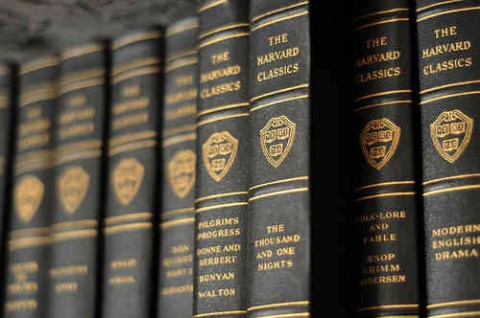
During his days as Harvard’s influential president, Charles W. Eliot made a frequent assertion: If you were to spend just 15 minutes a day reading the right books, a quantity that could fit on a five foot shelf, you could give yourself a proper liberal education. The publisher P. F. Collier and Son loved the idea and asked Eliot to assemble the right collection of works. The result wasa 51-volume series published in 1909 called Dr. Eliot’s Five Foot Shelf. Later it would simply be called The Harvard Classics.
You can still buy an old set off of eBay for $399. But, just as easily, you can head to the Internet Archive and Project Gutenberg, which have centralized links to every text included in The Harvard Classics (Wealth of Nations, Origin of Species, Plutarch’s Lives, the list goes on below). Please note that the previous two links won’t give you access to the actual annotated Harvard Classics texts edited by Eliot himself. But if you want just that, you can always click here and get digital scans of the true Harvard Classics. Please note that the first two volumes appear at the bottom of the page. And, in case you want to deepen your liberal education yet further, don’t forget to check out our collection 1,700 Free Online Courses from Top Universities. Also spend some time with these other resources: 800 Free eBooks for iPad, Kindle & Other Devices and 1,000 Free Audio Books: Download Great Books for Free.
A big h/t to @eugenephoto
Texts in the Harvard Classics collection (courtesy of Wikipedia):
Vol. 1: FRANKLIN, WOOLMAN, PENN
His Autobiography, by Benjamin Franklin
The Journal of John Woolman, by John Woolman (1774 and subsequent editions)
Fruits of Solitude, by William Penn
Vol. 2. PLATO, EPICTETUS, MARCUS AURELIUS
The Apology, Phaedo, and Crito, by Plato
The Golden Sayings, by Epictetus
The Meditations, by Marcus Aurelius
Vol. 3. BACON, MILTON’S PROSE, THOS. BROWNE
Essays, Civil and Moral, and New Atlantis, by Francis Bacon
Areopagitica and Tractate of Education, by John Milton
Religio Medici, by Sir Thomas Browne
Vol. 4. COMPLETE POEMS IN ENGLISH, MILTON
Complete poems written in English, by John Milton
Vol. 5. ESSAYS AND ENGLISH TRAITS, EMERSON
Essays and English Traits, by Ralph Waldo Emerson
Vol. 6. POEMS AND SONGS, BURNS
Poems and songs, by Robert Burns
Vol. 7. CONFESSIONS OF ST. AUGUSTINE, IMITATIONS OF CHRIST
The Confessions, by Saint Augustine
The Imitation of Christ, by Thomas á Kempis
Vol. 8. NINE GREEK DRAMAS
Agamemnon, The Libation Bearers, The Furies, and Prometheus Bound, by Aeschylus
Oedipus the King and Antigone, by Sophocles
Hippolytus and The Bacchae, by Euripides
The Frogs, by Aristophanes
Vol. 9. LETTERS AND TREATISES OF CICERO AND PLINY
On Friendship, On Old Age, and letters, by Cicero
Letters, by Pliny the Younger
Vol. 10. WEALTH OF NATIONS, ADAM SMITH
The Wealth of Nations, by Adam Smith
Vol. 11. ORIGIN OF SPECIES, DARWIN
The Origin of Species, by Charles Darwin
Vol. 12. PLUTARCH’S LIVES
Lives, by Plutarch
Vol. 13. AENEID, VIRGIL
Aeneid, by Virgil
Vol. 14. DON QUIXOTE, PART 1, CERVANTES
Don Quixote, part 1, by Cervantes
Vol. 15. PILGRIM’S PROGRESS, DONNE & HERBERT, BUNYAN, WALTON
The Pilgrim’s Progress, by John Bunyan
The Lives of Donne and Herbert, by Izaak Walton
Vol. 16. THE THOUSAND AND ONE NIGHTS
Stories from the Thousand and One Nights
Vol. 17. FOLKLORE AND FABLE, AESOP, GRIMM, ANDERSON
Fables, by Aesop
Children’s and Household Tales, by Jacob and Wilhelm Grimm
Tales, by Hans Christian Andersen
Vol. 18. MODERN ENGLISH DRAMA
All for Love, by John Dryden
The School for Scandal, by Richard Brinsley Sheridan
She Stoops to Conquer, by Oliver Goldsmith
The Cenci, by Percy Bysshe Shelley
A Blot in the ‘Scutcheon, by Robert Browning
Manfred, by Lord Byron
Vol. 19. FAUST, EGMONT, ETC. DOCTOR FAUSTUS, GOETHE, MARLOWE
Faust, part 1, Egmont, and Hermann and Dorothea, by Johann Wolfgang von Goethe
Dr. Faustus, by Christopher Marlowe
Vol. 20. THE DIVINE COMEDY, DANTE
The Divine Comedy, by Dante Alighieri
Vol. 21. I PROMESSI SPOSI, MANZONI
I Promessi Sposi, by Alessandro Manzoni
Vol. 22. THE ODYSSEY, HOMER
The Odyssey, by Homer
Vol. 23. TWO YEARS BEFORE THE MAST, DANA
Two Years Before the Mast, by Richard Henry Dana, Jr.
Vol. 24. ON THE SUBLIME, FRENCH REVOLUTION, ETC., BURKE
On Taste, On the Sublime and Beautiful, Reflections on the French Revolution, and A Letter to a Noble Lord, by Edmund Burke
Vol. 25. AUTOBIOGRAPHY, ETC., ESSAYS AND ADDRESSES, J.S. MILL, T. CARLYLE
Autobiography and On Liberty, by John Stuart Mill
Characteristics, Inaugural Address at Edinburgh, and Sir Walter Scott, by Thomas Carlyle
Vol. 26. CONTINENTAL DRAMA
Life is a Dream, by Pedro Calderón de la Barca
Polyeucte, by Pierre Corneille
Phèdre, by Jean Racine
Tartuffe, by Molière
Minna von Barnhelm, by Gotthold Ephraim Lessing
William Tell, by Friedrich von Schiller
Vol. 27. ENGLISH ESSAYS: SIDNEY TO MACAULAY
Vol. 28. ESSAYS: ENGLISH AND AMERICAN
Vol. 29. VOYAGE OF THE BEAGLE, DARWIN
The Voyage of the Beagle, by Charles Darwin
Vol. 30. FARADAY, HELMHOLTZ, KELVIN, NEWCOMB, ETC
The Forces of Matter and The Chemical History of a Candle, by Michael Faraday
On the Conservation of Force and Ice and Glaciers, by Hermann von Helmholtz
The Wave Theory of Light and The Tides, by Lord Kelvin
The Extent of the Universe, by Simon Newcomb
Geographical Evolution, by Sir Archibald Geikie
Vol. 31. AUTOBIOGRAPHY, BENVENUTO CELLINI
The Autobiography of Benvenuto Cellini
Vol. 32. LITERARY AND PHILOSOPHICAL ESSAYS
Essays, by Michel Eyquem de Montaigne
Montaigne and What is a Classic?, by Charles Augustin Sainte-Beuve
The Poetry of the Celtic Races, by Ernest Renan
The Education of the Human Race, by Gotthold Ephraim Lessing
Letters upon the Aesthetic Education of Man, by Friedrich von Schiller
Fundamental Principles of the Metaphysic of Morals, by Immanuel Kant
Byron and Goethe, by Giuseppe Mazzini
Vol. 33. VOYAGES AND TRAVELS
An account of Egypt from The Histories, by Herodotus
Germany, by Tacitus
Sir Francis Drake Revived, by Philip Nichols
Sir Francis Drake’s Famous Voyage Round the World, by Francis Pretty
Drake’s Great Armada, by Captain Walter Bigges
Sir Humphrey Gilbert’s Voyage to Newfoundland, by Edward Haies
The Discovery of Guiana, by Sir Walter Raleigh
Vol. 34. FRENCH AND ENGLISH PHILOSOPHERS, DESCARTES, VOLTAIRE, ROUSSEAU, HOBBES
Discourse on Method, by René Descartes
Letters on the English, by Voltaire
On the Inequality among Mankind and Profession of Faith of a Savoyard Vicar, by Jean Jacques Rousseau
Of Man, Being the First Part of Leviathan, by Thomas Hobbes
Vol. 35. CHRONICLE AND ROMANCE, FROISSART, MALORY, HOLINSHEAD
Chronicles, by Jean Froissart
The Holy Grail, by Sir Thomas Malory
A Description of Elizabethan England, by William Harrison
Vol. 36. MACHIAVELLI, MORE, LUTHER
The Prince, by Niccolò Machiavelli
The Life of Sir Thomas More, by William Roper
Utopia, by Sir Thomas More
The Ninety-Five Theses, To the Christian Nobility of the German Nation, and On the Freedom of a Christian, by Martin Luther
Vol. 37. LOCKE, BERKELEY, HUME
Some Thoughts Concerning Education, by John Locke
Three Dialogues Between Hylas and Philonous in Opposition to Sceptics and Atheists, by George Berkeley
An Enquiry Concerning Human Understanding, by David Hume
Vol. 38. HARVEY, JENNER, LISTER, PASTEUR
The Oath of Hippocrates
Journeys in Diverse Places, by Ambroise Paré
On the Motion of the Heart and Blood in Animals, by William Harvey
The Three Original Publications on Vaccination Against Smallpox, by Edward Jenner
The Contagiousness of Puerperal Fever, by Oliver Wendell Holmes
On the Antiseptic Principle of the Practice of Surgery, by Joseph Lister
Scientific papers, by Louis Pasteur
Scientific papers, by Charles Lyell
Vol. 39. FAMOUS PREFACES
Vol. 40. ENGLISH POETRY 1: CHAUCER TO GRAY
Vol. 41. ENGLISH POETRY 2: COLLINS TO FITZGERALD
Vol. 42. ENGLISH POETRY 3: TENNYSON TO WHITMAN
Vol. 43. AMERICAN HISTORICAL DOCUMENTS
Vol. 44. SACRED WRITINGS 1
Confucian: The sayings of Confucius
Hebrew: Job, Psalms, and Ecclesiastes
Christian I: Luke and Acts
Vol. 45. SACRED WRITINGS 2
Christian II: Corinthians I and II and hymns
Buddhist: Writings
Hindu: The Bhagavad-Gita
Mohammedan: Chapters from the Koran
Vol. 46. ELIZABETHAN DRAMA 1
Edward the Second, by Christopher Marlowe
Hamlet, King Lear, Macbeth, and The Tempest, by William Shakespeare
Vol. 47. ELIZABETHAN DRAMA 2
The Shoemaker’s Holiday, by Thomas Dekker
The Alchemist, by Ben Jonson
Philaster, by Beaumont and Fletcher
The Duchess of Malfi, by John Webster
A New Way to Pay Old Debts, by Philip Massinger
Vol. 48. THOUGHTS AND MINOR WORKS, PASCAL
Thoughts, letters, and minor works, by Blaise Pascal
Vol. 49. EPIC AND SAGA
Beowulf
The Song of Roland
The Destruction of Dá Derga’s Hostel
The Story of the Volsungs and Niblungs
Vol. 50. INTRODUCTION, READER’S GUIDE, INDEXES
Vol. 51. LECTURES
The last volume contains sixty lectures introducing and summarizing the covered fields: history, poetry, natural science, philosophy, biography, prose fiction, criticism and the essay, education, political science, drama, travelogues, and religion.