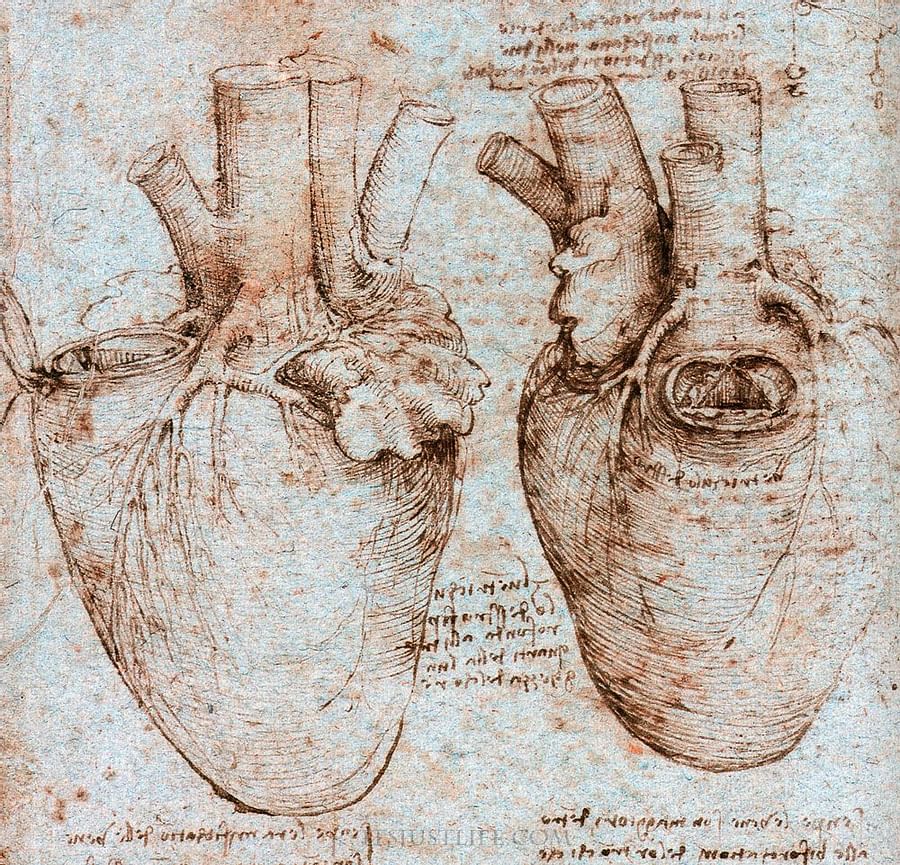
Leonardo da Vinci didn’t really have hobbies; he had passionate, unpaid obsessions that filled whole notebooks with puzzles scientists are still trying to solve. Many of the problems to which he applied himself were those none of his contemporaries understood, because he was the only person to have noticed them at all. The amateur anatomist was the first, for example, “to sketch trabeculae,” notes Medievalists.net, “and their snowflake-like fractal patterns in the 16th century.”
These geometric patterns of muscle fibers on the inner surface of the heart have remained a mystery for over 500 years since Leonardo’s anatomical investigations, carried out first on pig and oxen hearts, then later, in hasty dissections in the winter cold, on human specimens. He speculated they might have warmed the blood, but scientists have recently found they enhance blood flow “just like the dimples on a golf ball reduce air resistance.”
Leonardo may have been wide of the mark in his trabeculae theory, not having access to genetic testing, AI, or MRI. But he was the first to describe coronary artery disease, which would become one of the leading causes of death 500 years later. Many of his medical conclusions have turned out to be startingly correct, in fact. He detailed and elegantly sketched the heart’s anatomy from 1507 until his death in 1519, working out the flow of the blood through the body.
As the Medlife Crisis video above explains, Leonardo’s studies on the heart elegantly brought together his interests in art, anatomy, and engineering. Because of this multi-dimensional approach, he was able to explain a fact about the heart’s operation that even many cardiologists today get wrong, the movement of the aortic valve. In order to visualize the “flow dynamics” of the heart’s machinery, without imaging machinery of his own, he built a glass model, and drew several sketches of what he saw. “Incredibly, it took 450 years to prove him right.”
The mind of this extraordinary figure continues to divulge its secrets, and scholars and doctors across multiple fields continue to engage with his work, in the pages, for example, of the Netherlands Heart Journal. His studies on the heart particularly show how his astonishing breadth of knowledge and skill paradoxically made him such a focused, determined, and creative thinker.
For some of us (no names) the world of TikTok is baffling and bizarre. Why does Gen Z flock to it? Who knows, but they do, in droves. Anyone can be a “creator” on what Jason Parham at Wired calls “the most exciting cultural product of this time.” It also happens to be a place where “digital blackface” has evolved—an online cultural phenomenon in which Black users of a platform get disproportionately censored while others who adopt the trappings of Black American culture, often in exaggerated, stereotypical ways, rack up followers and views.
21st century forms of blackface persist for all sorts of reasons. The intent may not be consciously to demean, but the effects are usually otherwise, especially given the long history of blackface as a way of mocking Black Americans, while forcing Black actors to themselves perform in blackface to gain an audience and get work. Minstrelsy performed by white stage actors, comedians, musicians, etc. set a tragically low bar for Black actors.
A once-prominent example comes from the career of performer Bert Williams. “Largely forgotten today,” Claudia Roth Pierpont writes at The New Yorker, Williams was “the first African-American star: the most famous ‘colored man’ in America during the early years of the twentieth century.” He performed at Buckingham Palace, was the only Black member of Ziegfeld Follies (and a headliner) and played “alongside Fanny Brice and Eddie Cantor—for nearly a decade.”
He did all of it in blackface, decades after the original Jim Crow character appeared in 1830. Born in 1874 in the Bahamas, says Caribbean novelist Caryl Phillips, Williams “was an outsider in all sorts of ways… He didn’t see himself to be fully a part of African American traditions, so in a sense he didn’t quite understand the full implications of the blackface performance. He saw it as part of his costume.” That may not necessarily be so. In his stage act, Williams and his partner resisted the practice for as long as they could, until they realized that they would be subject to constant violence from white audiences without it.
Blackface affectations helped Williams cross over into a film career. He “produced, wrote, directed and starred in two short films for Biograph,” the San Francisco Silent Film Festival notes, “A Natural Born Gambler (1916) and Fish (1916). Produced by a black man for white audiences, they were groundbreaking, however, these films featured characters and storylines that still satisfied dominant racist stereotypes of black men.”
In contrast, a third film, produced three years earlier, titled Lime Kiln Club Field Day, “one of a handful of surviving silent films with an all-black cast,” told a very different kind of story. Williams appeared in blackface, but the other actors did not. “The film … features one of the first examples of on-screen intimacy between a black man and a black woman—a kiss—along with scenes of middle class leisure; story elements that challenged the mostly negative, sometimes evil, depictions of blacks in the majority of white-produced films, which reached a distressing nadir in D.W. Griffith’s The Birth of a Nation, released two years later.”
Lime Kiln Club Field Day was never completed. Its many unedited reels of film were only recently rediscovered, a century later, in the archives at New York’s Museum of Modern Art. See the film above, restored by curator Ron Magliozzi and preservation officer Peter Williamson, who conducted research “over nearly a decade,” the MoMA writes, to decipher the plot of the film and recover its production history, even going so far as to employ a lip reader and explore Staten Island and New Jersey in search of locations.”
Film historians do not know why the project was abandoned. They do know that Williams suffered significantly for the racist caricatures he felt forced to perform. Read more about his extraordinary career at The New Yorker and learn more about the Lime Kiln Club Field Day restoration project at the San Francisco Silent Film Festival site.
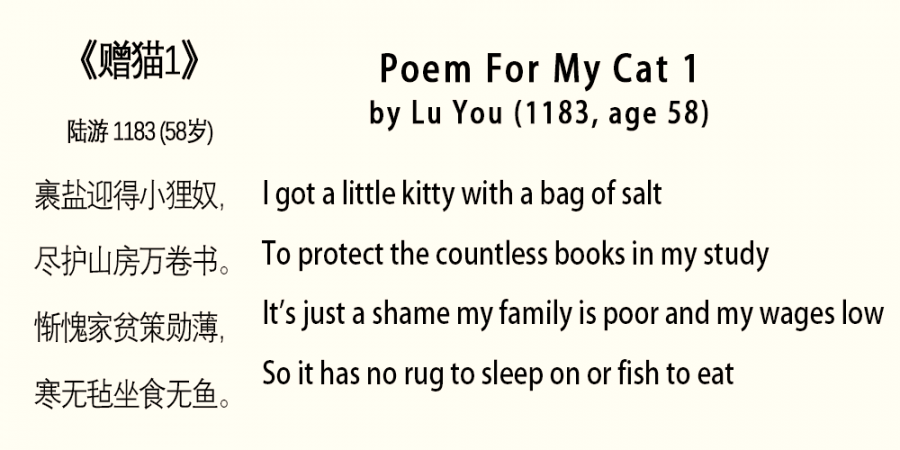
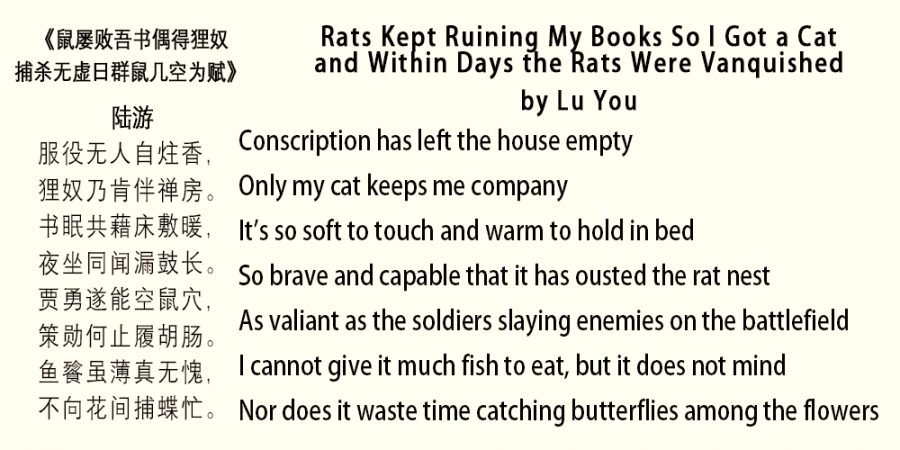
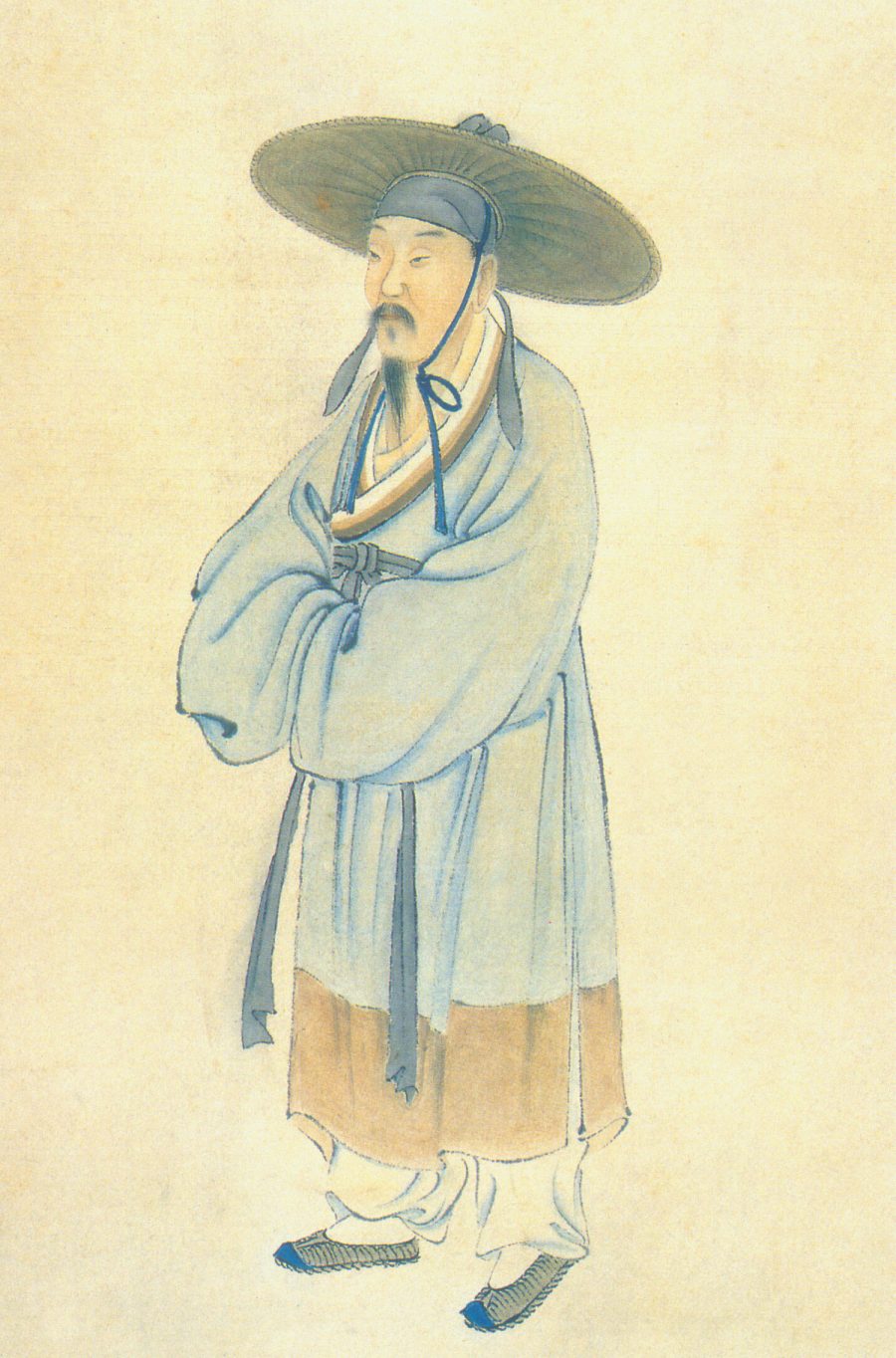
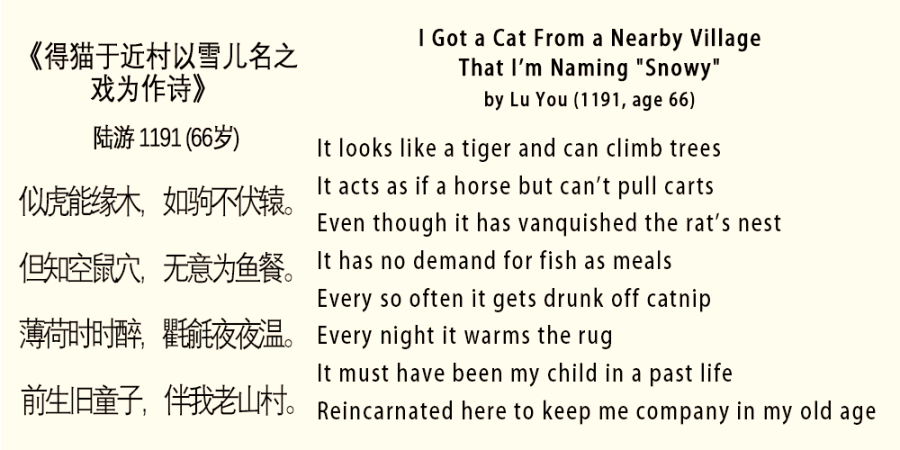
Here in Korea, where I live, cat owners aren’t called cat owners: they’re called goyangi jibsa, literally “cat butlers.” Clearly the idea that felines have flipped the domestic-animal script, not serving humans but being served by humans, transcends cultures. It also goes far back in history: witness the 12th-century verses recently tweeted out in translation by writer Xiran Jay Zhao, in which “Song dynasty poet Lu You” — one of the most prolific literary artists of his time and place — “poem-liveblogged his descent from cat owner to cat slave.”
The story begins in 1138, writes Zhao, when “Down On His Luck scholar-official Lu You gets a cat because rats keep munching on his books.” The eight poems in this series begin with praise for the animal — “It’s so soft to touch and warm to hold in bed / So brave and capable that it has ousted the rat nest” — and goes on to describe the cats he subsequently acquires, who selflessly vanquish the household rats while indulging in nothing more than the occasional catnip binge.
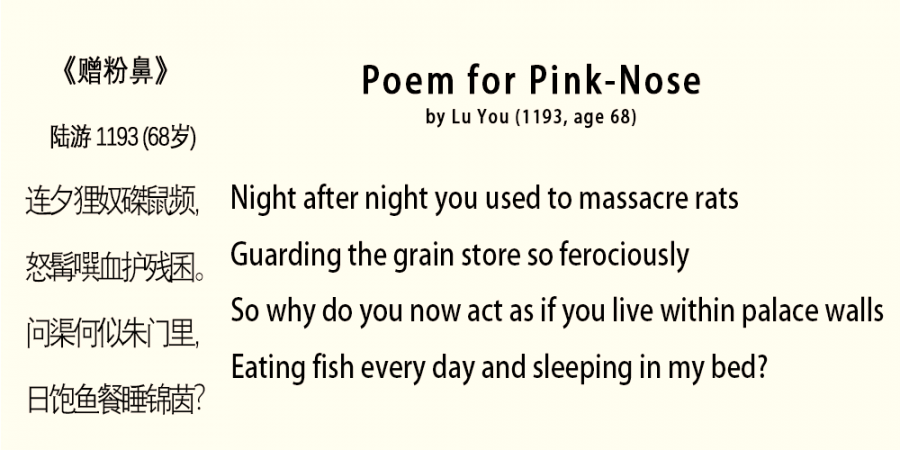
Or at least they do at first. “Night after night you used to massacre rats / Guarding the grain store so ferociously,” Lu asks one in “Poem for Pink-Nose.” “So why do you now act as if you live within palace walls / Eating fish every day and sleeping in my bed?”
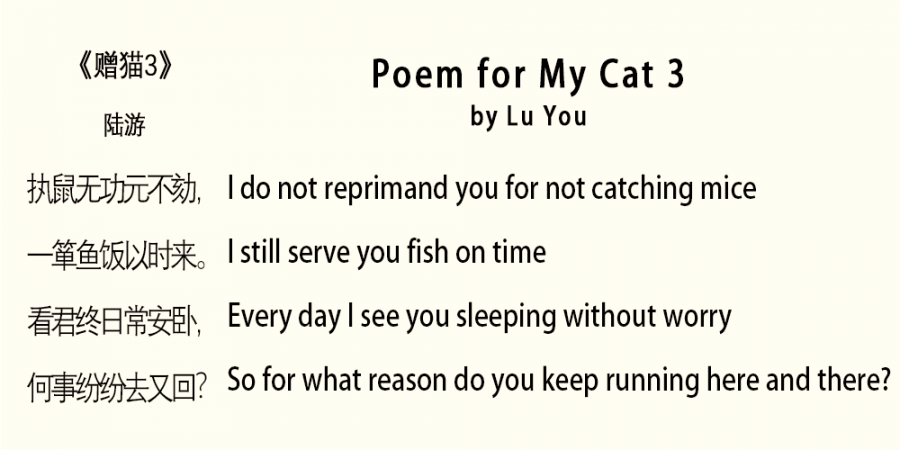
As time goes on, Lu finds himself “serving fish on time” to his cats only to find them “sleeping without worry.” As the rats rampage, he poetically moans, “my books are getting ruined and the birds wake me before dawn.” Has it all been nothing more than “a ruse to get food from me?”
Yet it seems that Lu has no regrets about cat ownership, if ownership be the word. “Wind sweeps the world and rain darkens the village / Rumbles roll off the mountains like ocean waves churning,” he writes in 1192’s “A Rainstorm on the Fourth Day of the Eleventh Month.” Yet “the furnace is soothing and the rug is warm / Me and my cat are not leaving the house.” This is relatable content for the cat butlers of Korea (a culture thoroughly influenced by China in Lu’s day), or indeed anywhere else in the world. The patriotic poet would surely be pleased by the modern-day ascent of China — and perhaps just as much by the high and ever-rising status of the domestic cat.
Based in Seoul, Colin Marshall writes and broadcasts on cities, language, and culture. His projects include the book The Stateless City: a Walk through 21st-Century Los Angeles and the video series The City in Cinema. Follow him on Twitter at @colinmarshall, on Facebook, or on Instagram.
Every empire seems to think (as much as empires seem to think) that it will be the one to outlast them all. And all of them have ended up more or less the same way in the end. This isn’t just a gloomy fact of human history, it’s a fact of entropy, mortality, and the linear experience of time. If imperial rulers forget—begin to think themselves immortal—there have always been poets to remind them, though maybe not so directly. Epic poetry often legitimizes the founding of empires. Another form, the poetry of ruin, interprets their inevitable demise.
All the Romantics were doing it, and so too was an unknown 8th century British poet who encountered Roman ruins during the so-called “Dark Ages.” The poem they left behind “gives us a glimpse of a world of mystery,” says Paul Cooper above in episode one of his Fall of Civilizations podcast, which begins with Roman Britain and continues, in each subsequent (but not chronological) episode, to explore the collapse of empires around the world through literature and culture. “Every ruin,” says Cooper in an interview with the North Star Podcast, “is a place where a physical object was torn apart, and that happened because of some historical force.”
But as our Old English poet above demonstrates, the fascination predates Shakespeare and Marlowe. Cooper would know. He has dedicated his life to studying and writing about ruins, earning a PhD in their cultural and literary significance. Along the way, he has written for The New York Times, The Atlantic, National Geographic, Discover Magazine, and the BBC.
Cooper also began publishing one of the most intriguing Twitter feeds in 2017, detailing in “several nested threads” various “ruin-related thoughts and feelings,” as Shruti Ravindran writes at Timber Media. His tweets became so popular that he turned them into a podcast, and it is not your standard informally chatty podcast fare. Fall of Civilizations engages deeply with its subjects on their own terms, and avoids the sensationalist cliches of so much popular history. Cooper “knew, for certain, what he wanted to avoid,” when he began: the “focus on gruesome torture techniques, executions, and the sexcapades of nobles.”
“History writers often don’t trust their audience will be interested in the past if they don’t Hollywoodize it,” says Cooper. Instead, in the latest episode on the Byzantine Empire he recruits the choir from the Greek Orthodox Cathedral in London, “and a number of musicians playing traditional Byzantine instruments such as the Byzantine lyra, the Qanun and the Greek Santur,” he explains. In his episode on the Han dynasty, Cooper looks back through “ancient Chinese poetry, songs and folk music” to the empire’s rise, “its remarkable technological advances, and its first, tentative attempts to make contact with the empires of the west.”
This is a rich journey through ancient history, guided by a master storyteller dedicated to taking ruins seriously. (Cooper has published a novel about ruins, River of Ink, “inspired by time spent in UNESCO sites in Sri Lanka,” Ravindran reports.) There is “love among the ruins,” wrote Robert Browning, and there is poetry and music and story and song—all of it brought to bear in Fall of Civilizations to “make sense about what must have happened,” says Cooper. Find more episodes, on fallen civilizations all around the world, on YouTube or head to Fall of Civilizations to subscribe through the podcast service of your choice.
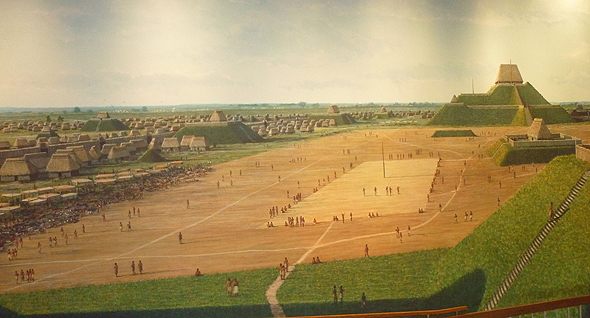
In our current epoch of human history, when populations of major cities swell into the tens of millions, an urban center of 30,000 people doesn’t seem very impressive. 1,000 years ago, a city that size was larger than London or Paris, and sat atop what is now East St. Louis. At its height in 1050, Annalee Newitz writes at Ars Technica, “it was the largest pre-Colombian city in what became the United States…. Its colorful wooden homes and monuments rose along the eastern side of the Mississippi, eventually spreading across the river to St. Louis.”
It is called Cahokia, but that name comes from later inhabitants who themselves didn’t know who built the ancient metropolis, Roger Kaza explains, “We really have no idea what the builders called their city.” Also, no one, including the people who settled there not long afterward, knows what happened to the city’s inhabitants. Archaeologists call these lost indigenous societies the Mississippians.
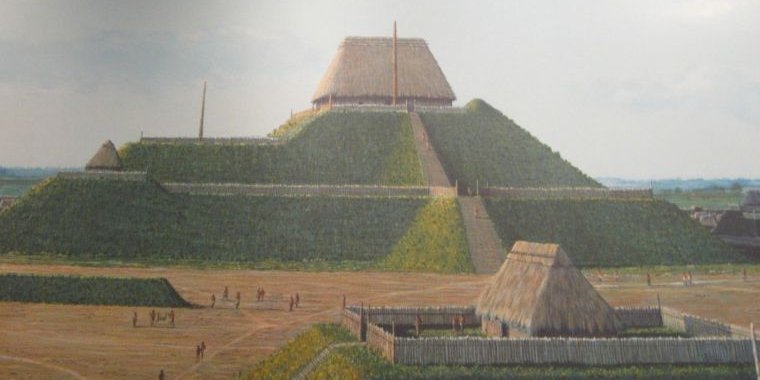
They occupied a territory along the river of nearly 1,600 hectares during what is called the Mississippian period, roughly between 800 and 1400 A.D. The society built mounds, “some 120,” notes UNESCO, who have designated Cahokia a world heritage site. (See an introductory video below from the Cahokia Mounds Museum Society and two artist recreations elsewhere on this page.) The largest of these mounds, Monk’s Mound, stands 30 meters high.
Cahokia is “a striking example of a complex chiefdom society, with many satellite mound centres and numerous outlying hamlet and villages.” Size estimates vary. UNESCO’s is more conservative “This agricultural society may have had a population of 10–20,000 at its peak between 1050 and 1150,” they write—still, at any rate, a major city at the time. The Mississippian civilization left behind “pottery, ceremonial art, games and weapons,” Kaza notes. “Their trade network was vast, stretching from the Great Lakes to the Gulf of Mexico.”
The mounds were a symbol of both earthly and religious power, and the city appears to have been a pilgrimage site of some kind, with remains of what may have been a 5,000 square foot temple at the top of Monk’s Mound and evidence of human sacrifice on other mounds. “A circle of posts west of Monk’s Mound has been dubbed ‘Woodhenge,’ because the posts clearly mark solstices and equinoxes,” writes Kaza.
But the true strength of Cahokia, as in all great metropolises, was economic power. As archaeologist Timothy Pauketat of the University of Illinois notes, “it just so happens that some of the richest agricultural soils in the midcontinent are right up against that area of Cahokia.” Corn grew plentifully, produced surpluses, and the society grew rich. Then, seemingly inexplicably, it collapsed. “By the time European colonizers set foot on American soil in the 15th century, these cities were already empty,”
One recent study suggests two natural climate change events several hundred years apart explain both Cahokia’s rise and fall: “an unusually warm period called the Medieval Climatic Anomaly” gave rise to the region’s abundance, and an abrupt cooling period called “the Little Ice Age” brought on its end. Climatologists have found evidence showing how a drought in 1350 caused the pre-Columbian Mississippian corn industry to implode.
Pauketat finds this explanation persuasive, but insufficient. Politics and culture played a role. It’s possible, says archeologist Jeremy Wilson, who coauthored the recent climate paper, that “the climate change we have documented may have exacerbated what was an already deteriorating sociopolitical situation.”
Evidence suggests mounting conflict and violence as food grew scarcer. Climatologist Broxton Bird argues that the Mississippians left their cities and “migrated to places farther south and east like present-day Georgia,” Angus Chen writes at NPR, “where conditions were less extreme. Before the end of the 14th century, the archaeological record suggests Cahokia and other city-states were completely abandoned.”
We should be careful of seeing in this contemporary language any close parallels to the situation major cities face in the 21st century. Just one link in the global supply chain that drives climate change today can employ 10,000–20,000 people. But perhaps it’s possible to see, in the distant indigenous past of North America, the not-so-future vision of a migratory future for the inhabitants of many cities around the world.
No matter how little we know of the Hindu religion, a line from one of its holy scriptures lives within us all: “Now I am become Death, the destroyer of worlds.” This is one facet of the legacy of J. Robert Oppenheimer, an American theoretical physicist who left an outsized mark on history. For his crucial role in the Manhattan Project that during World War II produced the first nuclear weapons, he’s now remembered as the“father of the atomic bomb.” He secured that title on July 16, 1945, the day of the test in the New Mexican desert that proved these experimental weapons actually work — that is, they could wreak a kind of destruction previously only seen in visions of the end of the world.
“We knew the world would not be the same,” Oppenheimer remembered in 1965. “A few people laughed, a few people cried. Most people were silent. I remembered the line from the Hindu scripture, the Bhagavad Gita; Vishnu is trying to persuade the Prince that he should do his duty and, to impress him, takes on his multi-armed form and says, ‘Now I am become Death, the destroyer of worlds.’ ” The translation’s grammatical archaism made it even more powerful, resonating with lines in Tennyson (“I am become a name, for always roaming with a hungry heart”), Shakespeare (“I am come to know your pleasure”), and the Bible (“I am come a light into the world, that whosoever believeth on me should not abide in darkness”).
But what is death, as the Gita sees it? In an interview with Wired, Sanskrit scholar Stephen Thompson explains that, in the original, the word that Oppenheimer speaks as “death” refers to “literally the world-destroying time.” This means that “irrespective of what Arjuna does” — Arjuna being the aforementioned prince, the narrative’s protagonist — everything is in the hands of the divine.” Oppenheimer would have learned all this while teaching in the 1930s at Berkeley, where he learned Sanskrit and read the Gita in the original. This created in him, said his colleague Isidor Rabi, “a feeling of mystery of the universe that surrounded him like a fog.”
The necessity of the United States’ subsequent dropping of not one but two atomic bombs on Japan, examined in the 1965 documentary The Decision to Drop the Bomb, remains a matter of debate. Oppenheimer went on to oppose nuclear weapons, describing himself to an appalled President Harry Truman as having “blood on my hands.” But in developing them, could he have simply seen himself as a modern Prince Arjuna? “It has been argued by scholars,” writes the Economic Times’ Mayank Chhaya, “that Oppenheimer’s approach to the atomic bomb was that of doing his duty as part of his dharma as prescribed in the Gita.” He knew, to quote another line from that scripture brought to mind by the nuclear explosion, that “if the radiance of a thousand suns were to burst into the sky that would be like the splendor of the Mighty One” — and perhaps also that splendor and wrath may be one.
Based in Seoul, Colin Marshall writes and broadcasts on cities, language, and culture. His projects include the book The Stateless City: a Walk through 21st-Century Los Angeles and the video series The City in Cinema. Follow him on Twitter at @colinmarshall, on Facebook, or on Instagram.
Maintaining the balance of power among European states has always been a fraught affair, but it was especially so in the years when mercantilism made fragile alliances during the religious wars of the 17th century. This was a time when merchants made excellent diplomats, not only because they traveled extensively and learned foreign tongues and customs, but because they spoke the universal language of trade.
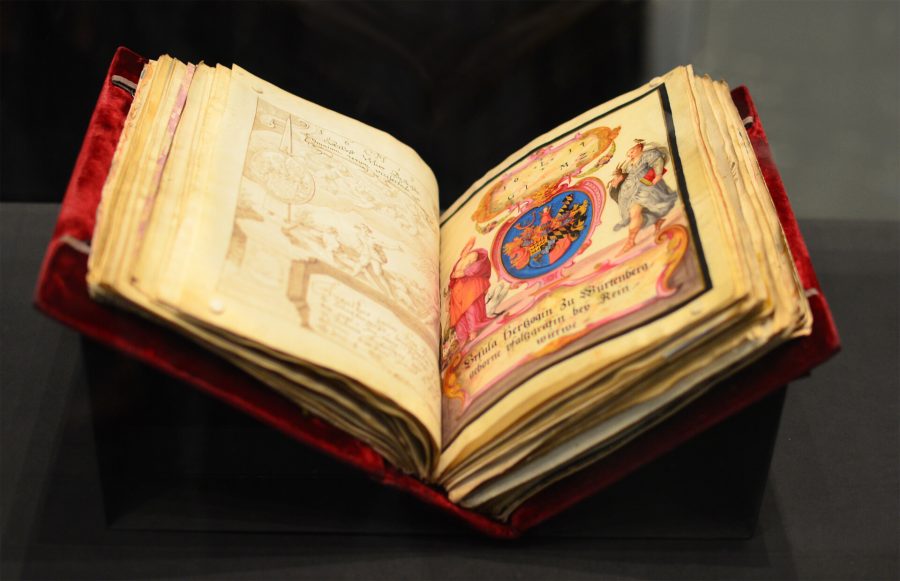
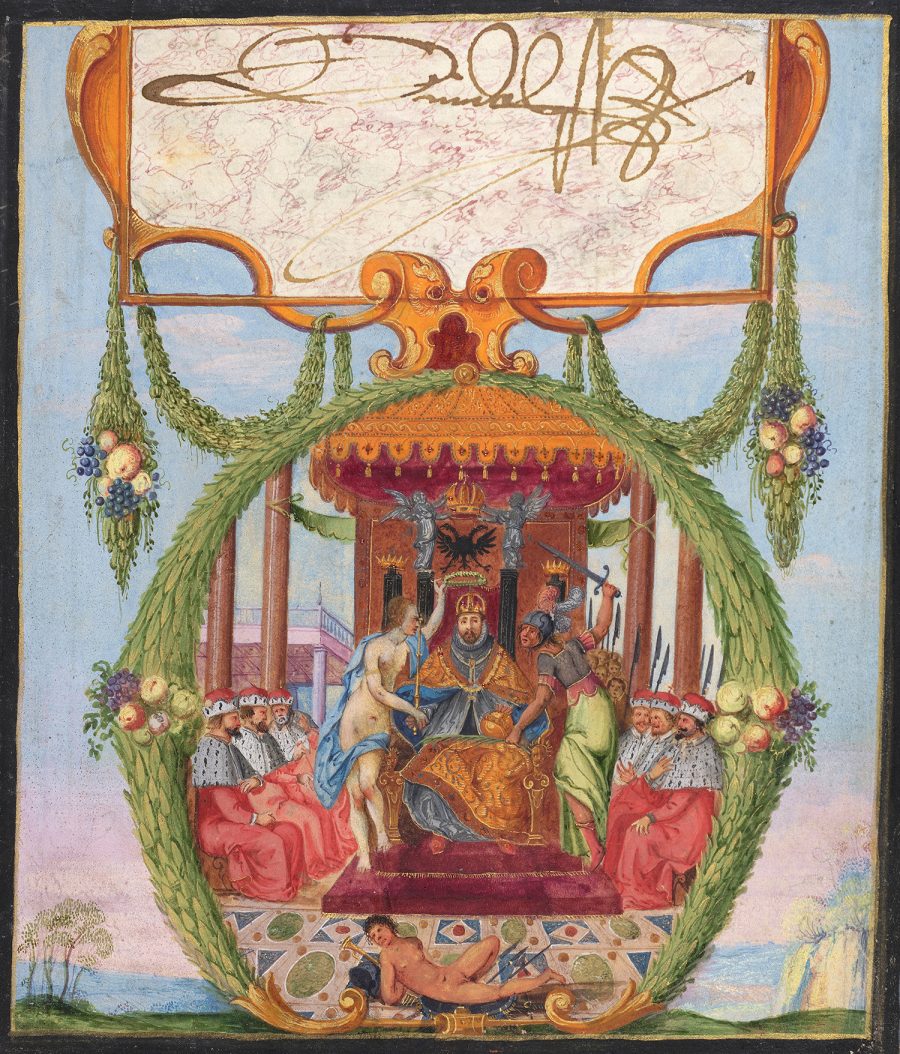
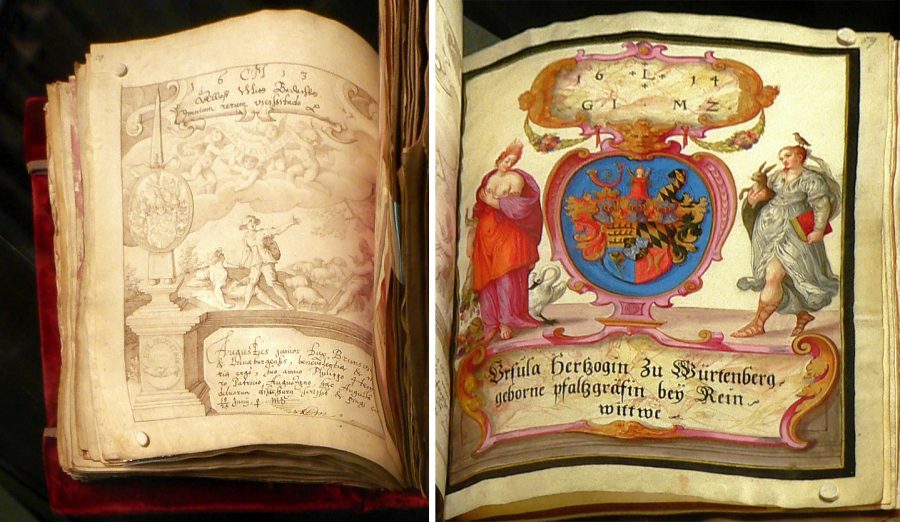
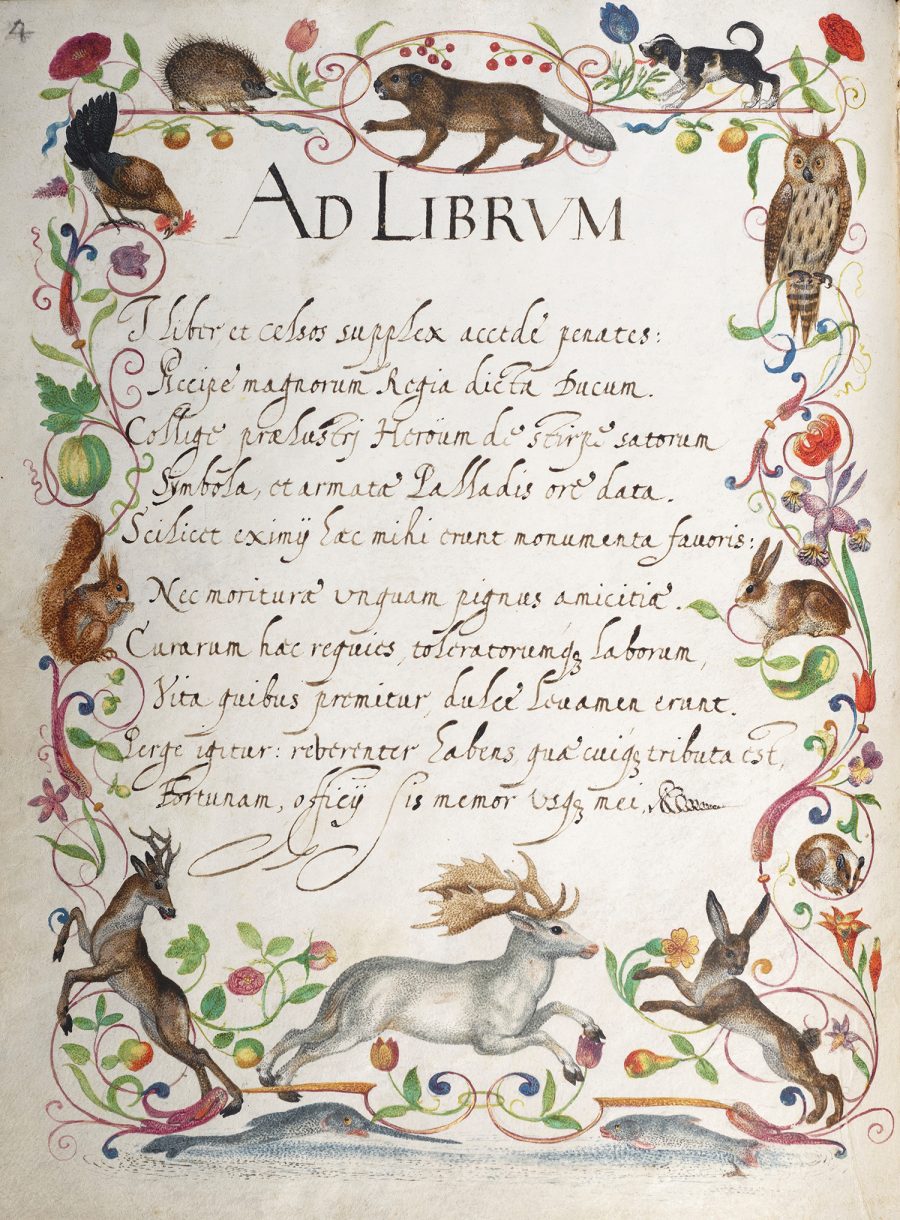
German merchant and diplomat Philipp Hainhofer from Augsburg was such a figure, traveling from court to court to meet with Europe’s renowned dignitaries. As he did so, he would ask them to sign his album amicorum, or “friendship book,” also called a stammbuch. Each signer would then “commission an artist to create a painting accompanying their signatures,” Alison Flood writes at The Guardian.
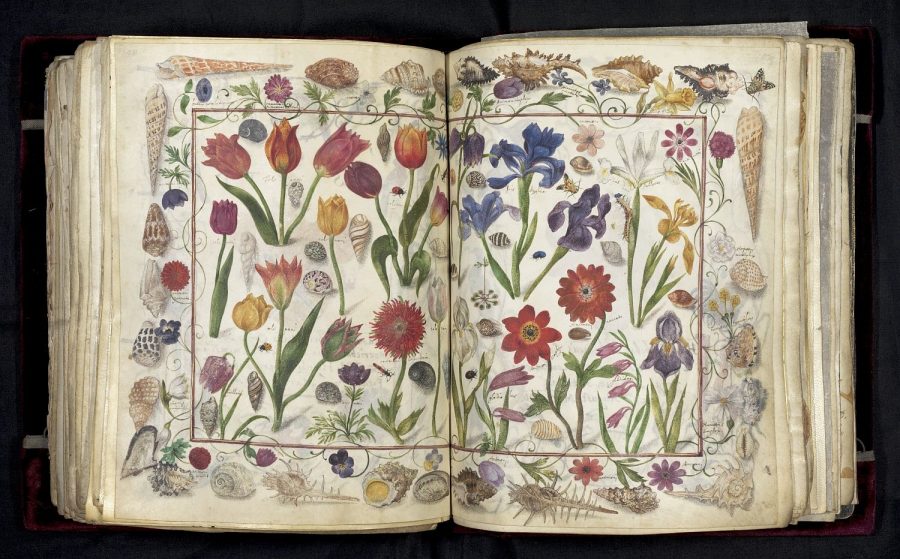
“There are around 100 drawings” in his autograph book, known as the Große Stammbuch, “which took more than 50 years to compile.” After Hainhofer’s death in 1647, his friend August the Younger—who helped collect the hundreds of thousand of books in the Herzog August Bibliothek—tried to acquire the book but failed. Now it has finally landed in the huge library, one of the world’s oldest, almost 400 years later, after a purchase at a private auction this week.
Friendship books were commonly used at the time to record the names of family and friends. Students used them as yearbooks, and Hainhofer began his collection of signatures as a college student. He gradually gained a select clientele as his career advanced. Signatories, the History Blog points out, “include Holy Roman Emperor Rudolf II, another HRE Matthias, Christian IV of Denmark and Norway, Cosimo II de’Medici, Grand Duke of Tuscany…” and many others.
Hainhofer’s Große Stammbuch is, as you can see, a beautiful work of art—or almost 100 collected works of art—in its own right. “The elaborateness of the illustrations directly corresponds to the signatory’s status and rank in society,” as Grace Ebert notes at Colossal. It is also a fascinating record of Early Modern European politics, trade, and diplomacy, a fine art all its own.
The burial rites of ancient and exotic peoples can seem outlandish to us, but there’s nothing particularly normal about the funeral traditions in the United States and the UK, where corpses are sent off to professional undertakers and made to look alive before they’re sealed in boxes and buried or turned into piles of ash.
Andrea DenHoed at The New Yorker refers to the practice of Tibetan Buddhist sky burials, in which “bodies are ritually dissected and left in the open to be consumed by vultures” and of the Torajans of Indonesia, who “have a ritual called Ma’Nene, in which bodies are disinterred, dressed in new clothes, and carried in a parade around the village.” These rites seem almost to mock our western fears of death.
Innovations on the funeral displace us further from the body. DenHoed writes, in 2016, of the then-relatively rare experience of attending a funeral over Skype, now commonplace by virtue of bleak necessity. It’s hard to say if high-tech mourning rituals like turning human remains into playable vinyl records brings us closer to accepting dead bodies, but they certainly bring us closer to an ancestral prehistoric past when at least some Bronze Age Britons turned the bones of their dead into musical instruments.
What’s that now? Through radiocarbon-dating, the researchers, in other words, were able to determine that ancient people who lived between 2500–600 BC “were keeping and curating body parts, bones and cremated remains” of people they knew well, sometimes exhuming and ritually re-burying the remains in their homes, or just keeping them around for a couple generations.
“It’s indicative of a broader mindset where the line between the living and the dead was more blurred than it is today,” Booth tells The Guardian. “There wasn’t a mindset that human remains go in the ground and you forget about them. They were always present among the living.” This is hardly strange. The incredible amount of loss people will feel after COVID-19 will likely bring a proliferation of such rituals.
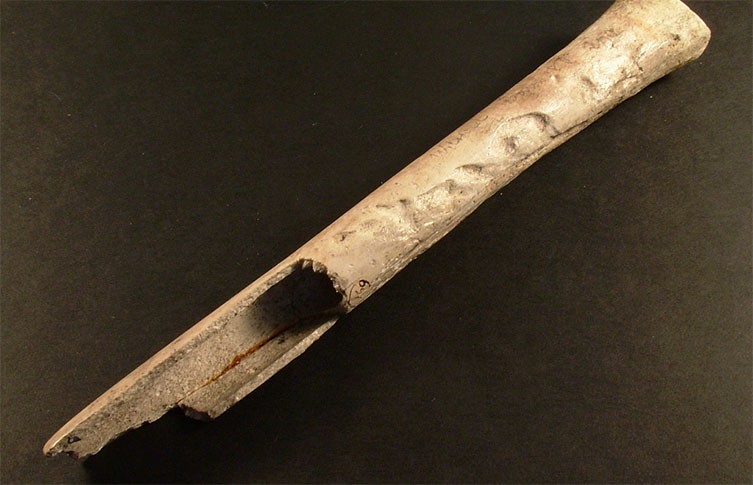
The find making headlines is a human thigh bone “that had been carved into a whistle” Josh Davis writes at the British Natural History Museum, and buried with another adult male. “When dated, it revealed that the thigh bone came from a person who probably lived around the same date as the man that it was buried with, meaning it is likely that it was someone that they knew in life, or were fairly close to.”
There doesn’t seem to be any suggestion that this was a common or widespread practice, but it’s not that dissimilar to wearing the remains of the dead as jewelry. “The Romans did it,” notes Glenn McDonald at National Geographic, “The Persians did it. The Maya did it.” And the Victorians, also, wore the remains of their dead, 4,000 years after their ancient ancestors. “The technologies change,” says McDonald, “but the basic human experience” of death, loss, and mourning remains the same.
We're hoping to rely on loyal readers, rather than erratic ads. Please click the Donate button and support Open Culture. You can use Paypal, Venmo, Patreon, even Crypto! We thank you!
Open Culture scours the web for the best educational media. We find the free courses and audio books you need, the language lessons & educational videos you want, and plenty of enlightenment in between.