Attention culinary historians, survivalists, wildcrafters, and gonzo eaters!
Nettle pudding, Britain’s—and quite possibly the world’s—oldest recipe, looks like a good bet in the event of a zombie invasion, or some other catastrophe.
The ingredients—sorrel, watercress, dandelions, nettles—are the sort of thing you can find in a ditch or public park.
Should barley flour prove in short supply, don’t worry about it! Grind some acorns, like that kid in My Side of the Mountain.
You think early man sweated substitutions?
No way! Improvisation was the name of the game.
Rigid adherence to published ingredients will have no place in the zombie invasion! As Cardiff Metropolitan University’s home economist Dr. Ruth Fairchild told The Daily Mail:
You have to think how much more is wasted now than then.
Food waste today is huge. A third of the food in our fridges is thrown away every week without being eaten.
But they wouldn’t have wasted anything, even hooves would have been used for something.
They had to eat what was grown within a few miles, because it would have taken so long to collect everything, and even collecting water would have been a bit of a trial.
Yet today, so many people don’t want to cook because they think of it as a chore.
Stop thinking of nettle pudding as a chore! Start practicing for the zombie invasion withAntiquity Now’s step-by-step recipe and let us know how it tastes.
NETTLE PUDDING (an 8000 year old recipe!)
Ingredients
1 bunch of sorrel
1 bunch of watercress
1 bunch of dandelion leaves
2 bunches of young nettle leaves
Some chives
1 cup of barley flour
1 teaspoon of salt
Instructions
Chop the herbs finely and mix in the barley flour and salt.
Add enough water to bind it together and place in the center of a linen or muslin cloth.
Tie the cloth securely and add to a pot of simmering venison or wild boar (a pork joint will do just as well). Make sure the string is long enough to pull the pudding from the pot.
Cook the pudding until the meat is done (at least two hours).
Leave the pudding to cool slightly, remove the muslin, then cut the pudding into thick slices with a knife.
Serve the pudding with chunks of barley bread.
(Be mindful that fire may attract zombies. Keep a shovel beside you at all times. Good luck!)
You can read more about the discovery of Nettle Pudding at the BBC and The Telegraph.
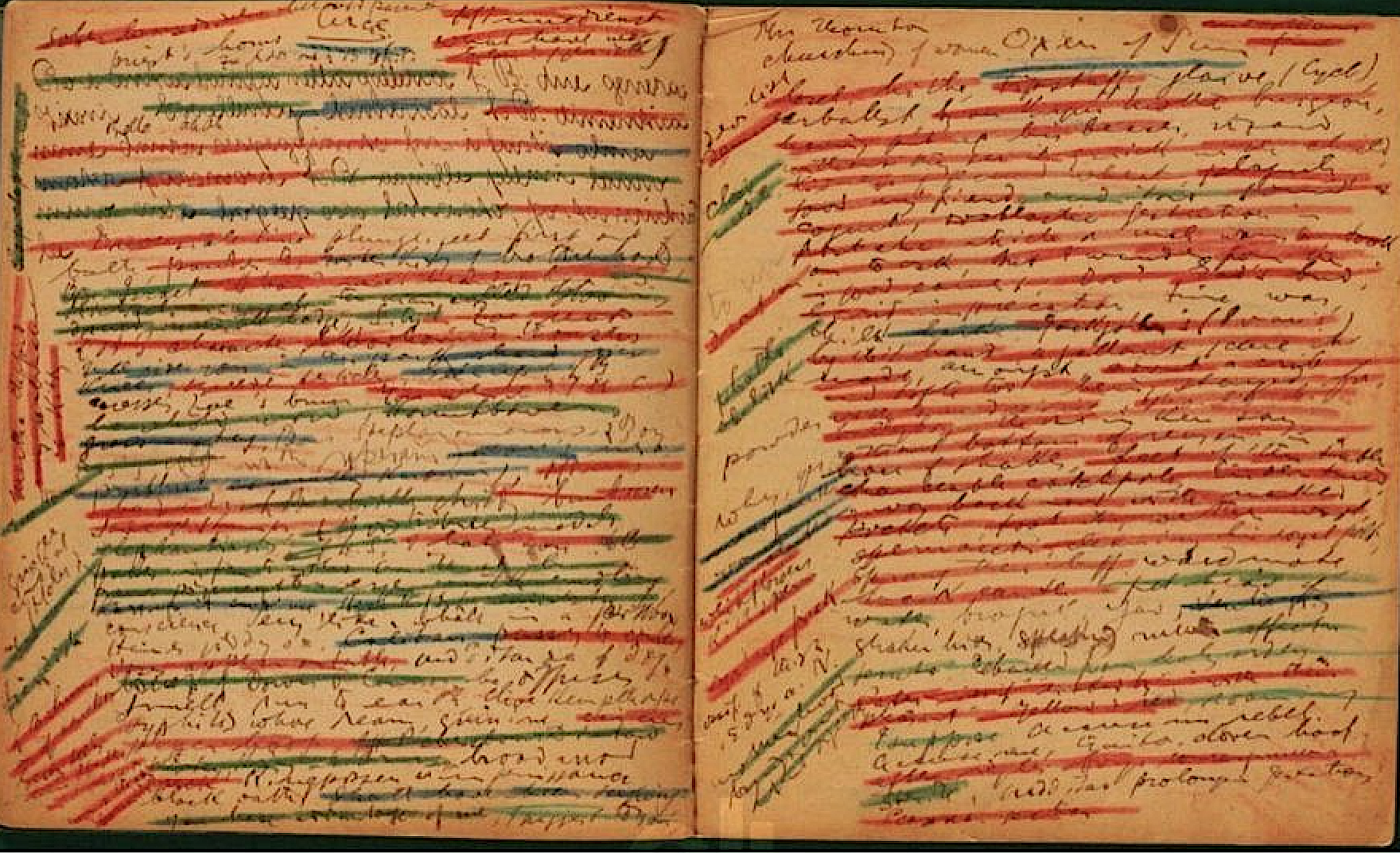
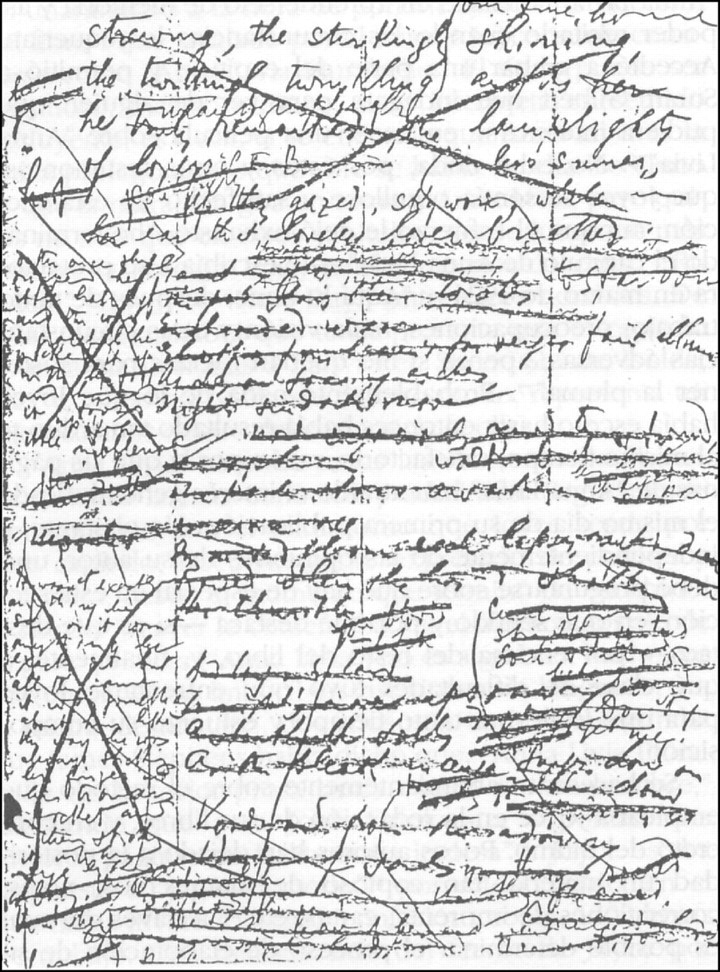
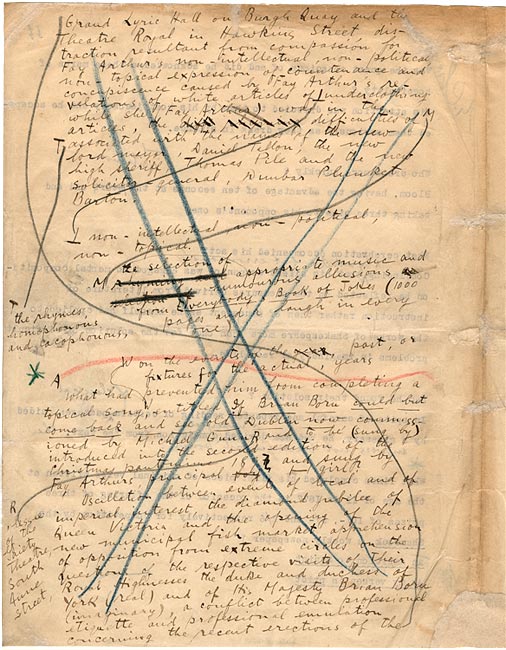
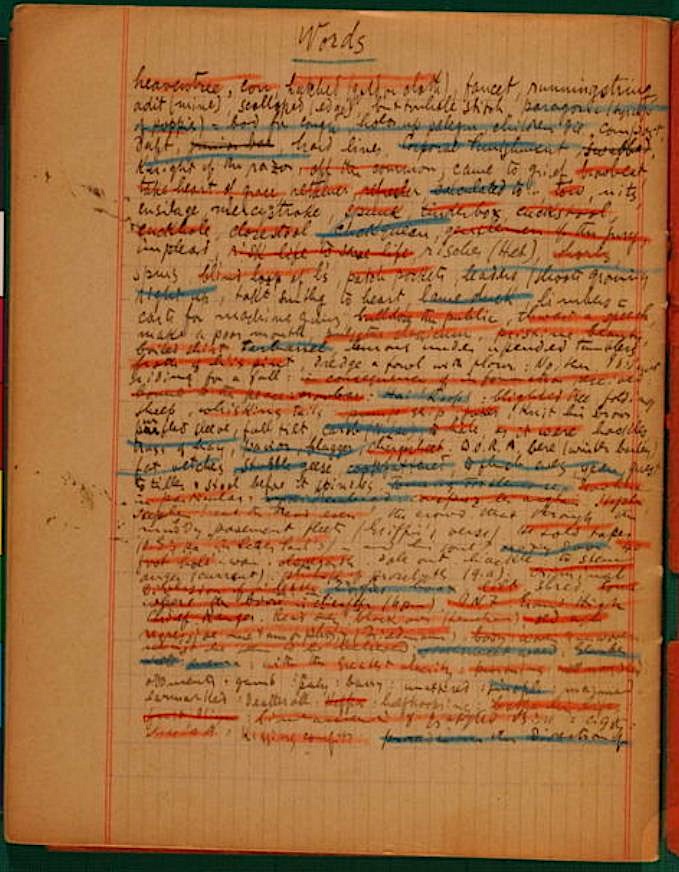
Even the most avid James Joyce fans surely have times when they open Finnegans Wakeand wonder how on Earth Joyce wrote the thing. Painstakingly, it turns out, and not just because of the infamous difficulty of the text itself: he “wrote lying on his stomach in bed, with a large blue pencil, clad in a white coat, and composed most of Finnegans Wake with crayon pieces on cardboard,” writes Brainpickings’ Maria Popova. By the time Joyce finished his final novel, the eye problems that had plagued him for most of his life had rendered him nearly blind. “The large crayons thus helped him see what he was writing, and the white coat helped reflect more light onto the page at night.”
Crayons also had a place in his intricate revision process. “Joyce used a different colored crayon each time he went through a notebook incorporating notes into his draft,” writes Derek Attridge in a review of The Finnegans Wake Notebooks at Buffalo, a compilation of all the extant working materials for Joyce’s final novel. He also calls Joyce’s colored crayon method part of “a scrupulousness which has never been satisfactorily explained” — but then, much about Joyce hasn’t, and may never be. “I’ve put in so many enigmas and puzzles that it will keep the professors busy for centuries arguing over what I meant,” he once wrote, “and that’s the only way of insuring one’s immortality.”
But he wrote that about Ulysses, a breeze of a read compared to Finnegans Wake, but a work that has surely inspired even more scholars to devote their careers to its author. Some become full-blown “Joyceaholics,” as Gabrielle Carey recently put it in the Sydney Review of Books, and must eventually find a way to “break up” with the object of their unhealthy literary fixation. She got hooked when a piano teacher introduced her to Molly Bloom’s soliloquy at the end of Ulysses. “The last page of Ulysses confirmed my youthful idea that there was such a thing as star-crossed lovers,” Carey writes. “Molly and Leopold were clearly meant for each other.” The conviction with which that idea resonated, she writes, “was to lead me down so many ill-fated paths.”
Carey stepped onto the long path that would lead her away from Joyce when she looked upon his manuscripts: “It was only then, almost thirty years after reading Joyce for the first time, that I noticed a tiny revision to the final paragraph.” Joyce’s insertion added a critical, deflating phrase to the passage that had brought her Joyce in the first place: “and I thought well as well him as another.” Whatever your own experience with Ulysses, Finnegans Wake, or any of Joyce’s other enduring works of literature, the actual pages on which he crafted them (the color ones seen here from Ulyssses and the black and white from Finnegans wake) can offer all kinds of illumination. They also remind us that the books must have required nearly as much mental fortitude to write as they do to properly read.
Based in Seoul, Colin Marshall writes and broadcasts on cities and culture. His projects include the book The Stateless City: a Walk through 21st-Century Los Angeles and the video series The City in Cinema. Follow him on Twitter at @colinmarshall or on Facebook.
Judging by the above video, the clear winner was Tuh’i, a beet and lamb stew which Lassen describes as a “proto-borscht.”
The vegetarian Unwinding Stew’s name proved unnecessarily vexing, while the milk-based Broth of Lamb was unappetizing to the eye (as well as the palate, according to Graham). Perhaps they should have substituted animal blood—another favorite Babylonian thickener.
As one of Lassen’s predecessors, Professor William W. Hallo, told The New York Times in 1988, it’s unlikely the average Mesopotamian would have had the opportunity to tuck into any of these dishes. The vast quantities of speciality ingredients and the elaborate instructions suggest a festive meal for the elite.
In addition to the dishes served at NYU’s Appetite for the Past conference, the tablets include recipes for stag, gazelle, kid, mutton, squab, and a bird that’s referred to as “tarru.”
Next time, perhaps.
And not to quibble with the Bulldogs, but the BBC reports that researchers from the University of Wales Institute are claiming a pudding made from nettles, ground barley, and water is actually the world’s oldest recipe, clocking in at 6000 BC. (Serve it with roast hedgehog and fish gut sauce…)
While the Yale team has yet to share its recipes in a language other than cuneiform, The Silk Road Gourmet has a good guide to various Mesopotamian spices and staples.
“Breton believed art and literature could represent the unconscious mind,” says the video’s narrator Peter Capaldi, well known as one of the Doctors of Doctor Who. He then names some artists who agreed with Breton on this point, such as Salvador Dalí, Max Ernst, Joan Miró, and Rene Magritte — just a few of the Surrealists. “Surreal,” as an adjective, has perhaps fallen victim to debasement by overuse in the past 84 years. But Breton had specific ideas about Surrealism’s potential effects, its sources of power, and its methods.
Desire, for instance, “was central to the Surrealist vision of love, poetry, and liberty. It was the key to understanding human beings.” Surrealist artistic practices included putting objects “that were not normally associated with one another together, to make something that was playful and disturbing at the same time in order to stimulate the unconscious mind.” Think of Dalí’s 1936 Lobster Telephone, made out of those very objects. “It’s about food and sex,” Capaldi pronounces. The Surrealist vision also extended to more complicated endeavors, such as elaborate paintings and films that still fascinate today.
You can catch up on Surrealist film here on Open Culture, beginning with Luis Buñuel & Salvador Dalí’s nightmarish 1929 short Un Chien Andalou, continuing on to the Surrealist feature Dreams That Money Can Buy (a collaboration by the likes of Man Ray, Marcel Duchamp, Alexander Calder, Fernand Léger and Hans Richter), and the history of Surrealist cinema as presented by David Lynch, a filmmaker widely considered one of the movement’s modern heirs. Whether Breton would recognize the Surrealist sensibility in its current manifestations will remain a matter of debate, but who could watch this Unlock Art primer and fail to sense the fascination its basic ideas — or basic compulsions, perhaps — still hold today?
Based in Seoul, Colin Marshall writes and broadcasts on cities and culture. His projects include the book The Stateless City: a Walk through 21st-Century Los Angeles and the video series The City in Cinema. Follow him on Twitter at @colinmarshall or on Facebook.
Take an innocuous statement like, “we should teach children about the life of Helen Keller.” What reasonable, compassionate person would disagree? Hers is a story of triumph over incredible adversity, of perseverance and friendship and love. Now, take a statement like, “we should teach children the political writing of Helen Keller,” and you might see brawls in town halls and school board meetings. This is because Helen Keller was a committed socialist and serious political thinker, who wrote extensively to advocate for economic cooperation over competition and to support the causes of working people. She was an activist for peace and justice who opposed war, imperialism, racism, and poverty, conditions that huge numbers of people seem devoted to maintaining—both in her lifetime and today.
Keller’s moving, persuasive writing is eloquent and uncompromising and should be taught alongside that of other great American rhetoricians. Consider, for example, the passage below from a letter she wrote in 1916 to Oswald Villard, then Vice-President of the NAACP:
Ashamed in my very soul I behold in my own beloved south-land the tears of those who are oppressed, those who must bring up their sons and daughters in bondage to be servants, because others have their fields and vineyards, and on the side of the oppressor is power. I feel with those suffering, toiling millions, I am thwarted with them. Every attempt to keep them down and crush their spirit is a betrayal of my faith that good is stronger than evil, and light stronger than darkness…. My spirit groans with all the deaf and blind of the world, I feel their chains chafing my limbs. I am disenfranchised with every wage-slave. I am overthrown, hurt, oppressed, beaten to the earth by the strong, ruthless ones who have taken away their inheritance. The wrongs of the poor endure ring fiercely in my soul, and I shall never rest until they are lifted into the light, and given their fair share in the blessings of life that God meant for us all alike.
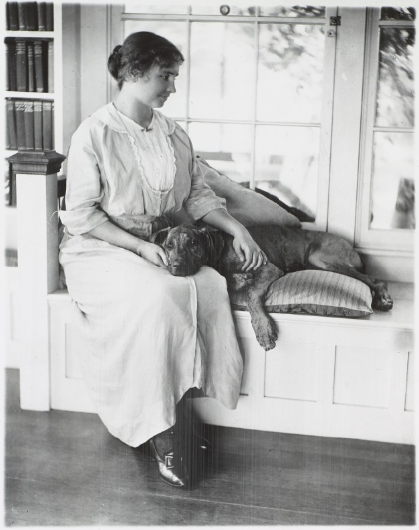
It is difficult to choose any one passage from the letter because the whole is written with such expressive feeling. This is but one document among many hundreds in the new Helen Keller archive at the American Foundation for the Blind (AFB), which has digitized letters, essays, speeches, photographs, and much more from Keller’s long, tireless career as a writer and public speaker. Funded by the National Endowment for the Humanities, the archive includes over 250,000 digital images of her work from the late 19th century to well into the 20th. There are many films of Keller, photos like that of her and her dog Sieglinde at the top, a collection of her correspondence with Mark Twain, and much more.
In addition to Keller’s own published and unpublished work, the archive contains many letters to and about her, press clippings, informative AFB blog posts, and resources for students and teachers. The site aims to be “fully accessible to audiences who are blind, deaf, hard-of-hearing, low vision, or deafblind.” On the whole, this project “presents an opportunity to encounter this renowned historical figure in a new, dynamic, and exciting way,” as AFB writes in a press release. “For example, despite her fame, relatively few people know that Helen Keller wrote 14 books as well as hundreds of essays and articles on a broad array of subjects ranging from animals and atomic energy to Mahatma Gandhi.”
And, of course, she was a lifelong advocate for the blind and deaf, writing and speaking out on disability rights issues for decades. Indeed, it’s difficult to find a subject in which she did not take an interest. The archive’s subject index shows her writing about games, sports, reading, shopping, swimming, travel, architecture and the arts, education, law, government, world religions, royalty, women’s suffrage, and more. There were many in her time who dismissed Keller’s unpopular views, calling her naïve and claiming that she had been duped by nefarious actors. The charge is insulting and false. Her body of work shows her to have been an extraordinarily well-read, wise, cosmopolitan, sensitive, self-aware, and honest critical thinker.
Two years after the NAACP letter, Keller wrote an essay called “Competition,” in which she made the case for “a better social order” against a central conceit of capitalism: that “life would not be worth while without the keen edge of competition,” and that without it “men would lose ambition, and the race would sink into dull sameness.” Keller advances her counterargument with vigorous and incisive reasoning.
This whole argument is a fallacy. Whatever is worth while in our civilization has survived in spite of competition. Under the competitive system the work of the world is badly done. The result is waste and ruin [….] Profit is the aim, and the public good is a secondary consideration. Competition sins against its own pet god efficiency. In spite of all the struggle, toil and fierce effort the result is a depressing state of destitution for the majority of mankind. Competition diverts man’s energies into useless channels and degrades his character. It is immoral as well as inefficient, since its commandment is “Thou shalt compete against thy neighbor.” Such a rule does not foster Truthfulness, honesty, consideration for others. [….] Competitors are indifferent to each other’s welfare. Indeed, they are glad of each other’s failure because they find their advantage in it. Compassion is deadened in them by the necessity they are under of nullifying the efforts of their fellow-competitors.
Keller refused to become cynical in the face of seemingly indefatigable greed, cruelty, and hypocrisy. Though not a member of a mainstream church (she belonged to the obscure Christian sect of Swedenborgianism), she exhorted American Christians to live up to their professions—to follow the example of their founder and the commandments of their sacred text. In an essay written after World War I, she argued movingly for disarmament and “the vital issue of world peace.” While making a number of logical arguments, Keller principally appeals to the common ethos of the nation’s dominant faith.
This is precisely where we have failed, calling ourselves Christians we have fundamentally broken, and taught others to break most patriotically, the commandment of the Lord, “Thou shalt not kill” [….] Let us then try out Christianity upon earth—not lip-service, but the teaching of Him who came upon earth that “all men might have life, and have it more abundantly.” War strikes at the very heart of this teaching.
We can hear Helen Keller’s voice speaking directly to us from the past, diagnosing the ills of her age that look so much like those of our own. “The mythological Helen Keller,” writes Keith Rosenthal, “has aptly been described as a sort of ‘plaster saint;’ a hollow, empty vessel who is little more than an apolitical symbol for perseverance and personal triumph.” Though she embodied those qualities, she also dedicated her entire life to careful observation of the world around her, to writing and speaking out on issues that mattered, and to caring deeply about the welfare of others. Get to know the real Helen Keller, in all her complexity, fierce intelligence, and ferocious compassion, at the American Foundation for the Blind’s exhaustive digital archive of her life and work.
From Shamoon Zamir, a literature professor at NYU Abu Dhabi, comes a “research archive of historical and contemporary photography from the Middle East and Northern Africa (MENA),” designed to be fully accessible to the public. We’re told:
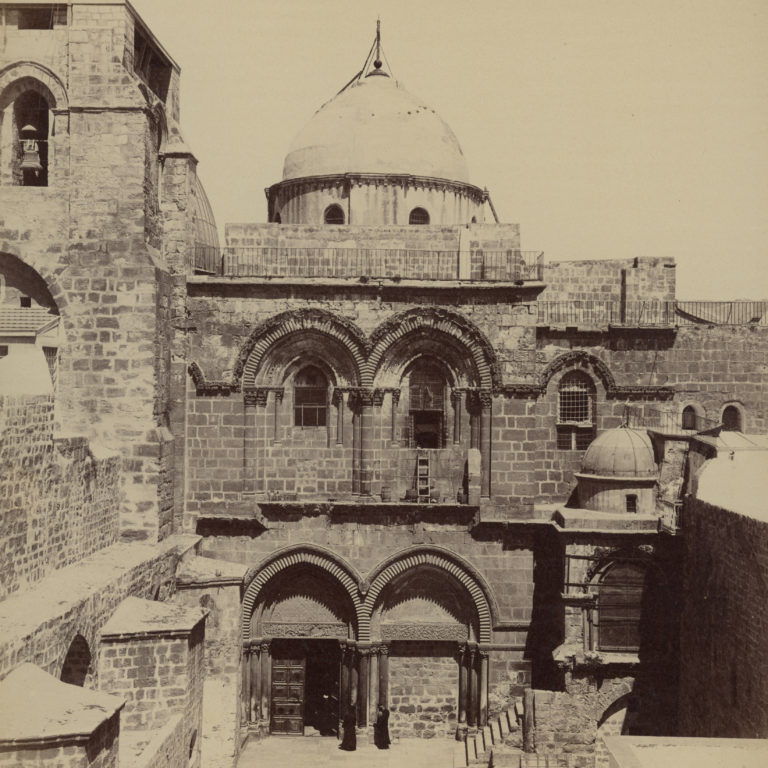
Today, Akkasah: The Center for Photography at NYU Abu Dhabi boasts an archive of 62,000 images from the UAE and across the MENA region – of which 9,000 are already digitized and available online — the only of its kind in the Middle East. These images offer new insights into the history and rapid transformation of the UAE and the broader Arab world. They include historical collections ranging from the nineteenth century to the late twentieth, covering a variety of themes and topics, from early images of the Holy Lands and from the Ottoman Empire, to images from family albums, institutional archives and the history of Egyptian cinema.
If you would like to support the mission of Open Culture, consider making a donation to our site. It’s hard to rely 100% on ads, and your contributions will help us continue providing the best free cultural and educational materials to learners everywhere. You can contribute through PayPal, Patreon, and Venmo (@openculture). Thanks!
We might assume that 21st-century technology enables us to produce fabric in all imaginable colors, most of them totally unknown to our ancestors. Yet none of it has ever quite replicated the striking hues achieved by dyers of centuries and centuries ago. That premise underlies the slow and painstaking work of Sachio Yoshioka, whose family’s fabric-dyeing heritage goes back to Japan’s Edo period of the 17th to the mid-19th century. Having taken over his father’s workshop Textiles Yoshioka in 1988, he has spent the past thirty years working only with traditional plant dyes, the kind that once, in a time long before his family even got into the dyeing business, made his homeland so colorful.
The Japanese dyeing tradition, in this reading of its history, reached its long apex of brilliance in the Nara and Heian periods, which together lasted from the years 710 to 1185. Most of the world admires Japanese aesthetic sensibilities, but often with reference to internationally well-known concepts like wabi-sabi that idealize the rustic, the imperfect, and the subdued. Unlike in the Edo period, when the strict Tokyugawa Shogunate mandated that common people stick to grays and browns, Nara and Heian cities would have been rich with vivid reds, blues, yellows, oranges, and even purples, all in varieties one seldom sees even today, in Japan or anywhere else.
Hence Yoshioka’s mission to practice and even refine the same labor-intensive dyeing methods used back then. Formerly a student of philosophy as well as a publisher of books on the history of color and fabric arts, he now seems devoted to what goes on in his Kyoto workshop. You can watch what he and his assistants do there in the video from the Victoria and Albert Museum above. Composed of four short films, it includes a segment on Yoshioka’s production of paper flowers for the Omizutori festival at the Tōdai-ji Buddhist temple in Nara, the historical capital outside Kyoto, that culminates in an evening fire ceremony.
That fire ceremony, called Otaimatsu, remains as compelling a spectacle today as it must have been more than a millennium ago, just as surely as the colors Yoshioka has rediscovered have lost none of their allure since then. His dedication to the work of traditional dyeing — work his daughter Sarasa will take into its sixth generation — comes not out of a desire to pay tribute to Japanese history, nor even out of filial piety, but something much simpler: “The colors you can obtain from plants are so beautiful,” he says. “This is the one and only reason I do what I do.”
Based in Seoul, Colin Marshall writes and broadcasts on cities and culture. His projects include the book The Stateless City: a Walk through 21st-Century Los Angeles and the video series The City in Cinema. Follow him on Twitter at @colinmarshall or on Facebook.
Fascism had been creeping back into European and North American politics for many years before the word regained its currency in mainstream discourse as an alarming description of present trends. In 2004, historian Enzo Traverso wrote of the “unsettling phenomenon” of “the rise of fascist-inspired political movements in the European arena (from France to Italy, from Belgium to Austria).” Many of those far-right movements have come very close to winning power, as in Austria and France’s recent elections, or have done so, as in Italy’s.
And while the sudden rise of the far right came as a shock to many in the US, political commentators frequently point out that the erosion of democratic civil rights and liberties has been a decades-long project, coinciding with the financialization of the economy, the privatization of public goods and services, the rise of the mass surveillance state, and the extraordinary war powers assumed, and never relinquished, by the executive after 9/11, creating a permanent state of exception and weakening checks on presidential power.
This is not even to mention the autocratic regimes of Turkey’s Recep Tayyip Erdoğan and Russia’s Vladimir Putin, which are tied to other anti-democratic movements across the West not only geopolitically but also philosophically, a subject that gets far less press than it deserves. When analysis of the philosophical underpinnings of neo-fascism comes up, it often focuses on Russian academic Alexander Dugin, “who has been called,” notes Salon’s Conor Lynch, “everything from ‘Putin’s brain’ to ‘Putin’s Rasputin.’” (Bloomberg calls Dugin “the one Russian linking Putin, Erdogon and Trump.”)
Dugin’s fusion of Heideggerian postmodernism and apocalyptic mysticism plays a significant role in the ideology of the globalized far right. But Yale historian Timothy Snyder—who has written extensively on both Soviet Russia and Nazi Germany—points to an earlier Russian thinker whom he says exercises considerable influence on the ideology of Vladimir Putin, the fascist philosopher Ivan Ilyin.
Anton Barbashin and Hannah Thoburn called Ilyin “Putin’s philosopher” in a Foreign Affairs profile. Ilyin was “a publicist, a conspiracy theorist, and a Russian nationalist with a core of fascistic leanings.” David Brooks identified Ilyin as one of a trio of nationalist philosophers Putin quotes and recommends. Snyder defines Ilyin’s philosophy as explicitly “Russian Christian fascism,” describing at the New York Review of Booksthe Russian thinker’s prolific writing before and after the Russian Revolution, a hodgepodge of German idealism, psychoanalysis, Italian fascism, and Christianity.
In brief, Ilyin’s theoretical works argued that “the world was corrupt; it needed redemption from a nation capable of total politics; that nation was unsoiled Russia.” Ilyin’s, and Putin’s, Russian nationalism has had a paradoxically global appeal among a wide swath of far right political parties and movements across the West, as Snyder writes in his latest book The Road to Unfreedom: Russia, Europe, America. “What these ways of thinking have in common,” write The Economist in their review of Snyder’s book, “is a quasi-mystical belief in the destiny of nations and rulers, which sets aside the need to observe laws or procedures, or grapple with physical realities.”
Snyder summarizes Ilyin’s ideas in the Big Think video above in ways that make clear how his thought appeals to far right movements across national borders. Ilyin, he says, is “probably the most important example of how old ideas”—the fascism of the 20s, 30s, and 40s—“can be brought back in the 21st century for a postmodern context.” Those ideas can be summarized in three theses, says Snyder, the first having to do with the conservative reification of social hierarchies. “Social advancement was impossible because the political system, the social system, is like a body… you have a place in this body. Freedom means knowing your place.”
“A second idea,” says Snyder, relates to voting as a ratification, rather than election, of the leader. “Democracy is a ritual…. We only vote in order to affirm our collective support for our leader. The leader’s not legitimated by our votes or chosen by our votes.” The leader, instead, emerges “from some other place.… In fascism the leader is some kind of hero, who emerges from myth.” The third idea might immediately remind US readers of Karl Rove’s dismissal of the “reality-based community,” a chilling augur of the fact-free reality of today’s politics.
Ilyin thought that “the factual world doesn’t count. It’s not real.” In a restatement of gnostic theology, he believed that “God created the world but that was a mistake. The world was a kind of aborted process,” because it lacks coherence and unity. The world of observable facts was, to him, “horrifying…. Those facts are disgusting and of no value whatsoever.” These three ideas, Snyder argues, underpin Putin’s rule. They also define American political life under Trump, he concludes in his New York Review of Books essay.
Ilyin “made of lawlessness a virtue so pure as to be invisible,” Snyder writes, “and so absolute as to demand the destruction of the West. He shows us how fragile masculinity generates enemies, how perverted Christianity rejects Jesus, how economic inequality imitates innocence, and how fascist ideas flow into the postmodern. This is no longer just Russian philosophy. It is now American life.” There are more than enough homegrown sources for American authoritarianism and inequality, one can argue. But Snyder makes a compelling case for the obscure Russian thinker as an indirect, and insidious, influence.
We're hoping to rely on loyal readers, rather than erratic ads. Please click the Donate button and support Open Culture. You can use Paypal, Venmo, Patreon, even Crypto! We thank you!
Open Culture scours the web for the best educational media. We find the free courses and audio books you need, the language lessons & educational videos you want, and plenty of enlightenment in between.