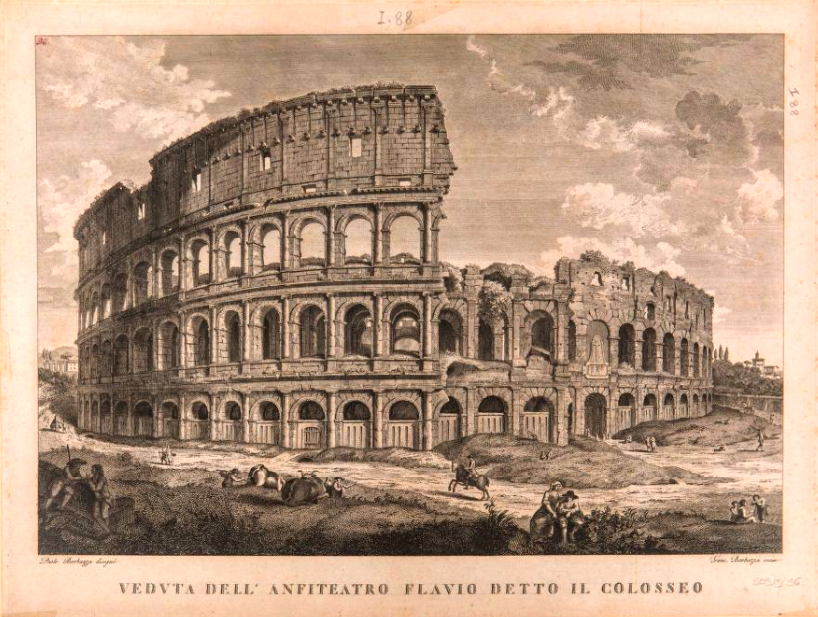
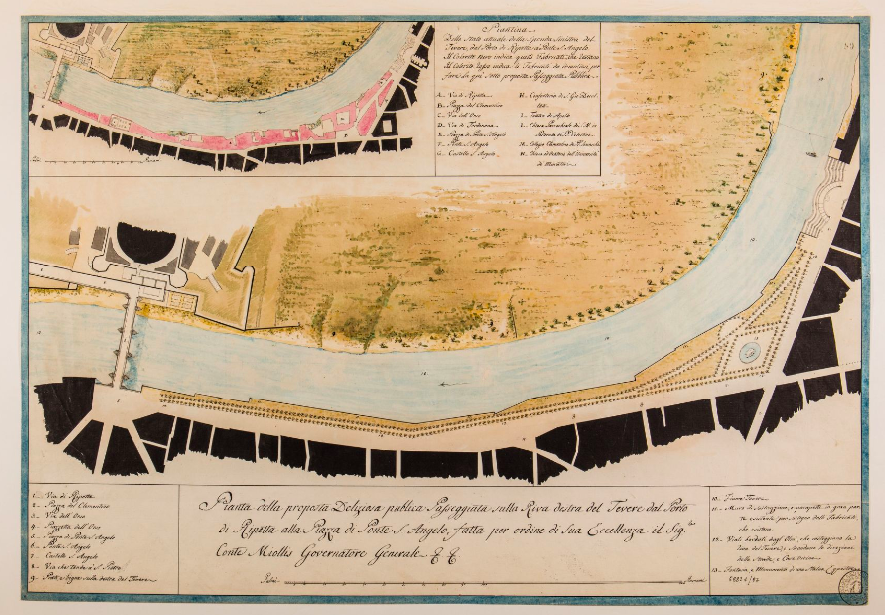
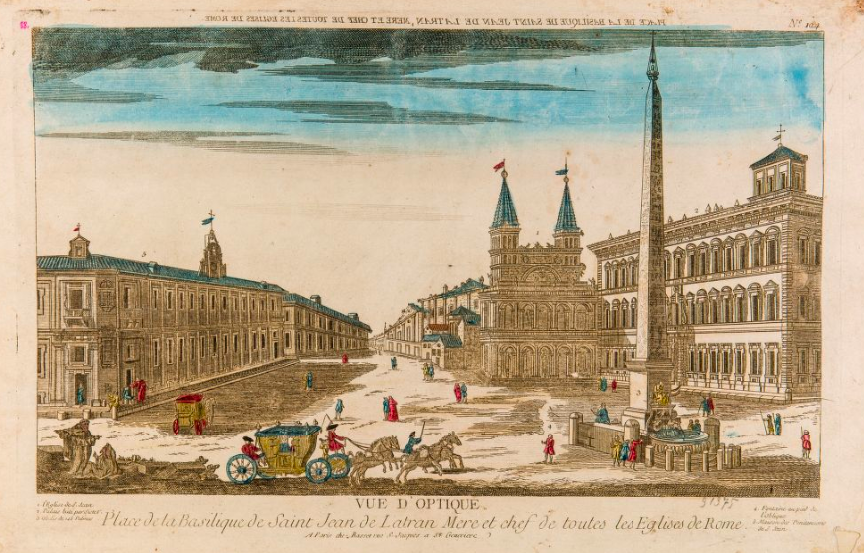
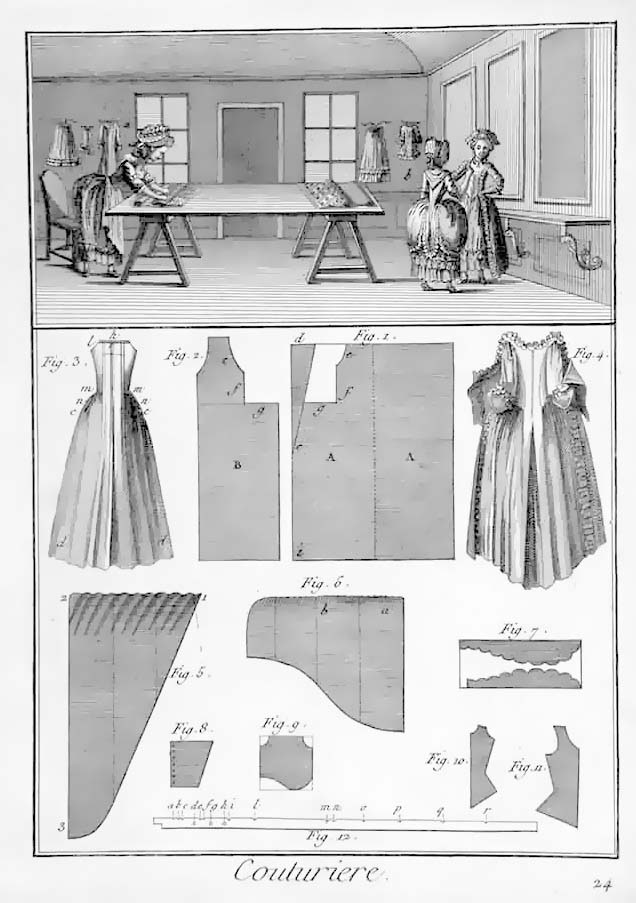
The poet Tibullus first described Rome as “The Eternal City” in the first century BC, and that evocative nickname has stuck over the thousands of years since. Or rather, he would have called it “Urbs Aeterna,” which for Italian-speakers would have been “La Città Eterna,” but regardless of which language you prefer it in, it throws down a daunting challenge before any historian of Rome. Each scholar has had to find their own way of approaching such a historically formidable place, and few have built up such a robust visual record as Rodolfo Lanciani, 4000 items from whose collection became available to view online this year, thanks to Stanford Libraries.
As an “archaeologist, professor of topography, and secretary of the Archaeological Commission,” says the collection’s about page, Lanciani, “was a pioneer in the systematic, modern study of the city of Rome.”
Having lived from 1845 to 1929 with a long and fruitful career to match, he “collected a vast archive of his own notes and manuscripts, as well as works by others including rare prints and original drawings by artists and architects stretching back to the sixteenth century.” After he died, his whole library found a buyer in the Istituto Nazionale di Archeologia e Storia dell’Arte (INASA), which made it available to researchers at the 15th-century Palazzo Venezia in Rome.
Based in Seoul, Colin Marshall writes and broadcasts on cities and culture. His projects include the book The Stateless City: a Walk through 21st-Century Los Angeles and the video series The City in Cinema. Follow him on Twitter at @colinmarshall or on Facebook.
As Halloween draws nigh, our thoughts turn to costumes.
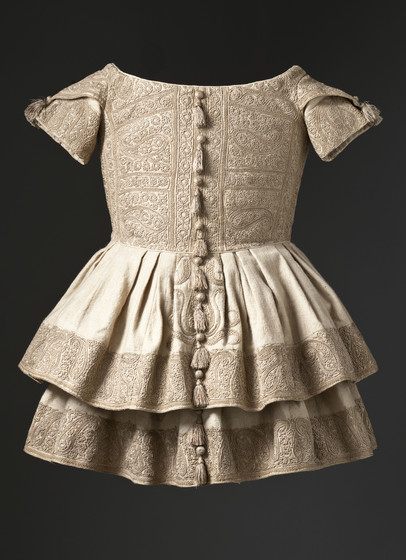
Not those rubbery, poorly constructed, sexy and/or gory off-the-rack readymades, but the sort of lavish, historically accurate, home-sewn affairs that would have earned praise and extra candy, if only our mother had been inclined to spend the bulk of October chained to a sewing machine.
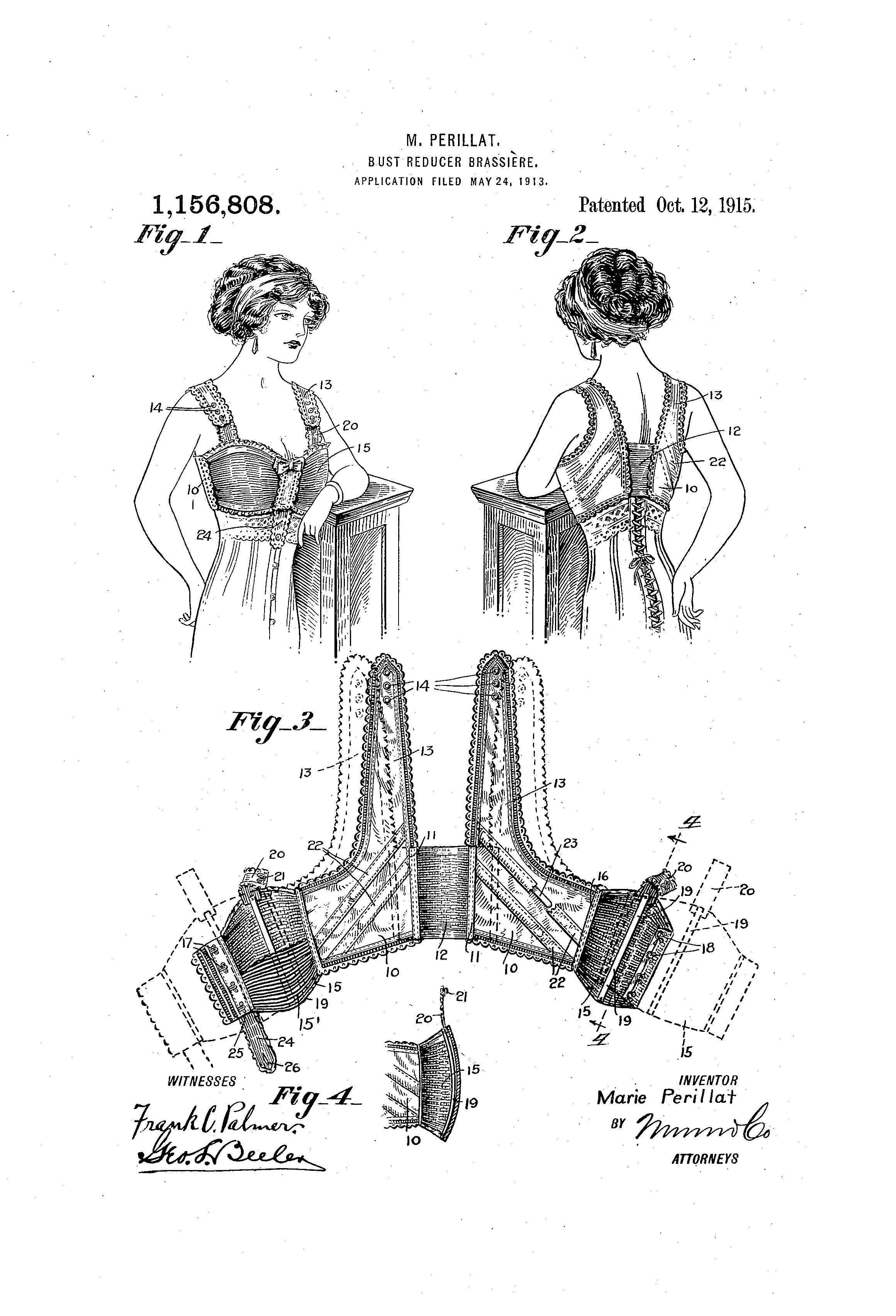
Press someone else’s seams with a straightening iron, then kick back and enjoy the vintage ads, photos of antique garments, and the period information that often accompanies these how-tos. And check out the 1913 patent application for Marie Perillat’s Bust Reducer, a miracle invention designed to “prevent flesh bulging while providing self adjustable, comfortable, hygienic support.”
When people ask why we have specifically black histories, or queer histories, or women’s histories, it can be hard for many who do historical research to take the question seriously. But in fairness, such questions point to the very reason that alternative or “revisionist” histories exist. We cannot know what we are not told about history—at least not without doing the kind of digging professional scholars can do. Virginia Woolf’s tragic, but fictional, history of Shakespeare’s sister notwithstanding, the claims made by cultural critics about marginalization and oppression aren’t based on speculation, but on case after case of individuals who were ignored by, or shut out of, the wider culture, and subsequently disappeared from historical memory.
One such extraordinary case involves the real sister of another towering European figure whose life we know much more about than Shakespeare’s. Before Wolfgang Amadeus Mozart began writing his first compositions, his older sister Maria Anna Mozart, nicknamed Nannerl, had already proven herself a prodigy.
The two toured Europe together as children—she was with her brother during his 18-month stay in London. “There are contemporaneous reviews praising Nannerl,” writes Sylvia Milo, “and she was even billed first.” A 1763 review, for example, sounds indistinguishable from those written about young Wolfgang.
Imagine an eleven-year-old girl, performing the most difficult sonatas and concertos of the greatest composers, on the harpsichord or fortepiano, with precision, with incredible lightness, with impeccable taste. It was a source of wonder to many.
18th century classical audiences first came to know Wolfgang as part of a brother-sister duo of “wunderkinder.” But the sister half has been airbrushed out of the picture. She does not appear in the definitive Hollywood treatment, Milos Forman’s Amadeus. And, moreover, she only recently began to emerge in the academic and classical worlds. “I grew up studying to be a violinist,” writes Sylvia Milo. “Neither my music history nor my repertoire included any female composers.”
With my braided hair I was called “little Mozart” by my violin teacher, but he meant Wolfi. I never heard that Amadeus had a sister. I never heard of Nannerl Mozart until I saw that family portrait.
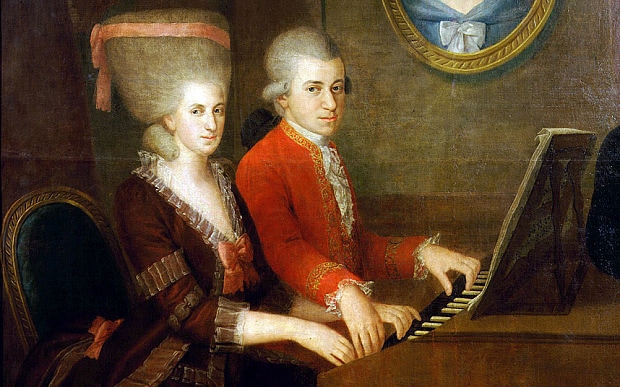
In the portrait (top), Nannerl and Wolfgang sit together at the harpsichord while their father Leopold stands nearby. Nannerl, in the foreground, has an enormous pompadour crowning her small oval face. Of the hairdo, she wrote to her brother, in their typically playful rapport, “I am writing to you with an erection on my head and I am very much afraid of burning my hair.”
After discovering Nanerl, Milo poured through the historical archives, reading contemporary accounts and personal letters. The research gave birth to a one-woman play, The Other Mozart, which has toured for the last four years to critical acclaim. (See a trailer video above). In her Guardian essay, Milo describes Nannerl’s fate: “left behind in Salzberg” when she turned 18. “A little girl could perform and tour, but a woman doing so risked her reputation…. Her father only took Wolfgang on their next journeys around the courts of Europe. Nannerl never toured again.” We do know that she wrote music. Wolfgang praised one composition as “beautiful” in a letter to her. But none of her music has survived. “Maybe we will find it one day,” Milo writes. Indeed, an Australian researcher claims to have found Nannerl’s “musical handwriting” in the compositions Wolfgang used for practice.
Other scholars have speculated that Mozart’s sister, five years his senior, certainly would have had some influence on his playing. “No musicians develop their art in a vacuum,” says musical sociologist Stevan Jackson. “Musicians learn by watching other musicians, by being an apprentice, formally or informally.” The question may remain an academic one, but the life of Nannerl has recently become a matter of popular interest as well, not only in Milo’s play but in several novels, many titled Mozart’s Sister, and a 2011 film, also titled Mozart’s Sister, written and directed by René Féret and starring his daughter in the titular role. The trailer above promises a richly emotional period drama, which—as all entertainments must do—takes some liberties with the facts as we know, or don’t know, them, but which also, like Milo’s play, gives flesh to a significant, and significantly frustrated, historical figure who had, for a couple hundred years, at least, been rendered invisible.
It may be a great irony that our age of cultural destruction and—many would argue—decline also happens to be a golden age of preservation, thanks to the very new media and big data forces credited with dumbing things down. We spend ample time contemplating the losses; archival initiatives like The Great 78 Project, like so many others we regularly feature here, should give us reasons to celebrate.
In a post this past August, we outlined the goals and methods of the project. Centralized at the Internet Archive—that magnanimous citizens’ repository of digitized texts, recordings, films, etc.—the project contains several thousand carefully preserved 78rpm recordings, which document the distinctive sounds of the early 20th century from 1898 to the late-1950s.
Thanks to partners like preservation company George Blood, L.P. and the ARChive of Contemporary Music, we can hear many thousands of records from artists both famous and obscure in the original sound of the first mass-produced consumer audio format.
Just a few days ago, the Internet Archive announced that they would be joined in the endeavor by the Boston Public Library, who, writes Wendy Hanamura, “will digitize, preserve” and make available to the public “hundreds of thousands of audio recordings in a variety of historical formats,” including not only 78s, but also LP’s and Thomas Edison’s first recording medium, the wax cylinder. “These recordings have never been circulated and were in storage for several decades, uncatalogued and inaccessible to the public.”
The process, notes WBUR, “could take a few years,” given the sizable bulk of the collection and the meticulous methods of the Internet Archive’s technicians, who labor to preserve the condition of the often fragile materials, and to produce a number of different versions, “from remastered to raw.” The object, says Boston Public Library president David Leonard, is to “produce recordings in a way that’s interesting to the casual listener as well as to the hard-core music listener in the research business.”
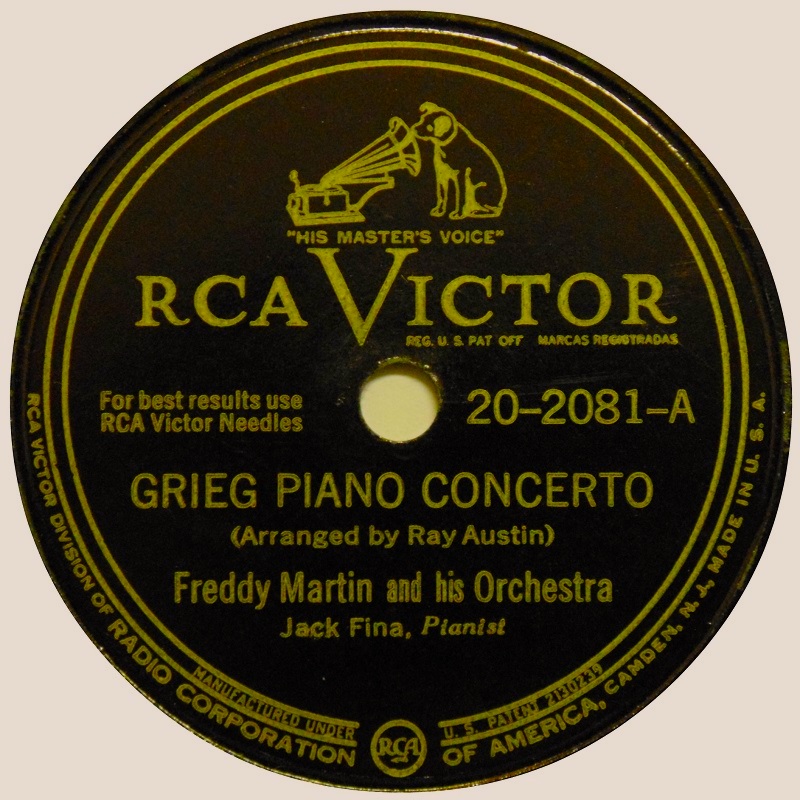
Thus far, only two recordings from BPL’s extensive collections have become available—a 1938 recording called “Please Pass the Biscuits, Pappy (I Like Mountain Music)” by W. Lee O’Daniel and His Hillbilly Boys and Edvard Grieg’s only piano concerto, recorded by Freddy Martin and His Orchestra in 1947. Even in this tiny sampling, you can see the range of material the archive will feature, consistent with the tremendous variety the Great 78 Project already contains.
While we can count it as a great gain to have free and open access to this historic vault of recorded audio, it is also the case that digital archiving has become an urgent bulwark against total loss. Current recording formats instantly spawn innumerable copies of themselves. The physical media of the past existed in finite numbers and are subject to total erasure with time. “The simple fact of the matter,” archivist George Blood tells the BPL, “is most audiovisual recordings will be lost. These 78s are disappearing left and right. It is important that we do a good job preserving what we can get to, because there won’t be a second chance.”
The Bauhaus, which operated as an influential school in Germany between 1919 and 1933 but lives on as a kind of aesthetic ideal, has its strongest associations with highly visual work, like textiles, graphic design, industrial design, and especially architecture. But a good deal of thought went into establishing the kind of rationality- and functionality-oriented philosophical basis that would produce all that visual work, and you can hear some of the leading lights of the Bauhaus discuss it, in English, on the record BauhausReviewed: 1919 to 1933, now available on Spotify. (If you don’t have Spotify’s software, you can download it here.) You can also purchase your own copy online.
“The bulk of the narrative is by [Walter] Gropius, an articulate and passionate advocate for this remarkable experiment in education,” writes All Music Guide’s Stephen Eddins. “Artist Josef Albers and architect [Ludwig] Mies van der Rohe also contribute commentary. [LTM Records founder] James Nice is credited with ‘curating’ the CD, and it must be his editing that gives the album such a clear and informative narrative structure — one comes away with a vivid understanding of the development of the movement, both philosophically and pragmatically.”
In between the spoken passages on the origins of the Bauhaus, form and totality, handling and texture, utopianism, and other topics besides, Bauhaus Reviewed 1919–1933 offers musical compositions by such Bauhaus-associated composers as Arnold Schoenberg, Josef Matthias Hauer, and George Antheil. You can hear some of the sound from the record repurposed in Architecture as Language, the short about Mies by Swiss filmmaker Alexandre Favre just below. In it that pioneer of modernism discusses the Bauhaus as well as his own individual work, all of it interesting to anyone with an inclination toward midcentury European-American architecture and design, none of it ultimately more relevant than the final words the master speaks: “I don’t want to be interesting. I want to be good.”
Based in Seoul, Colin Marshall writes and broadcasts on cities and culture. His projects include the book The Stateless City: a Walk through 21st-Century Los Angeles and the video series The City in Cinema. Follow him on Twitter at @colinmarshall or on Facebook.
Our country’s bipartisan system ensures that every election will give rise to a winning side and a losing side—and depressingly, a sizable group who refrained from casting a vote either way.
There are times when the divide between the factions does not seem insurmountable, when leaders in the highest positions of authority seem sincerely committed to reaching across the divide….
And then there are other times.
Earlier in the year, the Women’s March on Washington and its hundreds of sister marches gave many of us reason to hope. The numbers alone were inspiring.
But history shows how great numbers can go the other way too.
With many American high school history curriculums whizzing through World War II in a week, if that, it’s doubly important to slow down long enough to watch the 7 minute documentary above.
What you’re looking at is the 1939 “Pro-American Rally” (aka Pro-Nazi Rally) sponsored by the German American Bund at Madison Square Garden on George Washington’s 207th Birthday. Banners emblazoned with such slogans as “Stop Jewish Domination of Christian Americans,” “Wake Up America. Smash Jewish Communism,” and “1,000,000 Bund Members by 1940” decorated the great hall.
New York City Mayor Fiorello LaGuardia—an Episcopalian with a Jewish mother—considered canceling the event, but ultimately he, along with the American Jewish Committee and the American Civil Liberties Committee decreed that the Bund was exercising its right to free speech and free assembly.
A crowd of 20,000 filled the famous sports venue in mid-town Manhattan to capacity. 1,500 police officers were present to render the Garden “a fortress impregnable to anti-Nazis.” An estimated 100,000 counter-demonstrators were gathering outside.
The most disturbing moment in the short film comes at the 3:50 mark, when another security force—the Bund’s Ordnungsdienst or “Order Service” pile on Isidore Greenbaum, a 26-year-old Jewish worker who rushed the podium where bundesführerFritz Julius Kuhn was fanning the flames of hatred. Valentine’s men eventually pulled them off, just barely managing to save the “anti-Nazi” from the vicious beating he was undergoing.
Reportedly he was beaten again, as the crowd inside the Garden howled for his blood.
The uniformed youth performing a spontaneous hornpipe in the row behind the Bund’s drum and bugle corps is a chilling sight to see.
Director Marshall Curry was spurred to bring the historic footage to Field of Vision, a filmmaker-driven documentary unit that commissions short films as a rapid response to developing stories around the globe. In this case, the developing story was the “Unite the Right” white nationalist rally in Charlottesville, which had occurred a mere two days before.
“The footage is so powerful,” Curry told an interviewer, “it seems amazing that it isn’t a stock part of every high school history class. But I think the rally has slipped out of our collective memory in part because it’s scary and embarrassing. It tells a story about our country that we’d prefer to forget. We’d like to think that when Nazism rose up, all Americans were instantly appalled. But while the vast majority of Americans were appalled by the Nazis, there was also a significant group of Americans who were sympathetic to their white supremacist, anti-Semitic message. When you see 20,000 Americans gathering in Madison Square Garden you can be sure that many times that were passively supportive.”
Field of Vision co-founder Laura Poitras recalled how after meeting with Curry, “my first thought was, ‘we need to put this film in cinemas,’ and release it like a newsreel.”’ The Alamo Drafthouse cinema chain screened it before features on September 26 of this year.
We might draw any number of conclusions from the fact that rats’ brains are enough like ours that they stand in for humans in laboratories. A misanthropic existentialist may see the unflattering similarity as evidence that there’s nothing special about human beings, despite our grandiose sense of ourselves. A medieval European thinker would draw a moral lesson, pointing to the rat’s gluttony as nature’s allegory for human greed. And a skeptical observer in the 19th and early 20th centuries might take note of how easily both rats and humans can be manipulated; the latter, for example, by pseudo-phenomena like Spiritualism, which encompassed a wide range of claims about ghosts and the afterlife, from seances to spirit photography.
One such skeptical observer in 1920, Millaias Culpin, even wrote in his Spiritualism and the New Psychology of the “’scientific’ supporters of spiritualism,” most of them “eminent in physical science.” They are easily convinced, Culpin thought, because “they have been trained in a world where honesty is assumed to be a quality of all workers. A laboratory assistant who played a trick upon one of them would find his career at an end, and ordinary cunning is foreign to them. When they enter upon the world of Dissociates, where deceit masquerades under the disguise of transparent honesty, these eminent men are but as babes—country cousins in the hands of confidence-trick men.”
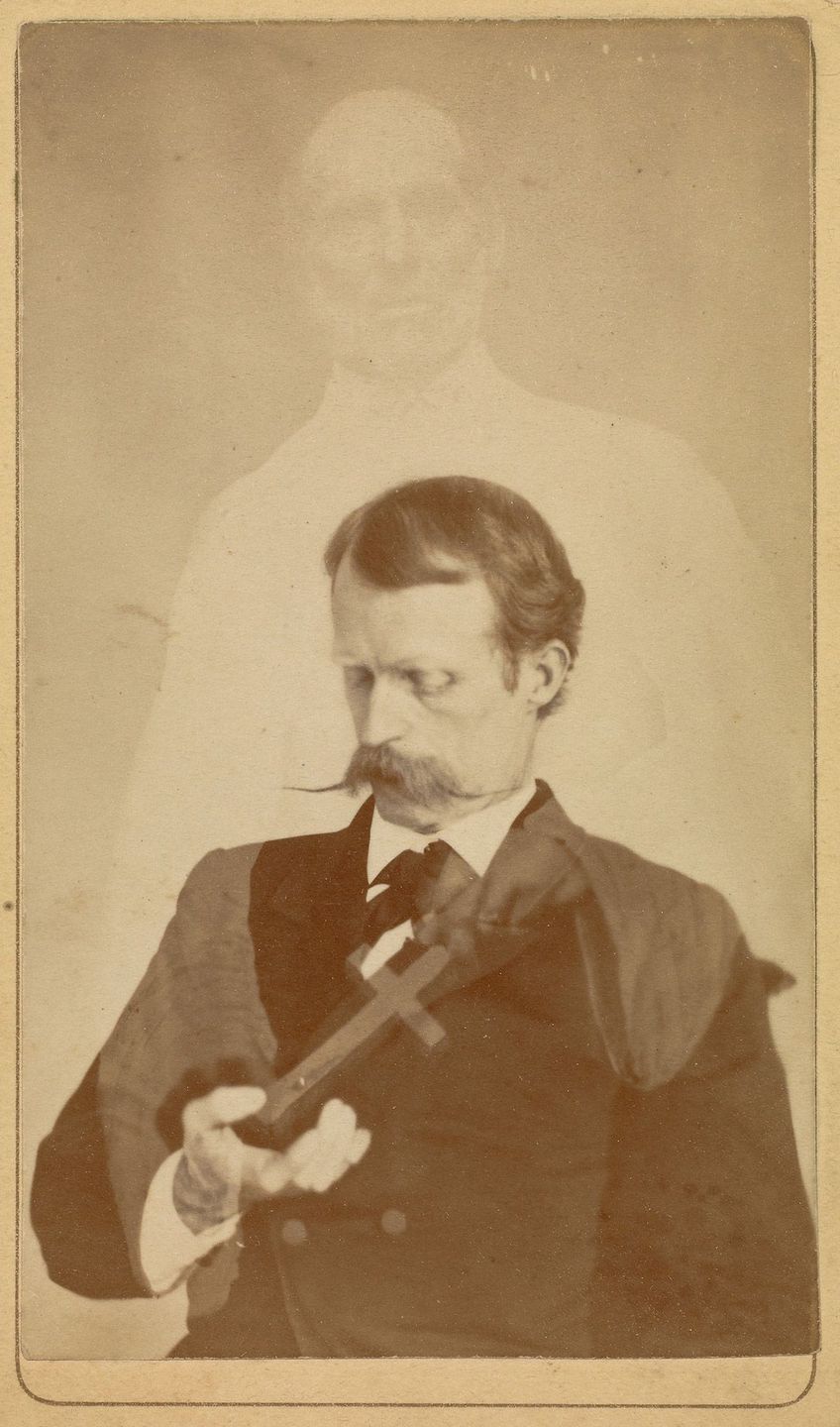
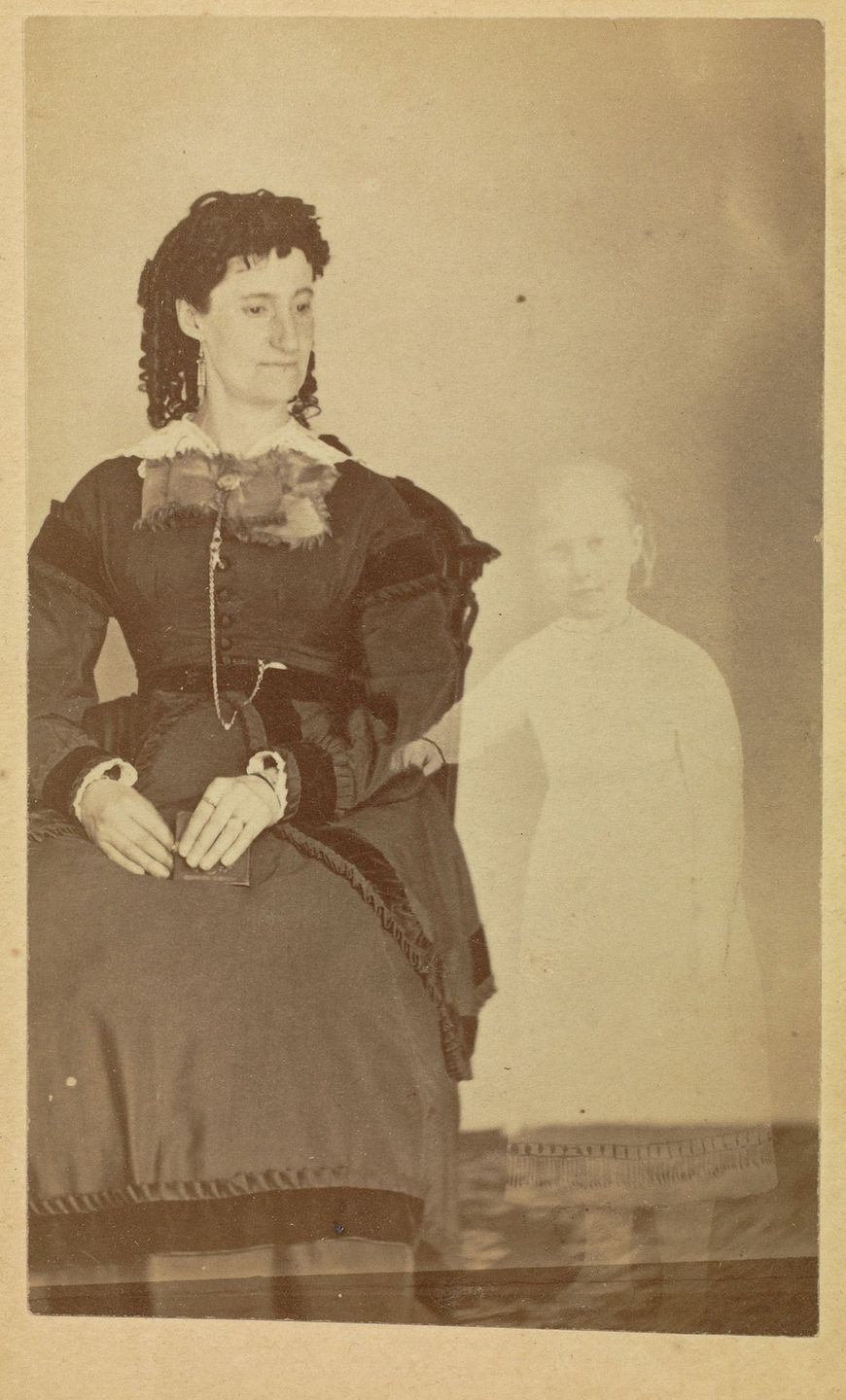
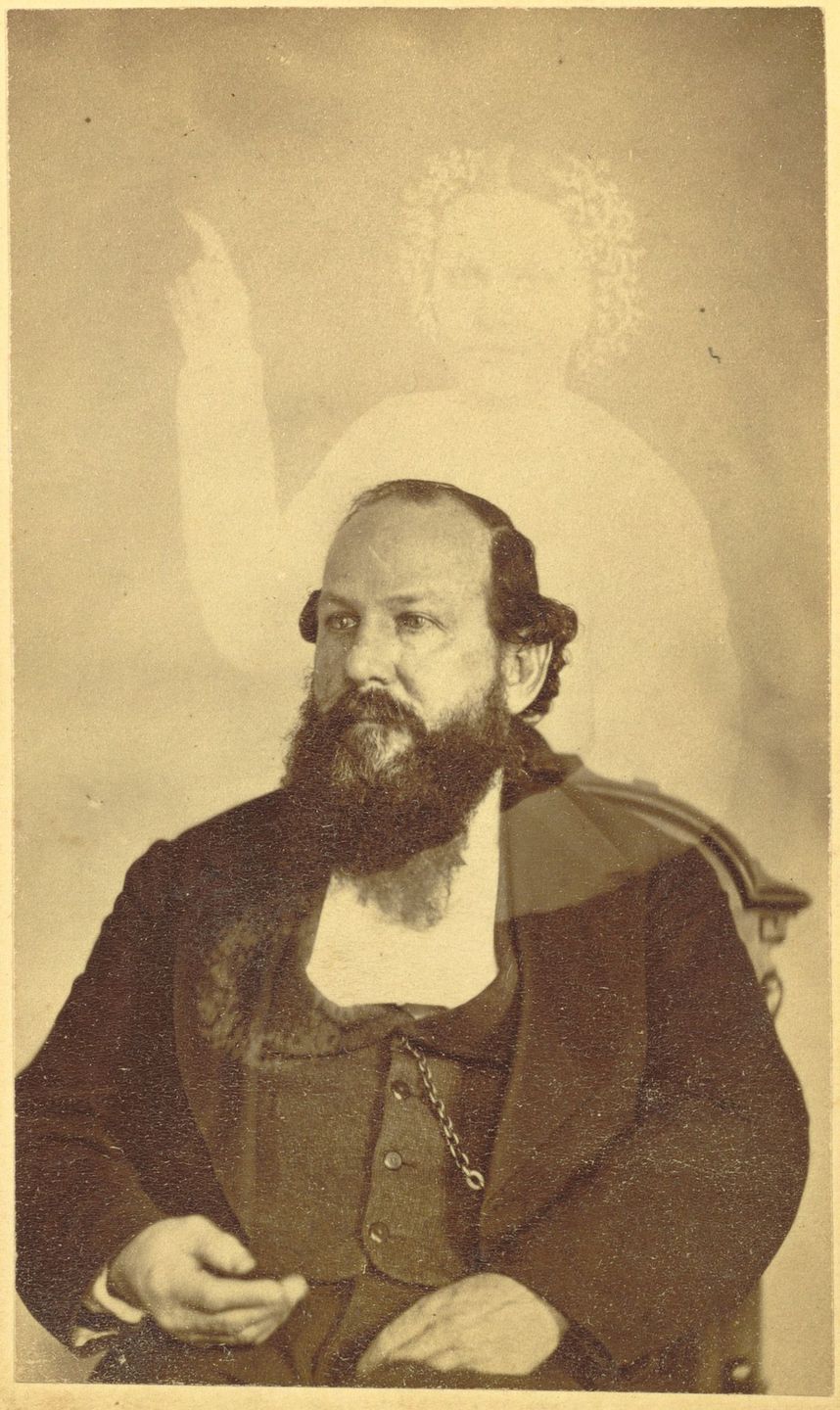
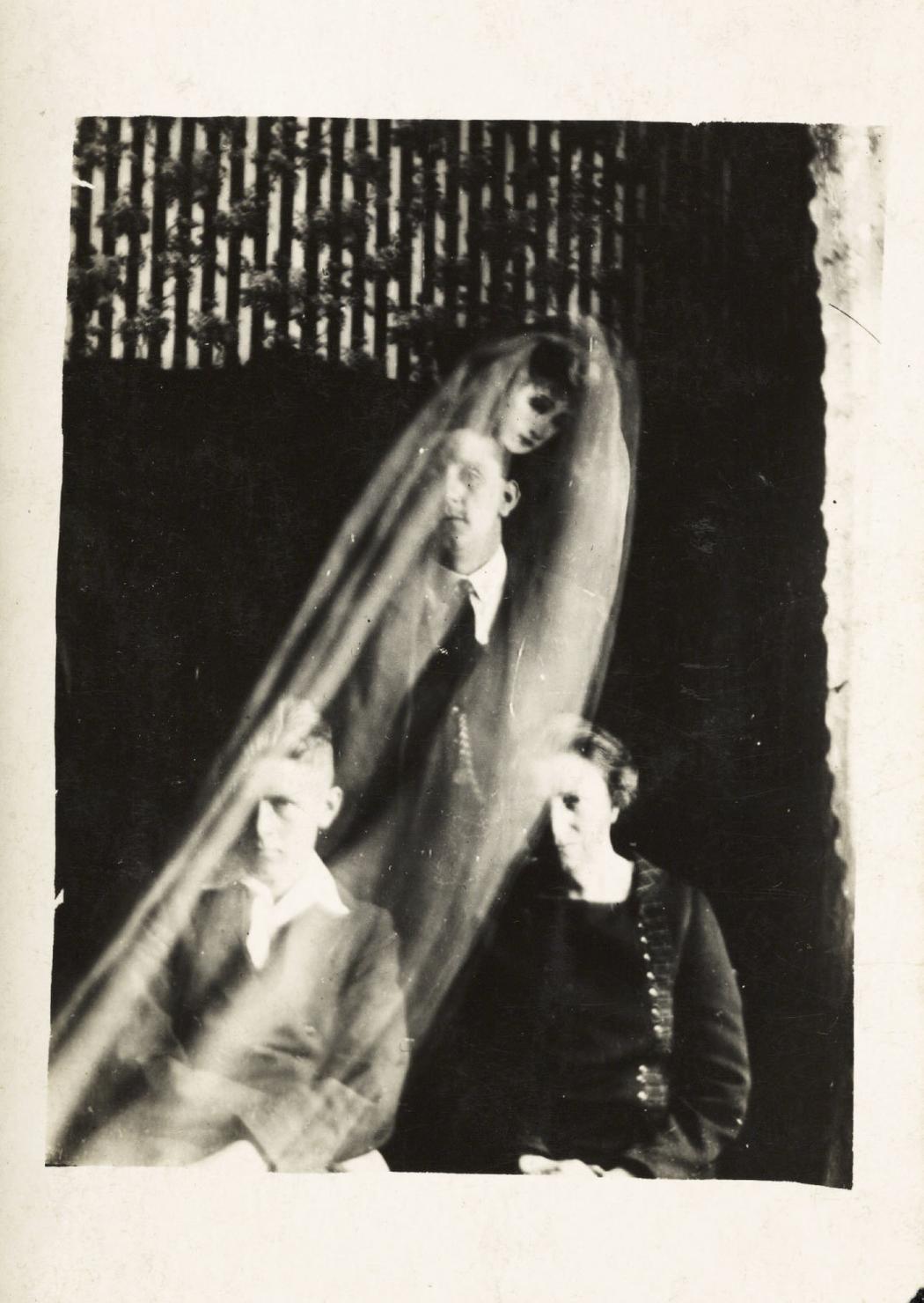
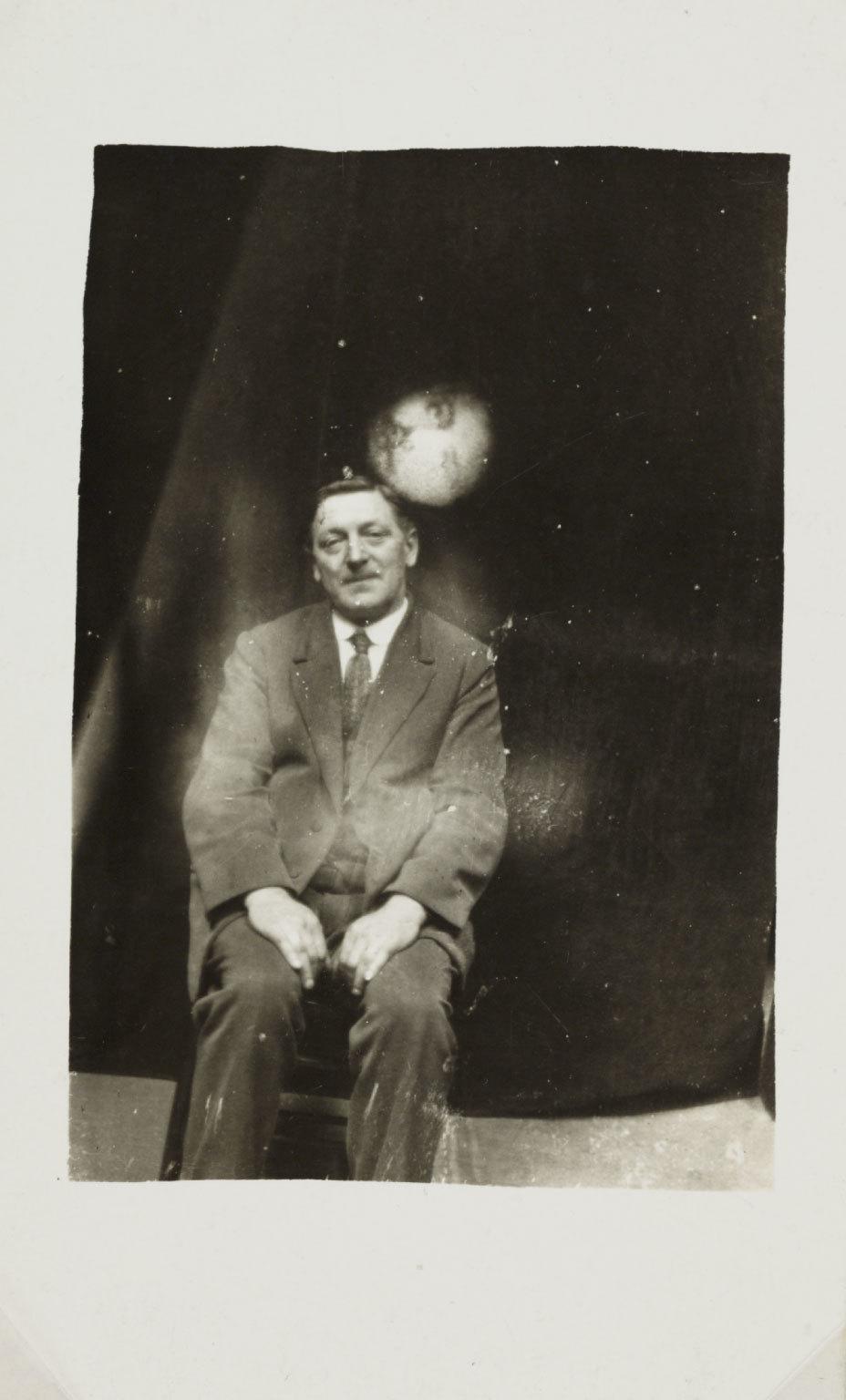
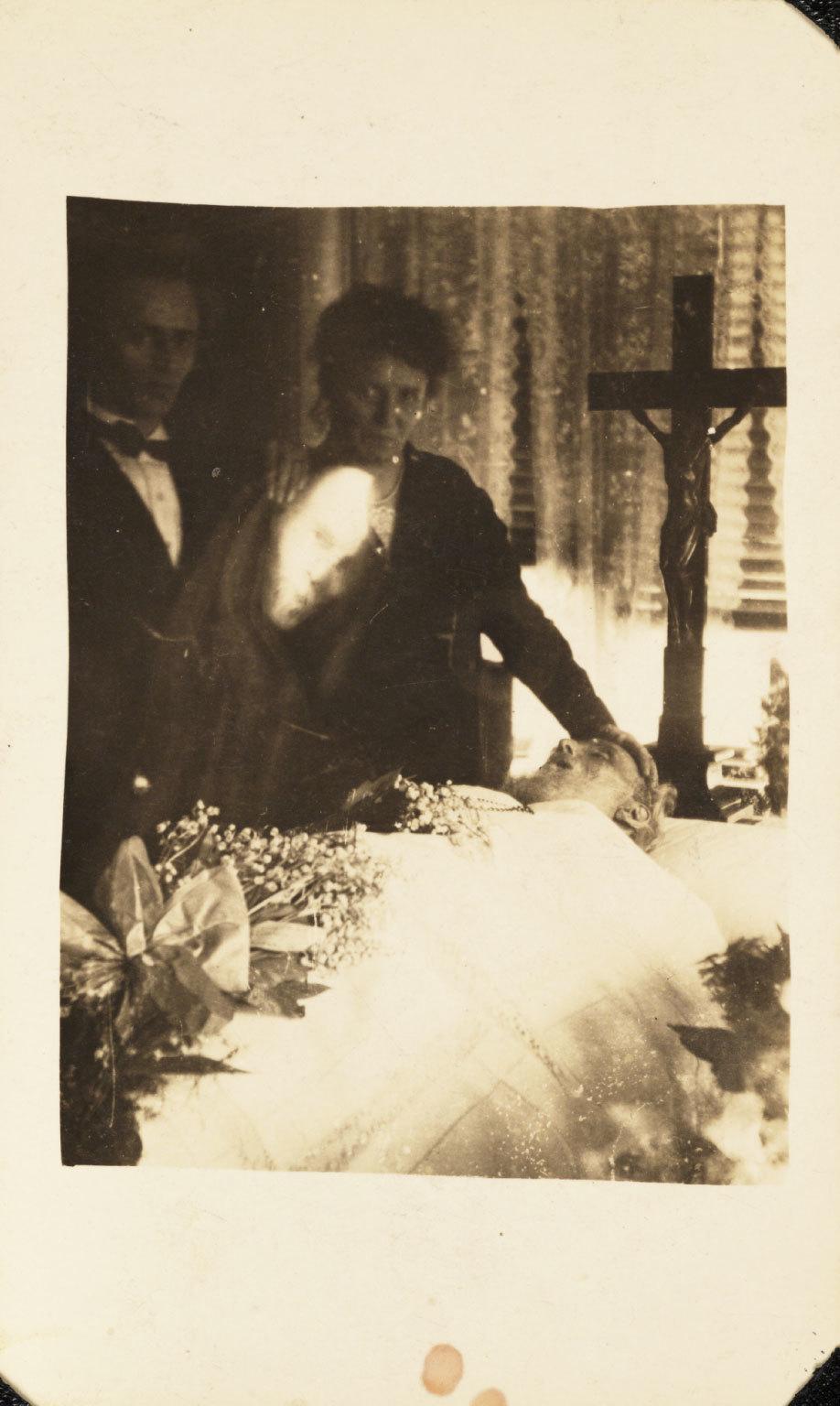
Such adherents of Spiritualist beliefs were taken in not because they were naturally credulous or stupid, but because they had been “trained” to trust the evidence of their senses. So-called spirit photographs, like those you see here, allowed people to “show material evidence for their beliefs.” Photographers who created the images, Mashable explains, could “easily make two exposures on a single negative, manipulate the negative to create ghostly blurs, or overlap two negatives in the darkroom to produce an extra face within the resultant frame.”
The audience for this work was “vast,” and many fit Culpin’s generalizations. In 1921, for example, paranormal investigator Hereward Carrington wrote of “a number of ‘spirit’ and ‘thought’ photographs, the evidence for which seemed to me to be exceptionally good.” In describing other pictures as “obviously fraudulent” or “extremely puzzling,” Carrington made critical distinctions and appeared to use the methods and the language of science in the evaluation of objects purporting to prove the existence of ghosts.
It may seem incredible that spirit photography had widespread appeal for as long as it did. The photographs first began appearing in the 1860s, emerging “from a small Boston portrait studio” and first made by William H. Mumler, the genre’s inventor and “most prominent early proponent,” writes Mashable.
Mumler was neither a photographer nor a medium. He originally worked as a silver engraver, while dabbling in photography in the local studio of a woman named Mrs. Stuart. One day in 1861, in the midst of developing a self-portrait, Mumler reported that the dim figure of a young cousin who had died twelve years earlier emerged in the final print.
These ghostly images continued to appear—on their own, the story goes—and the studio’s receptionist, a part-time medium, helped popularize them. Soon Mumler “received visitors from across America, including the recently widowed Mary Todd Lincoln.” Most of these visitors did not work as scientists or professional paranormal investigators. They were ordinary people bereaved by the mass death of the Civil War and deeply motivated to accept physical confirmation of an afterlife. Moreover, before the rise of Fundamentalist Evangelicalism in the 1920s, Spiritualism was on the front lines of an earlier culture war: spirit photography was “a tangible symbol of the overarching argument of mysticism versus science and rationalism.”
The three images at the top of the post date from the earliest period of spirit photography, between 1862 and 1875, and they were all produced by Mumler in Boston and New York, where he moved in 1869, and where he was charged with fraud, then “acquitted of all charges because they could not be sufficiently proven.” (See many more of his photos at Mashable and the Getty Museum online archive.) Though his business suffered, spirit photography only grew more popular, particularly in Spiritualist circles in Britain, where Arthur Conan Doyle, creator of the hyper-rational Sherlock Holmes, was one of the most ardent of Spiritualist believers.
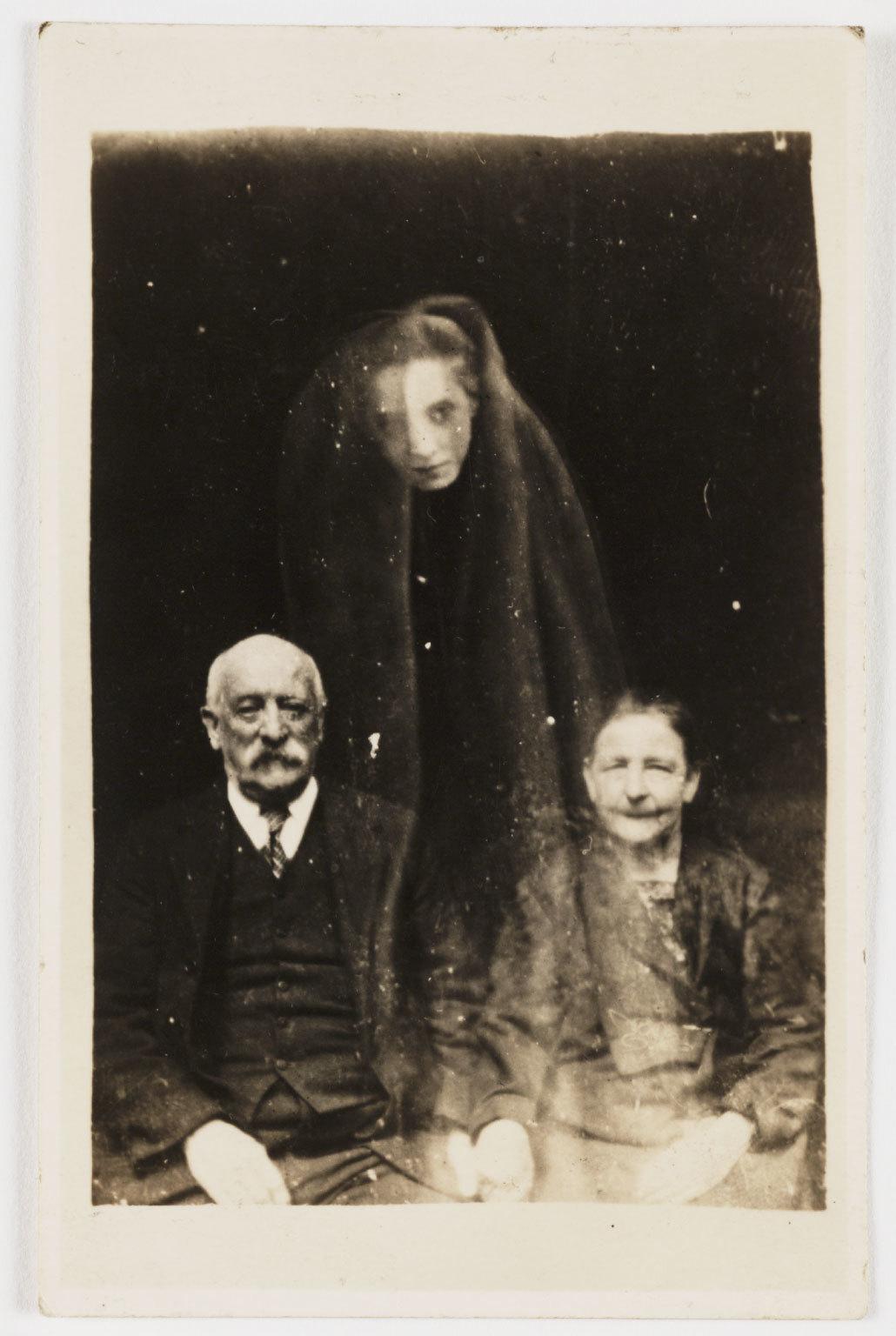
Doyle supported a British photographer named William Hope, who began taking spirit photographs in 1905, founded a group called the Crewe Circle and later “went on to prey on grieving families,” writes River Donaghey at Vice, “who lost loved ones in WWI and desperately wanted photographic proof that their relatives were still hovering around in spectral form.” Even after Hope and his crew were exposed, Doyle continued to support him, going so far as to write a book called The Case for Spirit Photography. The four photographs above and below are Hope’s work (see many more at Vice and the Public Domain Review). They are seriously creepy—in the way movies like The Ring are creepy—but they are also, quite obviously, photographic fictions.
Even as viewers of photography became savvier as the century wore on, many people thrilled to Hope’s work until his death in 1933, maybe for the same reason we watch The Ring; it’s a fun scare, nothing more, if we suspend our disbelief. As for the true believers in spirit photography—they are not so different either from us 21st century sophisticates. We’re still taken in all the time by hoaxes and frauds, maybe because it’s still as easy to push the buttons in our brains, and because, well, we just want to believe.
Every piece of technology has a precedent. Most have several different types of precedents. You’ve probably used (and may well own) an eBook reader, for instance, but what would have afforded you a selection of reading material two or three centuries ago? If you were a Jacobean Englishman of means, you might have used the kind of traveling library we featured in August, a handsome portable case custom-made for your books. (If you’re Tom Stoppard in the 21st century, you still do.) If you were Napoleon, who seemed to love books as much as he loved military power — he didn’t just amass a vast collection of them, but kept a personal librarian to oversee it — you’d take it a big step further.
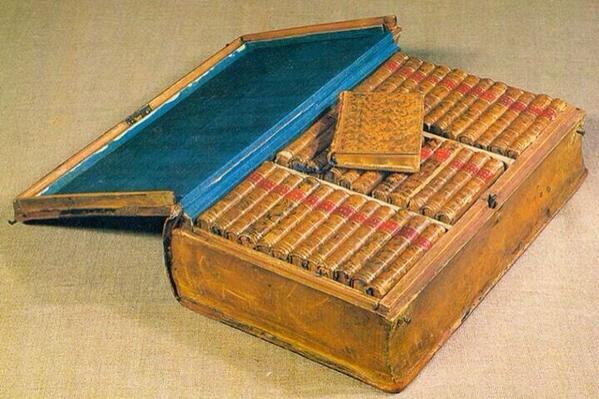
“Many of Napoleon’s biographers have incidentally mentioned that he […] used to carry about a certain number of favorite books wherever he went, whether traveling or camping,” says an 1885 Sacramento Daily Union article posted by Austin Kleon, “but it is not generally known that he made several plans for the construction of portable libraries which were to form part of his baggage.” The piece’s main source, a Louvre librarian who grew up as the son of one of Napoleon’s librarians, recalls from his father’s stories that “for a long time Napoleon used to carry about the books he required in several boxes holding about sixty volumes each,” each box first made of mahogany and later of more solid leather-covered oak. “The inside was lined with green leather or velvet, and the books were bound in morocco,” an even softer leather most often used for bookbinding.
To use this early traveling library, Napoleon had his attendants consult “a catalogue for each case, with a corresponding number upon every volume, so that there was never a moment’s delay in picking out any book that was wanted.” This worked well enough for a while, but eventually “Napoleon found that many books which he wanted to consult were not included in the collection,” for obvious reasons of space. And so, on July 8, 1803, he sent his librarian these orders:
The Emperor wishes you to form a traveling library of one thousand volumes in small 12mo and printed in handsome type. It is his Majesty’s intention to have these works printed for his special use, and in order to economize space there is to be no margin to them. They should contain from five hundred to six hundred pages, and be bound in covers as flexible as possible and with spring backs. There should be forty works on religion, forty dramatic works, forty volumes of epic and sixty of other poetry, one hundred novels and sixty volumes of history, the remainder being historical memoirs of every period.
In sum: not only did Napoleon possess a traveling library, but when that traveling library proved too cumbersome for his many and varied literary demands, he had a whole new set of not just portable book cases but even more portable books made for him. (You can see how they looked packed away in the image tweeted by Cork County Library above.) This prefigured in a highly analog manner the digital-age concept of recreating books in another format specifically for compactness and convenience — the kind of compactness and convenience now increasingly available to all of us today, and to a degree Napoleon never could have imagined, let alone demanded. It’s always good to be the Emperor, but in many ways, it’s better to be a reader in the 21st century.
Based in Seoul, Colin Marshall writes and broadcasts on cities and culture. His projects include the book The Stateless City: a Walk through 21st-Century Los Angeles and the video series The City in Cinema. Follow him on Twitter at @colinmarshall or on Facebook.
We're hoping to rely on loyal readers, rather than erratic ads. Please click the Donate button and support Open Culture. You can use Paypal, Venmo, Patreon, even Crypto! We thank you!
Open Culture scours the web for the best educational media. We find the free courses and audio books you need, the language lessons & educational videos you want, and plenty of enlightenment in between.