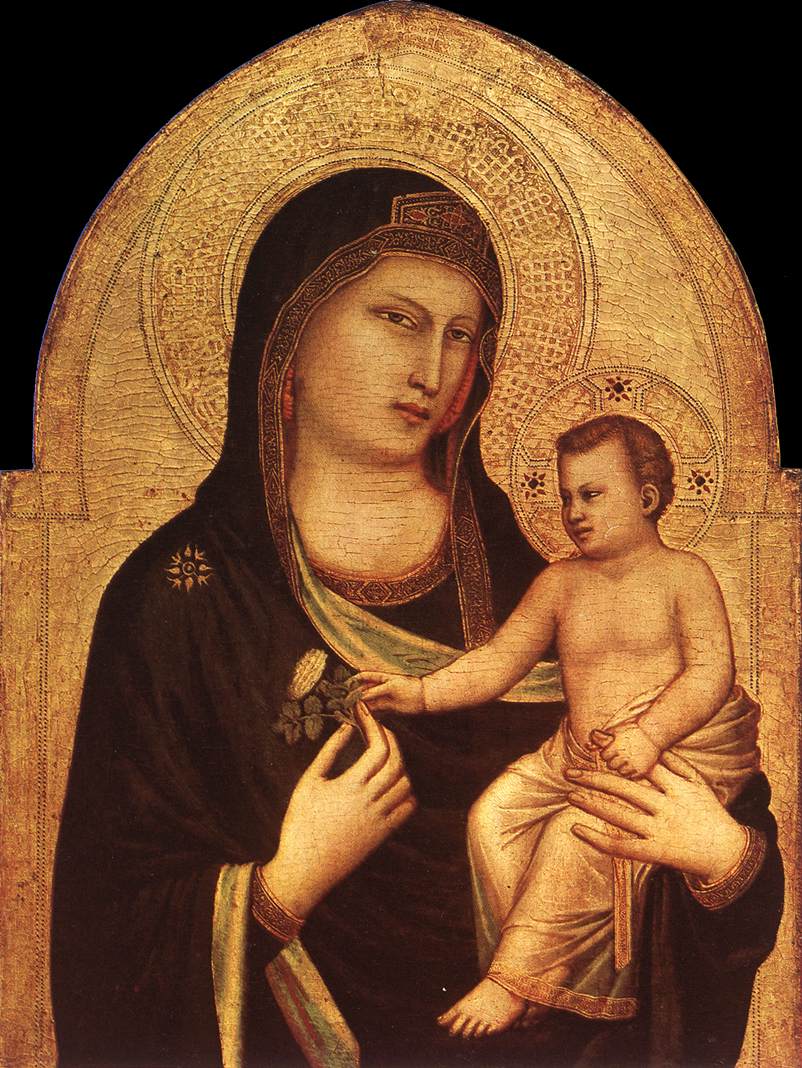
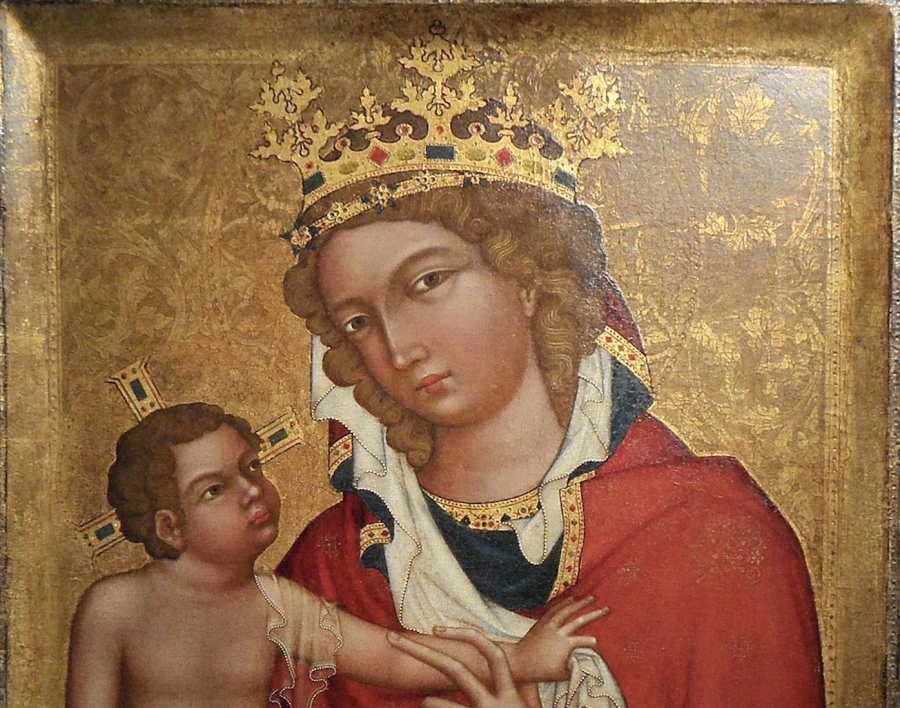
How much special treatment should we give children, and how much should we regard them as small adults? The answer to that question varies not just between but within time periods and societies. The attitude in the 21st-century west can, at times, seem to have erred toward a patronizing overprotectiveness, but history has shown that if the social pendulum swings one way, it’ll probably swing the other in due time. We certainly find ourselves far from the view of children taken in medieval Europe, of which we catch a glimpse whenever we behold the babies in its paintings — babies that invariably, according to a Voxpiece by Phil Edwards, “look like ugly old men.”
“Medieval portraits of children were usually commissioned by churches,” writes Edwards, “and that made the range of subjects limited to Jesus and a few other biblical babies. Medieval concepts of Jesus were deeply influenced by the homunculus, which literally means little man.” It also goes along with a strangeness prevalent in medieval art which, according to Creighton University art historian Matthew Averett, “stems from a lack of interest in naturalism” and a reliance on “expressionistic conventions.” These conditions changed, as did much else, with the Renaissance: “a transformation of the idea of children was underway: from tiny adults to uniquely innocent creatures” with the cuteness to match.
You can witness a veritable parade of oddly manlike medieval babies in the short video at the top of the post. “After the Renaissance, cherubs didn’t seem out of place, and neither did cuter pictures of baby Jesus,” says Edwards, narrating. “It’s kind of stayed that way since. We want babies who look like they need their cheeks pinched, not their prostates checked. We want them chubby and cute, and we want babies that fit our ideals” — ideals that have led from pudgy angels to the Gerber Baby to the collected work of Anne Geddes. We probably need not fear an aesthetic return to the middle-aged, homuncular babies of yore, but their frowny expressions have certainly made a comeback in real life: just look at any 21st-century infant immersed in an iPad.
Based in Seoul, Colin Marshall writes and broadcasts on cities and culture. His projects include the book The Stateless City: a Walk through 21st-Century Los Angeles and the video series The City in Cinema. Follow him on Twitter at @colinmarshall or on Facebook.
Hues which have words, and speak to ye of heaven,
Floats o’er this vast and wondrous monument,
And shadows forth its glory.
—Lord Byron, Childe Harold’s Pilgrimage (1818)
A modern visitor to Rome, drawn to the Coliseum on a moonlit night, is unlikely to be so bewitched, sandwiched between his or her fellow tourists and an army of vendors aggressively peddling light-up whirligigs, knock off designer scarves, and acrylic columns etched with the Eternal City’s must-see attractions.
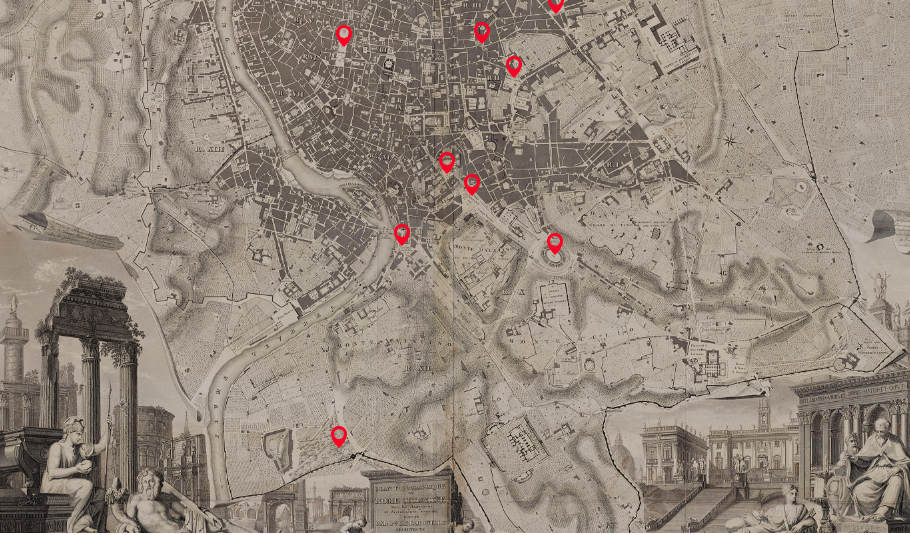
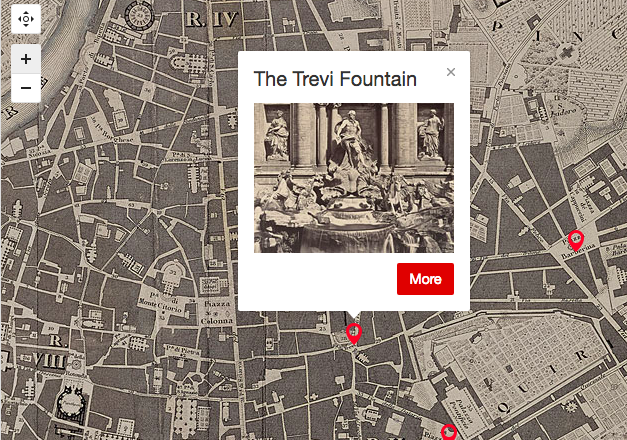
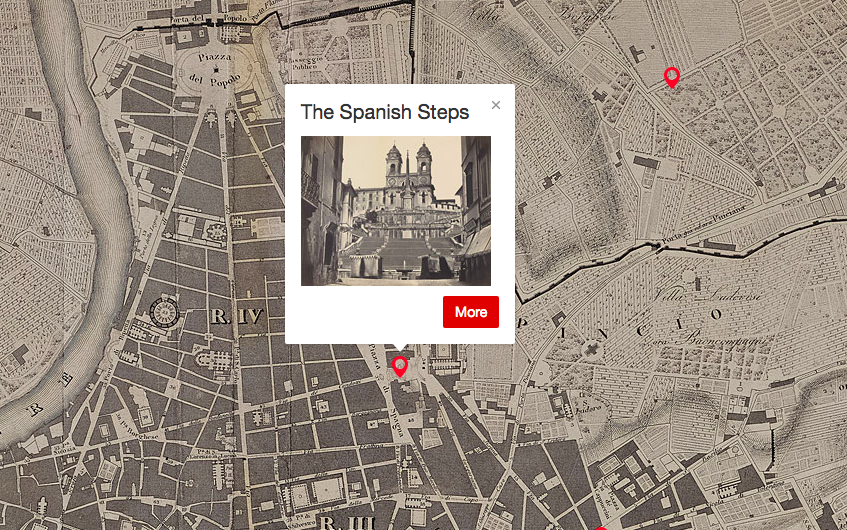
These days, your best bet for touring Rome’s best known landmarks in peace may be an interactive map, compliments of the Morgan Library and Museum. Based on Paul-Marie Letarouilly’s picturesque 1841 city plan, each digital pin can be expanded to reveal descriptions by nineteenth-century authors and side-by-side, then-and-now comparisons of the featured monuments.
The enduring popularity of the film Three Coins in the Fountain, coupled with the invention of the selfie stick has turned the area around the Trevi Fountain into a pickpocket’s dream and a claustrophobe’s worst nightmare.
Not so in Nathaniel Hawthorne’s day, though unlike Lord Byron, he cultivated a cool remove, at least at first:
They and the rest of the party descended some steps to the water’s brim, and, after a sip or two, stood gazing at the absurd design of the fountain, where some sculptor of Bernini’s school had gone absolutely mad in marble. It was a great palace-front, with niches and many bas-reliefs, out of which looked Agrippa’s legendary virgin, and several of the allegoric sisterhood; while, at the base, appeared Neptune, with his floundering steeds and Tritons blowing their horns about him, and twenty other artificial fantasies, which the calm moonlight soothed into better taste than was native to them. And, after all, it was as magnificent a piece of work as ever human skill contrived. At the foot of the palatial façade was strown, with careful art and ordered irregularity, a broad and broken heap of massive rock, looking as if it might have lain there since the deluge. Over a central precipice fell the water, in a semicircular cascade; and from a hundred crevices, on all sides, snowy jets gushed up, and streams spouted out of the mouths and nostrils of stone monsters, and fell in glistening drops; while other rivulets, that had run wild, came leaping from one rude step to another, over stones that were mossy, slimy, and green with sedge, because in a century of their wild play, Nature had adopted the Fountain of Trevi, with all its elaborate devices, for her own.
The human statues garbed as gladiators and charioteers spend hours in the blazing sun at the foot of the Spanish Steps—the heirs to the artists and models who populated William Wetmore Story’s Roba di Roma:
All day long, these steps are flooded with sunshine in which, stretched at length, or gathered in picturesque groups, models of every age and both sexes bask away the hours when they are free from employment in the studios. … Sometimes a group of artists, passing by, will pause and steadily examine one of these models, turn him about, pose him, point out his defects and excellences, give him a baiocco, and pass on. It is, in fact, a models’ exchange.
The Medici Villa houses the Académie de France, and its gardens remain a pleasant respite, even in 2017. Visitors who aren’t wholly consumed with finding a wifi signal may find themselves fantasizing about a different life, much as Henry James did in his Italian Hours:
Such a dim light as of a fabled, haunted place, such a soft suffusion of tender grey-green tones, such a company of gnarled and twisted little miniature trunks—dwarfs playing with each other at being giants—and such a shower of golden sparkles drifting in from the vivid West! … I should name for my own first wish that one didn’t have to be a Frenchman to come and live and dream and work at the Académie de France. Can there be for a while a happier destiny than that of a young artist conscious of talent and of no errand but to educate, polish and perfect it, transplanted to these sacred shades?…What mornings and afternoons one might spend there, brush in hand, unpreoccupied, untormented, pensioned, satisfied—either persuading one’s self that one would be “doing something” in consequence or not caring if one shouldn’t be.
Every week, five million people in the United Kingdom alone tune in to the BBC’s Fake or Fortune?, a television show about the provenance and attribution of notable works of art. That may well say something about the British character, but it says even more about its host and co-creator, art dealer Philip Mould. Involved with antiques from a very early age, he displays in Fake or Fortune? and his other media projects a keen sense of not just how a piece of art appeals to us, but what hidden potential it carries within. Take, for instance, the grimy 17th-century portrait you can see partially restored in the clip above, which he posted on Twitter this week.
At first glance, the painting might not look that much worse for wear than anything else from the Jacobean era, but even the first few minutes of work reveal the true brilliance of the colors hidden underneath what turn out to be layers of brown and yellow. They’ve actually built up in the name of preservation: over about 200 years, a few (or more than a few) coats of varnish had been applied to the canvas in order to protect it, but that varnish turns color over time. Luckily, with the right tools and the right technique, it comes off.
“The painting was originally ina private collection in England,” Mould told the Telegraph. “A mixture of gel and solvent was created, specifically just to remove the varnish and not to damage the underlying paint.” Certainly the portrait’s subject would approve of her appearance’s return to its former splendor, though little information remains as to the identity of the lady herself: “We don’t know the identity yet but certain iconographic clues are starting to emerge,” said Mould. “All we know is she is 36 and it was painted in 1617.”
And so we happen upon another of the compelling aspects of art history: its potential to turn into a detective story. But if you’d like to accompany the narrative experience with a little more technical knowledge, have a look at the short video above showing what it takes to revive a 400-year-old masterwork. People once commissioned portraits so that posterity could know their likenesses, but one wonders if they understood just how far into posterity their likenesses would make it — some of them, thanks to art restorers, looking fresher than they have for centuries.
Based in Seoul, Colin Marshall writes and broadcasts on cities and culture. His projects include the book The Stateless City: a Walk through 21st-Century Los Angeles and the video series The City in Cinema. Follow him on Twitter at @colinmarshall or on Facebook.
Nearly 500 years after his death, we still admire Leonardo da Vinci’s many and varied accomplishments in painting, sculpture, architecture, science, and quite a few other fields besides, most of which would have begun with his putting down some part of the formidable contents of his head on to a piece of paper. (As we’ve seen, sometimes he needed to draw up a to-do list first.) Some of those works remained on paper, and even became famous in that humble form. If you’ve only seen one of Leonardo’s drawings, for instance, it’s almost certainly Vitruvian Man.
Leonardo’s circa-1490 study of the proportions of the human body — or to put it in more common terms, the picture of the naked fellow standing inside a square and a circle — stands at an intersection of art and mathematics, one at which Leonardo spent a great deal of time throughout his life. The Ted-ED lesson above, written by educator James Earle, gets into “the geometric, religious and philosophical significance of this deceptively simple drawing” whose title references the first-century BCE Roman architect and civil engineer Marcus Vitruvius Pollio, who claimed that “the navel is the center of the human body, and that if one takes a compass and places the fixed point on the navel, a circle can be drawn perfectly around the body.”
Vitruvius also realized that “arm span and height have a nearly perfect correspondence in the human body, thus placing the body perfectly inside a square as well.” Both he and Leonardo saw real implications in this alignment between anatomy and geography, beginning with the notion that buildings and other works of man should also take on these “perfect” proportions. All of this ties in with the problem, first proposed by ancient geometers, of “squaring the circle,” that is, finding a procedure to hand-draw a square and a circle both of equal area. Leonardo used Vitruvian Man to point toward one possible solution using the human body.
You can learn more about the importance and legacy of the drawing in the BBC documentary The Beauty of Diagrams, available on Youtube (part one, part two). “Although the diagram doesn’t represent some huge scientific breakthrough,” says its host, mathematician Marcus du Sautoy, “it captures an idea: that mathematics underpins both nature and the manmade world. It represents a synthesis of architecture, anatomy, and geometry. But it’s the perfection and elegance of Leonardo’s solution to this riddle of the square and the circle in Vitruvius which gives the diagram its power and its beauty.” And judging by the unabated popularity of Vitruvian Manparodies, it looks to have at least another half-millennium of relevance ahead.
Based in Seoul, Colin Marshall writes and broadcasts on cities and culture. His projects include the book The Stateless City: a Walk through 21st-Century Los Angeles and the video series The City in Cinema. Follow him on Twitter at @colinmarshall or on Facebook.
When we think of political propaganda, we do not typically think of French Neoclassical painter Jacques-Louis David. There’s something debased about the term—it stinks of insincerity, staginess, emotional manipulation, qualities that cannot possibly belong to great art. But let us put aside this prejudice and consider David’s 1787 The Death of Socrates. Created two years before the start of the French Revolution, the painting “gave expression to the principle of resisting unjust authority,” and—like its source, Plato’s Phaedo—it makes a martyr of its hero, who is the soul of reason and a thorn in the side of dogma and tradition.
Nonetheless, as Evan Puschak, the Nerdwriter, shows us in the short video above, The Death of Socrates situates itself firmly within the traditions of European art, drawing heavily on classical sculptures and friezes as well as the greatest works of the Renaissance. There are echoes of da Vinci’s Last Supper in the number of figures and their placement, and a distinct reference of Raphael’s School of Athens in Socrates’ upward-pointing finger, which belongs to Plato in the earlier painting. Here, David has Plato, already an old man, seated at the foot of the bed, the scene arranged behind him as if “exploding from the back of his head.”
Socrates, says Puschak, “has been discussing at length the immortality of the soul, and he doesn’t even seem to care that he’s about to take the implement of his death in hand. On the contrary, Socrates is defiant… David idealizes him… he would have been 70 at the time and somewhat less muscular and beautiful than painted here.” He is a “symbol of strength over passion, of stoic commitment to an abstract ideal,” a theme David articulated with much less subtlety in an earlier painting, The Oath of the Horatii, with its Roman salutes and bundled swords—a “severe, moralistic canvas,” with which the artist “effectively invented the Neoclassical style.”
In The Death of Socrates, David refines his moralistic tendencies, and Puschak ties the composition loosely to a sense of prophecy about the coming Terror after the storming of the Bastille. The Nerdwriter summation of the painting’s angles and influences does help us see it anew. But Puschak’s vague historicizing doesn’t quite do the artist justice, failing to mention David’s direct part in the wave of bloody executions under Robespierre.
David was an active supporter of the Revolution and designed “uniforms, banners, triumphal arches, and inspirational props for the Jacobin Club’s propaganda,” notes a Boston College account. He was also “elected a Deputy form the city of Paris, and voted for the execution of Louis XVI.” Historians have identified over “300 victims for whom David signed execution orders.” The severity of his earlier classical scenes comes into greater focus in The Death of Socrates around the central figure, a great man of history, one whose heroic feats and tragic sacrifices drive the course of all events worth mentioning.
Indeed, we can see David’s work as a visual precursor to philosopher and historian Thomas Carlyle’s theories of “the heroic in history.” (Carlyle also happened to write the 19th century’s definitive history of the French Revolution.) In 1793, David took his visual great man theory and Neoclassical style and applied them for the first time to a contemporary event, the murder of his friendJean-Paul Marat, Swiss Jacobin journalist, by the Girondist Charlotte Corday. (Learn more in the Khan Academy video above.) This is one of three canvases David made of “martyrs of the Revolution”—the other two are lost to history. And it is here that we can see the evolution of his political painting from classical allegory to contemporary propaganda, in a canvas widely hailed, along with The Death of Socrates, as one of the greatest European paintings of the age.
We can look to David for both formal mastery and didactic intent. But we should not look to him for political constancy. He was no John Milton—the poet of the English Revolution who was still devoted to the cause even after the restoration of the monarch. David, on the other hand, “could easily be denounced as a brilliant cynic,” writes Michael Glover at The Independent. Once Napoleon came to power and began his rapid ascension to the self-appointed role of Emperor, David quickly became court painter, and created the two most famous portraits of the ruler.
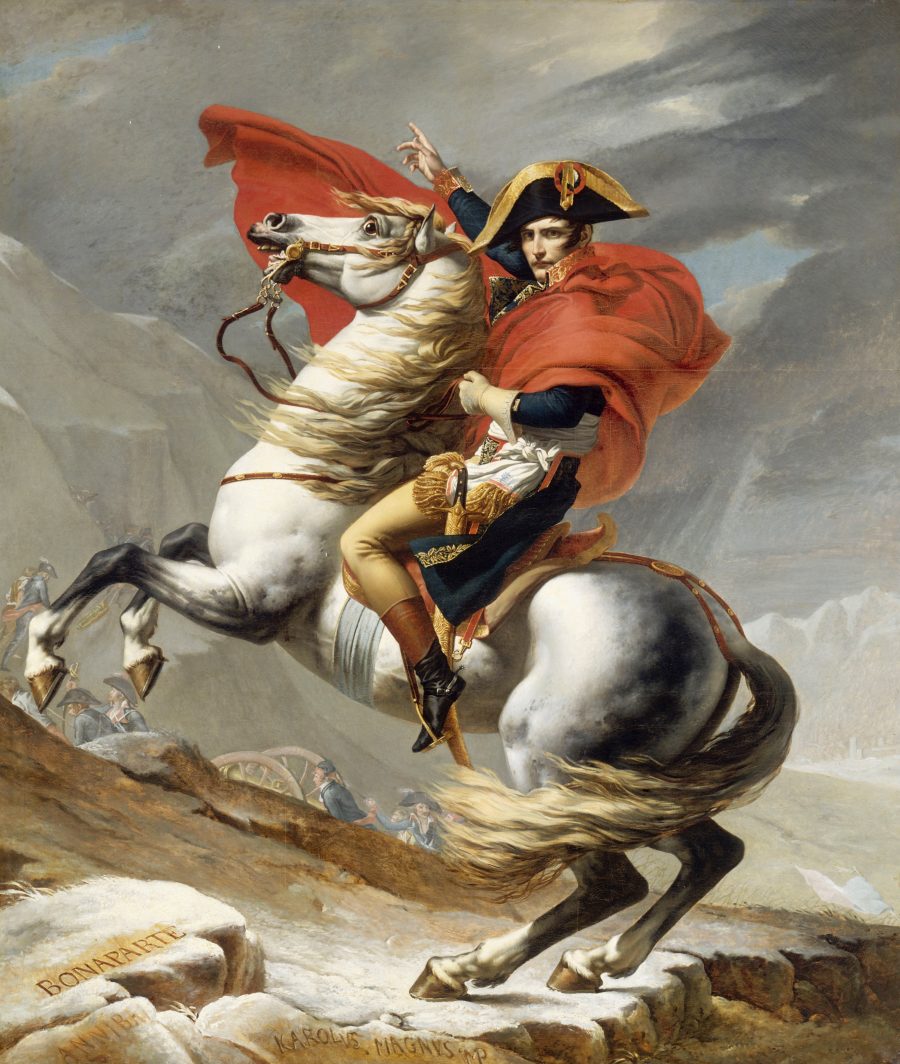
We’re quite familiar with The Emperor Napoleon in His Study at the Tuileries, in which the subject stands in an awkward pose, his hand thrust into his waistcoat. And surely know Napoleon at the Saint-Bernard Pass, above. Here, the finger pointing upward takes on an entirely new resonance than it has in The Death of Socrates. It is the gesture not of a man nobly prepared to leave the world behind, but of one who plans to conquer and subdue it under his absolute rule.
Over the course of this tumultuous year, new CIA director Mike Pompeo has repeatedly indicated that he would move the Agency in a “more aggressive direction.” In response, at least one person took on the guise of former Chilean president Salvador Allende and joked, incredulously, “more aggressive”? In 1973, the reactionary forces of General Augusto Pinochet overthrew Allende, the first elected Marxist leader in Latin America. Pinochet then proceeded to institute a brutal 17-year dictatorship characterized by mass torture, imprisonment, and execution. The Agency may not have orchestrated the coup directly but it did at least support it materially and ideologically under the orders of President Richard Nixon, on a day known to many, post-2001, as “the other 9/11.”
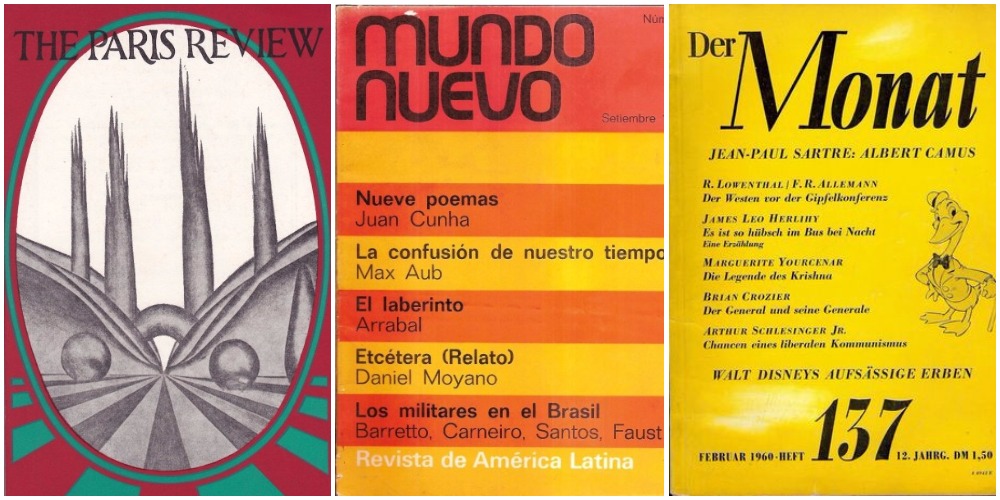
The Chilean coup is one of many CIA interventions into the affairs of Latin America and the former European colonies in Africa and Asia after World War II. It is by now well known that the Agency “occasionally undermined democracies for the sake of fighting communism,” as Mary von Aue writes at Vice, throughout the Cold War years. But years before some of its most aggressive initiatives, the CIA “developed several guises to throw money at young, burgeoning writers, creating a cultural propaganda strategy with literary outposts around the world, from Lebanon to Uganda, India to Latin America.” The Agency didn’t invent the post-war literary movements that first spread through the pages of magazines like The Partisan Reviewand The Paris Reviewin the 1950s. But it funded, organized, and curated them, with the full knowledge of editors like Paris Review co-founder Peter Matthiessen, himself a CIA agent.
The Agency waged a cold culture war against international Communism using many of the people who might seem most sympathetic to it. Revealed in 1967 by former agent Tom Bradenin the pages of the Saturday Evening Post, the strategy involved secretly diverting funds to what the Agency called “civil society” groups. The focal point of the strategy was the CCF, or “Congress for Cultural Freedom,” which recruited liberal and leftist writers and editors, oftentimes unwittingly, to “guarantee that anti-Communist ideas were not voiced only by reactionary speakers,” writes Patrick Iber at The Awl. As Braden contended in his exposé, in “much of Europe in the 1950s, socialists, people who called themselves ‘left’—the very people whom many Americans thought no better than Communists—were about the only people who gave a damn about fighting Communism.”
No doubt some literary scholars would find this claim tendentious, but it became agency doctrine not only because the CIA saw funding and promoting writers like James Baldwin, Gabriel Garcia Márquez, Richard Wright, and Ernest Hemingway as a convenient means to an end, but also because many of the program’s founders were themselves literary scholars. The CIA began as a World War II spy agency called the Office of Strategic Services (OSS). After the war, says Guernica magazine editor Joel Whitney in an interview with Bomb, “some of the OSS guys became professors at Ivy League Universities,” where they recruited people like Matthiessen.
The more liberal guys who were part of the brain trust that formed the CIA saw that the Soviets in Berlin were getting masses of people from other sectors to come over for their symphonies and films. They saw that culture itself was becoming a weapon, and they wanted a kind of Ministry of Culture too. They felt the only way they could get this paid for was through the CIA’s black budget.
McCarthy-ism reigned at the time, and “the less sophisticated reactionaries,” says Whitney, “who represented small states, small towns, and so on, were very suspicious of culture, of the avant-garde, the little intellectual magazines, and of intellectuals themselves.” But Ivy League agents who fancied themselves tastemakers saw things very differently.
Whitney’s book, Finks: How the CIA Tricked the World’s Best Writers, documents the Agency’s whirlwind of activity behind literary magazines like the London-based Encounter, French Preuves, Italian Tempo Presente, Austrian Forum, Australian Quadrant, Japanese Jiyu, and Latin American Cuadernos and Mundo Nuevo. Many of the CCF’s founders and participants conceived of the enterprise as “an altruistic funding of culture,” Whitney tells von Aue. “But it was actually a control of journalism, a control of the fourth estate. It was a control of how intellectuals thought about the US.”
While we often look at post-war literature as a bastion of anti-colonial, anti-establishment sentiment, the pose, we learn from researchers like Iber and Whitney, was often carefully cultivated by a number of intermediaries. Does this mean we can no longer enjoy this literature as the artistic creation of singular geniuses? “You want to know the truth about the writers and publications you love,” says Whitney, “but that shouldn’t mean they’re ruined.” Indeed, the Agency’s cultural operations went far beyond the little magazines. The Congress of Cultural Freedoms used jazz musicians like Louie Armstrong, Dave Brubeck, and Dizzy Gillespie as “goodwill ambassadors” in concerts all over the world, and funded exhibitions of Abstract Expressionists like Mark Rothko, Jackson Pollack, and Willem de Kooning.
The motives behind funding and promoting modern art might mystify us unless we include the context in which such cultural warfare developed. After the Cuban Revolution and subsequent Communist fervor in former European colonies, the Agency found that “soft liners,” as Whitney puts it, had more anti-Communist reach than “hard liners.” Additionally, Communist propagandists could easily point to the U.S.‘s socio-political backwardness and lack of freedom under Jim Crow. So the CIA co-opted anti-racist writers at home, and could silence artists abroad, as it did in the mid-60s when Louis Armstrong went behind the Iron Curtain and refused to criticize the South, despite his previous strong civil rights statements. The post-war world saw thriving free presses and arts and literary cultures filled with bold experimentalism and philosophical and political debate. Knowing who really controlled these conversations offers us an entirely new way to view the directions they inevitably seemed to take.
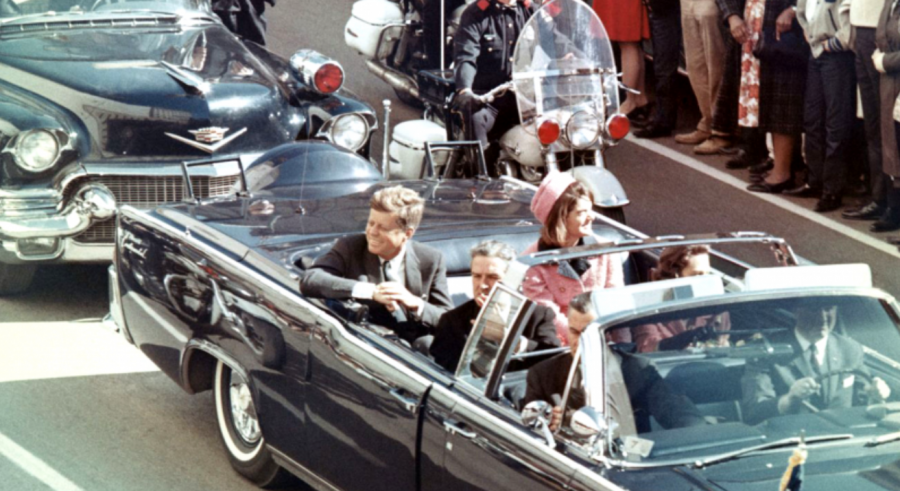
Moments ago, the National Archives released a trove of 2,800 documents that will shed more light on the assassination of John F. Kennedy. According to the Archives, the release includes “FBI, CIA, and other agency documents (both formerly withheld in part and formerly withheld in full) identified by the Assassination Records Review Board as assassination records.” You can find the documents here.
This data dump was meant to include even more documents. But, according to TheNew YorkTimes, Donald Trump “bowed to protests by the C.I.A. and F.B.I. by withholding thousands of additional papers pending six more months of review.” If those ever see the light of day, we’ll let you know.
If you’ve ever deliberately studied the English language — or, even worse, taught it — you know that bottomless aggravation awaits anyone foolish enough to try to explain its “rules.” What makes English so apparently strange and different from other languages, and how could such a language go on to get so much traction all over the world? Whether you speak English natively (and thus haven’t had much occasion to give the matter thought) or learned it as a second language, the five-minute TED-Ed lesson above, written by Yale linguistics professor Claire Bowern and animated by Patrick Smith, will give you a solid start on understanding the answer to those questions and others.
“When we talk about ‘English,’ we often think of it as a single language,” says the lesson’s narrator, “but what do the dialects spoken in dozens of countries around the world have in common with each other, or with the writings of Chaucer? And how are any of them related to the strange words in Beowulf?”
The answer involves English’s distinctive evolutionary path through generations and generations of speakers, expanding and changing all the while. Along the way, it’s picked up words from Latin-derived Romance languages like French and Spanish, a process that began with the Norman invasion of England in 1066. So also emerged Old English, a member of — you guessed it — the Germanic language family, one brought to the British isles in the fifth and sixth centuries. Then, of course, you’ve got the Viking invaders bringing in their Old Norse from the eighth to the eleventh centuries.
English thus came to its characteristically rich (and often confusing) mixture of words drawn from all over the place quite some time ago, leaving modern linguists to perform the quasi-archaeological task of tracing each word back to its origins through its sound and usage. Go far enough and you get to the tongues we call “Proto-Germanic,” spoken circa 500 BC, and “Proto-Indo-European,” which had its heyday six millennia ago in modern-day Ukraine and Russia. English now often gets labeled, rightly or wrongly, a “global language,” but a look into its complicated history — and thus the history of all European languages — reveals something more impressive: “Nearly three billion people around the world, many of whom cannot understand each other, are nevertheless speaking the same words, shaped by 6,000 years of history.”
Based in Seoul, Colin Marshall writes and broadcasts on cities and culture. His projects include the book The Stateless City: a Walk through 21st-Century Los Angeles and the video series The City in Cinema. Follow him on Twitter at @colinmarshall or on Facebook.
We're hoping to rely on loyal readers, rather than erratic ads. Please click the Donate button and support Open Culture. You can use Paypal, Venmo, Patreon, even Crypto! We thank you!
Open Culture scours the web for the best educational media. We find the free courses and audio books you need, the language lessons & educational videos you want, and plenty of enlightenment in between.