Baseball has the great capacity to transcend politics. People on the right love it. (Think George Will, the columnist who finds himself at the center of a hot controversy this week). The same holds true for folks on the left. One leftist with a deep and abiding love for baseball is Fidel Castro. Before he seized power in 1959, Castro spent some time on the diamond. Baseball-Reference.com tells us that Fidel likely “pitched in intramural competition in college for the University of Havana law school.” But “he was not good enough to pitch on the college’s varsity team.” Nor is the long-standing myth true that “Castro tried out for either the New York Yankees or Washington Senators and failed to impress enough to sign a contract.” He was never going to have a big league career. That’s for sure. But once Castro actually rose to power, no one was going to stop him from hitting or pitching in a 1959 charity game. (Watch above.) As they say, sometimes “it’s good to be the king.” Just ask Vladimir Putin, who recently scored 6 goals, and made 5 assists, in a hockey game.
(Be warned, these videos are Not Safe for Work. And unless you can deal with strong language, you should skip watching these clips.)
Last year we featured James Joyce’s “dirty letters” to his wife, originally written in 1909 but not discovered in all their cerebrally erotic glory until this century. For Valentine’s Day, the sketch comedy video site Funny or Die capitalized on the availability of these highly detailed, fantasy-saturated Joycean mash notes by having them read dramatically. For this task the producers rounded up five well-known actors, such as Martin Starr from such comedically respected television shows as Freaks and Geeks and Party Down. You can watch his reading above. “I would like you to wear drawers with three or four frills, one over the other at the knees and up the thighs, and great crimson bows in them, so that when I bend down over you to open them and” — but you don’t just want to read it. You want to hear such a masterpiece performed.
Off raising the children in Trieste, Joyce’s wife Nora wrote replies of a presumably similar ardor-saturated nature. Alas, these remain undiscovered, but that unfortunate fact doesn’t stop actresses as well as actors from providing oral renditions of their own. Just above, we have Paget Brewster from Friends and Criminal Mindsreading aloud another of Joyce’s love letters, one which moves with surprising swiftness from evoking “the spirit of eternal beauty” to evoking “a hog riding a sow.” This series of readings also includes contributions from The Middleman’s Natalie Morales, The Kids in the Hall’s Dave Foley, and Saturday Night Live’s Michaela Watkins. They all reveal that, with his textual creativity as well as his close acquaintance with those places where the romantic meets the repulsive, James Joyce would have made quite a sexter today. You can have that idea for free, literate sketch comedy video producers of the internet.
PS Apologies for the lengthy ads that precede the videos. They come from Funny or Die and we have no control over them.
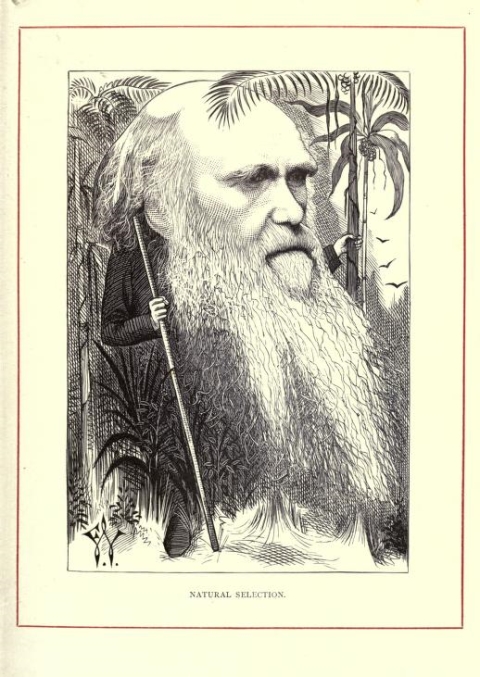
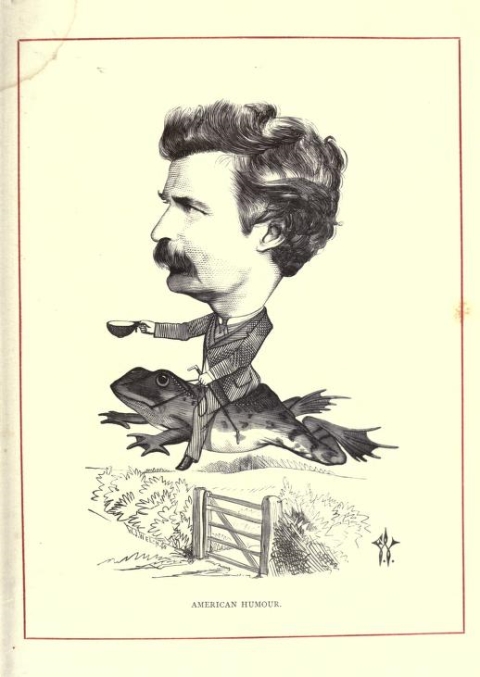
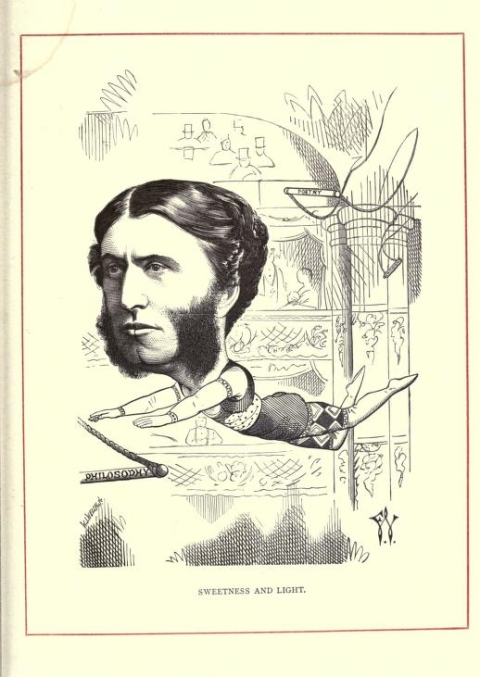
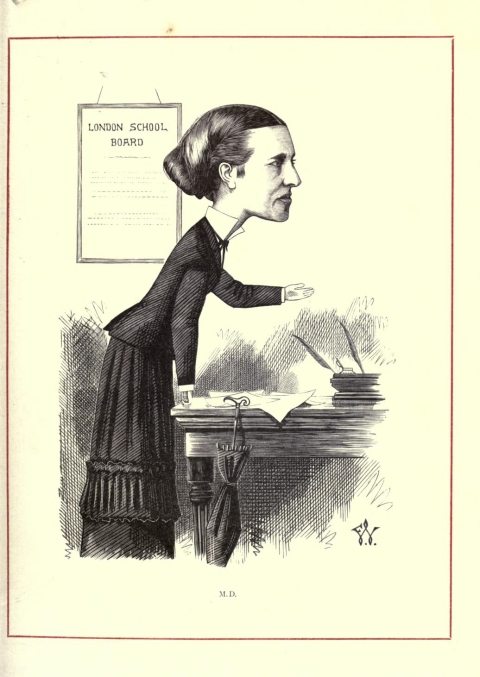
Students and lovers of Victoriana, we have a treat for you. The 1873 book above, Cartoon Portraits and Biographical Sketches of Men of the Day, offers caricatures of forty-nine prominent men, and one woman, of the 19th century, some of them less-than-famous now and some still veritable giants of their respective fields.
Accompanied by lively biographies, the portraits were all drawn by illustrator Frederick Waddy, who is perhaps best known for the drawing on page six of a white-bearded Charles Darwin (above) entitled “Natural Selection”—often reproduced in color and found hanging on the office walls of biology teachers. Darwin appears second in Cartoon Portraits, preceded only by Sir Edward Bulwer-Lytton of “It was a dark and stormy night” fame.
In addition to professor’s offices, you may also encounter some of Waddy’s work at the National Portrait Gallery in London. In his time, Waddy was one of the foremost caricaturists of the day—an important position in periodical publishing before the advent of cheaply mass-reproducible photography. All of the portraits originally appeared in a magazine called Once a Week, founded in a split between Charles Dickens and his publisher Bradbury and Evans, who started the journal with editor Samuel Lucas in 1859 to compete with Dickens’ All the Year Round. Once a Week ran until 1880, publishing pieces on history and current affairs and occasional poems by Tennyson, Swinburne, Dante Rossetti and others. Its popularity was buoyed by Waddy’s drawings and the detailed illustrations of several other graphic artists. Above, see Mark Twain riding his celebrated jumping frog, and just below, poet and critic Matthew Arnold does a high-wire act between two trapezes labelled “Poetry” and “Philosophy.” Twain’s portrait is titled “American Humour”— and he is the only American in the series—and Arnold’s is called “Sweetness and Light.”
Though the book’s title promises only “Men of the Day,” it does include one woman, Dr. Elizabeth Garrett Anderson (below, simply titled “M.D.”), the first Englishwoman to officially work as a physician. Her biographical sketch begins with a long and somewhat tortuous historical defense for female doctors, stating that “social prejudices are almost as hard to eradicate as those of religion. It was not till quite lately that the feeling against woman’s rights as regard education was successfully combated.” Once a Week was a progressive-leaning magazine, its editor a noted abolitionist, and it regularly published the work of women writers like Harriet Martineau, Isabella Blagden, and Mary Elizabeth Braddon, though one wonders why they didn’t warrant caricatures as well.
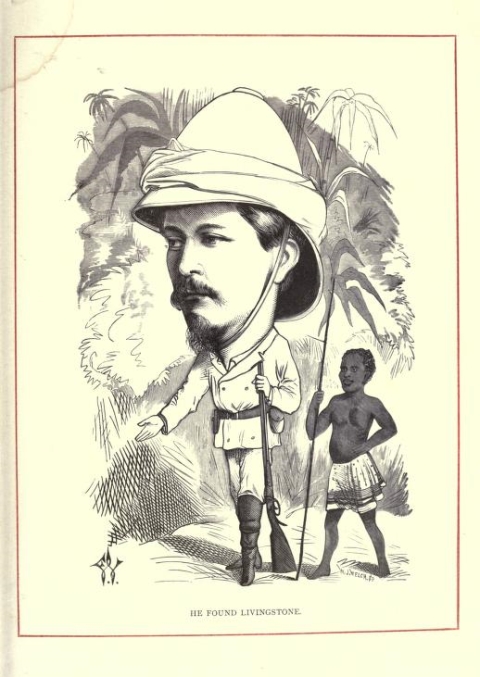
Below, see Waddy’s portrait of central African explorer Henry Morton Stanley, standing twice the height of the native African next to him. It’s a fitting image of colonial ego, though the scene may be drawn after a photo of Stanley with his adopted son Kalulu. The title refers to his search for—and famous exclamation upon discovering—Scottish missionary David Livingstone. All in all, Cartoon Portraits gives us a fascinating look at Victorian visual media and a representative sample of the most popular literary, scientific, and political figures in England during the middle of the century. While the names of Waddy and his fellow comic artists are hardly remembered now, the authors of The Smiling Muse: Victoriana in the Comic Press assert that in their day, “they were the ones who had their fingers on the pulse of what we now call the ‘popular culture’ of the time.” See The Public Domain Review for more highlights from the book.
In Walking in Ruins, novelist and adventurous pedestrian Geoff Nicholson’s book about the on-foot exploration of England and America’s disused places, the author devotes a fascinating section to an Essex “secret nuclear bunker.” Rendered un-secret, and indeed unnecessary, by the end of the Cold War, the whole underground complex underwent conversion into a forlorn tourist attraction. “In some of the bunker’s smaller, emptier rooms, videos were being shown on chunky old TV sets, documentaries related to nuclear war and its survival,” Nicholson writes. “They included the notorious public information series Protect and Survive, twenty short episodes, basic animation, strangely ahead-of-its-time electronic music, and a voice-over by Patrick Allen, deeply unsympathetic and unreassuring, though you imagine he was supposed to be both. The titles in the series included ‘What to Put in Your Fallout Room’ and ‘Sanitation Care and Casualties.’ ”
“ ‘Stay at Home,’ ” Nicholson tells us, “reminded us that fallout ‘can settle anywhere, so no place in the United Kingdom is safer than any other,’ and my favorite single sentence comes from the episode ‘Refuges’: ‘If you live in a caravan or other building of lightweight construction with very little protection against fallout, your local authority will be able to advise you on what to do’ — and there was a cartoon image of a tiny caravan that looked like it might be blown away by a good sneeze, never mind a nuclear explosion.” The compilation above collects 51 minutes of these and other episodes of Protect and Survive, originally commissioned by the British government in the 1970s and meant for transmission only in the case of an imminent nuclear attack on the country. But episodes leaked, and the BBC proceeded to broadcast them absent that immediate threat, thereby ensuring the legacy of this Cold War media artifact beloved of irony-loving Britons — that is to say, Britons — across the country.
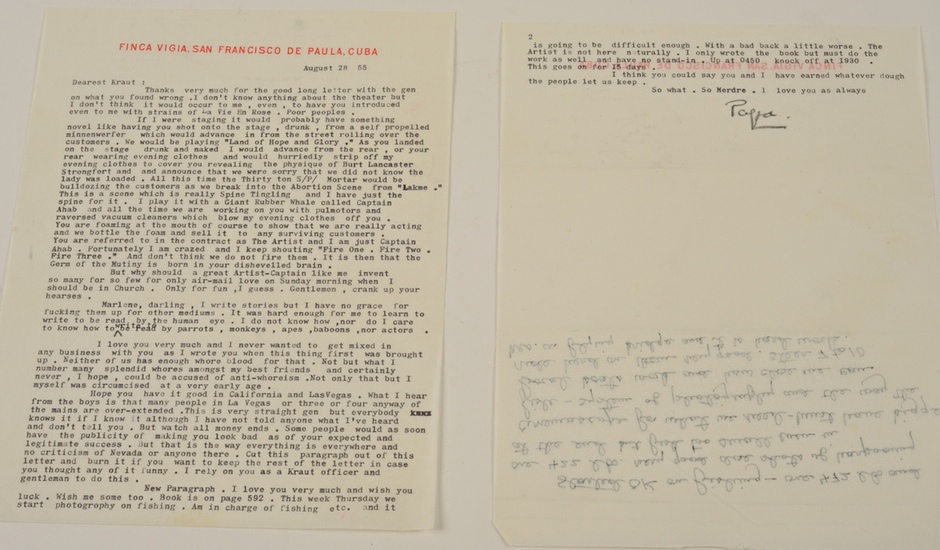
We think today of Ernest Hemingway as that most stylistically disciplined of writers, but it seems that, outside his published work and especially in his personal correspondence, he could cut pretty loose. One particularly vivid example has returned to public attention recently by appearing for sale on a site called auctionmystuff.com: a letter from Hemingway to legendary singer-actress Marlene Dietrich, dated August 28, 1955. “In the intimate, rambling and revealing letter,” writes the Wall Street Journal’s Jonathan Welsh, “Hemingway professes his love for Dietrich a number of times, though the two are said to have never consummated the relationship.” He also, Welsh notes, “talks about staging one of her performances, in which he imagines her ‘drunk and naked.’ ” The full letter, which spares no detail of this elaborate fantasy, runs as follows:
Dearest Kraut :
Thanks very much for the good long letter with the gen on what you found wrong. I don’t know anything about the theater but I don’t think it would occur to me, even, to have you introduced even to me with strains of La Vie En Rose. Poor peoples.
If I were staging it would probably have something novel like having you shot onto the stage, drunk, from a self-propelled minnenwerfer which would advance in from the street rolling over the customers. We would be playing “Land of Hope and Glory.” As you landed on the stage drunk and naked I would advance from the rear, or from your rear wearing evening clothes and would hurriedly strip off my evening clothes to cover you revealing the physique of Burt Lancaster Strongfort and announce that we were sorry that we did not know the lady was loaded. All this time the Thirty ton S/P/ Mortar would be bulldozing the customers as we break into the Abortion Scene from “Lakme.” This is a scene which is really Spine Tingling and I have just the spine for it. I play it with a Giant Rubber Whale called Captain Ahab and all the time we are working on you with pulmotors and raversed (sic) cleaners which blow my evening clothes off you. You are foaming at the mouth of course to show that we are really acting and we bottle the foam and sell it to any surviving customers. You are referred to in the contract as The Artist and I am just Captain Ahab. Fortunately I am crazed and I keep shouting “Fire One. Fire Two. Fire Three.” And don’t think we do not fire them. It is then that the Germ of the Mutiny is born in your disheveled brain.
But why should a great Artist-Captain like me invent so many for so few for only air-mail love on Sunday morning when I should be in church. Only for fun, I guess. Gentlemen, crank up your hearses.
Marlene, darling, I write stories but I have no grace for fucking them up for other mediums. It was hard enough for me to learn to write to be read by the human eye. I do not know how, nor do I care to know how to write to be read by parrots, monkeys, apes, baboons, nor actors.
I love you very much and I never wanted to get mixed in any business with you as I wrote you when this thing first was brought up. Neither of us has enough whore blood for that. Not but what I number many splendid whores amongst my best friends and certainly never, I hope, could be accused of anti-whoreism. Not only that but I was circumcised as a very early age.
Hope you have it good in California and Las Vegas. What I hear from the boys is that many people in La Vegas (sic) or three or four anyway of the mains are over-extended. This is very straightgen but everybody knows it if I know it although I have not told anyone what I’ve heard and don’t tell you. But watch all money ends. Some people would as soon have the publicity of making you look bad as of your expected and legitimate success. But that is the way everything is everywhere and no criticism of Nevada or anyone there. Cut this paragraph out of this letter and burn it if you want to keep the rest of the letter in case you thought any of it funny. I rely on you as a Kraut officer and gentlemen do this.
New Paragraph. I love you very much and wish you luck. Wish me some too. Book is on page 592. This week Thursday we start photography on fishing. Am in charge of fishing etc. and it is going to be difficult enough. With a bad back a little worse. The Artist is not here naturally. I only wrote the book but must do the work as well and have no stand-in. Up at 0450 knock off at I930. This goes on for I5 days.
I think you could say you and I have earned whatever dough the people let us keep.
So what. So Merdre. I love you as always.
Papa
“To him she was ‘my little Kraut,’ or ‘daughter,’ to her he was simply ‘Papa’ — and it was love at first sight when they met aboard a French ocean liner in 1934,” writes TheGuardian’s Kate Connolly of the two icons’ unusual relationship. “Hemingway and Dietrich started writing to each other when he was 50 and she was 47, remaining in close contact until the writer’s suicide in 1961. But they never consummated their love, because of what Hemingway referred to as ‘unsynchronised passion.’ ” A fan of both Hemingway and Dietrich could presumably desire nothing more than one of the original pieces of their correspondence, but this particular letter, with a starting price of $35,000, drew not a single bid — perhaps a sale, like the physical expression of the Old Man and the Sea author and “Lili Marleen” singer’s love, fated never to happen.
“If you remember the ‘60s, you weren’t there.” The quote was supposedly uttered by Grace Slick. Or Paul Kantner. Or Dennis Hopper. The truth is no one really remembers who said it first.
Of course, the “60s” was not simply the decade that came between the ‘50s and the ‘70s but a shorthand for a generational revolt fueled in part by one stupid war and a general disillusionment with consumer capitalism. The ground zero for the “60s,” at least in the United States, was in San Francisco and, at the center of the scene, there was Ken Kesey, the Merry Pranksters and their legendary counterculture bacchanalias called Acid Tests. These happenings featured groovy flashing lights, live music from the likes of The Grateful Dead, and copious amounts of LSD. Up top, Kesey explains the meaning of the Acid Tests for you:
Thanks to the internet, you can experience a bit of what these original hippie fests were like. Above is audio from two shows in January 1966 which had Kesey and longtime Merry Prankster Ken Babbs cracking jokes and dropping truth bombs in between songs from the Grateful Dead. Below is the set list of that show along with the audio of two more shows with Kesey and the Dead. Some of the track listings might be incomplete probably because everyone was having too much fun to take notes. So crank it up and turn on, tune in and drop out.
The Fillmore Acid Test
Fillmore Auditorium, San Francisco, CA
January 8, 1966
1. Stage Chaos/More Power Rap
2. King Bee
3. I’m A Hog For You Baby
4. Caution: Do Not Step On Tracks >
5. Death Don’t Have No Mercy
6. Star Spangled Banner / closing remarks
The Sound City Acid Test
363 6th Street, San Francisco, CA
January 29, 1966
7. Ken Kesey interviewed by Frank Fey
8. Ken Babbs and harmonica
9. Take Two: Ken Kesey
10. Bull
11. Peggy The Pistol
12. One-way Ticket
13. Bells And Fairies
14. Levitation
15. Trip X
16. The End
The Pico Acid Test
Danish Center, Los Angeles, CA
March 12, 1966
1. Viola Lee Blues
2. You See A Broken Heart
3. In The Midnight Hour
[mis-dated, according to David Lemieux, and not corresponding to the vault copy’s setlist; these are probably from 3/19/1966]
The San Francisco State Acid Test
Whatever It Is Festival
San Francisco State University, San Francisco, CA
Stereo Control Room Master (rec. 4:00AM — 6:00AM)
October 2, 1966
4. The Head Has Become Fat Rap
5. A Mexican Story: 25 Bennies
6. A Tarnished Galahad
7. Get It Off The Ground Rap >
8. It’s Good To Be God Rap >
9. Nirvana Army Rap >
10. The Butcher Is Back
11. Acid Test Graduation Announcement
12. Send Me To The Moon >Closing Rap
Credits on 10/2/66:
Voices: Ken Kesey and Hugh Romney
Guitar: Ken Kesey
Violin: Dale Kesey
Organ: Jerry Garcia
Engineering: Steve Newman, Ken Kesey, Mountain Girl
The San Francisco State Acid Test
Whatever It Is Festival
San Francisco State University, San Francisco, CA
October 2, 1966
1. Ken Kesey’s dialogue (isolated remix)
End of Whatever It Is Festival
October 2, 1966
5. Closing Jam
6. Prankster Electronics
Acid Test Graduation Jam
Winterland, San Francisco, CA
October 31, 1966
7. Jam Session (musicians unknown)
from The World Of Acid film soundtrack
Jonathan Crow is a Los Angeles-based writer and filmmaker whose work has appeared in Yahoo!, The Hollywood Reporter, and other publications. You can follow him at @jonccrow.
It is my habit, when travel looms, to case the Internet for obscure museums my destination might have to offer. Once loaded, I fixate. Chat me up about my itinerary, and you will definitely come away with the impression that these offbeat locales are the trip’s primary raison d’être.
It’s shocking how rarely I actually make it to one of these off-the-beaten path gems. Time flies and I rarely travel alone these days.
Take a recent family trip to London. Every time I brought up the Museum of Brands, my husband expressed reservations. “But what is it, exactly, other than a bunch of old labels?” he’d press.
I hemmed and hawed, realizing on the cellular level that neither he nor the kids could see the beauty in old labels. Dinosaurs, maybe. Vespas, no doubt. But old labels? This is how I found myself giving the British Museum nearly three times the Museum of Brand’s admission charge to join a mighty throng of pensioners, squinting at a handful of boring button fragments and a chunk of wood that no longer resembled a Viking Ship.
Next time, I swear…
How fortunate for me and my ilk that Chicago design firm Coudal Partners is committed to laboring far outside its expected scope. In addition to championing Stanley Kubrick and poetry, they’ve taken it upon themselves to consolidate a panoply of digital collections into the Museum of Online Museums. (The preferred acronym is MoOM, FYI.)
Meanwhile, the talk of the town here in New York City is the reappearance of Mmuseumm, an eclectic, non-profit housed in a 60-square-foot Tribeca elevator shaft. MoOM, take note.
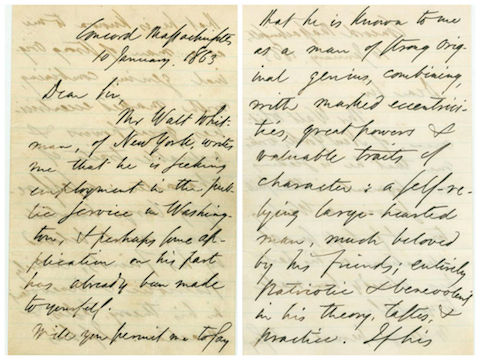
While we often recommend Letters of Note for the hits of history’s most illuminating pieces of incidental correspondence, do consider also making a regular visits to Slate’s history blog The Vault. There you’ll find such written artifacts as the one pictured in part above, astutely written up by occasional Open Culture contributor Rebecca Onion: “In 1863, as he considered seeking a government clerkship, Walt Whitman asked his friend and advocateRalph Waldo Emerson for a letter of recommendation. Emerson, for decades a respected name in American letters, knew the secretaries of state and treasury personally, and Whitman hoped that a note from him would help the younger poet secure steady employment in Washington.” This note runs, in a transcript from the Walt Whitman archive, as follows:
Concord Massachusetts 10 January 2, 1863
Dear Sir,
Mr Walt Whitman, of New York, writes me that he is seeking employment in the public service in Washington, & perhaps some application on his part has already been made to yourself. Will you permit me to say that he is known to me as a man of strong original genius, combining, with marked eccentricities, great powers & valuable traits of character: a self-relying large-hearted man, much beloved by his friends; entirely patriotic & benevolent in his theory, tastes, & practice. If his writings are in certain points open to criticism, they show extraordinary power, & are more deeply American, democratic, & in the interest of political liberty, than those of any other poet.
A man of his talents & dispositions will quickly make himself useful, and, if the government has work that he can do, I think it may easily find that it has called to its side more valuable aid than it bargained for.
With entire respect,
Your obedient servant,
R. W. Emerson.
Hon Salmon P. Chase, | Secretary of the Treasury.
Any of us, I feel certain, would love having such an eloquently praise-filled letter of recommendation sent on our behalf by a friend, a teacher, a former employer, or a pillar of American Transcendentalism. But even with that, the author of Leaves of Grass didn’t find the road to a day gig particularly smooth — in large part, of course, because of having written Leaves of Grass. Whitman, whose “reputation preceded him in job interviews, reported that Salmon Chase, the secretary of the treasury and addressee of this letter, was vehemently against the idea of employing the author of Leaves, a book that celebrated open sexuality in a way that Chase found distasteful.” He would even get fired from another job specifically “because of objections to his poetry.” Well, they can’t say Emerson didn’t warn them about Whitman’s “marked eccentricities” — such as his tendency to write some of the most enduring verse in American history.
We're hoping to rely on loyal readers, rather than erratic ads. Please click the Donate button and support Open Culture. You can use Paypal, Venmo, Patreon, even Crypto! We thank you!
Open Culture scours the web for the best educational media. We find the free courses and audio books you need, the language lessons & educational videos you want, and plenty of enlightenment in between.