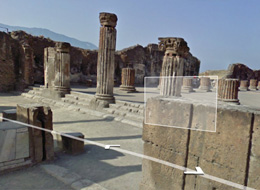
Visit Pompeii (also Stonehenge & Versailles) with Google Street View

pompeiigoogleThe sto­ry of Pom­peii is well known. Back in 79 AD, Mount Vesu­vius erupt­ed and cov­ered the neigh­bor­ing Roman city with 60 feet of ash over the course of two days. The city was wiped out and then entombed for cen­turies, until archae­ol­o­gists start­ed unearthing the ruins in the 18th and 19th cen­turies, offer­ing the mod­ern world an amaz­ing win­dow into the fin­er details of ancient Roman life. (Just for the record, dig­ging con­tin­ues there today, and I even got to do some this past sum­mer.) Today, Google is help­ing deep­en the mod­ern con­nec­tion to the ancient world. Using Google Street view, you can tour Pom­peii in 3D from the com­fort of your own home. To begin walk­ing through the ancient city, just click here.

As a side note, this isn’t the first time Google has used Street View in such a way. You can also find tours of Stone­henge and Louis XIV’s Ver­sailles. Plus, you can also use Google Earth, anoth­er Google pro­gram, to tour the ancient city of Rome.

Final­ly, to dig deep­er into ancient his­to­ry, I’d rec­om­mend look­ing through our pre­vi­ous post, Learn­ing Ancient His­to­ry for Free. This will point you to some of the best free cours­es avail­able on the web.

via Mash­able and the Nation­al Post

The Velvet Revolution Revisited: Havel at Columbia

havel20 years ago, the domi­noes fell in East­ern Europe. Not long after the Wall fell in Berlin, a non-vio­lent rev­o­lu­tion got under­way in Czecho­slo­va­kia. The Vel­vet Rev­o­lu­tion took just a mat­ter of six weeks (Novem­ber 17 — Decem­ber 29, 1989) to unfold. It was fast and blood­less, and it put on the world stage Václav Hav­el — the play­wright, turned anti-Sovi­et dis­si­dent, and soon demo­c­ra­t­ic pres­i­dent of Czecho­slo­va­kia (and lat­er the Czech Repub­lic).

In 2006, Hav­el arrived in New York City, to spend 8 weeks at Colum­bia Uni­ver­si­ty. To mark the occa­sion, the uni­ver­si­ty built a web site called Hav­el at Colum­bia that recon­sid­ered Hav­el and the Vel­vet Rev­o­lu­tion. Along with some intrigu­ing his­tor­i­cal footage, the site fea­tures video inter­views with George H.W. Bush, David Rem­nick (the New York­er edi­tor and author of Lenin’s Tomb), Milos For­man (the great movie direc­tor of Czech her­itage), Edward Albee (the play­wright best known for Who’s Afraid of Vir­ginia Woolf?), George Soros, and Lou Reed. Col­lec­tive­ly, these con­ver­sa­tions give you a very good feel for the man, the artist, and his his­tor­i­cal con­tri­bu­tions. You will also then find a con­ver­sa­tion between Pres­i­dents Bill Clin­ton and Václav Hav­el, and a read­ing of Havel’s play, The Gar­den Par­ty, direct­ed by Israel Horvitz fea­tur­ing Dustin Hoff­man and Robert Klein. Pod­casts of many of these won­der­ful events can be found on iTunes.

Note: The media-packed web­site, Hav­el at Colum­bia, was cre­at­ed by the Colum­bia Cen­ter for New Media for New Media Teach­ing and Learn­ing (CCNMTL) and the Colum­bia Uni­ver­si­ty Arts Ini­tia­tive (CUArts). Great work here, and I want to thank John F. for help­ing us put this post togeth­er.

The Fall of the Berlin Wall in Moving Images

When I trav­eled to East Berlin in 1988, my first time as a young­ster, I read reports of a split between the hard­line East Ger­man regime and the open­ing Sovi­et gov­ern­ment. But nobody real­ly paid much atten­tion to that news. Less than a year lat­er, the Iron Cur­tain and the Berlin Wall would be gone, all of it. Above, you can watch footage that shows how East Ger­mans expe­ri­enced that moment, and here, cour­tesy of @courosa, you can find a series of vivid his­tor­i­cal images that com­mem­o­rate the events that took place 20 years ago.

World War I Remembered in Second Life

Excel­lent find by Stephen Grant… You can now expe­ri­ence the bat­tle lines of World War I in Sec­ond Life, thanks to The First World War Poet­ry Dig­i­tal Archive and the Learn­ing Tech­nolo­gies Group at Oxford Uni­ver­si­ty. WWI shocked the West­ern world with its land­scape-chang­ing war­fare and high tech car­nage. Remem­brances of “The Great War” live on in some remark­able poet­ry and lit­er­a­ture. And now Sec­ond Life too. Find more infor­ma­tion on this project here.

Anne Frank’s Diary: From Reject Pile to Bestseller

We’re lucky to have Anne Frank’s diary — lucky that the diary was ever dis­cov­ered, and lucky, too, that some­one took a chance on pub­lish­ing the even­tu­al best­seller. This is all nice­ly out­lined by Francine Prose, who has a new book out called Anne Frank: The Book, The Life, The After­life. You can lis­ten to her full book talk here. And also be sure to see our recent post show­ing the only exist­ing video of Anne Frank. It’s now online.

by | Permalink | Make a Comment ( 1 ) |

Anne Frank: The Only Existing Video Now Online

There’s no sound, and the clip only runs 20 sec­onds. But this is the only known footage of Anne Frank, and it’s now online. The Anne Frank House does a good job of set­ting the scene for the video tak­en on July 22, 1941. “The girl next door is get­ting mar­ried. Anne Frank is lean­ing out of the win­dow of her house in Ams­ter­dam to get a good look at the bride and groom… At the time of her wed­ding, the bride lived on the sec­ond floor at Mer­wede­plein 39. The Frank fam­i­ly lived at num­ber 37, also on the sec­ond floor. The Anne Frank House can offer you this film footage thanks to the coop­er­a­tion of the cou­ple.” Find more videos on YouTube’s Anne Frank Chan­nel.

If you would like to sup­port the mis­sion of Open Cul­ture, con­sid­er mak­ing a dona­tion to our site. It’s hard to rely 100% on ads, and your con­tri­bu­tions will help us con­tin­ue pro­vid­ing the best free cul­tur­al and edu­ca­tion­al mate­ri­als to learn­ers every­where. You can con­tribute through Pay­Pal, Patre­on, and Ven­mo (@openculture). Thanks!

by | Permalink | Make a Comment ( 9 ) |

When The Wall Comes Tumbling Down: History on YouTube

The Berlin Wall and the Iron Cur­tain col­lapsed a lit­tle more than 20 years ago (August 1989). And even though I watched the events on TV, my mem­o­ry of it all has already start­ed to fade. But that’s where YouTube comes in. Above, a quick refresh­er that makes my day. This clip comes from a larg­er col­lec­tion called 101 His­tor­i­cal Moments You Can Relive on YouTube. Thanks for the heads up on this one.

Watch Malcolm X Debate at Oxford, Quoting Lines from Shakespeare’s Hamlet (1964)

I enjoy replay­ing this vin­tage gem every now and then  — Mal­colm X debat­ing at Oxford Uni­ver­si­ty in 1964. In this clas­sic video, you get a good feel for Mal­colm X’s pres­ence and mes­sage, not to men­tion the social issues that were alive dur­ing the day. You’ll hear X’s trade­mark claim that lib­er­ty can be attained by “what­ev­er means nec­es­sary,” includ­ing force, if the gov­ern­ment won’t guar­an­tee it, and that “intel­li­gent­ly direct­ed extrem­ism” will achieve lib­er­ty far more effec­tive­ly than paci­fist strate­gies. (He’s clear­ly allud­ing to Mar­tin Luther King.) You can lis­ten to the speech in its entire­ty here (Real Audio), some­thing that is well worth doing. But I’d also encour­age you to watch the dra­mat­ic clos­ing min­utes and pay some atten­tion to the nice rhetor­i­cal slide, where X takes lines from Shake­speare’s Ham­let and uses them to jus­ti­fy his “by what­ev­er means nec­es­sary” posi­tion. You’d prob­a­bly nev­er expect to see Ham­let get­ting invoked that way, let alone Mal­colm X speak­ing at Oxford. A won­der­ful set of con­trasts.

“I read once, pass­ing­ly, about a man named Shake­speare. I only read about him pass­ing­ly, but I remem­ber one thing he wrote that kind of moved me. He put it in the mouth of Ham­let, I think, it was, who said, ‘To be or not to be.’ He was in doubt about something—whether it was nobler in the mind of man to suf­fer the slings and arrows of out­ra­geous fortune—moderation—or to take up arms against a sea of trou­bles and by oppos­ing end them. And I go for that. If you take up arms, you’ll end it, but if you sit around and wait for the one who’s in pow­er to make up his mind that he should end it, you’ll be wait­ing a long time. And in my opin­ion, the young gen­er­a­tion of whites, blacks, browns, what­ev­er else there is, you’re liv­ing at a time of extrem­ism, a time of rev­o­lu­tion, a time when there’s got to be a change. Peo­ple in pow­er have mis­used it, and now there has to be a change and a bet­ter world has to be built, and the only way it’s going to be built—is with extreme meth­ods. And I, for one, will join in with anyone—I don’t care what col­or you are—as long as you want to change this mis­er­able con­di­tion that exists on this earth.”

Relat­ed Con­tent:

Free Online Shake­speare Cours­es: Primers on the Bard from Oxford, Har­vard, Berke­ley & More

Hear Allen Ginsberg’s Short Free Course on Shakespeare’s Play, The Tem­pest (1980)

James Bald­win Bests William F. Buck­ley in 1965 Debate at Cam­bridge Uni­ver­si­ty

Albert Ein­stein Called Racism “A Dis­ease of White Peo­ple” in His Lit­tle-Known Fight for Civ­il Rights

by | Permalink | Make a Comment ( 6 ) |

« Go Back — More in this category... »
Quantcast