A quick heads up on a new open educational resource (OER) initiative…
Last week, Amazon announced that it will launch Amazon Inspire, “a free service for the search, discovery, and sharing of digital educational resources.” Once up and running this fall, Inspire will help educators quickly find resources they need in the classroom–for example, free lesson plans, teaching modules, worksheets, digital texts, and more. In large part, much of the content will be provided by schools and educators themselves. Then Amazon will use its services to organize–or even curate–the content, allowing instructors to find appropriate materials in an efficient way. In a press release, Amazon enumerated some of the services the platform will provide. It reads:
Smart search — With smart search, teachers can explore resources by grade level, standard or even from a particular district. Educators can filter search results using more than 10 criteria to find great resources that best fit their needs.
Collections — Educators can group resources into collections. They can describe the collection, curate the resources in it, recommend an order for going through the resources and share the collection with other teachers.
Simple upload — Amazon Inspire offers an easy to use and intuitive upload interface. Educators can drag and drop files they want to share, add basic metadata such as title, description, grade and subject, and publish the content on the service, all in a few minutes.
Customer reviews — Teachers can rate and review resources on Amazon Inspire, helping their colleagues around the country select the best resources for their needs.
Accessibility support — Amazon Inspire has built in accessibility features. For example, educators can navigate Amazon Inspire using popular screen readers and users are also able to indicate the accessibility features of resources they upload.
If you would like to sign up for Open Culture’s free email newsletter, please find it here. It’s a great way to see our new posts, all bundled in one email, each day.
If you would like to support the mission of Open Culture, consider making a donation to our site. It’s hard to rely 100% on ads, and your contributions will help us continue providing the best free cultural and educational materials to learners everywhere. You can contribute through PayPal, Patreon, and Venmo (@openculture). Thanks!
Despite the intensive focus on STEM (as opposed to STEAM—a debate for another day), Americans still find themselves falling far behind in science education. According to the National Math and Science Initiative, U.S. students placed 20th in science in a recent ranking of 34 countries. “The way the U.S. teaches science,” argues Popular Science, “simply doesn’t work…. Since scientists don’t just stand around memorizing stuff, students shouldn’t either.” The approach isn’t only counter to the scientific method; it’s tedious and doesn’t engage that most important of intellectual faculties: curiosity.
The problems are beyond pedagogy, as we know from polls that show upwards of 42% of Americans subscribing to literalist interpretations of their religious texts, and actively rejecting scientific thinking. These cultural roadblocks were very familiar to Carl Sagan, who spent a good part of his career attempting to coax the public out of its belief in a “demon-haunted world.” As a science educator, Sagan not only knew how to draw out the childlike awe in grown-ups, but also how to engage the natural curiosity of children, who—as every parent knows—long to know the why of everything.
Sagan’s first talk “explores the diversity of life on our own planet,” writes the Royal Institution, “and the building blocks behind it.” Then, he moves on to “questioning whether the same organic chemistry is occurring on planets in the outer solar system” in his second lecture, above. In the following three talks, below, Sagan takes us to Mars, a planet he helped explore without ever leaving the ground with his theories in the late 60s about the nature of the planet’s surface—theories later confirmed several years later by the Viking Project. Sagan’s talks below—“The History of Mars,” “Mars Before Viking,” and “Mars After Viking”—share the latest research with his young audience. With models of the planet and the Viking spacecraft, Sagan demonstrates in detail how NASA obtained its data.
The History of Mars
Mars Before Viking
Mars After Viking”>Mars After Viking
In his final Royal Institution Christmas Lecture, below, “Planetary Systems Beyond the Sun,” Sagan ventures far beyond the reach of NASA’s instruments (at the time) to speculate on what might lie beyond the Solar System. But first, he orients us—again using models and space photography—by explaining what a solar system is, and why other systems likely resemble ours. In his own scientific career, Sagan was instrumental in promoting the SETI Institute—which now has a center named after him. He believed unflaggingly in the possibility of extraterrestrial life, which he hypothesized based on many of the observations he shares below.
When Sagan delivered these lectures, the Royal Institution points out, “NASA had only just begun its Voyager program to the furthest planets in our solar system and no extra-solar planets were known to exist. Now, over three decades later, astronomers are looking at planets that lie beyond our solar system to ask the very same question we pondered over Mars: is there life out there?” As you may have heard, NASA’s Kepler mission has discovered a “habitable zone” of planets in another solar system with two suns—a find sure to pique the curiosity of kids of all ages, and one that would have excited Sagan to no end.
See Sagan’s Christmas lectures with better video and audio quality at the Royal Institution’s website, and please—whether you’re a parent, teacher, older sibling, etc.—share these with the kids in your life.
Of course you can! All it takes is a device with a built-in spelling app, an innovation of which no eighth grader in the far western reaches of bluegrass area Kentucky could have conceived back in 1912.
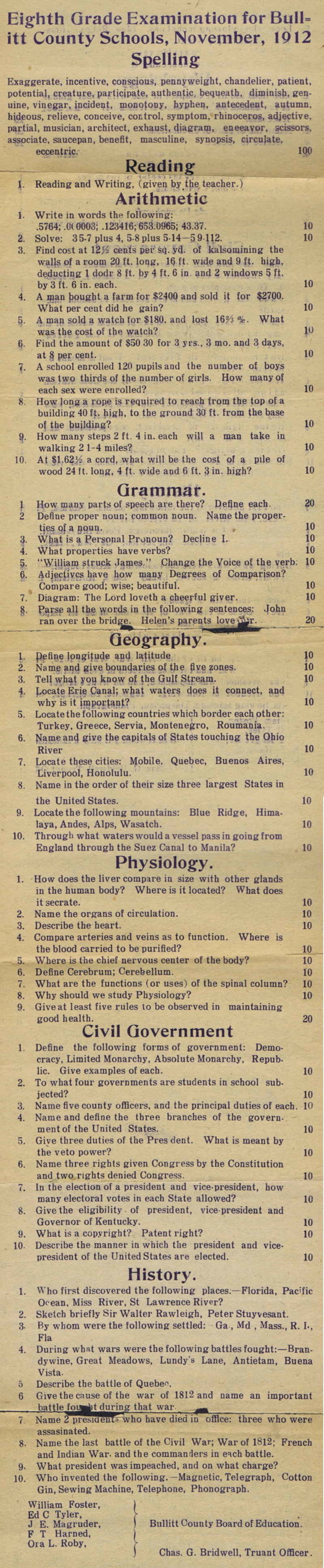
They were, however, expected to be able to name the waters though which an English vessel would pass en route to Manila via the Suez Canal.
Can you?
While we’re at it, how much do you really know about the human liver? Enough to locate it, identify its secretions, and discourse on its size relative to other bodily glands?
If you answered yes, congratulations. There’s a good chance you’d be promoted to high school back in 1912. Not bad for a kid attending a one-room school in rural Bullit County.
And now for some extra credit, name the last battles of the Civil War, the War of 1812, and the French and Indian War. Commanding officers, too…
That’s the sort of multipart question that awaited the eighth graders converging on the Bullit County courthouse for 1912’s common exam, above. The very same courthouse in which the modern day Bullitt County History Museum is located. A civic-minded individual donated a copy of the test to this institution, and the staff put it online, thinking it might be fun for latter-day specimens like you and me to see how we measure up.
So—just for fun—try typing the phrase “commanding officer last battle french & indian war” into your search engine of choice. Forget instant gratification. Embrace the anxiety!
Thank god the Internet was there to define “kalsomining” for me. Even with the aid of a calculator, math is not my strong suit. That said, I’m usually good enough with words to get the narrative gist of any story problem.
Usually.
I confess, I was so demoralized by my ignorance, I couldn’t have dreamed of attempting to figure out how much it would cost to “kalsomine” a 20 x 16 x 9 foot room, especially with a door and window involved.
Fortunately, the Bullit County Genealogical Society has seen fit to provide an online answer sheet, a digital luxury that would have gobsmacked their forebears.
SPOILER: $8.01. That’s the amount it would’ve cost to kalsomine your room at 1912 prices. (A steal, considering that a quart of White Wash Pickling Water Based Stain will run you $12.37 a quart at a nationally known hardware superstore today.)
Go ahead, take that test.
If you quail at the prospect of faring poorly against a rural 1912 eighth grader, just imagine how well he or she would do, teleported to 2016, and forced to contend with such mysteries as cyber bullying, gender politics, and offensive eggplant emojis…
Ayun Halliday is an author, illustrator, and Chief Primatologist of the East Village Inky zine. She lives in fear that her youngest child will pen a memoir titled I Was a Homeschooled 8th Grader and Other Chillling True Life Tales. Follow her @AyunHalliday
Gather round, children and listen to Grandma reminiscin’ ‘bout the days when studying comics meant changing out of your pajamas and showing up at the bursar’s office, check in hand.
Actually, Grandma’s full of it. Graphic novels are enjoying unprecedented popularity and educators are turning to comics to reach reluctant readers, but as of this writing, there still aren’t that many programs for those interested in making a career of this art form.
At the very least, you’ll learn a thing or two about layout, the relationship of art to text, and using compression to denote the passage of time.
It’s the sort of nitty gritty training that would benefit both veterans and newbies alike.
Ready to sign up? The free course, which starts in February, will require approximately 10 hours per week. The syllabus is below.
Session 1: Defining Comics
Identify key relationships in sample texts & demonstrate the use of various camera angles on a comics page
Session 2: Comics Relationships
Create Text-Image and Image-Image Panels
Session 3: Time And Space
One Second, One Hour, One Day Comics Challenge
Session 4: Layout And Grid Design
Apply multiple panel grids to provided script
Session 5: Thumbnails
Create thumbnail sketches of a multipage scene
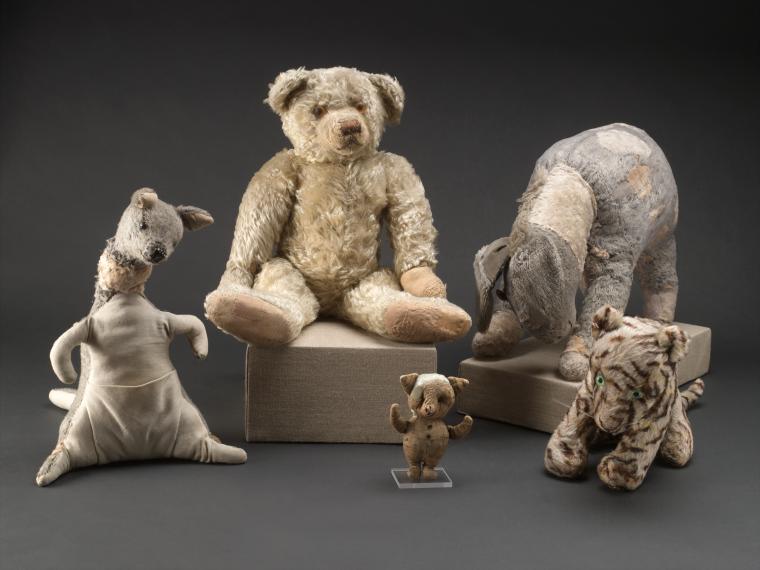
In the picture above, you can see the original Winnie the Pooh bear, joined by his friends Tigger, Kanga, Eeyore, and Piglet. They all now live at The New York Public Library, where kids and adults can see them on display. It should be noted that Roo isn’t in the picture because he was lost a long time ago. Meanwhile you won’t find Owl or Rabbit, because they weren’t originally based on stuffed animals.
If you would like to sign up for Open Culture’s free email newsletter, please find it here. It’s a great way to see our new posts, all bundled in one email, each day.
If you would like to support the mission of Open Culture, consider making a donation to our site. It’s hard to rely 100% on ads, and your contributions will help us continue providing the best free cultural and educational materials to learners everywhere. You can contribute through PayPal, Patreon, and Venmo (@openculture). Thanks!
In English-speaking countries where Christmas is celebrated, A Christmas Carol, Charles Dickens’ secular Victorian tale of a Grinch restored to holiday cheer, usually plays some part.
How many children have been traumatized by Marley’s Ghost in the annual rebroadcast of the half hour, 1971 animated version, featuring the voices of Alistair Sim and Michael Redgrave as Scrooge and Bob Cratchit?
Personally, I lived in mortal fear of the cowled Ghost of Christmas Yet to Come from Scrooge, a movie musical version starring Albert Finney.
And in some lucky families, an older relative with a flair for the theatrical reads the story aloud, preferably on the actual day.
It’s a tradition that Charles Dickens himself observed. It must’ve been a very picturesque scene, with his wife and all ten of their children gathered around. (Presumably his mistress was not included in the festivities).
Eventually, the torch was passed to the next generation, who mimicked and preserved the cadences favored by the master.
Dickens great-granddaughter, novelist Monica Dickens, who narrated a condensed version of the classic tale in 1984, above, was schooled in the family interpretation by her grandfather, Henry Fielding Dickens, who said of his famous father:
I remember him as being at his best either at Christmas time or at other times when Gad’s Hill was full of guests, for he loved social intercourse and was a perfect host. At such times he rose to the very height of the occasion, and it is quite impossible to express in words his geniality and brilliancy amid a brilliant circle.
Before the reading, Ms. Dickens shares some charming anecdotes about the original publication, but those with limited time and/or a Scrooge-like aversion to jolly intros can skip ahead to 7:59, when Big Ben chimes to signal the start of the story proper.
Cartoonist turned educator Lynda Barry is again permitting the world at large to freely audit one of her fascinating University of Wisconsin-Madison classes via her Tumblr. (To get to the start of the class, click here and then scroll down the page until you reach the syllabus, then start working your way backwards.)
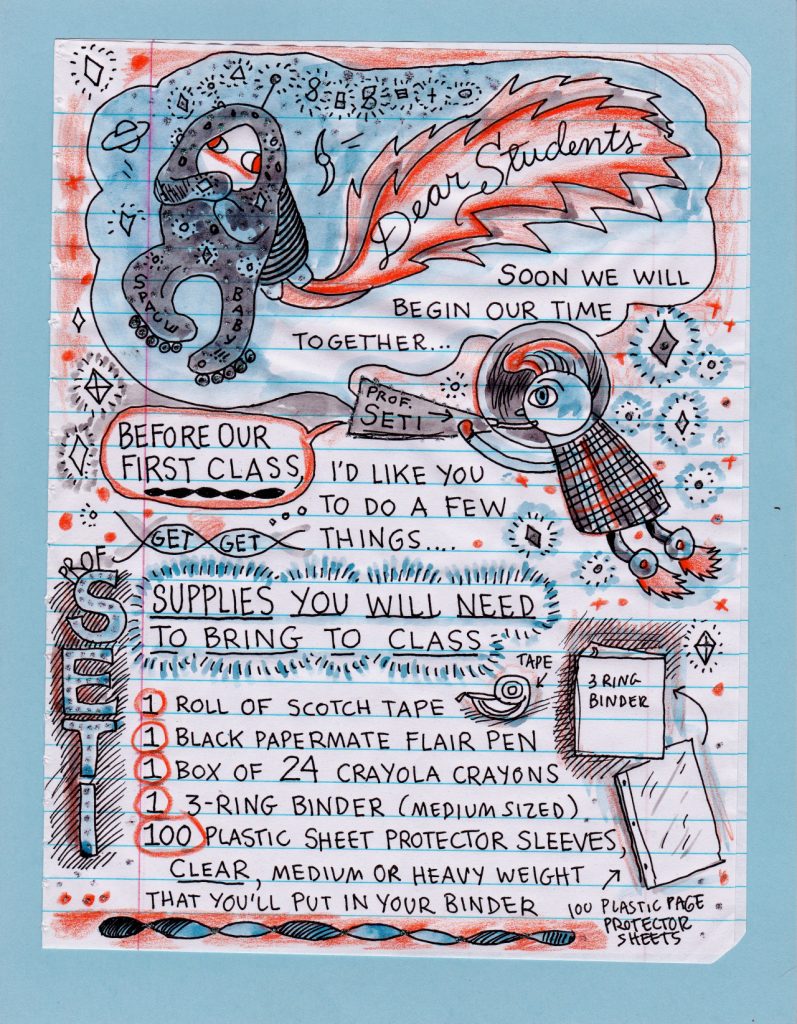
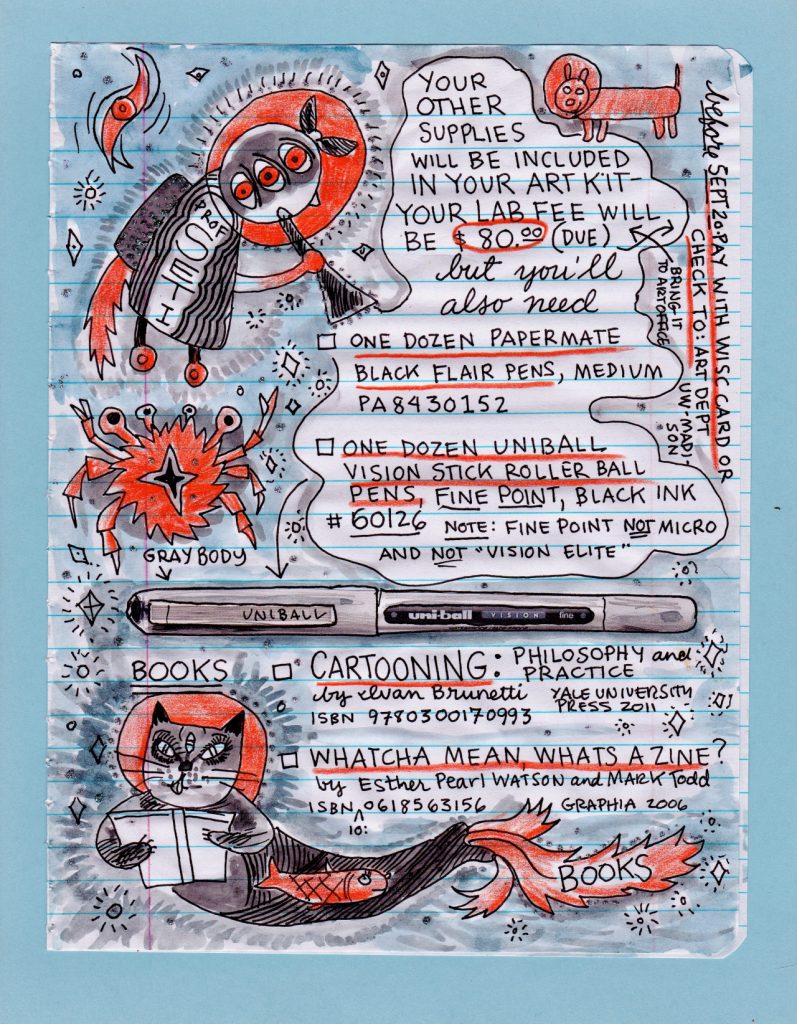
As in previous classes, the syllabus, above, spells out a highly specialized set of required supplies, including a number of items rarely called for at the college level.
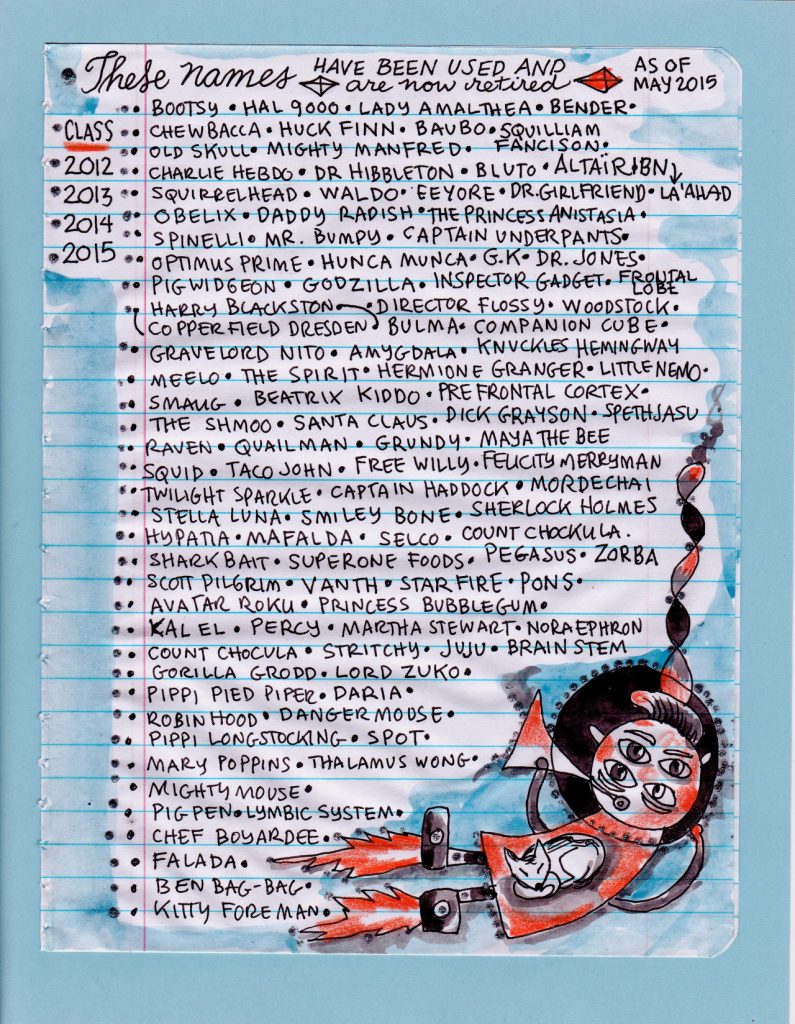
It’s become a time honored tradition for Barry’s students to adopt new names by which to refer to each other in-class, something they’ll enjoy hearing spoken aloud. For “Making Comics,” Barry is flying under the handle Professor SETI (as in “search for extraterrestrial intelligence”), telling the class that “images are the ETI in SETI.”
The students have responded with the following handles: Chef Boyardee, Ginger, Lois Lane, Rosie the Riveter, Regina Phalange, Arabella, Snoopy, Skeeter, Tigger, Arya Stark, Nala, Nostalgia, Akira, Lapus Lazuli, The Buffalo,Mr. November, The Short Giraffe, Nicki Minaj, Neko, Vincent Brooks, Regular Sized Rudy, and Zef.
(Sounds like a rough and ready crew. What name would you choose, and why?)
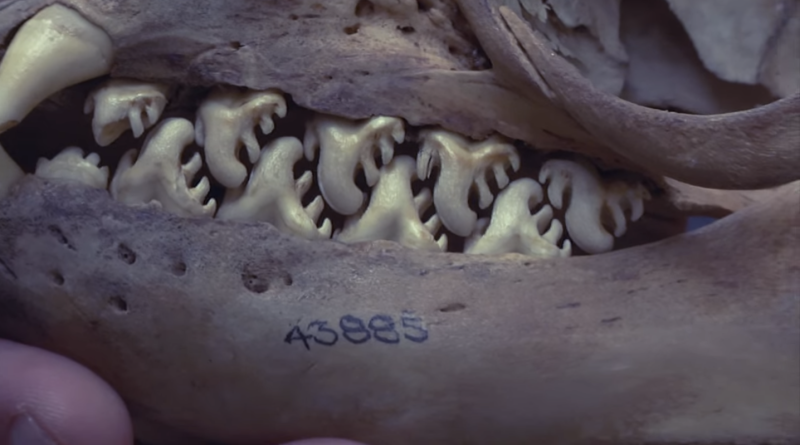
As usual, Barry draws inspiration from the dizzying bounty of images available on the net, bombarding her pupils with findings such as the lobed teeth of the crab-eater seal, above.
What to do with all of these images? Draw them, of course! As Barry tells her students:
Drawing is a language. It’s hard to understand what that really means until you’ve ‘spoken’ and ‘listened’ to it enough in a reliable regular way like the reliable regular way we will have together this semester.
That’s an important definition for those lacking confidence in their drawing abilities to keep in mind. Barry may revere the inky blacks of comics legend Jaime Hernandez, but she’s also a devotee of the wild, unbridled line that may be a beginner’s truest expression. (Stick figures, however, “don’t cut it.”) To her way of thinking, everyone is capable of communicating fluently in visual language. The current crop of student work reveals a range of training and natural talent, but all are worthy when viewed through Barry’s lens.
The teacher’s philosophy is the binding element here, but don’t fret if you are unable to take the class in person:
We rarely speak directly about the work we do in our class though we look at it together. We stare at it and sometimes it makes us laugh or we silently point out some part of it to the classmate beside us. To be able to speak this unspoken language we need to practice seeing (hearing) the way it talks.
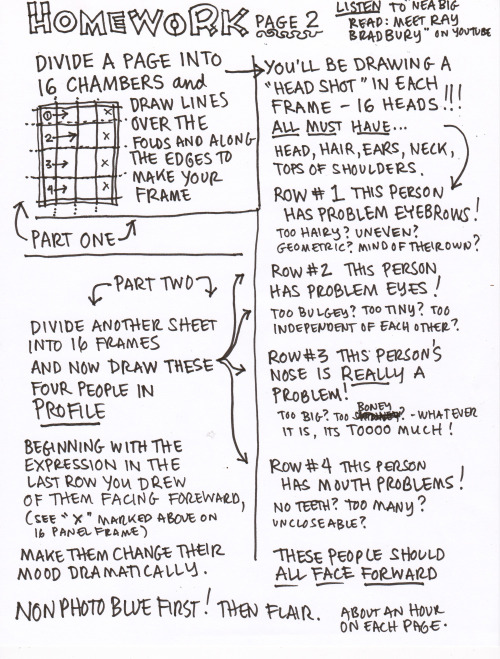
That earlier-alluded-to rigor is no joke. Daily diary comics, 3 minute self portraits on index cards, pages folded to yield 16 frames in need of filling, and found images copied while listening to prescribed music, lectures, and readingsare a constant, non-negotiable expectation of all participants. Her methodology may sound goose‑y but it’s far from loose‑y.
In other words, if you want to play along, prepare to set aside a large chunk of time to complete her weekly assignments with the vigor demanded of non-virtual students.
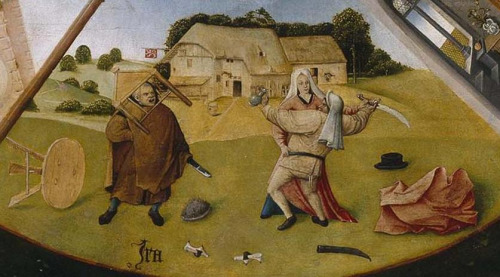
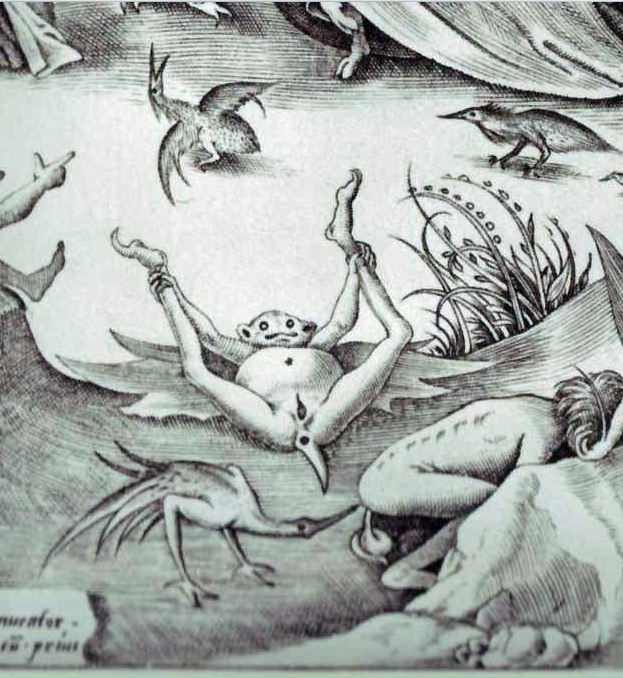
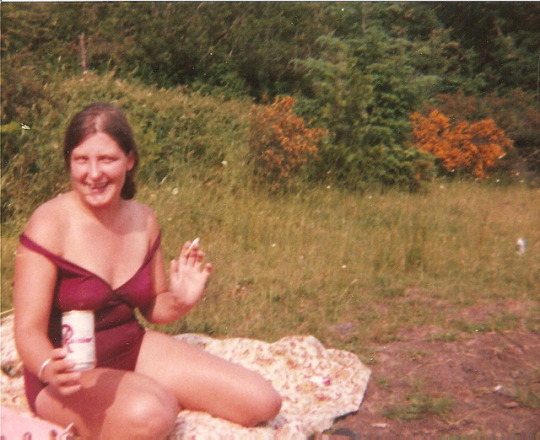
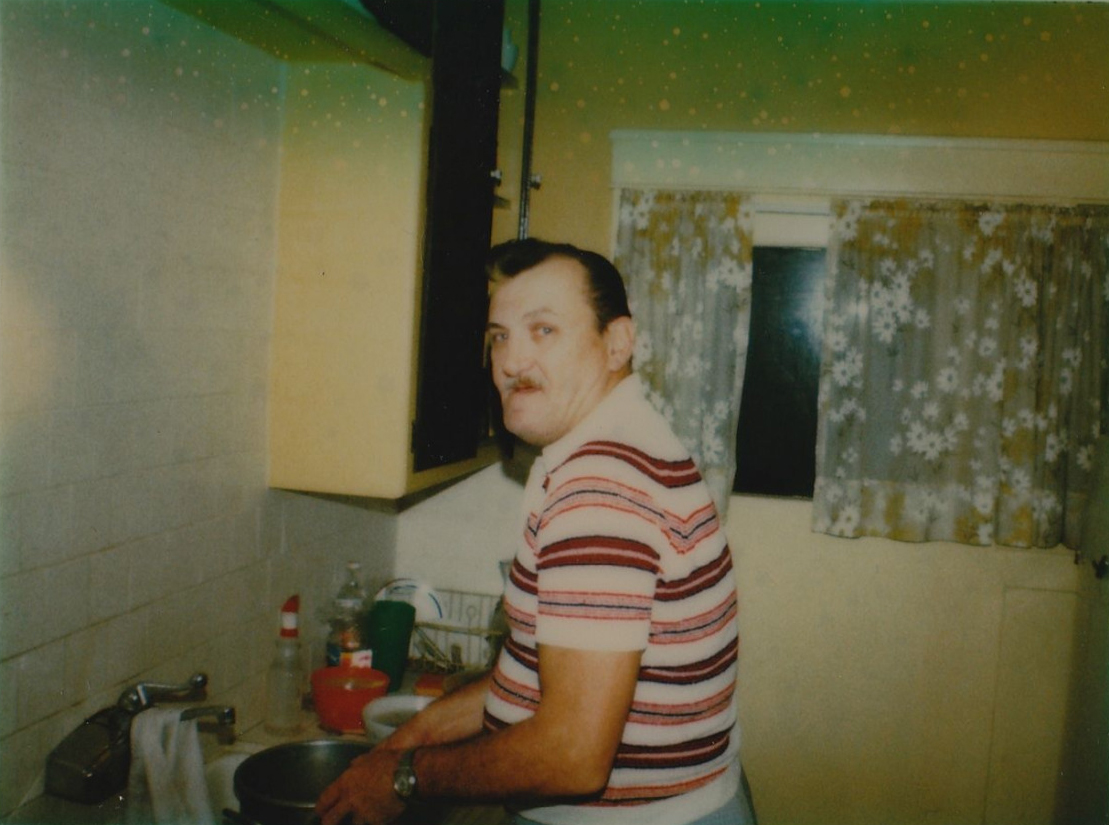
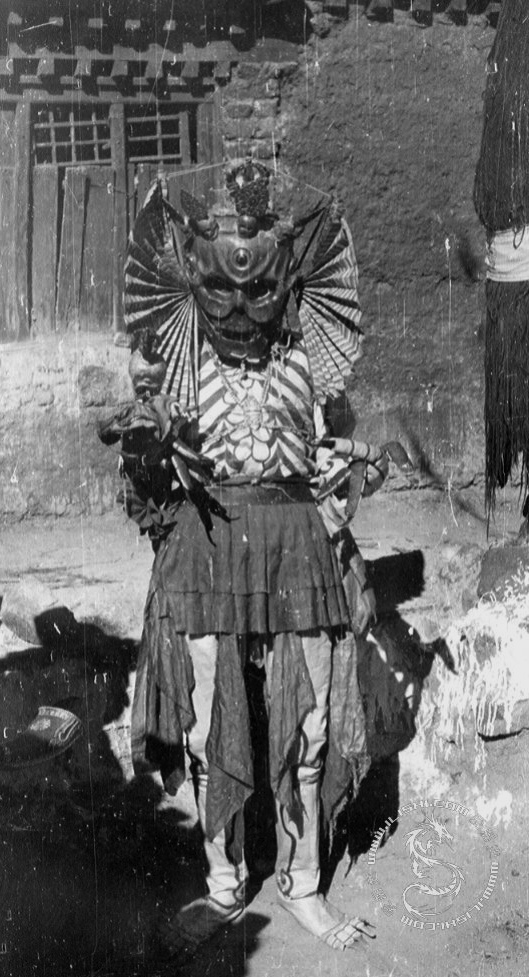
Those who aren’t able to commit to going the distance at this time can reconstruct the class later. Barry leaves both the assignments and examples of student work on her Tumblr for perpetuity. (You can see an example here.) For now, try completing the 20 minute exercise using the assigned image above, or by choosing from one of her “extra credit” images, below:
Set timer for three minutes and begin this drawing using a yellow color pencil. Try to draw as much of the drawing as you can in three minutes. You can draw fast, and in a messy way, The important thing is to get as much covered as you can in three minutes. You can color things in if you like. Look for the darkest areas of the photo and color those in.
Set a timer for another three minutes and using your non-dominant hand, draw with orange or color pencil to draw the entire drawing again, drawing right on top of the first drawing layer. The lines don’t have to match or be right on top of each other, you can change your mind as you add this layer. You can move a bit to the right rather than try to draw directly onto the first set of lines.
Set a timer for another 3 minutes and use a red pencil and draw it again, using you dominant hand, adding another layer to the drawing. Again, you don’t have to follow your original lines. Just draw on top of them.
Set a timer for another 3 minutes and use a dark green pencil to draw the entire drawing one more time on top of all the others.
Set a timer for 8 minutes and use a dark blue pencil to draw it one more time.
Spend the last 8 minutes inking the image in with your uniball pen. Remember that solid black is the very last thing you’d do given your time limit. You want to make sure to draw all the parts of the picture first.
Code.org, a non-profit dedicated to expanding access to computer science, has created a fun way for students to learn the basics of coding. Teaming up with Disney and Lucasfilm, they’ve launched Star Wars: Building a Galaxy with Code, a tutorial designed to teach students to write JavaScript as they guide Star Wars characters through a fun mission. The module is designed for kids 11 and up. (Adults, that could definitely apply to you.) There’s also a separate beginner’s tutorial for kids between the ages of 6 and 10.
More Code.org tutorials can be found here. And you’ll find other introductory coding courses (some designed with an older demographic in mind) in the Relateds below.
We're hoping to rely on loyal readers, rather than erratic ads. Please click the Donate button and support Open Culture. You can use Paypal, Venmo, Patreon, even Crypto! We thank you!
Open Culture scours the web for the best educational media. We find the free courses and audio books you need, the language lessons & educational videos you want, and plenty of enlightenment in between.