William Faulkner attended the University of Mississippi and lasted only three semesters. He skipped classes, managed to pull a D in English, and then dropped out in 1920.
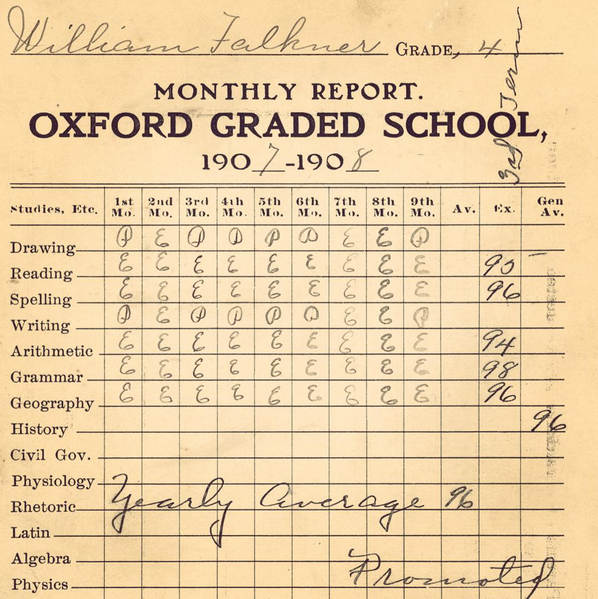
A far cry from his academic performance in 1907–1908 when, as a fourth grader, he got mostly E’s (presumably meaning “Excellent”), a yearly average of 96, and a high grade of 98 in Grammar.
A quick follow up: Back in January, Colin Marshall took you inside Haruki Murakami’s unexpected stint as an agony uncle, writing an online advice column called Mr. Murakami’s Place. According to his publisher, readers sent the Japanese novelist 37,465 questions (see a few in translation here), and he penned responses to 3,716 of them — answering questions like: “30 is right around the corner for me, but there isn’t a single thing that I feel like I’ve accomplished.… What should I do with myself?” Or, “My wife quite frequently belches right near the back of my head when she passes behind me… Is there something I can do to stop my wife’s belching?”
Luckily, at least for Japanese readers, Murakami has now published his responses (all of them) as an ebook in Japan. And it’s been climbing Japan’s Kindle bestseller list. Currently, there are no plans to release Mr. Murakami’s Place — The Complete Edition– in English. The task of translating what amounts to an 8‑volume set of books would be formidable. And yet somehow — like most things Murakami has written — I suspect the collection will eventually see the light of day in English-speaking markets.
You can always learn something from your elders. 8‑year-olds can learn from 9‑year-olds, just as octogenarians can learn from nonagenarians. With age comes wisdom. That’s the premise of this touching, farewell video from the CBC’s WireTap radio show, which is about to go off the air.
If you would like to support the mission of Open Culture, consider making a donation to our site. It’s hard to rely 100% on ads, and your contributions will help us continue providing the best free cultural and educational materials to learners everywhere. You can contribute through PayPal, Patreon, and Venmo (@openculture). Thanks!
For a certain period of time, it became very hip to think of classic tattoo artist Norman “Sailor Jerry” Collins as the epitome of WWII era retro cool. His name has become a prominent brand, and a household name in tattooed households—or those that watch tattoo-themed reality shows. But I submit to you another name for your consideration to represent the height of vintage rebellion: Maud Wagner (1877–1961).
No, “Maud” has none of the rakish charm of “Sailor Jerry,” but neither does the name Norman. I mean no disrespect to Jerry, by the way. He was a prototypically American character, tailor-made for the marketing hagiography written in his name. But so, indeed, was Maud Wagner, not only because she was the first known professional female tattoo artist in the U.S., but also because she became so, writes Margo DeMello in her history Inked, while “working as a contortionist and acrobatic performer in the circus, carnival, and world fair circuit” at the turn of the century.
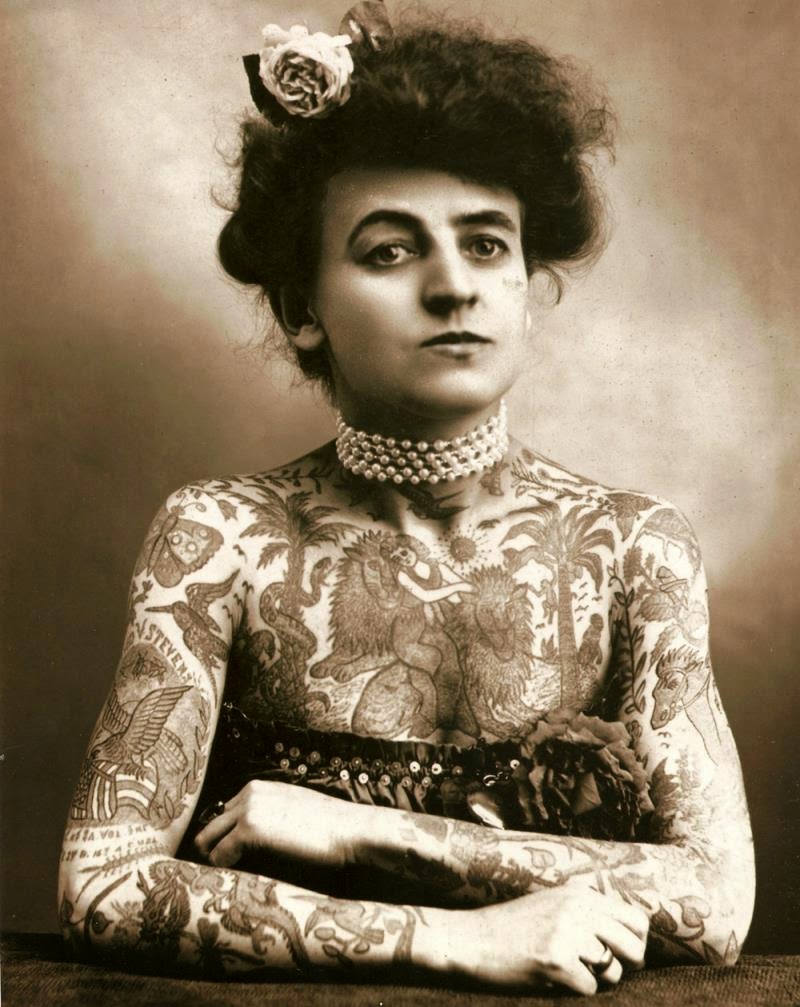
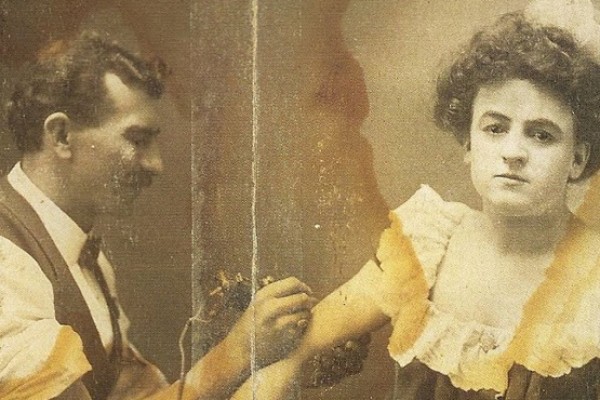
Aside from the cowboy perhaps, no spirit is freer in our mythology than that of the circus performer. The reality of that life was of course much less romantic than we imagine, but Maud’s life—as a side show artist and tattooist—involves a romance fit for the movies. Or so the story goes. She learned to tattoo from her husband, Gus Wagner, an artist she met at the St. Louis World’s Fair, who offered to teach her in exchange for a date. As you can see in her 1907 picture at the top, after giving her the first tattoo, he just kept going (see the two of them above). “Maud’s tattoos were typical of the period,” writes DeMello, “She wore patriotic tattoos, tattoos of monkeys, butterflies, lions, horses, snakes, trees, women, and had her own name tattooed on her left arm.”
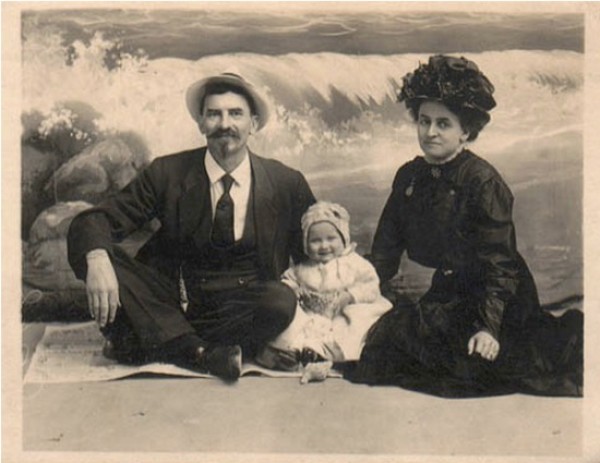
Unfortunately there seem to be no images of Maud’s own handiwork about, but her legacy lived on in part because Gus and Maud had a daughter, given the endearing name Lovetta (see the family above), who also became a tattoo artist. Unlike her mother, however, Lovetta did not become a canvas for her father’s work or anyone else’s. According to tattoo site Let’s Ink, “Maud had forbidden her husband to tattoo her and, after Gus died, Lovetta decided that if she could not be tattooed by her father she would not be tattooed by anyone.” Like I said, romantic story. Unlike Sailor Jerry, the Wagner women tattooed by hand, not machine. Lovetta gave her last tattoo, in 1983, to modern-day celebrity artist, marketing genius, and Sailor Jerry protégée Don Ed Hardy.
The cultural history of tattooed and tattooing women is long and complicated, as Margot Mifflin documents in her 1997 Bodies of Subversion: A Secret History of Women and Tattoo. For the first half of the twentieth century, heavily-inked women like Maud were circus attractions, symbols of deviance and outsiderhood. Mifflin dates the practice of displaying tattooed white women to 1858 with Olive Oatman (above), a young girl captured by Yavapis Indians and later tattooed by the Mohave people who adopted and raised her. At age nineteen, she returned and became a national celebrity.
Tattooed Native women had been put on display for hundreds of years, and by the turn of the 20th century World’s Fair, “natives… whether tattooed or not, were shown,” writes DeMello, in staged displays of primitivism, a “construction of the other for public consumption.” While these spectacles were meant to represent for fairgoers “the enormous progress achieved by the West through technological advancements and world conquest,” another burgeoning spectacle took shape—the tattooed lady as both pin-up girl and rebellious thumb in the eye of imperialist Victorianism and its cult of womanhood.
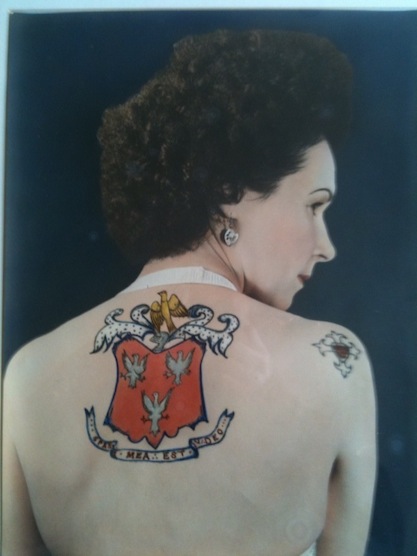
And here I submit another name for your consideration: Jessie Knight (above, with a tattoo of her family crest), Britain’s first female tattoo artist and also onetime circus performer, who, according to Jezebel, worked in her father’s sharp shooting act before striking out on her own as a tattooist. The Mary Sue quotes an unnamed source who writes that her job was “to stand before [her father] so that he could hit a target that was sometimes placed on her head or on an area of her body.” Supposedly, one night he “accidentally shot Jesse in the shoulder,” sending her off to work for tattoo artist Charlie Bell. As the narrator in the short film below from British Pathe puts it, Knight (1904–1994), “was once the target in a sharp shooting act. Now she’s at the business end of the target no more.”
The remark sums up the kind of agency tattooing gave women like Knight and the independence tattooed women represented. Popular stereotypes have not always endorsed this view. “Over the last 100 years,” writes Amelia Klem Osterud in Things & Ink magazine, “a stigma has developed against tattooed women—you know the misconceptions, women with tattoos are sluts, they’re ‘bad girls,’ just as false as the myth that only sailors and criminals get tattoos.”
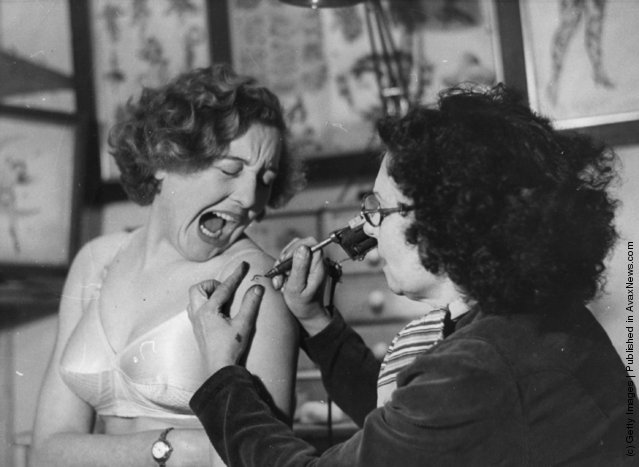
Jesse Knight—as you can see from the Pathe film and the photo above from 1951—was portrayed as a consummate professional, and in fact won 2nd place in a “Champion Tattoo Artist of all England” in 1955. See several more photos of her at work at Jezebel, and see a gallery of tattooed—and tattooist—ladies from Mifflin’s book at The New Yorker, including such characters as Botticelli and Michelangelo-tattooed Anna Mae Burlington Gibbons, Betty Broadbent, the tattooed contestant in the first televised beauty pageant, and Australian tattoo artist Cindy Ray, “The Classy Lassy with the Tattooed Chassis.” Now there’s a name to remember.
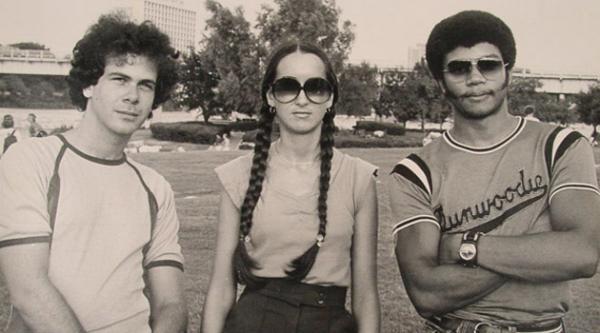
Last year, we revisited the high school days of Neil deGrasse Tyson. Growing up in New York City during the 1970s, Tyson attended Bronx Science (class of ’76), ran an impressive 4:25 mile, captained the school’s wrestling team, and, he fondly recalls, wore basketball sneakers belonging to the Knick’s Walt “Clyde” Frazier. Tyson was, of course, also a precocious student. Famously, Carl Sagan recruited Tyson to study with him at Cornell. But Tyson politely declined and went to Harvard for his undergraduate studies. Then, he headed off to Texas, to start his PhD at UT-Austin. That’s where the photo, taken circa 1980, captures him above — hanging out with friends, and looking hipper than your average astrophysics student.
This photo (now making the rounds on Reddit) originally appeared in a 2012 article published in the Alcalde, the alumni magazine of The University of Texas. To the magazine’s credit, the article takes an unvarnished look at Tyson’s “failed experiment” in Texas. The piece starts with the lede “Neil deGrasse Tyson, MA ’83, is the public face of science. But he says his success has nothing to do with UT.” And, from there, it recounts how professors and university police immediately stereotyped him.
The first comment directed to me in the first minute of the first day by a faculty member I had just met was, ‘You must join the department basketball team!
or
I was stopped and questioned seven times by University police on my way into the physics building. Seven times. Zero times was I stopped going into the gym—and I went to the gym a lot. That says all you need to know about how welcome I felt at Texas.
But the real problem wasn’t race. According to Tyson, “there was simply no room for me to be the full person that I was.” “An obsessive focus on one thing at a time; a strong connection to pop culture, from the moonwalk to the Rubik’s cube; and a refusal to put research first: these traits contributed to Tyson’s failure at UT,” concludes the Alcalde. They also allowed him to flourish later in life.
After his “advisors dissolved his dissertation committee—essentially flunking him,” Tyson transferred to Columbia, earned his PhD in 1988, and became the greatest popularizer of science since Carl Sagan. We like stories with happy endings.
Read more about Tyson’s experience in Texas at the Alcalde.
The assignment wasn’t as easy as he’d anticipated, the telegenic chef confesses before whipping up a lovely brown miche that appears far more mouth watering than the carbonized round found in the Herculaneum oven.
His recipe could be mistaken for modern sourdough, but he also has a go at several details that speak to bread’s role in ancient Roman life:
Its perimeter has a cord baked in to provide for easy transport home. Most Roman homes were without ovens. Those who didn’t buy direct from a bakery took their dough to community ovens, where it was baked for them overnight.
The loaf was scored into eight wedges. This is true of the 80 loaves found in the ovens of the unfortunate baker, Modestus. Locatelli speculates that the wedges could be used as monetary units, but I suspect it’s more a business practice on par with pizza-by-the-slice.
The crust bears a telltale stamp. Locatelli takes the opportunity to brand his with the logo of his Michelin-starred restaurant, Locanda Locatelli. His inspiration is stamped ‘Property of Celer, Slave of Q. Granius Verus.’ To me, this suggests the possibility that the bread was found in a communal oven.
Locatelli also introduces a Flintstonian vision when he alludes to specially-devised labor saving machines to which Roman bakers yoked “animals,” presumably donkeys…or knowing the Romans and their class system, slaves.
His published recipe is below. Here is a conversion chart for those unfamiliar with metric measurements.
INGREDIENTS
400g biga acida (sourdough)
12g yeast
18g gluten
24g salt
532g water
405g spelt flour
405g wholemeal flour
Melt the yeast into the water and add it into the biga. Mix and sieve the flours together with the gluten and add to the water mix. Mix for two minutes, add the salt and keep mixing for another three minutes. Make a round shape with it and leave to rest for one hour. Put some string around it to keep its shape during cooking. Make some cuts on top before cooking to help the bread rise in the oven and cook for 30–45 minutes at 200 degrees.
For an even more artisanal attempt (and extremely detailed instructions) check out the Artisan Pompeii Miche recipe on the Fresh Loaf bread enthusiast community.
When you think of Audrey Hepburn, you think of Roman Holiday, the 1953 film that launched her career. How can you forget Hepburn as Princess Anne? Originally, the part was written for Elizabeth Taylor, then a major star. But something happened during the casting that changed all of that. In his biography of Ms. Hepburn, the author Barry Paris writes:
Her Roman Holiday test took place at Pinewood Studio in London, September 18, 1951, under [Thorold] Dickinson’s direction. “We did some scenes out of the script,” he said, but “Paramount also wanted to see what Audrey was actually like not acting a part, so I did an interview with her. We loaded a thousand feet of film into a camera and every foot of it went on this conversation. She talked about her experiences in the war, the Allied raid on Arnhem, and hiding out in a cellar. A deeply moving thing.”
Later, so the story goes, the director William Wyler watched the footage (shown above) in Rome and found it irresistible. He claimed: “She had everything I was looking for: charm, innocence and talent. She also was very funny. She was absolutely enchanting, and we said, ‘That’s the girl!’ ”
In watching the footage, one thing will leap out. Hepburn’s adolescence was hardly suited for a princess. Living in the Dutch town of Arnhem during World War II, she experienced the harsh German occupation firsthand and suffered from malnutrition, acute anemia, respiratory problems, and edema by the war’s end. It was a formative experience that later made her a devoted activist for children’s rights.
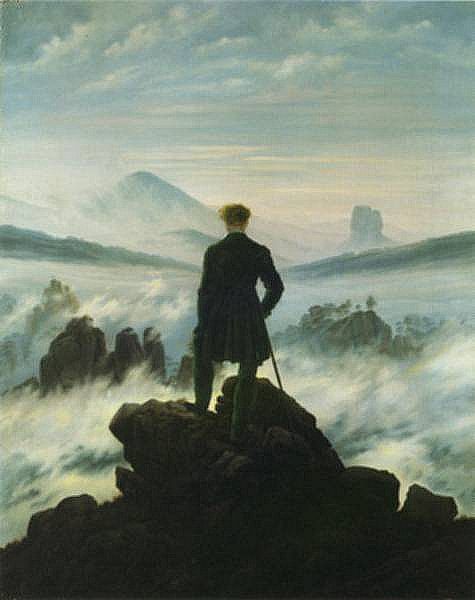
Of all the philosophical concepts Immanuel Kant is known for, the one I’ve had to struggle the least to grasp is his description of the sublime, a state in which we are overawed by the scale of some great work of man or nature. It’s an experience, in typical Kantian fashion, that he explains as being not about the thing itself, but rather the idea of the thing. Yet the concept of the sublime isn’t his. Philosophers from the Greek teacher Longinus in the 1st century to Edmund Burke and other English Enlightenment thinkers in Kant’s own 18th century have had their take on it. For the classical writers, the sublime was rhetorical, for the Brits, it was empirical. But above all, the sublime is peak aesthetics—a supra-rational experience of art or nature one cannot get one’s head around. To be so fully absorbed, so stricken with awe, wonder, and, yes, even fear—all of these philosophers believed in some fashion—is to have an experience critical to transcending our limitations.
We may not, in either common speech or academic philosophy, talk much about the sublime these days, but whatever we call the feeling of being absorbed in art, music, or nature, it turns out to have physical benefits as well as mental and emotional. “There seems to be something about awe,” says professor of psychology Dacher Keltner. “It seems to have pronounced impact on markers related to inflammation.”
In other words, immersing yourself in art or nature is good for the joints, and it could possibly preempt various diseases triggered by inflammation. Keltner and his fellow researchers at UC Berkeley conducted a study which found that “awe, wonder and beauty promote [lower and overall] healthier levels of cytokines”—proteins that “signal the immune system to work harder.” He goes on to say that “the things we do to experience these emotions—a walk in nature, losing oneself in music, beholding art—has [sic] a direct influence upon health and life expectancy.”
Never mind that Kant and Burke thought of the sublime and the beautiful as two very different things. Whether we become totally overwhelmed by, or just find deep appreciation in an aesthetic experience, the emotions produced “might be just as salubrious as hitting the gym,” writes Hyperallergic. That may seem a crude way of thinking about the spiritual and emotional grandeur of the sublime, but it brings our physical being into the discussion in ways many philosophers have neglected. Granted, the researchers themselves admit the causal link is uncertain: it might be better health that leads to more experiences of awe, and not the other way around. But certainly no harm—and a great deal of good—can come from conducting the experiment on yourself. Read an abstract (or purchase a copy) of the Berkeley team’s article here, and learn more about their work with the University’s Greater Good Science Center, which aims to “sponsor groundbreaking scientific research into social and emotional well-being.”
We're hoping to rely on loyal readers, rather than erratic ads. Please click the Donate button and support Open Culture. You can use Paypal, Venmo, Patreon, even Crypto! We thank you!
Open Culture scours the web for the best educational media. We find the free courses and audio books you need, the language lessons & educational videos you want, and plenty of enlightenment in between.

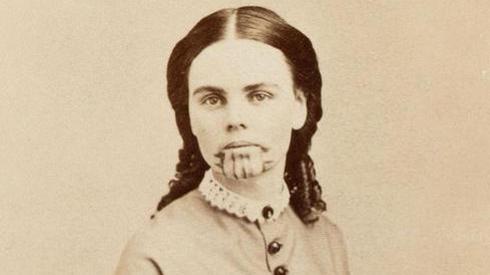
 . For the first half of the twentieth century, heavily-inked women like Maud were circus attractions, symbols of deviance and outsiderhood. Mifflin dates the practice of displaying tattooed white women to 1858 with