Several years ago, an interviewer asked Stephen Fry to look backward — to reflect on his life and answer this question, “What do you wish you had known when you were 18”? What lessons would you draw in hindsight? Some of his answers included:
Don’t set goals for yourself, particularly material ones. They’re disastrous and will keep you from becoming who you really are.
Keep your ego in check. You’ll be better liked, and more opportunities will come your way.
Get outside your comfort zone by traveling to distant lands and reading books in a serendipitous way.
Be a giver, not a taker. It’s more rewarding.
In the clip above, Gay Byrne, a broadcaster with RTÉ, now asks Fry to look forward and answer another question: Suppose there is a God, and you arrive at the Pearly Gates, what would you say to him, her or it? Fry, an avowed secular humanist, isn’t throwing God any softballs: Why create a world where kids have bone cancer? Why create insects that burrow into children’s eyes and render them blind? Why create a world with so much pain, misery and injustice in it? As he answers these questions, and concludes that such a God (were it to exist) would be nothing short of maniacal, Byrne’s face contorts, revealing his discomfort. You can watch other scenes from the interview here, and catch Fry’s animated primers on secular humanism here.
Ah, the joys of dining at a new friend’s home, knowing sooner or later, one’s hostess’ bladder or some bit of last minute meal preparation will dictate that one will be left alone to rifle the titles on her bookshelf with abandon. No medicine cabinet can compete with this peek into the psyche.
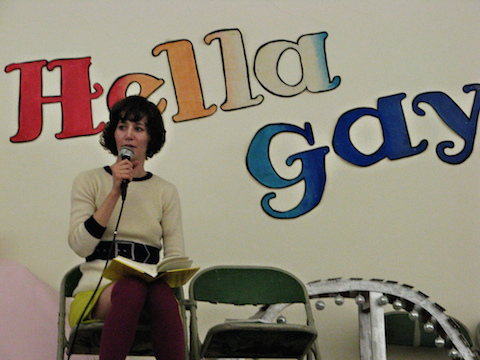
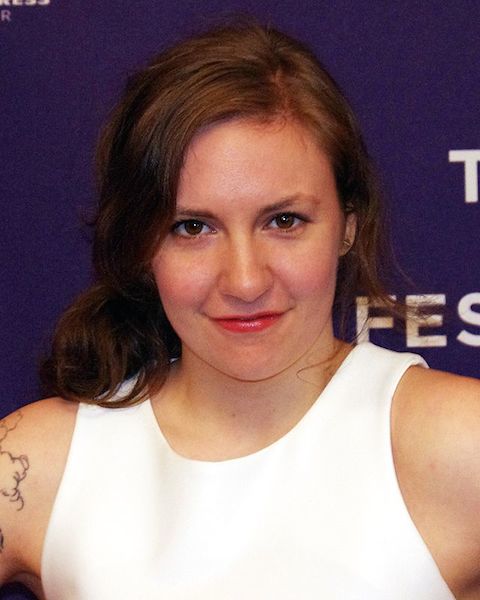
Pity that some of the people whose bookshelves I’d be most curious to see are the least likely to open their homes to me. That’s why I’d like to thank The Strand bookstore for providing a virtual peek at the shelves of filmmakers-cum-authors Miranda July and Lena Dunham. (Previous participants in the Authors Bookshelf series include just-plain-regular authors George Saunders, Edwidge Danticat and the late David Foster Wallace whose contributions were selected by biographer D.T. Max.)
I wish Dunham and July had offered up some personal commentary to explain their hand-picked titles. (Surely their homes are lined with books. Surely each list is but a representative sampling, one shelf from hundreds. Hmm. Interesting. Did they run back and forth between various rooms, curating with a vengeance, or is this a case of whatever happened to be in the case closest at hand when deadline loomed?)
Which book’s a longtime favorite?
Which the literary equivalent of comfort food?
Are there things that only made the cut because the author is a friend?
Both women are celebrated storytellers. Surely, there are stories here beyond the ones contained between two covers.
But no matter. The lack of accompanying anecdotes means we now have the fun of inventing imaginary dinner parties:
ME: (flustered) Oh, ha ha, yes! Alex! … I sent him a Facebook request and he accepted.
LENA DUNHAM: (mutters under her breath)
ME: Design Sponge? Really? What’s someone in your shoes doing with a bunch of DIY decorating books?
LENA DUNHAM: (coldly) Research.
Actually, maybe it is better to admire one’s idols’ bookshelves from afar.
I’m chagrined that I don’t recognize more of their modern fiction picks. That wasn’t such a problem when I was measuring myself against the 430 books on Marilyn Monroe’s reading list.
Thank heaven for old standbys like Madame Bovary.
In all sincerity, I was glad that Dunham didn’t try to mask her love of home decor blog books.
One’s shelves, after all, are a matter of taste. So, celebrate the similarities, take their recommendations under advisement, see below and read what you like!
The Girls’ Guide to Hunting and Fishing — Melissa Bank
A Little History of the World — E. H. Gombrich
Anne of Green Gables — L.M. Montgomery
Apartment Therapy Presents: Real Homes, Real People, Hundreds of Real Design Solutions — Maxwell Gillingham-Ryan
Ariel: The Restored Edition — Sylvia Plath
Bad Feminist: Essays — Roxane Gay
Bastard Out of Carolina (20th Anniversary Edition) — Dorothy Allison
Blue is the Warmest Color — Julie Maroh
Brighton Rock — Graham Greene
Cavedweller - Dorothy Allison
Country Girl: A Memoir — Edna O’Brien
Crazy Salad and Scribble Scribble: Some Things About Women and Notes on Media — Nora Ephron
Design Sponge at Home — Grace Bonney
Dinner: A Love Story: It All Begins at the Family Table — Jenny Rosenstrach
Eleanor & Park — Rainbow Rowell
Eloise — Kay Thompson
Eloise In Moscow — Kay Thompson
Eloise In Paris — Kay Thompson
Fanny At Chez Panisse — Alice Waters
Goodbye, Columbus and Five Short Stories — Philip Roth
Holidays on Ice — David Sedaris
Important Artifacts and Personal Property from the Collection of Lenore Doolan and Harold Morris, Including Books, Street Fashion, and Jewelry — Leanne Shapton
Lentil — Robert McCloskey
Love Poems — Nikki Giovanni
Love, an Index (McSweeney’s Poetry Series) — Rebecca Lindenberg
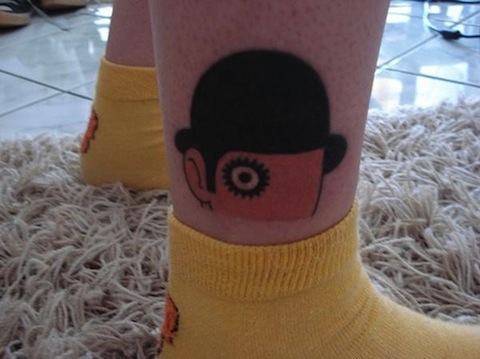
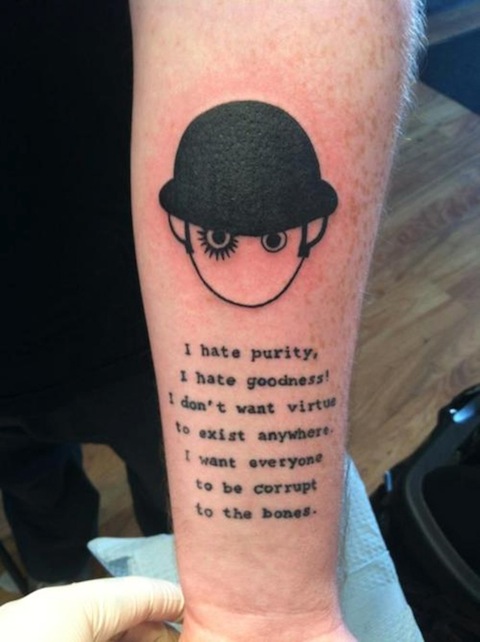
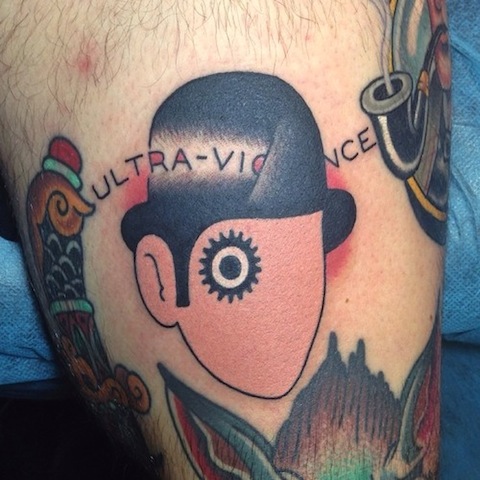
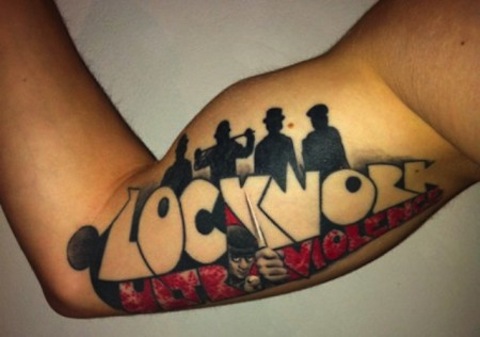
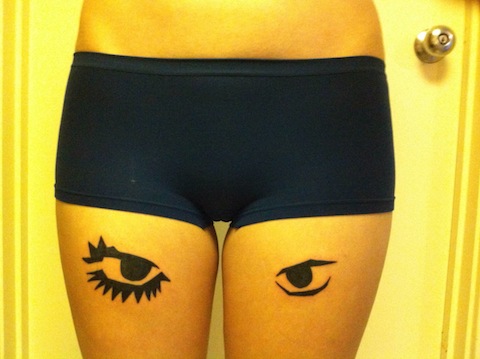
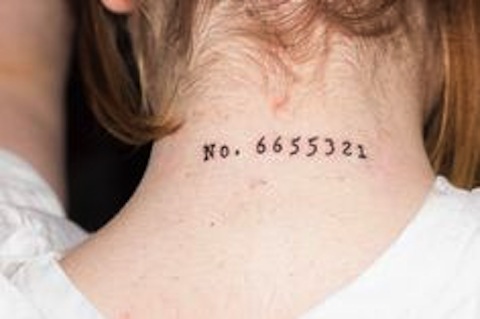
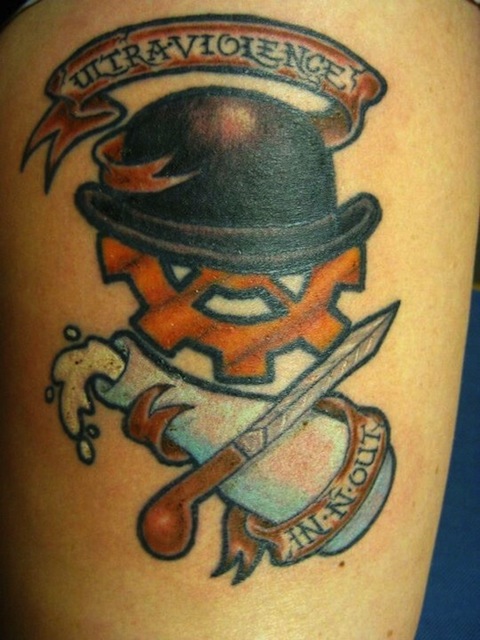
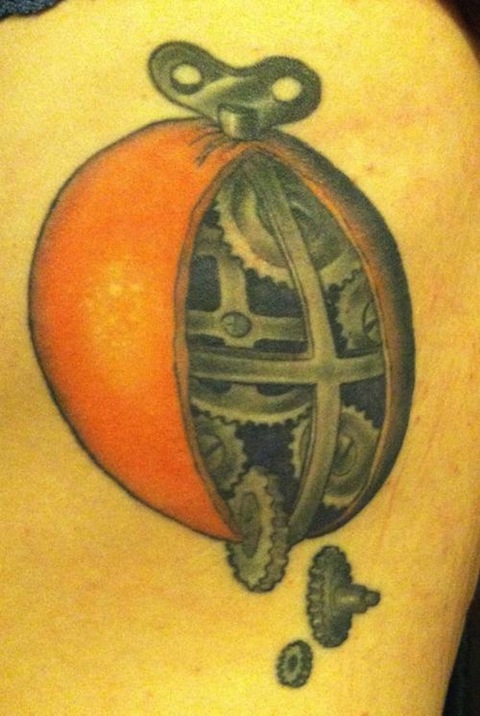
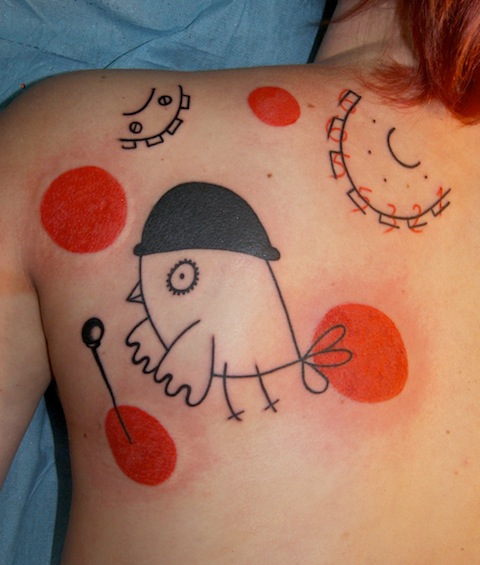
Alex, the protagonist of Anthony Burgess’ A Clockwork Orange takes teenage rebellion to psychotic extremes, but one act he and hisdroogs never indulge in is getting tattooed. It doesn’t even seem to be on their radar. How different things were in 1962, when the book was published!
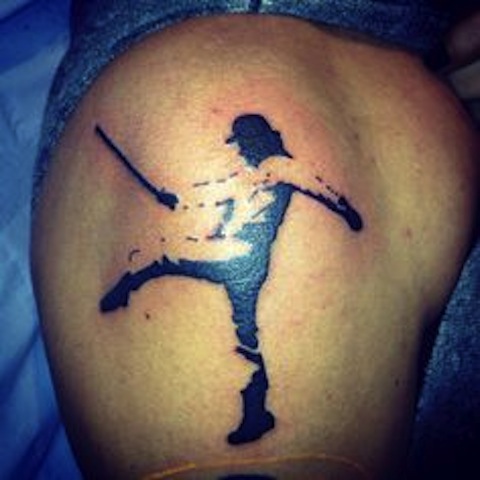
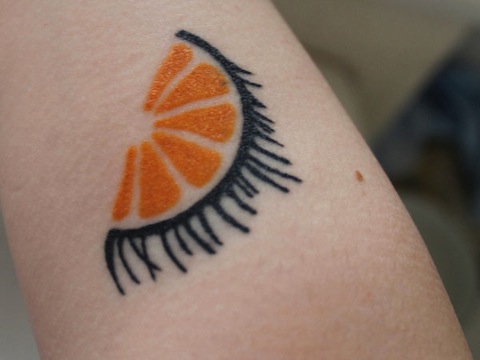
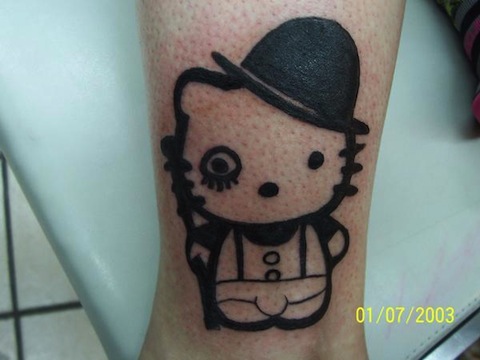
It’s also just one of many Clockwork Orange-inspired images that decorates fans’ hides now that tattooing has hit the mainstream. What would Alex think?
The little monster’s ego would’ve have relished the notoriety, but I bet he’d have had a snicker, too, at the lengths to which eager chellovecks and devotchkas will go. It’s the kind of thing his dim droogie Dim would do—mark himself up permanent when he could’ve just as well have bought a totebag.
Whether or not you personally would consider making a salute to A Clockwork Orange a lifelong feature of your birthday suit, it’s hard not to admire the commitment of the passionate literature and film lovers who do.
In assembling the gallery below, we’ve opted to forgo the photorealistic portraits of McDowell—particularly the ones that recreate the aversion therapy scene—in favor of the graphic, the creative, the jaw dropping, the sly… and the unavoidable Hello Kitty mash up, which we’re kind of hoping washes off.
Jean Cocteau was a great many things to a great many people—writer, filmmaker, painter, friend, and lover. In the latter two categories he could count among his acquaintances such modernist giants as Pablo Picasso, Kenneth Anger, Erik Satie, Marlene Dietrich, Edith Piaf, Jean Marais, Marcel Proust, André Gide, and a number of other famous names. But Cocteau himself had little use for fame and its blandishments. As you’ll see in the short film above, “Cocteau Addresses the Year 2000,” the great 20th century artist considered the many awards bestowed upon him naught but “transcendent punishment.” What Cocteau cared for most was poetry; for him it was the “basis of all art, a ‘religion without hope.’ ”
Cocteau began his career as a poet, publishing his first collection, Aladdin’s Lamp, at the age of 19. By 1963, at the age of 73, he had lived one of the richest artistic lives imaginable, transforming every genre he touched.
Deciding to leave one last artifact to posterity, Cocteau sat down and recorded the film above, a message to the year 2000, intending it as a time capsule only to be opened in that year (though it was discovered, and viewed a few years earlier). Biographer James S. Williams describes the documentary testament as “Cocteau’s final gift to his fellow human beings.”
He reiterates some of his long-standing artistic themes and principles: death is a form of life; poetry is beyond time and a kind of superior mathematics; we are all a procession of others who inhabit us; errors are the true expression of an individual, and so on. The tone is at once speculative and uncompromising…
Portraying himself as “a living anachronism” in a “phantom-like state,” Cocteau, seated before his own artwork, quotes St. Augustine, makes parables of events in his life, and addresses, primarily, the youth of the future. The uses and misuses of technology comprise a central theme of his discourse: “I certainly hope that you have not become robots,” Cocteau says, “but on the contrary that you have become very humanized: that’s my hope.” The people of his time, he claims, “remain apprentice robots.”
Among Cocteau’s concerns is the dominance of an “architectural Esperanto, which remains our time’s great mistake.” By this phrase he means that “the same house is being built everywhere and no attention is paid to climate, atmospherical conditions or landscape.” Whether we take this as a literal statement or a metaphor for social engineering, or both, Cocteau sees the condition as one in which these monotonous repeating houses are “prisons which lock you up or barracks which fence you in.” The modern condition, as he frames it, is one “straddling contradictions” between humanity and machinery. Nonetheless, he is impressed with scientific advancement, a realm of “men who do extraordinary things.”
And yet, “the real man of genius,” for Cocteau, is the poet, and he hopes for us that the genius of poetry “hasn’t become something like a shameful and contagious sickness against which you wish to be immunized.” He has very much more of interest to communicate, about his own time, and his hopes for ours. Cocteau recorded this transmission from the past in August of 1963. On October 11 of that same year, he died of a heart attack, supposedly shocked to death by news of his friend Edith Piaf’s death that same day in the same manner.
His final film, and final communication to a public yet to be born, accords with one of the great themes of his life’s work—“the tug of war between the old and the new and the paradoxical disparities that surface because of that tension.” Should we attend to his messages to our time, we may find that he anticipated many of our 21st century dilemmas between technology and humanity, and between history and myth. It’s interesting to imagine how we might describe our own age to a later generation, and, like Cocteau, what we might hope for them.
The lists are in. By overwhelming consensus, the buzzword of 2014 was “vape.” Apparently, that’s the verb that enables you to smoke an e‑cig. Left to its own devices, my computer will still autocorrect 2014’s biggest word to “cape,” but that could change.
Hopefully not.
Hopefully, 2015 will yield a buzzword more piquant than “vape.”
With luck, a razor-witted teen is already on the case, but just in case, let’s hedge our bets. Let’s go spelunking in an era when buzzwords were cool, but adult…insouciant, yet substantive.
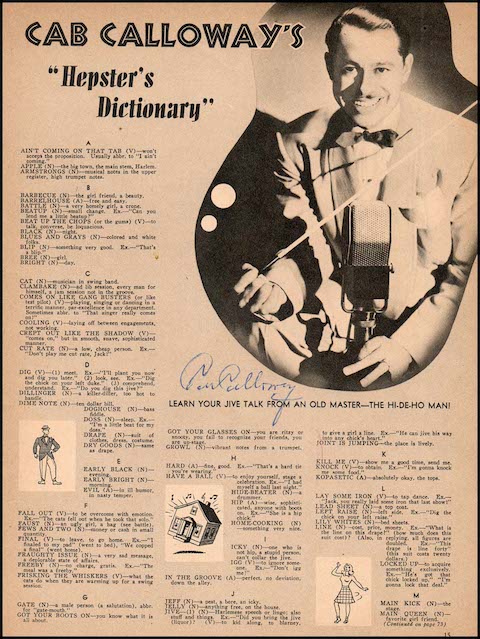
If only every amateur lexicographer were foxy enough to set his or her definitions to music, and creep them out like the shadow, as Calloway does above. The complete list is below.
What a blip!
By my calculation, we’ve got eleven months to identify a choice candidate, resurrect it, and integrate it into everyday speech. With luck some fine dinner whose star is on the rise will beef our word in public, preferably during a scandalous, much analyzed performance.
It’s immaterial which one we pick. Gammin’? Jeff? Hincty? Fruiting? Whatever you choose, I’m in. Let’s blow their wigs.
Bust your conks in the comments section. I’m ready.
HEPSTER’S DICTIONARY
A hummer (n.) — exceptionally good. Ex., “Man, that boy is a hummer.”
Ain’t coming on that tab (v.) — won’t accept the proposition. Usually abbr. to “I ain’t coming.”
Alligator (n.) — jitterbug.
Apple (n.) — the big town, the main stem, Harlem.
Armstrongs (n.) — musical notes in the upper register, high trumpet notes.
Barbecue (n.) — the girl friend, a beauty
Barrelhouse (adj.) — free and easy.
Battle (n.) — a very homely girl, a crone.
Beat (adj.) — (1) tired, exhausted. Ex., “You look beat” or “I feel beat.” (2) lacking anything. Ex, “I am beat for my cash”, “I am beat to my socks” (lacking everything).
Beat it out (v.) — play it hot, emphasize the rhythym.
Beat up (adj.) — sad, uncomplimentary, tired.
Beat up the chops (or the gums) (v.) — to talk, converse, be loquacious.
Beef (v.) — to say, to state. Ex., “He beefed to me that, etc.”
Bible (n.) — the gospel truth. Ex., “It’s the bible!”
Black (n.) — night.
Black and tan (n.) — dark and light colored folks. Not colored and white folks as erroneously assumed.
Blew their wigs (adj.) — excited with enthusiasm, gone crazy.
Blip (n.) — something very good. Ex., “That’s a blip”; “She’s a blip.”
Blow the top (v.) — to be overcome with emotion (delight). Ex., “You’ll blow your top when you hear this one.”
Boogie-woogie (n.) — harmony with accented bass.
Boot (v.) — to give. Ex., “Boot me that glove.”
Break it up (v.) — to win applause, to stop the show.
Bree (n.) — girl.
Bright (n.) — day.
Brightnin’ (n.) — daybreak.
Bring down ((1) n. (2) v.) — (1) something depressing. Ex., “That’s a bring down.” (2) Ex., “That brings me down.”
Buddy ghee (n.) — fellow.
Bust your conk (v.) — apply yourself diligently, break your neck.
Canary (n.) — girl vocalist.
Capped (v.) — outdone, surpassed.
Cat (n.) — musician in swing band.
Chick (n.) — girl.
Chime (n.) — hour. Ex., “I got in at six chimes.”
Clambake (n.) — ad lib session, every man for himself, a jam session not in the groove.
Chirp (n.) — female singer.
Cogs (n.) — sun glasses.
Collar (v.) — to get, to obtain, to comprehend. Ex., “I gotta collar me some food”; “Do you collar this jive?”
Come again (v.) — try it over, do better than you are doing, I don’t understand you.
Comes on like gangbusters (or like test pilot) (v.) — plays, sings, or dances in a terrific manner, par excellence in any department. Sometimes abbr. to “That singer really comes on!”
Cop (v.) — to get, to obtain (see collar; knock).
Corny (adj.) — old-fashioned, stale.
Creeps out like the shadow (v.) — “comes on,” but in smooth, suave, sophisticated manner.
Crumb crushers (n.) — teeth.
Cubby (n.) — room, flat, home.
Cups (n.) — sleep. Ex., “I gotta catch some cups.”
Cut out (v.) — to leave, to depart. Ex., “It’s time to cut out”; “I cut out from the joint in early bright.”
Cut rate (n.) — a low, cheap person. Ex., “Don’t play me cut rate, Jack!”
Dicty (adj.) — high-class, nifty, smart.
Dig (v.) — (1) meet. Ex., “I’ll plant you now and dig you later.” (2) look, see. Ex., “Dig the chick on your left duke.” (3) comprehend, understand. Ex., “Do you dig this jive?”
Dim (n.) — evening.
Dime note (n.) — ten-dollar bill.
Doghouse (n.) — bass fiddle.
Domi (n.) — ordinary place to live in. Ex., “I live in a righteous dome.”
Doss (n.) — sleep. Ex., “I’m a little beat for my doss.”
Down with it (adj.) — through with it.
Drape (n.) — suit of clothes, dress, costume.
Dreamers (n.) — bed covers, blankets.
Dry-goods (n.) — same as drape.
Duke (n.) — hand, mitt.
Dutchess (n.) — girl.
Early black (n.) — evening
Early bright (n.) — morning.
Evil (adj.) — in ill humor, in a nasty temper.
Fall out (v.) — to be overcome with emotion. Ex., “The cats fell out when he took that solo.”
Fews and two (n.) — money or cash in small quatity.
Final (v.) — to leave, to go home. Ex., “I finaled to my pad” (went to bed); “We copped a final” (went home).
Fine dinner (n.) — a good-looking girl.
Focus (v.) — to look, to see.
Foxy (v.) — shrewd.
Frame (n.) — the body.
Fraughty issue (n.) — a very sad message, a deplorable state of affairs.
Freeby (n.) — no charge, gratis. Ex., “The meal was a freeby.”
Frisking the whiskers (v.) — what the cats do when they are warming up for a swing session.
Frolic pad (n.) — place of entertainment, theater, nightclub.
Fromby (adj.) — a frompy queen is a battle or faust.
Front (n.) — a suit of clothes.
Fruiting (v.) — fickle, fooling around with no particular object.
Fry (v.) — to go to get hair straightened.
Gabriels (n.) — trumpet players.
Gammin’ (adj.) — showing off, flirtatious.
Gasser (n, adj.) — sensational. Ex., “When it comes to dancing, she’s a gasser.”
Gate (n.) — a male person (a salutation), abbr. for “gate-mouth.”
Get in there (exclamation.) — go to work, get busy, make it hot, give all you’ve got.
Gimme some skin (v.) — shake hands.
Glims (n.) — the eyes.
Got your boots on — you know what it is all about, you are a hep cat, you are wise.
Got your glasses on — you are ritzy or snooty, you fail to recognize your friends, you are up-stage.
Gravy (n.) — profits.
Grease (v.) — to eat.
Groovy (adj.) — fine. Ex., “I feel groovy.”
Ground grippers (n.) — new shoes.
Growl (n.) — vibrant notes from a trumpet.
Gut-bucket (adj.) — low-down music.
Guzzlin’ foam (v.) — drinking beer.
Hard (adj.) — fine, good. Ex., “That’s a hard tie you’re wearing.”
Hard spiel (n.) — interesting line of talk.
Have a ball (v.) — to enjoy yourself, stage a celebration. Ex., “I had myself a ball last night.”
Hep cat (n.) — a guy who knows all the answers, understands jive.
Hide-beater (n.) — a drummer (see skin-beater).
Hincty (adj.) — conceited, snooty.
Hip (adj.) — wise, sophisticated, anyone with boots on. Ex., “She’s a hip chick.”
Home-cooking (n.) — something very dinner (see fine dinner).
Hot (adj.) — musically torrid; before swing, tunes were hot or bands were hot.
Hype (n, v.) — build up for a loan, wooing a girl, persuasive talk.
Icky (n.) — one who is not hip, a stupid person, can’t collar the jive.
Igg (v.) — to ignore someone. Ex., “Don’t igg me!)
In the groove (adj.) — perfect, no deviation, down the alley.
Jack (n.) — name for all male friends (see gate; pops).
Jam ((1)n, (2)v.) — (1) improvised swing music. Ex., “That’s swell jam.” (2) to play such music. Ex., “That cat surely can jam.”
Jeff (n.) — a pest, a bore, an icky.
Jelly (n.) — anything free, on the house.
Jitterbug (n.) — a swing fan.
Jive (n.) — Harlemese speech.
Joint is jumping — the place is lively, the club is leaping with fun.
Jumped in port (v.) — arrived in town.
Kick (n.) — a pocket. Ex., “I’ve got five bucks in my kick.”
Kill me (v.) — show me a good time, send me.
Killer-diller (n.) — a great thrill.
Knock (v.) — give. Ex., “Knock me a kiss.”
Kopasetic (adj.) — absolutely okay, the tops.
Lamp (v.) — to see, to look at.
Land o’darkness (n.) — Harlem.
Lane (n.) — a male, usually a nonprofessional.
Latch on (v.) — grab, take hold, get wise to.
Lay some iron (v.) — to tap dance. Ex., “Jack, you really laid some iron that last show!”
Lay your racket (v.) — to jive, to sell an idea, to promote a proposition.
Lead sheet (n.) — a topcoat.
Left raise (n.) — left side. Ex., “Dig the chick on your left raise.”
Licking the chops (v.) — see frisking the whiskers.
Licks (n.) — hot musical phrases.
Lily whites (n.) — bed sheets.
Line (n.) — cost, price, money. Ex., “What is the line on this drape” (how much does this suit cost)? “Have you got the line in the mouse” (do you have the cash in your pocket)? Also, in replying, all figures are doubled. Ex., “This drape is line forty” (this suit costs twenty dollars).
Lock up — to acquire something exclusively. Ex., “He’s got that chick locked up”; “I’m gonna lock up that deal.”
Main kick (n.) — the stage.
Main on the hitch (n.) — husband.
Main queen (n.) — favorite girl friend, sweetheart.
Man in gray (n.) — the postman.
Mash me a fin (command.) — Give me $5.
Mellow (adj.) — all right, fine. Ex., “That’s mellow, Jack.”
Melted out (adj.) — broke.
Mess (n.) — something good. Ex., “That last drink was a mess.”
Meter (n.) — quarter, twenty-five cents.
Mezz (n.) — anything supreme, genuine. Ex., “this is really the mezz.”
Mitt pounding (n.) — applause.
Moo juice (n.) — milk.
Mouse (n.) — pocket. Ex., “I’ve got a meter in the mouse.”
Muggin’ (v.) — making ‘em laugh, putting on the jive. “Muggin’ lightly,” light staccato swing; “muggin’ heavy,” heavy staccato swing.
Nicklette (n.) — automatic phonograph, music box.
Nickel note (n.) — five-dollar bill.
Nix out (v.) — to eliminate, get rid of. Ex., “I nixed that chick out last week”; “I nixed my garments” (undressed).
Nod (n.) — sleep. Ex., “I think I’l cop a nod.”
Ofay (n.) — white person.
Off the cob (adj.) — corny, out of date.
Off-time jive (n.) — a sorry excuse, saying the wrong thing.
Orchestration (n.) — an overcoat.
Out of the world (adj.) — perfect rendition. Ex., “That sax chorus was out of the world.”
Ow! — an exclamation with varied meaning. When a beautiful chick passes by, it’s “Ow!”; and when someone pulls an awful pun, it’s also “Ow!”
Pad (n.) — bed.
Pecking (n.) — a dance introduced at the Cotton Club in 1937.
Peola (n.) — a light person, almost white.
Pigeon (n.) — a young girl.
Pops (n.) — salutation for all males (see gate; Jack).
Pounders (n.) — policemen.
Queen (n.) — a beautiful girl.
Rank (v.) — to lower.
Ready (adj.) — 100 per cent in every way. Ex., “That fried chicken was ready.”
Ride (v.) — to swing, to keep perfect tempo in playing or singing.
Riff (n.) — hot lick, musical phrase.
Righteous (adj.) — splendid, okay. Ex., “That was a righteous queen I dug you with last black.”
Rock me (v.) — send me, kill me, move me with rhythym.
Ruff (n.) — quarter, twenty-five cents.
Rug cutter (n.) — a very good dancer, an active jitterbug.
Sad (adj.) — very bad. Ex., “That was the saddest meal I ever collared.”
Sadder than a map (adj.) — terrible. Ex., “That man is sadder than a map.”
Salty (adj.) — angry, ill-tempered.
Sam got you — you’ve been drafted into the army.
Send (v.) — to arouse the emotions. (joyful). Ex., “That sends me!”
Set of seven brights (n.) — one week.
Sharp (adj.) — neat, smart, tricky. Ex., “That hat is sharp as a tack.”
Signify (v.) — to declare yourself, to brag, to boast.
Skins (n.) — drums.
Skin-beater (n.) — drummer (see hide-beater).
Sky piece (n.) — hat.
Slave (v.) — to work, whether arduous labor or not.
Slide your jib (v.) — to talk freely.
Snatcher (n.) — detective.
So help me — it’s the truth, that’s a fact.
Solid (adj.) — great, swell, okay.
Sounded off (v.) — began a program or conversation.
Spoutin’ (v.) — talking too much.
Square (n.) — an unhep person (see icky; Jeff).
Stache (v.) — to file, to hide away, to secrete.
Stand one up (v.) — to play one cheap, to assume one is a cut-rate.
To be stashed (v.) — to stand or remain.
Susie‑Q (n.) — a dance introduced at the Cotton Club in 1936.
Take it slow (v.) — be careful.
Take off (v.) — play a solo.
The man (n.) — the law.
Threads (n.) — suit, dress or costuem (see drape; dry-goods).
Tick (n.) — minute, moment. Ex., “I’ll dig you in a few ticks.” Also, ticks are doubled in accounting time, just as money isdoubled in giving “line.” Ex., “I finaled to the pad this early bright at tick twenty” (I got to bed this morning at ten o’clock).
Timber (n.) — toothipick.
To dribble (v.) — to stutter. Ex., “He talked in dribbles.”
Togged to the bricks — dressed to kill, from head to toe.
Too much (adj.) — term of highest praise. Ex., “You are too much!”
Trickeration (n.) — struttin’ your stuff, muggin’ lightly and politely.
Trilly (v.) — to leave, to depart. Ex., “Well, I guess I’ll trilly.”
Truck (v.) — to go somewhere. Ex., “I think I’ll truck on down to the ginmill (bar).”
Trucking (n.) — a dance introduced at the Cotton Club in 1933.
Twister to the slammer (n.) — the key to the door.
Two cents (n.) — two dollars.
Unhep (adj.) — not wise to the jive, said of an icky, a Jeff, a square.
Vine (n.) — a suit of clothes.
V‑8 (n.) — a chick who spurns company, is independent, is not amenable.
What’s your story? — What do you want? What have you got to say for yourself? How are tricks? What excuse can you offer? Ex., “I don’t know what his story is.”
Whipped up (adj.) — worn out, exhausted, beat for your everything.
Wren (n.) — a chick, a queen.
Wrong riff — the wrong thing said or done. Ex., “You’re coming up on the wrong riff.”
Yarddog (n.) — uncouth, badly attired, unattractive male or female.
Yeah, man — an exclamation of assent.
Zoot (adj.) — exaggerated
Zoot suit (n.) — the ultimate in clothes. The only totally and truly American civilian suit.
The Templeton Foundation asked some heavy-hitter thinkers to answer the question, “Does the Universe Have a Purpose”. Some said “Yes” and “Certainly.” Others concluded “Unlikely” and “No.” Neil deGrasse Tyson — astrophysicist, director of the Hayden Planetarium, and popularizer of science — gave an answer that falls technically in the “Not Certain” camp.
Above, you can watch a video where Tyson reads his answer aloud, and the makers of Minute Physics provide the rudimentary animation. One thing astrophysicists have is a knack for putting things into a deeper context, often making “big” human questions look remarkably small (if not somewhat absurd). Carl Sagan did it remarkably well in his famous ‘The Pale Blue Dot’ speech. And Tyson picks up right where Sagan left off.
We still live in a world where, despite Copernicus, we think the world revolves essentially around us. And, to the extent that that’s true, some will find Tyson’s data points disorienting. Others might wonder whether we should angst so much about the questions we perennially ask in the first place. I guess I am kind of there today.
Our vast media landscape feels grossly oversaturated with advertising, propaganda, and all manner of redundant noise. But the discerning eye, and ear, perceives just as much quality out there as crap. “Retired” auteur Steven Soderbergh, as fans of his will know, is just such a discerning customer — and an exacting, highly organized one at that. Soderbergh has sworn off directing film, turning his attention to television by directing the Cinemax series The Knick as well as—reports Indiewire—“producing, editing, and lensing Magic Mike XXL,” the second installment of the Channing Tatum-starring male stripper saga.
One might think all this work would keep Soderbergh busy from dawn to dusk, but he’s a man who “gets more done in a day than most do in a week.” A consummate consumer of culture high and low, Soderbergh assiduously documented his watching, reading, and listening experiences for the entire year previous. His list includes TV shows like Veep and Louie, and heavier fare like True Detective and House of Cards. He read Donna Tartt’s The Goldfinch and Karl Ove Gnausgaard’s laborious Proustian novel My Struggle (books one through three—in two months). In addition to recent films like Gone Girl, Soderbergh watched Kubrick’s 2001: A Space Odyssey three times and Jaws twice. He even found the time for Die Hard With a Vengeance.
The above represents but the tiniest sampling of Soderbergh’s voracious diet. You can see the full list, including his album purchases here. As Indiewire rightly observes, the list is “a lot to wade through.” Even more so the incredible range and diversity of creative works contained within. Soderbergh maintained a similar log for 2013, which you can see here. Scanning these may inspire you to step up your input, or maybe just to pull a manageable number of selections for future reading/viewing/listening of your own.
The common conception of New Year’s resolutions frames them as disposable ideals, not to be taken too seriously or followed through past the first few months of winter; by spring, we all assume, we’ll be right back to our slothful, gluttonous ways. Perhaps the problem lies in the way we approach this yearly ritual. Lists of the most common resolutions tend towards the almost shockingly banal, such that most people’s desires for change are interchangeable with their friends and neighbors and might as well be scripted by greeting card companies. I’d hazard it’s impossible to be passionate about half-thoughts and boilerplate ambition.
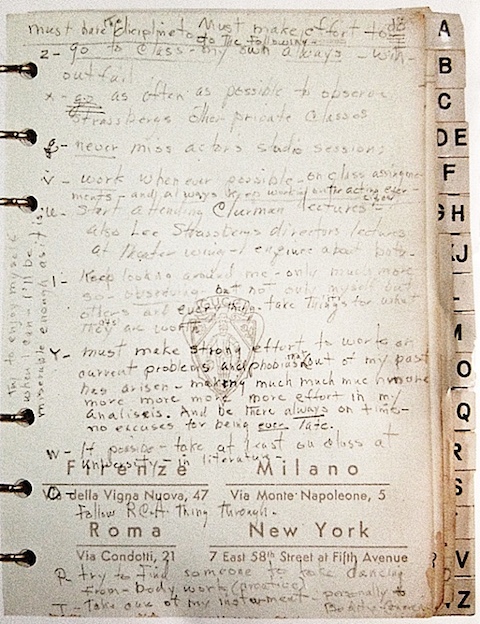
But there are those few people who really pour their hearts into it, creating lists so individualized and authentic that the documents expose their inner lives, their hopes, fears, loves, struggles, and deep, personal yearnings and aspirations. One such list that circulates often, and which we featured last year, is this gem from Woody Guthrie circa 1943. It’s so completely him, so much in his voice, that no one else could have written it, even in parody. This year, we direct your attention to the list above, from Marilyn Monroe, written at the end of 1955 when the star was 29.
Already well-known for her acting in such fine films as All About Eve, Gentlemen Prefer Blondes, and The Seven Year Itch, Monroe had recently been accepted to Lee Strasberg’s Actors Studio. As Lists of Note puts it, “judging by this list, she was determined to make the most of her opportunities.” I’m not sure what to make of the odd use of random letters at the beginning of each resolution, but what the list does offer us is a glimpse into Monroe’s deep commitment—despite her feeling that her life was “miserable”—to growing and developing as an actor and a person.
See a full transcript of her list of resolutions below.
Must make effort to do
Must have the dicipline to do the following –
z – go to class – my own always – without fail
x – go as often as possible to observe Strassberg’s other private classes
g – never miss actor’s studio sessions
v – work whenever possible – on class assignments – and always keep working on the acting exercises
u – start attending Clurman lectures – also Lee Strassberg’s directors lectures at theater wing – enquire about both
l – keep looking around me – only much more so – observing – but not only myself but others and everything – take things (it) for what they (it’s) are worth
y – must make strong effort to work on current problems and phobias that out of my past has arisen – making much much much more more more more more effort in my analisis. And be there always on time – no excuses for being ever late.
w – if possible – take at least one class at university – in literature –
o – follow RCA thing through.
p – try to find someone to take dancing from – body work (creative)
t – take care of my instrument – personally & bodily (exercise)
try to enjoy myself when I can – I’ll be miserable enough as it is.
We're hoping to rely on loyal readers, rather than erratic ads. Please click the Donate button and support Open Culture. You can use Paypal, Venmo, Patreon, even Crypto! We thank you!
Open Culture scours the web for the best educational media. We find the free courses and audio books you need, the language lessons & educational videos you want, and plenty of enlightenment in between.