Alan Turing, Brilliant Mathematician and Code Breaker, Will Be Finally Pardoned by British Government

turing pardon“Alan Tur­ing, the Enig­ma code­break­er who took his own life after being con­vict­ed of gross inde­cen­cy under anti-homo­sex­u­al­i­ty leg­is­la­tion, is to be giv­en a posthu­mous par­don,” writes The Guardian today. One of the great math­e­mati­cians of the last cen­tu­ry, Tur­ing laid the foun­da­tions for com­put­er sci­ence and played a key role in break­ing the Nazi Enig­ma code dur­ing World War II. Despite his con­tri­bu­tions to defend­ing Britain, Tur­ing was pros­e­cut­ed in 1952 for engag­ing in homo­sex­u­al acts under an 1885 law that led to the con­vic­tions of 49,000 gay men, includ­ing Oscar Wilde. It’s a sad tale that gets recount­ed by anoth­er com­put­er pio­neer Jaron Lanier here:

For years, sup­port­ers have called upon the British gov­ern­ment to issue a posthu­mous par­don. And while British Prime Min­is­ter Gor­don Brown apol­o­gized in 2010 for “the appalling way [Tur­ing] was treat­ed,” mem­bers of the House of Lords resist­ed issu­ing an actu­al par­don as recent­ly as last year. But, accord­ing to The Guardian, leg­is­la­tors are pre­pared to pass a new bill as ear­ly as this Octo­ber. As many of our read­ers will be quick to point out, the con­cept  of a par­don is a bit strange, see­ing that Tur­ing did noth­ing wrong. But the will­ing­ness of the gov­ern­ment to effec­tive­ly nul­li­fy the con­vic­tion and reject an archa­ic law is a wel­comed piece of news.

via @phi­los­o­phy­bites

Relat­ed Con­tent:

Watch the 1996 Film, Break­ing the Code, Star­ring Derek Jaco­bi

The Enig­ma Machine: How Alan Tur­ing Helped Break the Unbreak­able Nazi Code

by | Permalink | Make a Comment ( 6 ) |

Have I Told You Lately That I Love You?: A 1958 Look at How Modern Gadgets & Conveniences Lead to Existential Hell

Think grow­ing feel­ings of iso­la­tion in a world of mod­ern con­ve­niences is a new phe­nom­e­non? Slap a dial on that smart­phone, shove a col­lectible rock­et in your kid’s cere­al box, hop in a Cad­dy with fins and think again, pal!

Have I Told You Late­ly That I Love You, a cau­tion­ary tale cre­at­ed by Uni­ver­si­ty of South­ern Cal­i­for­nia stu­dents in 1958, is a far-from-silent film marked by a near-total absence of human speech. The lit­tle boy char­ac­ter seems hap­py enough with his pop­si­cle and tele­vi­sion West­erns, but his white-col­lar dad and house­wife mom are marooned in their indi­vid­ual exis­ten­tial hells, unable to con­nect. Could the new­fan­gled, labor sav­ing devices with which their home and dad’s work­place abound be to blame?

The newsy radio report play­ing inter­mit­tent­ly in the back­ground would cer­tain­ly have it so. Sto­ries of hair loss, headaches and a kid shoot­ing his father over a TV-relat­ed dis­pute sug­gest none too sub­tly that progress has long been a source of anx­i­ety.

I might sug­gest that the moth­er is suf­fer­ing more from the rigid gen­der roles of her era than the tyran­ny of an auto­mat­ic dish­wash­er. Per­haps the sub­urbs weren’t offer­ing them much in the way of com­mu­ni­ty. Isn’t it pos­si­ble that the rela­tion­ship has gone cold due to the father’s pen­chant for hop­ping in bed with the girls from the steno pool?

That’s pret­ty stan­dard behav­ior on Mad Men, no?

While this short film offers none of the afore­men­tioned’s sexy, booze-soaked highs, there’s quite a bit of black-and-white design porn on dis­play. Dic­ta­phones, gleam­ing kitchen appli­ances,  a music box that dis­pens­es cig­a­rettes…

Oth­er­wise it’s a vision of an aver­age Amer­i­can 1950’s fam­i­ly as con­ceived of by Ing­mar Bergman.

Relat­ed Con­tent:

Before Mad Men: Famil­iar and For­got­ten Ads from 1950s to 1980s Now Online

How a Clean, Tidy Home Can Help You Sur­vive the Atom­ic Bomb: A Cold War Film from 1954

How the CIA Secret­ly Fund­ed Abstract Expres­sion­ism Dur­ing the Cold War

Ayun Hal­l­i­day has always pre­ferred the Roar­ing Twen­ties. Fol­low her @AyunHalliday

The Real Value of a Guitar

True sto­ry — back in 2010 I bought a Mar­tin D‑28 from (gulp) Gui­tar Cen­ter. The sales­man rushed me out of the store and did­n’t both­er to tune the gui­tar, let alone set it up prop­er­ly. When I got home, I felt imme­di­ate buy­er’s remorse — remorse not that I had bought the Mar­tin, but that I had­n’t bought it from the best lit­tle gui­tar shop in the San Fran­cis­co Bay area, Gryphon Strings. The next day, I did the right thing. I returned the Mar­tin to GC and re-bought the same gui­tar from Gryphon. I lost a few bucks in the process. But the gui­tar was set up just right. And I felt unbur­dened. Les­son learned.

Nowa­days, I stop by Gryphon week­ly for lessons and occa­sion­al sali­va­tion ses­sions, and I get to see first­hand what this video by Cin­e­ma Mer­can­tile lets you see all too briefly. The care, craft and emo­tion (note the poignant chin quiver at the 2:22 mark) that goes into work­ing with gui­tars … if you’re doing it for the right rea­sons. In Sil­i­con Val­ley, there are very few places where busi­ness isn’t the main rea­son for being. Gryphon offers a good escape from that some­times soul-dead­en­ing real­i­ty. That’s why I will be head­ing back there tomor­row.

You can find two more short films by Cin­e­ma Mer­can­tile here.

via The Atlantic

Relat­ed Con­tent:

The Sto­ry of the Gui­tar: The Com­plete Three-Part Doc­u­men­tary

The Art of Mak­ing a Fla­men­co Gui­tar: 299 Hours of Blood, Sweat & Tears Expe­ri­enced in 3 Min­utes

Mak­ing Fend­er Gui­tars, Then (1959) and Now (2012)

The Joy of Mak­ing Artis­tic Home­made Gui­tars

by | Permalink | Make a Comment ( 5 ) |

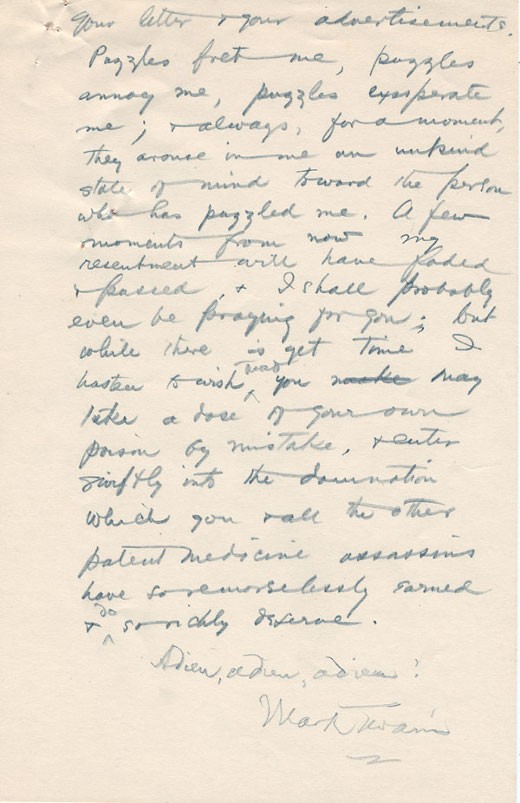
Mark Twain Drafts the Ultimate Letter of Complaint (1905)

TwainComplaint

Click above for a larg­er ver­sion of page one and click here to see page two. 

I recent­ly made the mis­take of craft­ing a let­ter of com­plaint that sound­ed much more tem­per­ate than I felt. On the advice of my hus­band, I delet­ed any­thing smack­ing of emo­tion, lim­it­ing my griev­ances to incon­tro­vert­ible fact. A month lat­er and I am still wait­ing for a reply.

Wish that I had let it all hang out, as Mark Twain did in the above 1905 let­ter to J. H. Todd, a snake oil sales­man whose “Elixir of Life” was alleged to cure even the most ter­mi­nal of med­ical con­di­tions. How sat­is­fy­ing it would have been to indulge in phras­es like “idiot of the 33rd degree” and “scion of an ances­tral pro­ces­sion of idiots stretch­ing back to the Miss­ing Link”!

Hav­ing answered phones in cus­tomer ser­vice, I can attest that there are times when such phras­es are mis­di­rect­ed. This was not one of them. Sub­ject your­self to a thor­ough read­ing of the Elixir’s claims (a typog­ra­phy chal­lenge on order of a Dr. Bron­ner’s label) and you will share the author’s out­rage.

Char­la­tans could be dealt with light­ly in lit­er­a­ture—wit­ness Huck­le­ber­ry Finn’s self-pro­claimed Duke—but hav­ing lost chil­dren to two of the dis­eases Tod­d’s potion pur­port­ed to cure, Twain refused to let Todd off the hook in real life. His “unkind state of mind” is as brac­ing as it is war­rant­ed.

Though I doubt he got a reply either.

Tran­scrip­tion:

Nov. 20. 1905

J. H. Todd

1212 Web­ster St.

San Fran­cis­co, Cal.

Dear Sir,

Your let­ter is an insol­u­ble puz­zle to me. The hand­writ­ing is good and exhibits con­sid­er­able char­ac­ter, and there are even traces of intel­li­gence in what you say, yet the let­ter and the accom­pa­ny­ing adver­tise­ments pro­fess to be the work of the same hand. The per­son who wrote the adver­tise­ments is with­out doubt the most igno­rant per­son now alive on the plan­et; also with­out doubt he is an idiot, an idiot of the 33rd degree, and scion of an ances­tral pro­ces­sion of idiots stretch­ing back to the Miss­ing Link. It puz­zles me to make out how the same hand could have con­struct­ed your let­ter and your adver­tise­ments. Puz­zles fret me, puz­zles annoy me, puz­zles exas­per­ate me; and always, for a moment, they arouse in me an unkind state of mind toward the per­son who has puz­zled me. A few moments from now my resent­ment will have fad­ed and passed and I shall prob­a­bly even be pray­ing for you; but while there is yet time I has­ten to wish that you may take a dose of your own poi­son by mis­take, and enter swift­ly into the damna­tion which you and all oth­er patent med­i­cine assas­sins have so remorse­less­ly earned and do so rich­ly deserve.

Adieu, adieu, adieu!

Mark Twain

via Let­ters of Note

Relat­ed Con­tent:

Mark Twain Wrote the First Book Ever Writ­ten With a Type­writer

Mark Twain Shirt­less in 1883 Pho­to

Mark Twain Cap­tured on Film by Thomas Edi­son in 1909. It’s the Only Known Footage of the Author.

Ayun Hal­l­i­day sus­pects Mum­my Pow­der is not an effec­tive treat­ment for epilep­sy. Fol­low her @AyunHalliday

New Yorker Cartoon Editor Bob Mankoff Reveals the Secret of a Successful New Yorker Cartoon

A friend of mine rails against the New York­er’s week­ly car­toon cap­tion con­test, insist­ing that while the read­er-sub­mit­ted entries are uni­ver­sal­ly bad, the win­ner is always the weak­est of the lot.

I dis­agree, agog at peo­ple’s clev­er­ness. Any line I come up with feels too obvi­ous or too obscure. Unlike my friend, I nev­er feel I could do bet­ter.

Car­toon edi­tor Bob Mankof­f’s recent TED Talk offers some key insights into what the mag­a­zine is look­ing for (incon­gruity, dis­po­si­tion­al humor, cog­ni­tive mash ups), as well as what it’s not inter­est­ed in (gross-out jokes, mild child-cen­tered can­ni­bal­ism) He also cites for­mer con­trib­u­tor and author of my father’s favorite New York­er car­toon, E.B. White on the futil­i­ty of ana­lyz­ing humor.

Fre­quent con­trib­u­tor Matthew Dif­fee’s short  satir­i­cal film Being Bob sug­gests Mankoff edi­to­r­i­al selec­tions owe much to gut response (and a jerk­ing knee). Such intu­ition is hard won. Mankoff glee­ful­ly alludes to the 2000 rejec­tion let­ters he him­self received between 1974 and 1977, fol­low­ing an uncer­e­mo­ni­ous dis­missal from psy­chol­o­gy school. Then, final­ly, he got his first accep­tance.

That accep­tance let­ter is some­thing to see.

Ayun Hal­l­i­day used Charles Bar­sotti’s New York­er car­toon of a danc­ing bird as her high­school year­book’s senior say­ing. Fol­low her @AyunHalliday

Relat­ed Con­tent:

The New Yorker’s Fic­tion Pod­cast: Where Great Writ­ers Read Sto­ries by Great Writ­ers

Improv with New York­er Car­toon­ists

Einstein’s Rel­a­tiv­i­ty: An Ani­mat­ed New York­er Car­toon

In “The Dictionary of Obscure Sorrows,” Artist John Koenig Names Feelings that Leave Us Speechless

It may be a mis­con­cep­tion, it may be a cliché: I’m not a Ger­man speaker—but read­ing translator’s intro­duc­tions to, say, Kant, Hegel or Goethe has con­vinced me that their lan­guage does a much bet­ter job than Eng­lish at cap­tur­ing those odd­ly spe­cif­ic twi­light moods and com­pound feel­ings that so often escape def­i­n­i­tion. Then again, Eng­lish absorbs, can­ni­bal­izes, appro­pri­ates, steals, and bas­tardizes words wher­ev­er it can find them, dri­ving lex­i­cog­ra­phers and gram­mar purists mad.

Graph­ic design­er and film­mak­er John Koenig does all of these things in his “Dic­tio­nary of Obscure Sor­rows,” a blog project in which he names emo­tions that oth­er­wise leave us speech­less. In his short video above, he illus­trates one of his words, “Son­der,” or “the real­iza­tion that each ran­dom passer­by is liv­ing a life as vivid and com­plex as your own…”—something like the shock of sud­den empa­thy that shakes us out of navel-gaz­ing. It’s an emo­tion I’ve expe­ri­enced, with­out know­ing what to call it.

This being an “obscure sor­row,” there’s more to it than empathy—in Koenig’s poet­ic video, “son­der” relates to the infi­nite num­ber of over­lap­ping sto­ries, in which each of us feels we are the hero, oth­ers sup­port­ing cast or extras. In a state of “son­der,” we sud­den­ly occu­py all of those roles at once, our screen time dimin­ish­ing as oth­ers take the lead. After watch­ing Koenig’s film, I’m think­ing “son­der” is a port­man­teau of “sub­lime” and “won­der.” It’s a mys­ti­cal phi­los­o­phy con­tained with­in a sin­gle made-up word.

Some oth­er Koenig coinages: “Ruck­kehrun­ruhe,” “nodus tol­lens,” “adroni­tis,” “rig­or sam­sa”.…. I leave it to you to vis­it Koenig’s Dic­tio­nary and learn what these words mean. It’s an expe­ri­ence well worth your time.

Relat­ed Con­tent:


The Atlas of True Names Restores Mod­ern Cities to Their Mid­dle Earth-ish Roots

The His­to­ry of the Eng­lish Lan­guage in Ten Ani­mat­ed Min­utes

Oxford Schol­ars Name Top Ten Irri­tat­ing Phras­es

Josh Jones is a writer and musi­cian based in Wash­ing­ton, DC. Fol­low him at @jdmagness

The Atlas of True Names Restores Modern Cities to Their Middle Earth-ish Roots

atlas 2

I was born in the City of the Flow­land Peo­ple, made my way to Stink Onion upon reach­ing matu­ri­ty, then onward to New Yew Tree Vil­lage where I have lived for the last 217 moons.

Look up some of your key co-ordi­nates in The Atlas of True Names and you too can have a per­son­al his­to­ry as myth­ic-sound­ing as mine. The maps—for the UK, USA, Cana­da, and World—replace mod­ern geo­graph­i­cal names with the orig­i­nal ety­mo­log­i­cal roots of cities, coun­tries, and bod­ies of water, trans­lat­ed into Eng­lish. Their web­site picks the “Sahara desert” to illus­trate the true name selec­tion process. Their cho­sen label “The Tawny One” has its basis in es-sahra, trans­lat­ed from the Ara­bic as â€śthe fawn col­ored desert”. It would be inter­est­ing to learn how many pro­fes­sion­al trans­la­tors lent a hand with the ety­mo­log­i­cal pars­ing. There are a lot of lan­guages in this world and we all know the hav­oc Google Trans­late can wreak.

Mar­ried car­tog­ra­phers (and Lord of the Rings fans) Stephan Hormes and Silke Peust acknowl­edge that there could be alter­nates to their trans­la­tions. This should come as a relief to the civic boost­ers of Philadel­phia. Quib­blers will no doubt enjoy tak­ing issue with Hormes and Peust’s choic­es. Hope­ful­ly, any result­ing inter­net brawls will take place on a higher—and dustier—plateau than those where vul­tures pick hap­less celebri­ties to shreds.

Order one of these maps and pack it along on your sum­mer road trip. Even if younger fam­i­ly mem­bers can’t be both­ered to learn how to nav­i­gate with­out a phone, the nar­ra­tive­ly rich names are sure to leav­en those long hours in the car. (How bad­ly do you have to go, Jason? Can you hold out until Table or should Dad­dy pull over in the Val­ley of the Dark­land Dweller?) 

It’s liv­ing his­to­ry in trav­el ver­sion.

Relat­ed Con­tent:

Dis­cov­er J.R.R. Tolkien’s Per­son­al Book Cov­er Designs for The Lord of the Rings Tril­o­gy

Down­load Eight Free Lec­tures on The Hob­bit by “The Tolkien Pro­fes­sor,” Corey Olsen

Willie Nel­son Audi­tions for The Hob­bit Film Sequel, Turns 80 Today

Ayun Hal­l­i­day is the author of sev­en books includ­ing the increas­ing­ly obso­lete Zinester’s Guide to NYC and No Touch Mon­key! and Oth­er Trav­el Lessons Learned Too Late. Fol­low her @AyunHallliday

James Gandolfini Shows Kinder, Softer, Gentler Side on Sesame Street (2002)

When James Gan­dolfi­ni first broke into film, he played Vir­gil, a bru­tal woman-beat­ing mafioso (view­er beware), in the 1993 thriller, True Romance, writ­ten by Quentin Taran­ti­no. In Ter­mi­nal Veloc­i­ty, he was back at it again, play­ing a Russ­ian mob­ster. By the 1999, when The Sopra­nos first aired on HBO, Gan­dolfi­ni had per­fect­ed the mob­ster role. The explo­sive anger, the raw vio­lence, the col­or­ful lan­guage — he had it all down. Of course, this con­tributed to a good gag when Gan­dolfi­ni appeared on Sesame Street in 2002. Now the world had the chance to see the actor as it had­n’t seen him before. Meek, timid, and death­ly afraid of giant talk­ing veg­eta­bles. It’s an endear­ing lit­tle scene.

Relat­ed Con­tent:

See Ste­vie Won­der Play “Super­sti­tion” and Ban­ter with Grover on Sesame Street in 1973

Philip Glass Com­pos­es for Sesame Street (1979)

Mor­gan Free­man Teach­es Kids to Read in Vin­tage Elec­tric Com­pa­ny Footage from 1971


« Go BackMore in this category... »
Quantcast