If you warbled “02134” without hesitation, you probably grew up watching a beloved children’s television show of the 70s.
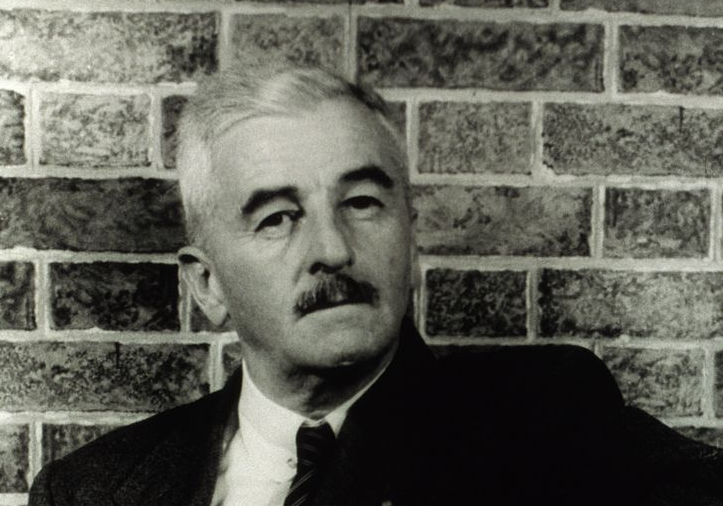
It turns out Zoom wasn’t the only cool program WGBH hatched in 1972. On March 13, just a couple of months after Zoom’s debut, the station aired Between Time and Timbuktu, a 90-minute special inspired by the work of Kurt Vonnegut.
Vonnegut also wrote the introduction to the published script, a paperback quickie enhanced by production stills and photos taken by Vonnegut’s wife, Jill Krementz. It was as good a forum as any for him to announce his retirement from film, which he cited as a medium “too clanking and real” for his comfort.
The show itself is likely to cause nostalgia for television’s freewheeling, Monty Python era.
Though 1972 wasn’t an entirely silly period, if you’ll recall. The Vietnam War was raging, with Walter Cronkite holding down the CBS Evening News desk.
Between Time and Timbuktu capitalizes on the veteran broadcaster’s ubiquity by casting comedian Ray Goulding of Bob and Ray fame, as an appropriately grave Walter Gesundheit. Bob joined him at the news desk as a fictitious former astronaut. Vonnegut was appreciative of their efforts, stating that American comedians had probably done more to shape his thinking than any other writer.
Also look for William Hickey, who played Prizzi’s Honor’s genial, aged mafia don, in the lead role of Stony Stevenson—now there’s a period character name! If you’ll remember, Stony is also the first civilian in space, at least according to the Sirens of Titan.
The medieval travelogue presents present-day writers and artists with an abundance of material. Writing in an age when the boundaries between fiction and non- were not so sharply drawn, early explorers and sailors had little compunction about embellishing their tales with exaggerations and outright lies. Travelers circulated stories of giants and monsters and credulous readers back home swallowed them whole. Well, sometimes. In the case of the most famed medieval traveler, Marco Polo, scholars have debated whether Il Milione—one of the titles of a narrative based on his accounts—refers to a family nickname or to Polo’s reputation for telling “a million lies.” But whether Polo told the truth or not hardly mattered to Italo Calvino, who found in the explorer’s colorful tales just the inspiration he needed for his 1972 novel Invisible Cities.
More a series of vignettes than a narrative, the book consists of chapter after chapter of Polo describing for Kublai Khan the various cities he encountered on his travels, each one more fantastic and magical than the last. “Kublai Khan does not necessarily believe everything Marco Polo says,” Calvino tells us in his introduction, “but the emperor of the Tartars does continue listening to the young Venetian with greater attention and curiosity than he shows any other messenger or explorer of his.” As readers, we too listen with rapt attention to curious stories of cities like Olinda, which “grows in concentric circles, like tree trunks which each year add one more ring” and Eusapia, where “the inhabitants have constructed an identical copy of their city, underground,” so that the dead can “continue their former activities.”
Playing on the bizarre nature of travelers’ tales and the imaginative excesses of exotic romances, Calvino’s novel abounds in delightful architectural absurdities and puzzling allegories, almost demanding to be illuminated like a medieval manuscript. Deciding to meet the challenge, artists Matt Kish, Leighton Connor, Joe Kuth began illustrating Invisible Cities in April of 2014. Their tumblr, Seeing Calvino, updates every Wednesday with a new interpretation of the novel’s many strange cities. At the top of the post, see “Thekla,” the “city forever under construction,” by Kish. Below it, Kuth’s imagining of “Irene,” the “name for a city in the distance, and if you approach it, it changes.” And just above, Connor’s interpretation of “Beersheba,” in which it is believed that “suspended in the heavens, there exists another Beersheba … They also believe, these inhabitants, that another Beersheba exists underground.”
Seeing Calvino isn’t Kish’s first foray into literary illustration. Previously, he undertook an illustration of every page of Melville’s Moby Dick, an impressive effort we featured last week. (Above, see another of his Invisible Cities pieces, “Adelma.”) Of the new, collaborative Calvino project, Kish tells us, “the episodic structure really appealed to us and we thought it was the perfect kind of thing to build a tumblr around and share with people.”
Invisible Cities has been fascinating to create… each of us brings a very different approach to the work. Joe’s Cities tend to be far more literal, realistic and representational, which I find kind of staggering because that is so difficult to do with Calvino. My illustrations are far more abstract and conceptual, trying to show in symbolic ways the ideas behind each chapter. Leighton falls somewhere between us on that spectrum, and his work has elements of realism and abstraction. None of us even talked about this before we started, we simply began independently (after settling on a rotation) and watched each other’s work evolve.
The three artists of Seeing Calvino have to date painted 45 of the 56 cities in Calvino’s novel. Kish has also illustrated Joseph Conrad’s Heart of Darkness, and his blog features many other graphic interpretations of literary and cinematic works. The Moby Dick project saw publication as a book in 2011. We can only hope that Calvino’s publisher sees the value of an Invisible Cities edition incorporating Kish, Kuth, and Connor’s illustrations.
A hundred years before Sigmund Freud used himself as a test subject for his experiments with cocaine, another scientist, Humphry Davy, English chemist and future president of the Royal Society, began “a very radical bout of self experimentation to determine the effects of” another drug—nitrous oxide, better known as “laughing gas.” Davy’s findings — Researches, Chemical and Philosophical Chiefly Concerning Nitrous Oxide, or Diphlogisticated Nitrous Air, And Its Respiration By Humphry Davy—published in 1800, come to us via ThePublic Domain Review, who describe the 1799 experiments thus:
With his assistant Dr. Kinglake, he would heat crystals of ammonium nitrate, collect the gas released in a green oiled-silk bag, pass it through water vapour to remove impurities and then inhale it through a mouthpiece. The effects were superb. Of these first experiments he described giddiness, flushed cheeks, intense pleasure, and “sublime emotion connected with highly vivid ideas.”
Though we don’t typically think of nitrous oxide as an addictive substance, like Freud’s experiments, Davy’s progressed rapidly from curiosity to recreation: “He began to take the gas outside of laboratory conditions, returning alone for solitary sessions in the dark, inhaling huge amounts, ‘occupied only by an ideal existence,’ and also after drinking in the evening.” Fortunately for us, however, also like Freud, Davy “continued to be meticulous in his scientific records throughout.” Eventually, the twenty-year-old Davy constructed an “air-tight breathing box.” Sealing himself inside, writes Mike Jay, Davy had Dr. Kinglake “release twenty quarts of nitrous oxide every five minutes for as long as he could retain consciousness.”
Also, like Freud’s use of cocaine, Davy’s research briefly led to a faddish recreational use of the drug, well into the early part of the nineteenth century, as you can see in the caricatures at the top and below, from 1830 and 1829, respectively. But despite what these humorous images suggest, “laughing gas” became known not only as a party drug, but also as a means of achieving heightened states of consciousness conducive to philosophical reflection and poetic creation (hence the “Philosophical” reference in the title of Davy’s research). During his own experiences “under the influence of the largest does of nitrous oxide anyone had ever taken,” Davy “’lost all connection with external things,’ and entered a self-enveloping realm of the senses,” writes Jay, finding himself “‘in a world of newly connected and modified ideas,’ where he could theorise without limits and make new discoveries at will.”
The appeal of this state to a scientist may be obvious, and to a poet even more so. Davy’s friend Robert Southey, the future Poet Laureate, became “as effusive” as Davy after taking the gas, exclaiming, “the atmosphere of the highest of all possible heavens must be composed of this gas.” In addition to Southey, Davy’s “freewheeling program of consciousness expansion… co-opted some of the most remarkable figures of his day”—including Samuel Taylor Coleridge, who is already well-known for finding some of his poetic inspiration under the influence of opium. Coleridge at the time had just published to great acclaim The Lyrical Ballads with William Wordsworth and had returned from a brief sojourn in Germany, where he had become heavily influenced by the German Idealist philosophy of Immanuel Kant and Friedrich Schelling.
Coleridge, who was “captivated by the young chemist” Davy, described his experience of taking nitrous oxide for the first time in very precise terms, avoiding the “extravagant metaphors” others tended to rely on. He recalled the sensations as resembling “that which I remember once to have experienced after returning from the snow into a warm room,” and, in a later trial, said he was “more violently acted upon” and that “towards the last I could not avoid, nor felt any wish to avoid, beating the ground with my feet; and after the mouthpiece was removed, I remained for a few seconds motionless, in great ecstacy.” Under the influence of both nitrous oxide and philosophical metaphysics, Coleridge had come to believe “the material world only an illusion projected by” the mind.
Davy, who fully endorsed this view, claiming “nothing exists but thoughts,” brought his “chaotic mélange of hedonism, heroism, poetry and philosophy” to heel in the “coherent and powerful” 580-page monograph above, which makes the case for laughing gas’s scientific and poetic worth. The report, writes Jay, combines “two mutually unintelligible languages—organic chemistry and subjective experience—to create a groundbreaking hybrid, a poetic science.” Like Freud’s use of cocaine or Timothy Leary’s experiments with LSD decades later, Davy’s experiments further demonstrate, perhaps, that the few times the sciences, philosophy, and poetry communicate with each other, it’s generally under the influence of mind-altering substances.
Where music goes, technologically speaking, audio books soon follow. We’ve had audio books on vinyl LP, on cassette tape, on CD, and on MP3, just like we’ve had music. Now that so many of us pull up our daily jams on Spotify, it shouldn’t come as a surprise that we can do a fair bit of our “reading” there as well. We’ve found a few lists that gather up the best audio book available on Spotify, including 21 classics and a collection of Shakespeare plays and sonnets at Gnarl’d, ten evergreen literary picks from Lifehacker, and a Spotify forum thread dedicated to subject.
Below, you’ll find Spotify links to more than 60 classic works of literature that, even if you struggled on getting them read in your English classes, you can now revisit in a perhaps much more lifestyle-compatible medium. If you find more audio books on Spotify, definitely let us know in the comments section below and we’ll add them to our list.
To listen to any of these, you will of course need Spotify’s software and account, both easy to come by: you just download and register.
The strict realist mold that dominated fiction and poetry for over a hundred years broke open in the late nineteenth century with symbolist French poets like Arthur Rimbaud, Stéphane Mallarmé, and Charles Baudelaire. The next few modernist decades made it impossible to ignore experimental literature, which trickled into the public consciousness through all variety of media. Popular songcraft, however, held out for a few more decades, and though styles proliferated, the standard ballad forms—straightforward narratives of love and loss—more or less dominated into the 1960s, with the exception of odd novelty records whose existence proved the rule.
Though neither ever abandoned the ballad, it’s significant that two of that decade’s most innovative pop songwriters, John Lennon and Bob Dylan, drew much of the inspiration for their more experimental songs from poetry—Lennon from an older nonsense tradition in English literature exemplified by Lewis Carroll, and Dylan from T.S. Eliot and other modernist poets.
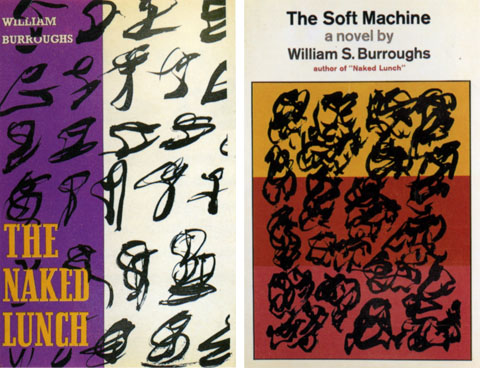
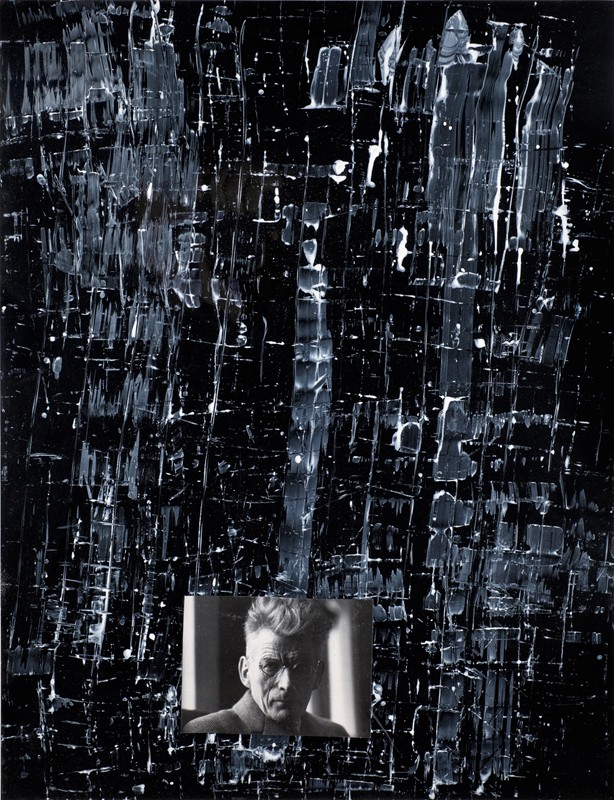
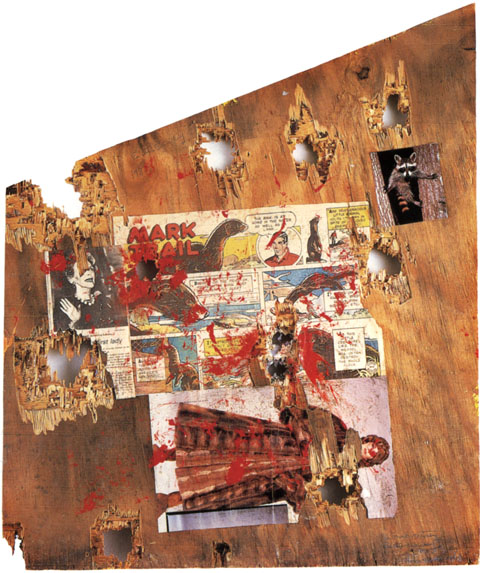
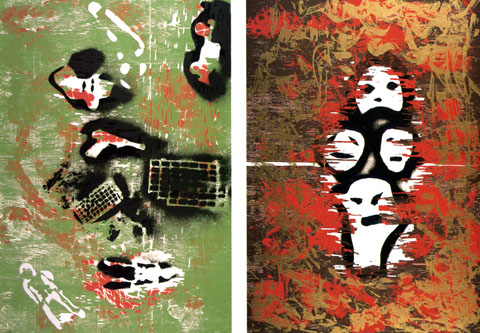
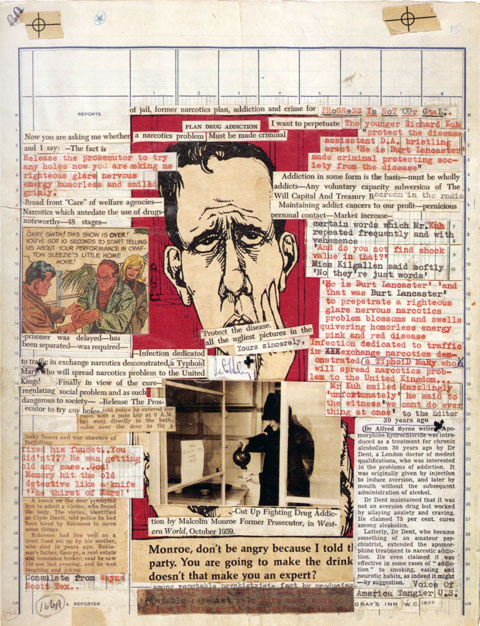
But another strain developed in the fifties and sixties—darker and weirder, though no less traceable to a literary source: William S. Burroughs’ surrealist cut-up technique, which he developed with artist Brion Gysin. Just above, you can hear Burroughs explain cut-up writing as a “montage technique” from painting applied to “words on a page.” Words and phrases are cut from newspapers and magazines and the fragments re-arranged at random. Burroughs and Gysin expanded the technique to audio recording and film, and these experiments inspired avant-garde electronic artists like Throbbing Gristle and Atari Teenage Riot, both of whom shared Burroughs’ desire to disrupt the social order with their audio experiments and neither of whom are household names. But Burroughs’ experiments with cut-up writing were also adopted by songwriters everyone knows well. In the clip at the top of the post, see David Bowie explain how he used the cut-up technique—“a kind of Western Tarot,” he calls it—both as a compositional tool and a means of finding inspiration.
In a 2008 interview, Bowie further explained his use of cut-ups: “You write down a paragraph or two describing different subjects, creating a kind of ‘story ingredients’ list, I suppose, and then cut the sentences into four or five-word sections, mix ‘em up and reconnect them.” The technique allows songwriters, he says, to “get some pretty interesting idea combinations,” even if they “have a craven need not to lose control.” Bowie almost single-handedly created the category of “art rock” with his application of avant-garde techniques to conventional song structures and rock ‘n’ roll attitudes.
Decades later, another hugely influential songwriter also made Burroughs’ technique mainstream. Kurt Cobain, who had the chance to meet and collaborate with Burroughs (above), used cut-ups to construct his lyrics—like Bowie, taking the bits of text from his own writing rather than from the mass media productions Burroughs and Gysin preferred. Pop music critic Jim Derogatis quotes Cobain as saying, “My lyrics are total cut-up. I take lines from different poems that I’ve written. I build on a theme if I can, but sometimes I can’t even come up with an idea of what the song is about.” Burroughs blog RealityStudio further documents the artistic influence of Burroughs and other writers on Cobain’s songwriting.
Though Bowie and Cobain are perhaps the two most prominent adopters of Burroughs’ technique, the Beat writer’s influence on pop music stretches back to the Beatles, who included him on the cover of Sgt. Peppers Lonely Hearts Club Band, and extends through the work of artists like Joy Division, Iggy Pop, and, notably, Radiohead’s Thom Yorke, who supposedly drew cut-up phrases from a hat to write the lyrics for the band’s groundbreaking album Kid A. And though Burroughs can seem like a sui generis force, wholly original, Language is a Virus notes that he himself “cited T.S. Eliot’s poem, The Waste Land (1922) and John Dos Passos’ U.S.A. Trilogy, which incorporated newspaper clippings, as early examples of the cut ups he popularized.” The technique can be traced even further back to founding Dadaist artist Tristan Tzara’s 1920 “To Make a Dadaist Poem.” Each case of Burroughs’ influence on both avant-garde and popular musicians demonstrates not only his well-deserved reputation as the father of the underground—from Beats to punks—but also the symbiotic relationship between musical and literary innovation.
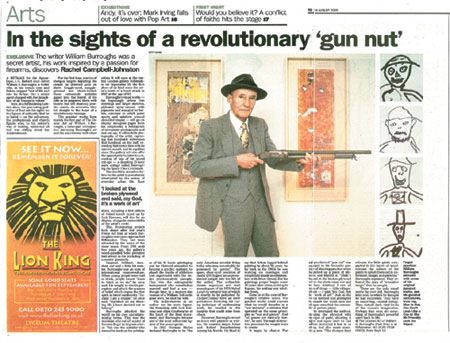
William S. Burroughs is one of the most mythologized American authors of the 20th century. When you recall the details of his life, they read like the biography of a fictional character. He was an unabashed heroin addict yet he dressed like a dapper insurance salesman. He was openly, militantly gay at a time when homosexuality wasn’t even mentioned in polite society. He shot his wife, Joan Vollmer, in Mexico City while playing an ill-conceived game of William Tell and then spent years in Tangiers indulging in every possible vice while writing Naked Lunch, which happened to be one of the most controversial books of the century. And his writing influenced just about everyone you consider cool.
This week is the 101st birthday of Burroughs. To mark the occasion, This American Life aired a BBC documentary on Burroughs’s life. The show is narrated by Iggy Pop whose voice, in announcer mode, bears an uncanny resemblance to Sam Elliot. Pop relates how Burroughs influenced Kurt Cobain, punk rock and Bob Dylan, and how he himself lifted lyrics from Burroughs for his most popular song, and unlikely Carnival Cruise jingle, “Lust for Life.”
As Ira Glass notes, the documentary paints a clear picture of why he is such a revered figure – going into detail about his writing, his hugely influential “Cut Up” method, his obsession with cats – while never buying into his mystique. In fact, one of the most interesting parts of the doc is a damning appraisal of Burroughs’s cool junkie persona by author Will Self, who was himself an addict for a couple of decades. You can listen to the whole episode above.
If you would like to sign up for Open Culture’s free email newsletter, please find it here. It’s a great way to see our new posts, all bundled in one email, each day.
If you would like to support the mission of Open Culture, consider making a donation to our site. It’s hard to rely 100% on ads, and your contributions will help us continue providing the best free cultural and educational materials to learners everywhere. You can contribute through PayPal, Patreon, and Venmo (@openculture). Thanks!
Jonathan Crow is a Los Angeles-based writer and filmmaker whose work has appeared in Yahoo!, The Hollywood Reporter, and other publications. You can follow him at @jonccrow. And check out his blog Veeptopus, featuring lots of pictures of badgers and even more pictures of vice presidents with octopuses on their heads. The Veeptopus store is here.
We can probably all agree that it’s a little premature, but all the same, the BBC has barreled ahead with its list of “The 21st Century’s 12 greatest novels.” Topping the list of excellent, if not especially surprising, picks is The Brief Wondrous Life of Oscar Wao, Junot Díaz’s Pulitzer Prize-winning debut novel about, as he puts it in the interview above, “a closeted nerd writing about an absolutely out nerd, and using their shared mutual language to tell the story.” The book has connected with such a wide swath of readers for more than its appeal to fellow nerds, though that’s no small thing. A great many readers have seen their own lives reflected in Díaz’s characters—Dominican immigrants growing up in New Jersey—or have found their experiences illuminating. And even though Yunior and Oscar’s very male point of view might have alienated female readers in the hands of a lesser author, Díaz has the sensitivity and self-awareness to—as Joe Fassler argues in The Atlantic—write sexist characters, but not sexist books. As the author himself says above, “if it wasn’t for women readers, I wouldn’t have a career.”
Díaz’s ear for dialogue and idiom and his facility for constructing completely believable characters with completely distinctive voices are matched by his commitment to representing the experiences of people who still get routinely left out of the contemporary canon. Despite the attention given to such stellar non-white, non-male writers as Toni Morrison, Maxine Hong-Kingston, Arundhati Roy, and Jamaica Kincaid, most MFA programs, Diaz argued in a recent essay for The New Yorker, are still “too white,” reproducing “exactly the dominant culture’s blind spots and assumptions around race and racism (and sexism and heteronormativity, etc).” In his own MFA workshop experiences at Cornell, he found that “the default subject position of reading and writing—of Literature with a capital L—was white, straight and male.”
The problem is more than just personal, though he certainly found the experience personally alienating, and it isn’t a matter of redressing historical wrongs or enforcing an abstract PC notion of diversity. Instead, as Díaz told Salon, it’s a problem of accurately representing reality. “If race or gender (or any other important social force) are not part of your interpretive logic—if they’re not part of what you consider the real—then you’re leaving out most of what has made our world our world.” In his own role at a professor at MIT, teaching undergraduate writing courses for the Comparative Media Studies/Writing Department, Díaz is very thoughtful about his approach, emphasizing, “it’s not the books you teach, but how you teach them.” In addition to novels by authors like Haitian-born Edwidge Danticat and Zimbabwean author NoViolet Bulawayo, he has his students read “classic Gothic texts which are themselves not very diverse by our standards,” but, he says, “the critical lens I deploy helps my students understand how issues of race, gender, coloniality etc. are never far.”
Salon tracked down the syllabi and reading lists for two of Díaz’s MIT courses, “World-Building” and “Advanced Fiction.” We do find one classic Gothic text—Bram Stoker’s Dracula—and also much of what we might expect from the self-confessed nerd, including work from such well-regarded comic writers as Frank Miller and Alan Moore and classic sci-fi from Tarzan creator Edgar Rice Burroughs. In addition to these white, male writers, we have fiction from African-American sci-fi authors Octavia Butler and N.K. Jemisin. Díaz’s “Advanced Fiction” list is even more wide-ranging, inclusive of writers from Chile, Zimbabwe, China, and Haiti, as well as the U.S. See both lists below.
World-Building:
Description: “This class concerns the design and analysis of imaginary (or constructed) worlds for narrative media such as roleplaying games, films, comics, videogames and literary texts. … The class’ primary goal is to help participants create better imaginary worlds – ultimately all our efforts should serve that higher purpose.”
Prerequisites: “You will need to have seen Star Wars (episode four: A New Hope) and read The Lord of the Rings by JRR Tolkien.”
Reading List:
“A Princess of Mars” by ER Burroughs
“Dracula” by Bram Stoker
“Batman: The Dark Knight Returns” by Frank Miller
“Sunshine” by Robin McKinley
“V for Vendetta” by Alan Moore
“The Hunger Games” by Suzanne Collins
“The Hundred Thousand Kingdoms” by NK Jemisin
“Lilith’s Brood” by Octavia Butler
“Perdido Street Station” by China Miéville
“Snow Crash” by Neal Stephenson (Recommended)
Some things to consider always when taking on a new world: What are its primary features—spatial, cultural, biological, fantastic, cosmological? What is the world’s ethos (the guiding beliefs or ideals that characterize the world)? What are the precise strategies that are used by its creator to convey the world to us and us to the world? How are our characters connected to the world? And how are we the viewer or reader or player connected to the world?
Advanced Fiction
Description: “An advanced workshop on the writing and critiquing of prose.”
Reading List:
“Clara” by Roberto Bolaño
“Hitting Budapest” by NoViolet Bulawayo
“Whites” by Julie Otsuka
“Ghosts” by Edwidge Danticat
“My Good Man” by Eric Gansworth
“Gold Boy, Emerald Girl” by Yiyun Li
“Bounty” by George Saunders
Herman Melville’s Moby Dick, the work he is most known for in death, had the effect in life of ruining his literary reputation and driving him into obscurity. This is but one of many ironies attending the massive novel, first published in Britain in three volumes on October 18, 1851. At that time, it was simply called The Whale, and as Melville.org informs us, was “expurgated to avoid offending delicate political and moral sensibilities.” One month later, the first American edition appeared, now titled Moby Dick; Or, The Whale, compiled into one huge volume, and with its censored passages, including the Epilogue, restored. In both printings, the book sold poorly, and the reviews—save those from a handful of American critics, including Melville’s fellow Great American novelist Nathaniel Hawthorne—were largely negative.
Another irony surrounding the novel is one nearly everyone who’s read it, or tried to read it, will know well. We’re socialized through visual media to approach the story as great, tragic action/adventure. As Melville’s friend, publisher Evert Augustus Duyckinck, described it, the novel is ostensibly “a romantic, fanciful & literal & most enjoyable presentment of the Whale Fishery,” driven by the revenge plot of mad old Captain Ahab. And yet, it is not that at all, or not simply that. Despite the fact that it lends itself so well to adventurous retelling, the novel itself can seem very obscure, ponderous, and digressive to a maddening degree. The so-called “whaling chapters,” notably “Cetology,” delve deeply into the lore and technique of whaling, the anatomy and physiology of various whale species, and the history and politics of the venture.
Throughout the novel, ordinary objects and events—especially, of course, the whale itself—acquire such symbolic weight that they become almost cartoonish talismans and leap bewilderingly out of the narrative, forcing the reader to contemplate their significance—no easy task. Depending on your sensibilities and tolerance for Melville’s labyrinthine prose, these very strange features of the novel are either indispensably fascinating or just plain excess baggage. Since many editions are published with the whaling chapters excised, many readers clearly feel they are the latter. That is unfortunate, I think. It’s one of my favorite novels, in all its baroque overstuffedness and philosophical density. But there’s no denying that it works, as they say, “on many levels.” Depending on how you experience the book—it’s either an incredibly gripping adventure tale, or a very dense and puzzling work of history, philosophy, politics, and zoology… or both, and more besides….
Recognizing the power of Melville’s arresting imagery, artist and librarian Matt Kish decided that he would illustrate all 552 pages of the Signet Classic paperback edition of Moby Dick, a book he considers “to be the greatest novel ever written.” He began the project in August of 2009 with the first page, illustrating those famous first words—“Call me Ishmael”—above. (At the top, see page 489, below it page 158, and directly below, page 116). Kish completed his epic project at the end of 2010. He used a variety of media—ink, watercolor, acrylic paint—and incorporated a number of different graphic art styles. As he explains in the comments under the first illustration, he chose “drawing and painting over pages from old books and diagrams because the presence of visual information on those pages would in some ways interfere with, and clutter up, my own obsessive control over my marks.” All in all, it’s a very admirable undertaking, and you can see each individual illustration, and many of the stages of drafting and composition, at Kish’s blog or on this list we’ve compiled. (You can also find links to the first 25 pages at bottom of this post.) The entire project has also been published as a book, Moby-Dick in Pictures: One Drawing for Every Page, a further irony given the obsessive literariness of Melville’s novel, a work as obsessed with language as Captain Ahab is with his great white nemesis.
Nonetheless, what Kish’s project further demonstrates is the seemingly inexhaustible treasure house that is Moby Dick, a book that so richly appeals to all the senses as it also ceaselessly engages the intellect. Kish has gone on to apply his wonderful interpretive technique to other classic literary works, including Joseph Conrad’s Heart of Darkness and Italo Calvino’s Invisible Cities. These projects are equally striking, but it’s Moby Dick, “the great unread American novel,” that most inspired Kish, as it has so many other artists and readers.
We're hoping to rely on loyal readers, rather than erratic ads. Please click the Donate button and support Open Culture. You can use Paypal, Venmo, Patreon, even Crypto! We thank you!
Open Culture scours the web for the best educational media. We find the free courses and audio books you need, the language lessons & educational videos you want, and plenty of enlightenment in between.