Just above, hear émigré Russian novelist Vladimir Nabokov, author of Lolita read the opening sentences of that novel in both English and Russian, after offering some brief comments on his relationship to his former native country. Then, after a few minutes of discussion of a work that became incorporated into his Ada or Ardor: A Family Chronicle, we get Nabokov the cantankerous critic. Or rather, Nabokov, the critic of critics. The author had little regard for critics themselves. In a Paris Review interview, he opines that the only purpose of literary criticism was that it “gives readers, including the author of the book, some information about the critic’s intelligence, or honesty, or both.” In the filmed interview above (at the 3:24 mark), Nabokov points his lance at the inflated popular notion of “great books”:
I’ve been perplexed and amused by fabricated notions about so-called “great books.” That, for instance, Mann’s asinine Death in Venice, or Pasternak’s melodramatic, vilely written Doctor Zhivago, or Faulkner’s corncobby chronicles can be considered masterpieces, or at least what journalists term “great books,” is to me the same sort of absurd delusion as when a hypnotized person makes love to a chair.
Nonetheless, after his takedown of such venerated names as Thomas Mann, Boris Pasternak, and the “corncobby” William Faulkner, Nabokov doesn’t hesitate to name his “greatest masterpieces of 20th century prose.” They are, in this order:
4) The first half of Proust’s fairy tale, In Search of Lost Time
So there you have it, from the mouth of the master himself. Should you hang in there for the next clip, you will hear Nabokov read from his notebook titled “Things I Detest.” How seriously we are to take any of this is hard to say—one never really knows with Nabokov.
In 1977, erudite Argentine writer Jorge Luis Borges delivered a series of seven lectures in Buenos Aires on a variety of topics, including Dante’s Divine Comedy, nightmares, and the Kabbalah. (The lecture series is collected in an English translation entitled Seven Nights.) One of the lectures is simply called “Buddhism,” and in it, Borges presents an overview of the ancient Eastern religion. Borges had previously made scattered reference to Buddhist subjects in his writing, though he certainly never devoted as much attention to it as he did Catholicism or Judaism, a faith and heritage he found endlessly fascinating and admirable.
His portrait of Buddhism, though much less in depth, is no less sympathetic. The lecture is adapted, it seems, from a short book written the previous year, Qué es el Budismo?, a “clear and concise explanation of the religion, its value systems, and how some of its principal teachings share some similarities with other faiths.” So writes the blog Vaguely Borgesian, who also comment that Borges’ book—and by extension the lecture—“rarely goes beyond what one might find on say a Wikipedia article on Buddhism.” That may be so, but—as we can see in this English translation of Borges’ lecture—the author does several times during his summary offer some distinctly Borgesian commentary of his own. Below are just a few excerpts:
Buddism’s Tolerance:
[Buddhism’s] longevity can be explained for historical reasons, but such reasons are fortuitous or, rather, they are debatable, fallible. I think there are two fundamental causes. The first is Buddhism’s tolerance. That strange tolerance does not correspond, as is the case with other religions, to distinct epochs: Buddism was always tolerant.
It has never had recourse to steel or fire, has never thought that steel or fire were persuasive…. A good Buddhist can be Lutheran, or Methodist, or Calvinist, or Sintoist, or Taoist, or Catholic; he can be a proselyte to Islam or Judaism, with complete freedom. But it is not permissible for a Christian, a Jew or a Muslim to be a Buddhist.
On the Historical Existence of the Buddha:
We may disbelieve this legend. I have a Japanese friend, a Zen Buddhist, with whom I have had long and friendly arguments. I told him that I believed in the historic truth of Buddha. I believed and I believe that two thousand five hundred years ago there was a Nepalese prince called Siddharta or Gautama who became the Buddha, that is, the Awoken, the Lucid One – as opposed to us who are asleep or who are dreaming this long dream which is life. I remember one of Joyce’s phrases: “History is a nightmare from which I want to awake.” Well then, Siddharta, at thirty years of age, awoke and became Buddha.
On Buddhism and Belief:
The other religions demand much more credulity on our part. If we are Christians we must believe that one of the three persons of the Divinity condescended to become a man and was crucified in Judea. If we are Muslims we must believe that there is no other god than God and that Mohammad is his apostle. We can be good Buddhists and deny that Buddha existed. Or, rather, we may think, we must think that our belief in history isn’t important: what is important is to believe in the Doctrine. Nevertheless, the legend of Buddha is so beautiful that we cannot help but refer to it.
Borges has much more to say in the full lecture on Buddhist cosmology and history. He concludes with the very respectful statement below:
What I have said today is fragmentary. It would have been absurd for me to have expounded on a doctrine to which I have dedicated many years – and of which I have understood little, really – with a wish to show a museum piece. Buddhism is not a museum piece for me: it is a path to salvation. Not for me, but for millions of people. It is the most widely held religion in the world and I believe that I have treated it with respect when explaining it tonight.
To learn more about Borges and Buddhism, see this article, and the watch the video above, a short introduction to a lecture course given by Borges’ friend Amelia Barili at UC Berkeley.
Seeing how the ever-more-distinctive cinema of Paul Thomas Anderson has developed from his feature debut Hard Eight to his new Thomas Pynchon adaptation Inherent Vice, you have to wonder how he learned his craft. Boogie Nights, Magnolia, Punch-Drunk Love, The Master: ambitious pictures like these, artistically unusual and heavily referential but also surprisingly popular, make you sense an unschooled filmmaker behind the camera (a path to filmmaking greatness best exemplified by Quentin Tarantino).
But Anderson didn’t get this far entirely without higher education: let the record show that he did spend two semesters at Emerson College — a brief period, but one in which he took an English class from none other than David Foster Wallace. “It was the first teacher I fell in love with,” he told Marc Maron in an interview on Maron’s podcast WTF . “I’d never found anybody else like that at any of the other schools I’d been to.” Anderson even called Wallace, a professor “generous with his phone number,” to discuss “a couple crazy ideas” on a paper he was writing about Don DeLillo’s White Noise at “midnight the night before it was due.”
(At The Paris Review, Dan Piepenbringhas more on the intersection of Anderson’s life and Wallace’s, including the latter’s opinions on the former’s movies: “he was a fan of Boogie Nights, which he told a friend was ‘exactly the story’ he’d wanted to write. He was less jazzed about Magnolia, though, which he found pretentious, hollow, and ‘100% gradschoolish in a bad way.‘”)
Anderson also enrolled at New York University’s film school, but rather than staying only two semesters, he stayed only two days. In the clip up top, from an interview with critic Elvis Mitchell, Anderson recounts the whole of his NYU experience. His first instructor announced, “If anyone is here to write Terminator 2, get out.” And so Anderson thought, “What if I do want to write Terminator 2? Terminator 2’s a pretty awesome movie.” (An assessment, incidentally, from which Wallace’s greatly differs.) When he turned in a page from a David Mamet script for his first assignment and his unsuspecting teacher gave it a C+, Anderson knew he had to leave. Living off of the tuition NYU returned to him, he got to work on a short film of his own.
“My filmmaking education consisted of finding out what filmmakers I liked were watching, then seeing those films,” he told the Los Angeles Times. “I learned the technical stuff from books and magazines, and with the new technology you can watch entire movies accompanied by audio commentary from the director. You can learn more from John Sturges’ audio track on the Bad Day at Black Rock laserdisc than you can in 20 years of film school.” He said that just a few years after leaving NYU, when he hit it big with Boogie Nights — a film whose highly entertaining DVD commentary from Anderson himself provides another few years’ worth of film school at least.
There may be no more a macabrely misogynistic sentence in English literature than Edgar Allan Poe’s contention that “the death… of a beautiful woman” is “unquestionably the most poetical topic in the world.” (His perhaps ironic observation prompted Sylvia Plath to write, over a hundred years later, “The woman is perfected / Her dead / Body wears the smile of accomplishment.”) The sentence comes from Poe’s 1846 essay “The Philosophy of Composition,” and if this work were only known for its literary fetishization of what Elisabeth Bronfen calls “an aesthetically pleasing corpse”—marking deep anxieties about both “female sexuality and decay”—then it would indeed still be of interest to feminists and academics, though not perhaps to the average reader.
But Poe has much more to say that does not involve a romance with dead women. The essay delivers on its title’s promise. It is here that we find Poe’s famous theory of what good literature is and does, achieving what he calls “unity of effect.” This literary “totality” results from a collection of essential elements that the author deems indispensable in “constructing a story,” whether in poetry or prose, that produces a “vivid effect.”
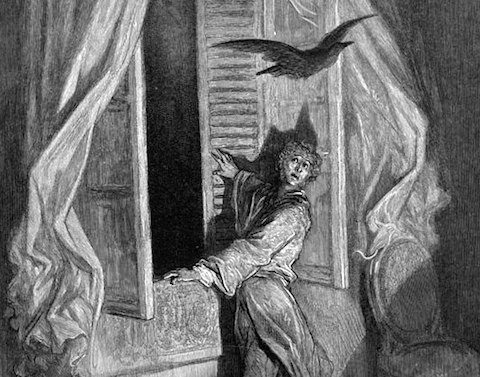
To illustrate what he means, Poe walks us through an analysis of his own work, “The Raven.” We are to take for granted as readers that “The Raven” achieves its desired effect. Poe has no misgivings about that. But how does it do so? Against commonplace ideas that writers “compose by a species of fine frenzy—an ecstatic intuition,” Poe has not “the least difficulty in recalling to mind the progressive steps of any of my compositions”—steps he considers almost “mathematical.” Nor does he consider it a “breach of decorum” to pull aside the curtain and reveal his tricks. Below, in condensed form, we have listed the major points of Poe’s essay, covering the elements he considers most necessary to “effective” literary composition.
Know the ending in advance, before you begin writing.
“Nothing is more clear,” writes Poe, “than that every plot, worth the name, must be elaborated to its dénouement before any thing be attempted with the pen.” Once writing commences, the author must keep the ending “constantly in view” in order to “give a plot its indispensable air of consequence” and inevitability.
Keep it short—the “single sitting” rule.
Poe contends that “if any literary work is too long to be read at one sitting, we must be content to dispense with the immensely important effect derivable from unity of impression.” Force the reader to take a break, and “the affairs of the world interfere” and break the spell. This “limit of a single sitting” admits of exceptions, of course. It must—or the novel would be disqualified as literature. Poe cites Robinson Crusoe as one example of a work of art “demanding of no unity.” But the single sitting rule applies to all poems, and for this reason, he writes, Milton’s Paradise Lost fails to achieve a sustained effect.
Decide on the desired effect.
The author must decide in advance “the choice of impression” he or she wishes to leave on the reader. Poe assumes here a tremendous amount about the ability of authors to manipulate readers’ emotions. He even has the audacity to claim that the design of the “The Raven” rendered the work “universally appreciable.” It may be so, but perhaps it does not universally inspire an appreciation of Beauty that “excites the sensitive soul to tears”—Poe’s desired effect for the poem.
Choose the tone of the work.
Poe claims the highest ground for his work, though it is debatable whether he was entirely serious. As “Beauty is the sole legitimate province of the poem” in general, and “The Raven” in particular, “Melancholy is thus the most legitimate of all poetical tones.” Whatever tone one chooses, however, the technique Poe employs, and recommends, likely applies. It is that of the “refrain”—a repeated “key-note” in word, phrase, or image that sustains the mood. In “The Raven,” the word “Nevermore” performs this function, a word Poe chose for its phonetic as much as for its conceptual qualities.
Poe claims that his choice of the Raven to deliver this refrain arose from a desire to reconcile the unthinking “monotony of the exercise” with the reasoning capabilities of a human character. He at first considered putting the word in the beak of a parrot, then settled on a Raven—“the bird of ill omen”—in keeping with the melancholy tone.
Determine the theme and characterization of the work.
Here Poe makes his claim about “the death of a beautiful woman,” and adds, “the lips best suited for such topic are those of a bereaved lover.” He chooses these particulars to represent his theme—“the most melancholy,” Death. Contrary to the methods of many a writer, Poe moves from the abstract to the concrete, choosing characters as mouthpieces of ideas.
Establish the climax.
In “The Raven,” Poe says, he “had now to combine the two ideas, of a lover lamenting his deceased mistress and a Raven continuously repeating the word ‘Nevermore.’” In bringing them together, he composed the third-to-last stanza first, allowing it to determine the “rhythm, the metre, and the length and general arrangement” of the remainder of the poem. As in the planning stage, Poe recommends that the writing “have its beginning—at the end.”
Determine the setting.
Though this aspect of any work seems the obvious place to start, Poe holds it to the end, after he has already decided why he wants to place certain characters in place, saying certain things. Only when he has clarified his purpose and broadly sketched in advance how he intends to acheive it does he decide “to place the lover in his chamber… richly furnished.” Arriving at these details last does not mean, however, that they are afterthoughts, but that they are suggested—or inevitably follow from—the work that comes before. In the case of “The Raven,” Poe tells us that in order to carry out his literary scheme, “a close circumscription of space is absolutely necessary to the effect of insulated incident.”
Throughout his analysis, Poe continues to stress—with the high degree of repetition he favors in all of his writing—that he keeps “originality always in view.” But originality, for Poe, is not “a matter, as some suppose, of impulse or intuition.” Instead, he writes, it “demands in its attainment less of invention than negation.” In other words, Poe recommends that the writer make full use of familiar conventions and forms, but varying, combining, and adapting them to suit the purpose of the work and make them his or her own.
Though some of Poe’s discussion of technique relates specifically to poetry, as his own prose fiction testifies, these steps can equally apply to the art of the short story. And though he insists that depictions of Beauty and Death—or the melancholy beauty of death—mark the highest of literary aims, one could certainly adapt his formula to less obsessively morbid themes as well.
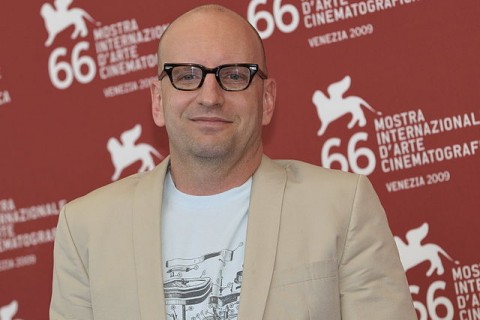
Our vast media landscape feels grossly oversaturated with advertising, propaganda, and all manner of redundant noise. But the discerning eye, and ear, perceives just as much quality out there as crap. “Retired” auteur Steven Soderbergh, as fans of his will know, is just such a discerning customer — and an exacting, highly organized one at that. Soderbergh has sworn off directing film, turning his attention to television by directing the Cinemax series The Knick as well as—reports Indiewire—“producing, editing, and lensing Magic Mike XXL,” the second installment of the Channing Tatum-starring male stripper saga.
One might think all this work would keep Soderbergh busy from dawn to dusk, but he’s a man who “gets more done in a day than most do in a week.” A consummate consumer of culture high and low, Soderbergh assiduously documented his watching, reading, and listening experiences for the entire year previous. His list includes TV shows like Veep and Louie, and heavier fare like True Detective and House of Cards. He read Donna Tartt’s The Goldfinch and Karl Ove Gnausgaard’s laborious Proustian novel My Struggle (books one through three—in two months). In addition to recent films like Gone Girl, Soderbergh watched Kubrick’s 2001: A Space Odyssey three times and Jaws twice. He even found the time for Die Hard With a Vengeance.
The above represents but the tiniest sampling of Soderbergh’s voracious diet. You can see the full list, including his album purchases here. As Indiewire rightly observes, the list is “a lot to wade through.” Even more so the incredible range and diversity of creative works contained within. Soderbergh maintained a similar log for 2013, which you can see here. Scanning these may inspire you to step up your input, or maybe just to pull a manageable number of selections for future reading/viewing/listening of your own.
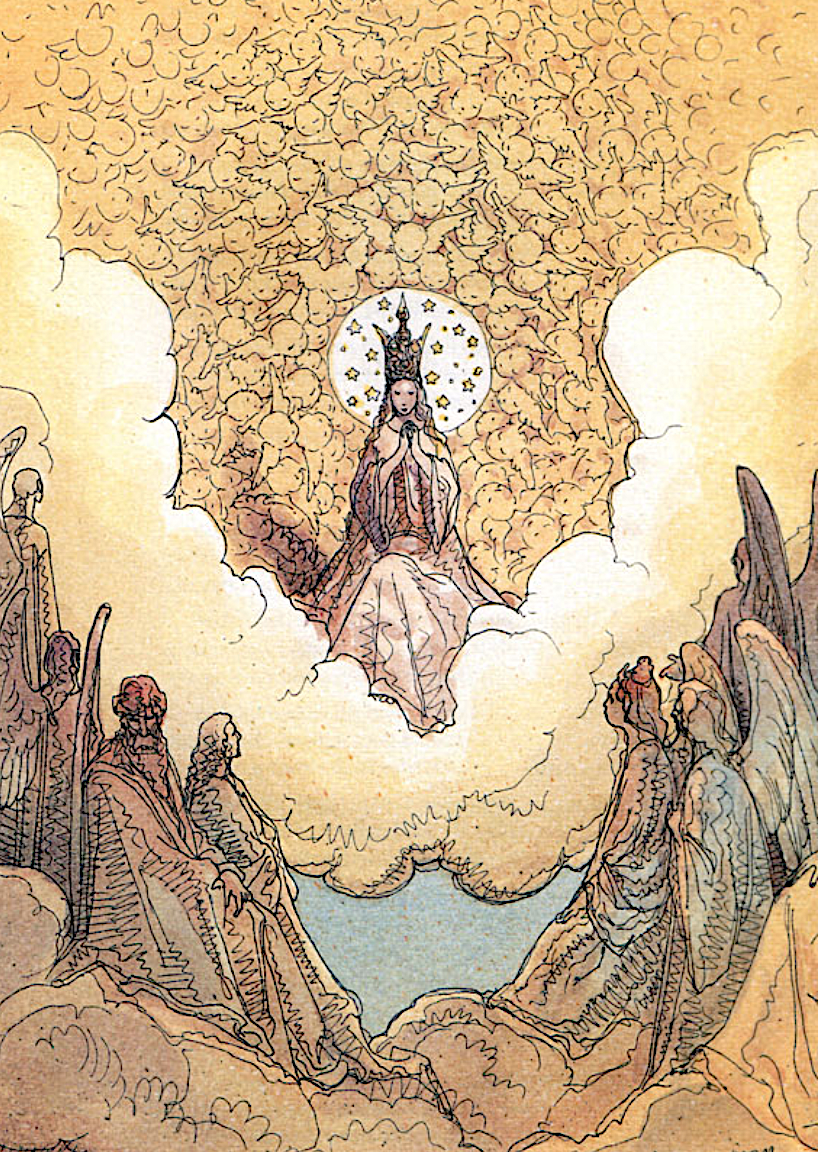
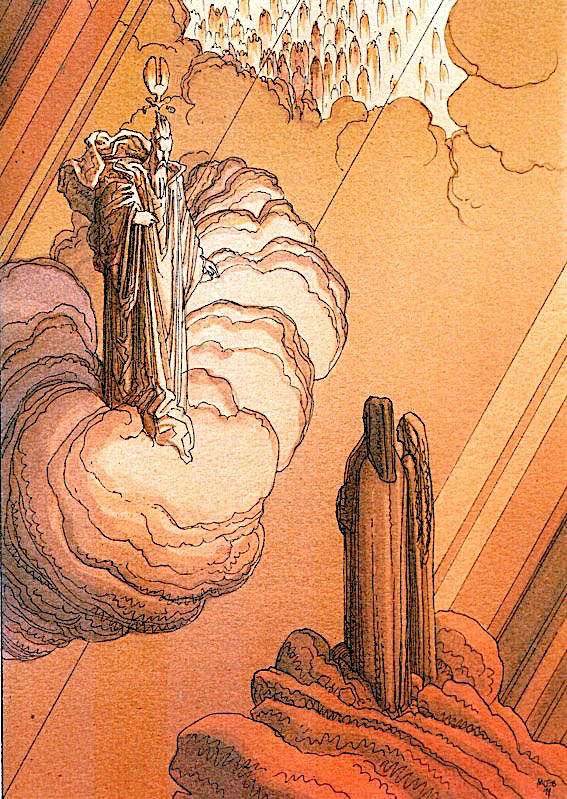
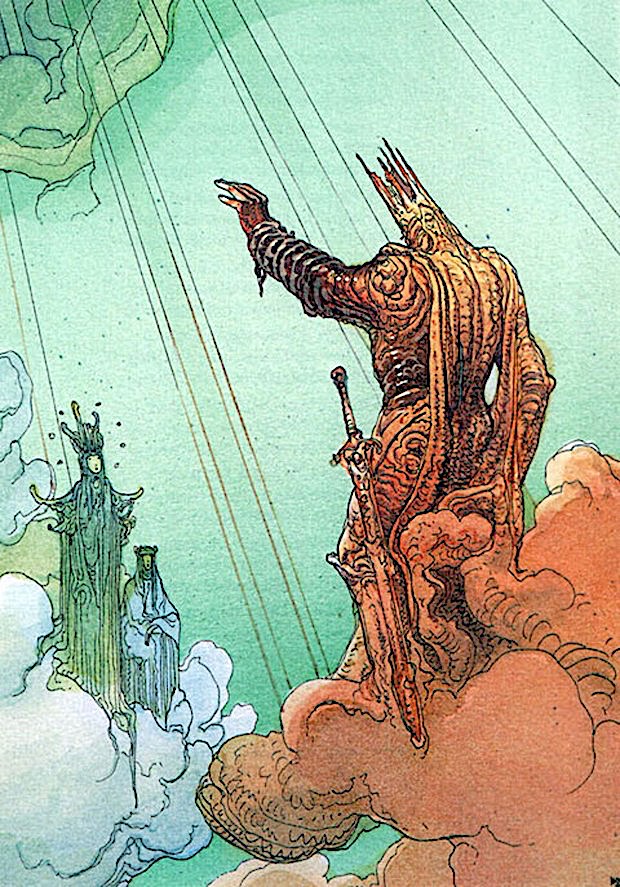
Salvador Dalí, Gustave Doré, Alberto Martini, Sandro Botticelli, the earlier and less-recognized Priamo della Quercia and Giovanni di Paolo — all of these artists have tried their hand at illustrating Dante Alighieri’s Divine Comedy. We have, in turn, featured all their efforts, each of a strikingly different sensibility and aesthetic interpretation of the harrowing journey out of the mortal realm and into the underworld described by this much-studied, much-translated, and just plain much-read 14th-century text. But none of those artists, despite the richness of their visions, spoke directly to the late 20th and early 21st century. For a truly modern Divine Comedy, behold the work of Jean Giraud, better known as Mœbius.
Mœbius, who passed out of this mortal realm himself in 2012, made his name with comics like Blueberry, Arzach, and The Airtight Garage of Jerry Cornelius — though to call these works, which belong simultaneously to the fields of science fiction and fantasy while transcending the both of them, nothing more than “comics” belies the artist’s ability to escape their conventions of storytelling and composition as if he’d never encountered them in the first place.
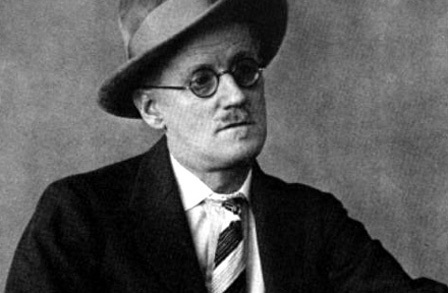
“The Dead” is the last – and most memorable – short story in James Joyce’s first book, Dubliners. Set during a New Year’s feast in 1904, the story focuses on Gabriel Conroy, a plump, bespectacled young man who is painfully aware of his own social ineptitude. As he navigates one minor faux pas after the next – making a poorly received joke here, clumsily parrying a barbed joke there – he comes to realize over the course of the party that his beautiful, distant wife has a past he never knew.
James’s story is filled with such humor, attention to character and musicality of language that it seems to cry out to be read aloud. The NPR series Selected Shorts heeded that call and presents the entire story performed live by Cynthia Nixon, of Sex and the City fame, who reads the first half, and by Irish author Colum McCann, who reads part of the second.
Jonathan Crow is a Los Angeles-based writer and filmmaker whose work has appeared in Yahoo!, The Hollywood Reporter, and other publications. You can follow him at @jonccrow. And check out his blog Veeptopus, featuring lots of pictures of badgers and even more pictures of vice presidents with octopuses on their heads. The Veeptopus store is here.
We don’t often think of the Beats as family men, and that’s because the most prominent of them weren’t, except William Burroughs for a time (a tragic story or two for another day). But friends of Ginsberg and Kerouac like Lucien and Francesca Carr and Robert and Mary Frank brought children into the poets’ lives, and you can see them all above, relaxing at the Harmony Bar & Restaurant in New York’s East Village in 1959.
This rare silent footage unites the three Carr and two Frank children in a rare appearance of the Beats together on film. The mustachioed Lucien Carr —a character with his own dark story—can be seen seated next to Kerouac. The Franks, père and mère, were both artists in their own right—London-born Mary a trained dancer, sculptor, and painter, and Robert an important American photographer and documentary filmmaker.
Dangerous Minds speculates that it’s Robert Frank behind the camera, both because we don’t see him in front of it and because Frank would that same year direct the short film Pull My Daisy (above), featuring both Ginsberg and Kerouac and adapted from Kerouac’s play Beat Generation. (Frank apparently denies he shot the footage at the top). Pull My Daisy also includes famous Beats like Gregory Corso, musician David Amram, and Ginsberg’s partner, poet Peter Orlovsky. In a previous post on that film, Open Culture’s Colin Marshall described it as crafted with “great deliberateness, albeit the kind of deliberateness meant to create the impression of thrown-together, ramshackle spontaneity.”
To learn more about the Beats’ appearances on film—as themselves, in character, and through their adapted work, see this excellent filmography. And just above, watch a mash-up of most of those various cinematic appearances in a trailer produced by Cinefamily for the IFC and Sundance series “Beats on Film.”
We're hoping to rely on loyal readers, rather than erratic ads. Please click the Donate button and support Open Culture. You can use Paypal, Venmo, Patreon, even Crypto! We thank you!
Open Culture scours the web for the best educational media. We find the free courses and audio books you need, the language lessons & educational videos you want, and plenty of enlightenment in between.