Although J.K. Rowling wrote the final book in the Harry Potter series in 2007, she continues to give Potter fans an occasional fix, publishing short works that add a little more color and detail to the Harry Potter story. Ardent fans know that Rowling wrote a short Prequel in 2008. Also, earlier this year, she began writing new stories about the 2014 Quidditch World Cup Finals for Pottermore, the website for all things Harry Potter. She later followed with a story that takes the form of an article published in The Daily Prophet (“Dumbledore’s Army Reunites at Quidditch World Cup Final”), which gives us the first glimpse of the adult Harry Potter.
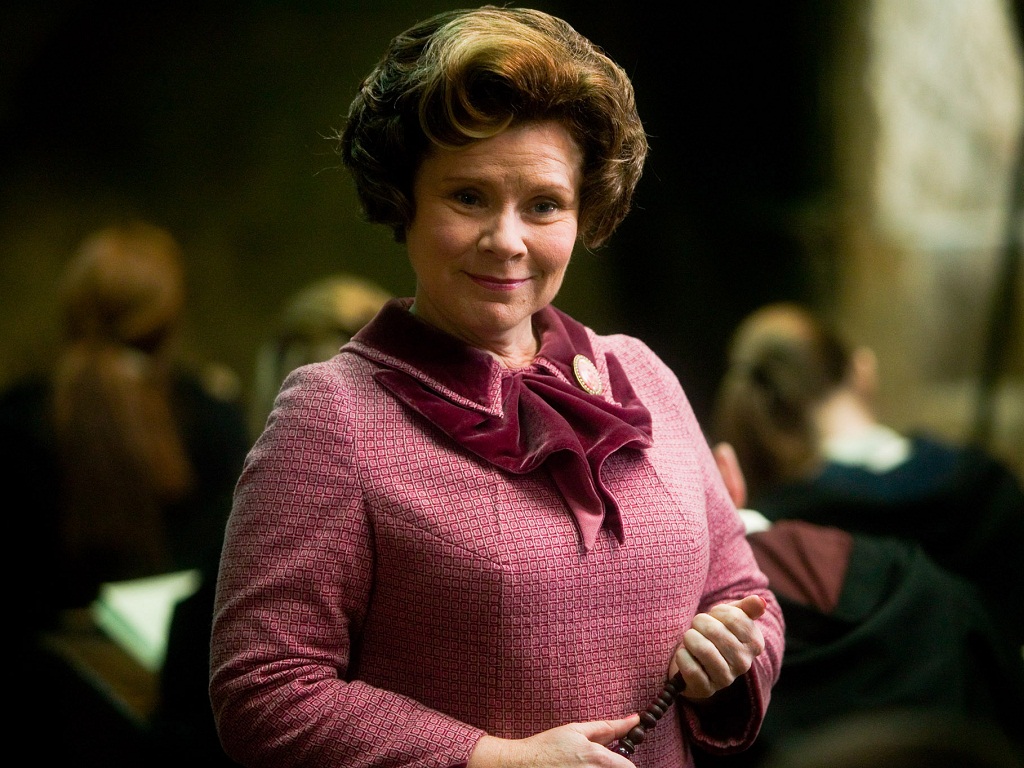
Now, on Halloween, we get “The Story of Dolores Jane Umbridge” — a short fictional essay that gives us a more complete personal portrait of the character that readers found so easy to dislike. In the essay [SPOILER ALERT], we learn that Umbridge was, gasp, a half blood, who had demonstrated a certain capacity for wickedness at a young age: “Even at seventeen, Dolores was judgemental, prejudiced and sadistic, although her conscientious attitude, her saccharine manner towards her superiors, and the ruthlessness and stealth with which she took credit for other people’s work soon gained her advancement.”
Rowling then appends some personal comments to the story, explaining the origins of the Umbridge character. She writes:
Once, long ago, I took instruction in a certain skill or subject (I am being vague as vague can be, for reasons that are about to become obvious), and in doing so, came into contact with a teacher or instructor whom I disliked intensely on sight.
The woman in question returned my antipathy with interest. Why we took against each other so instantly, heartily and (on my side, at least) irrationally, I honestly cannot say. What sticks in my mind is her pronounced taste for twee accessories. I particularly recall a tiny little plastic bow slide, pale lemon in colour that she wore in her short curly hair.… [H]er tendency to wear frills where (I felt) frills had no business to be, and to carry undersized handbags, again as though they had been borrowed from a child’s dressing-up box, jarred, I felt, with a personality that I found the reverse of sweet, innocent and ingenuous.
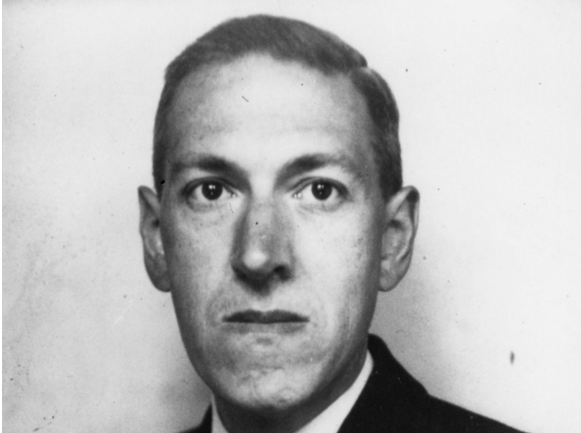
Though the term “weird fiction” came into being in the 19th century—originally used by Irish gothic writer Sheridan Le Fanu—it was picked up by H.P. Lovecraft in the 20th century as a way, primarily, of describing his own work. Lovecraft produced copious amounts of the stuff, as you can see from our post highlighting online collections of nearly his entire corpus. He also wrote in depth about writing itself. He did so in generally prescriptive ways, as in his 1920 essay “Literary Composition,” and in ways specific to his chosen mode—as in the 1927 “Supernatural Horror in Literature,” in which he defined weird fiction very differently than Le Fanu or modern authors like China Miéville. For Lovecraft,
The true weird tale has something more than secret murder, bloody bones, or a sheeted form clanking chains according to rule. A certain atmosphere of breathless and unexplainable dread of outer, unknown forces must be present; and there must be a hint, expressed with a seriousness and portentousness becoming its subject, of that most terrible conception of the human brain–a malign and particular suspension or defeat of those fixed laws of Nature which are our only safeguard against the assaults of chaos and the daemons of unplumbed space.
Here we have, broadly, the template for a very Lovecraftian tale indeed. Ten years later, in a 1937 essay titled “Notes on Writing Weird Fiction,” Lovecraft would return to the theme and elaborate more fully on how to produce such an artifact.
Weird Fiction, wrote Lovecraft in that later essay, is “obviously a special and perhaps a narrow” kind of “story-writing,” a form in which “horror and the unknown or the strange are always closely connected,” and one that “frequently emphasize[s] the element of horror because fear is our deepest and strongest emotion.” Although Lovecraft self-deprecatingly calls himself an “insignificant amateur,” he nonetheless situates himself in the company of “great authors” who mastered horror writing of one kind or another: “[Lord] Dunsany, Poe, Arthur Machen, M.R. James, Algernon Blackwood, and Walter de la Mare.” Even if you only know the name of Poe, it’s weighty company indeed.
But be not intimidated—Lovecraft wasn’t. As our traditional holiday celebration of fear approaches, perhaps you’d be so inclined to try your hand at a little weird fiction of your own. You should certainly, Lovecraft would stress, spend some time reading these writers’ works. But he goes further, and offers us a very concise, five point “set of rules” for writing a weird fiction story that he says might be “deduced… if the history of all my tales were analyzed.” See an abridged version below:
Prepare a synopsis or scenario of events in the order of their absolute occurrence—not the order of their narrations.
Prepare a second synopsis or scenario of events—this one in order of narration (not actual occurrence), with ample fullness and detail, and with notes as to changing perspective, stresses, and climax.
Write out the story—rapidly, fluently, and not too critically—following the second or narrative-order synopsis. Change incidents and plot whenever the developing process seems to suggest such change, never being bound by any previous design.
It may be that the second rule is made just to be broken, but it provides the weird fiction practitioner with a beginning. The third stage here brings us back to a process every writer on writing, such as Stephen King, will highlight as key—free, unfettered drafting, followed by…
Revise the entire text, paying attention to vocabulary, syntax, rhythm of prose, proportioning of parts, niceties of tone, grace and convincingness of transitions…
And finally….
Prepare a neatly typed copy—not hesitating to add final revisory touches where they seem in order.
You will notice right away that these five “rules” tell us nothing about what to put in our weird fiction, and could apply to any sort of fiction at all, really. This is part of the admirably comprehensive quality of the otherwise succinct essay. Lovecraft tells us why he writes, why he writes what he writes, and how he goes about it. The content of his fictional universe is entirely his own, a method of visualizing “vague, elusive, fragmentary impressions.” Your mileage, and your method, will indeed vary.
Lovecraft goes on to describe “four distinct types of weird story” that fit “into two rough categories—those in which the marvel or horror concerns some condition or phenomenon, and those in which it concerns some action of persons in connection with a bizarre condition or phenonmenon.” If this doesn’t clear things up for you, then perhaps a careful reading of Lovecraft’s complete “Notes on Writing Weird Fiction” will. Ultimately, however, “there is no one way” to write a story. But with some practice—and no small amount of imagination—you may find yourself joining the company of Poe, Lovecraft, and a host of contemporary writers who continue to push the boundaries of weird fiction past the sometimes parochial, often profoundly bigoted, limits that Lovecraft set out.
Blank on Blank returns with another one of their visually-distinctive animated videos. This one lets us time travel back to 1970 when Studs Terkel, the great American author, historian, and radio broadcaster, sat down with acclaimed poet Maya Angelou. The interview took place shortly after Angelou published her 1969 autobiography, I Know Why the Caged Bird Sings, and the conversation turns, amusingly, to her childhood years, when she learned how to hustle and count cards from her step father, Daddy Clidell. I bet Bukowski is applauding wherever he is. Blank on Blank made this video in partnership with the Studs Terkel Radio Archive, which we featured on our site late last year.
Last week, in deference to the approach of Halloween, we featured the complete works of Edgar Allan Poe as Free eBooks and Free Audio Books. If you give them a read, a listen, or both, you’ll discover that few creators, using nothing more than the written word, can disturb quite so effectively as Poe. But his written words have also provided inspiration to frightening works in other media, including the previously featured 1953 British animation of “The Tell-Tale Heart” and, today, the short-film version of “The Fall of the House of Usher.” That 1839 story perhaps most perfectly (and most viscerally) realizes such pet themes of Poe’s as illness, dread, and live burial, and as such has served as material to a great many filmmakers as defiantly lowbrow as Roger Corman and as uncompromisingly idiosyncratic as Jan Švankmajer. But here we offer you one of the most interesting cinematic “Usher“s ever made: James Sibley Watson and Melville Webber’s 13-minute avant-garde adaptation, scripted in part by poet e.e. cummings.
“Despite their importance as leading figures in the film world,” writes Tara Travisano, “Watson and Webber’s work is often overlooked and not given sufficient credit.” Though they got their shooting script from the modernist-influenced cummings, the filmmakers, “not fans of modernism,” “preferred to have their films described as amateur.” Their Fall of the House of Usher, the best-known work they ever produced, “hardly follows a narrative, but is valued for its creative use of repetition and variation and for the film’s dramatic lighting.” And don’t worry if you haven’t read the original story in a while; according to Travisano, Watson and Webber chose to film it because they themselves hadn’t read it in a while, and thus “would be free of its influence.” But after experiencing the brief but unsettling cinematic dream they managed to make out of this half-remembered Poean material, you may want to seek out its influence by going back and reading it again — or listening to it, or trying to sleep and re-dream it for yourself.
Just what is an author? It might seem like a silly question, and an academic dissection of the term may seem like a needlessly pedantic exercise. But the very variability of the concept means it isn’t a stable, fixed idea at all, but a shifting set of associations we have with notions about creativity, the social role of art, and that elusive quality known as “genius.” Questions raised in the Open University video above—part of a series of very short animated entrées into literary criticism called “Outside the Book”—make it hard to ignore the problems we encounter when we try to define authorship in simple, straightforward ways. Most of the questions relate to the work of French poststructuralist Michel Foucault, whose critical essay “What is an Author?”—along with structuralist thinker Roland Barthes’ “The Death of the Author”—disturbed many a literary critic’s comfortable assumptions about the creative locus behind any given work.
In the 18th century, at least in Europe, the author was a highly celebrated cultural figure, a status epitomized by Samuel Johnson’s reverential biography of John Dryden and edition of Shakespeare—and in turn Johnson’s own biography by his amanuensis Boswell. The 19th century began to see the author as a celebrity, with the hype and sometimes tawdry speculation that accompanies that designation. In the mid-twentieth century, even as the idea of the film director as auteur—a singular creative genius—gained ascendance, the inflated role of the literary author came in for a bruising. With Foucault, Barthes, and others like W.K. Wimsatt and Monroe Beardsley—whose essay “The Intentional Fallacy” more or less ruled out biography as a tool of the critic—the author receded and the “text” gained primacy as, in Foucault’s words, a “discursive unit.”
This means that questions of authorship became inseparable from questions of readership, interpretation, and influence; from questions of historical classification and social construction (i.e. how do we know anything about “Byron” except through biographies, documentaries, etc., themselves cultural productions?); from questions of translation, pseudepigraphy, and pen names. Put in much plainer terms, we once came to think of the author not simply as the writer—a role previously delegated to lowly, usually anonymous “scribes” who simply copied the words of gods, heroes, and prophets. Instead, the author became a god, a hero, and a prophet, a godlike creator with a “literary stamp of approval” that grants his or her every utterance on the page a special status; “that makes even the note on Shakespeare’s fridge a work of profound genius.” But that idea is anything but simple, and the critical discussion around it anything but trivial.
Ditto much of the above when it comes to that other seemingly indivisible unit of literature, the book. In the even shorter video guide above, Open University rapidly challenges our commonplace ideas about book-hood and raises the now-commonplace question about the future of this “reading gizmo.” For more “Outside the Book,” see the remaining videos in the series: “Comedy,” “Tragedy,” and “Two Styles of Love.” And for a much more sustained and serious study of the art of literary criticism, delve into Professor Paul Fry’s Yale course below. It’s part of Open Culture’s collection, 1,700 Free Online Courses from Top Universities.
I rarely think back to memories from that busywork-intensive containment unit known as American elementary school, but when I do, I usually arrive at listening to a Ray Bradbury story — something about a faraway planet, something about monsoons, I can never remember which one — during read-aloud time. Even then, on some level, I understood that the author of Fahrenheit 451 and The Martian Chronicles (not that I yet had any idea at the time about books like Fahrenheit 451 and The Martian Chronicles) wrote with the human voice in mind. Not necessarily the momentarily defamiliarized voice of a teacher reading to a post-lunch classroom of ten-year-olds, and not necessarily the flawlessly pronouncing and pausing, many-takes-recorded-per-sentence voice of the professional audiobook narrator (though Bradbury’s work did provide material for a few proto-audiobooks), but, perhaps, the voice of the mind. Of all Bradbury’s tales we love to read aloud, few seem quite so effective in this way as “The Veldt.”
The story first appeared, according to the web site of public radio station WNYC, in a 1950 Saturday Evening Post “with the title ‘The World the Children Made,’ which is a good description of what goes on in this eerie tale. It imagines the ‘model home’ of the future, including a programmable nursery that becomes the site of a power struggle. [Fellow speculative writer Neil] Gaiman says that Bradbury’s tale raises complex questions: ‘Are our children our own?,’ and ‘What does technology do to them?’ ” Public Radio International commissioned no less a speaker than Colbert Report and future Late Show host Stephen Colbert — a satirist highly attuned to the ironies inherent in mankind’s visions of its own future — to read it for their “Selected Shorts” series, and you can hear the whole thing above.
Given how much progress our pursuit of total automation and virtual stimulation (and our parallel desire to escape those conditions) has made in the past 64 years, “The Veldt” has grown only more relevant. Pair it with “There Will Come Soft Rains,” Bradbury’s other famously read-aloudable story of the home of the 1950 future, for a richly funny and troubling double-feature of the mind.
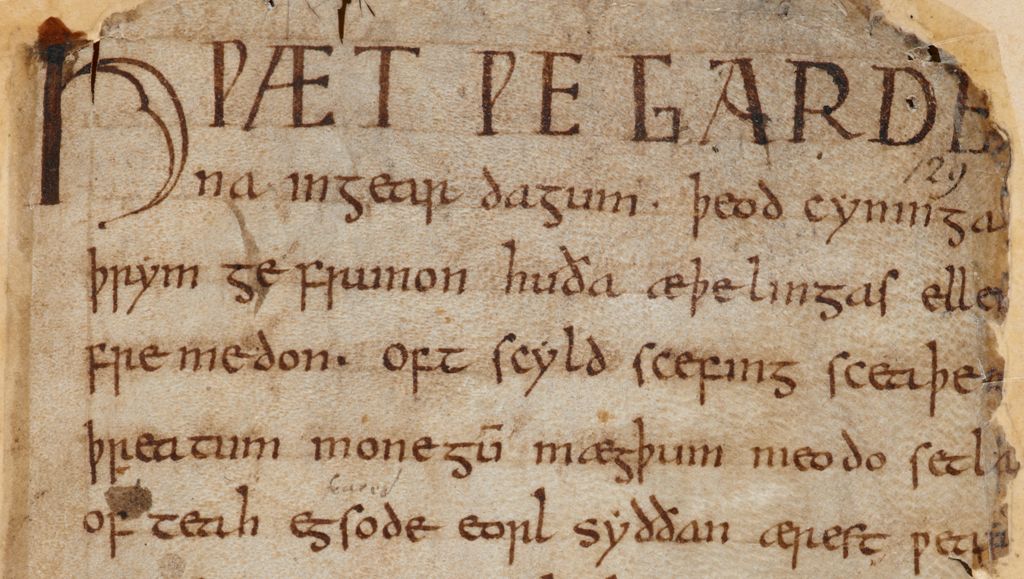
I was as surprised as most people are when I first heard the ancient language known as Old English. It’s nothing like Shakespeare, nor even Chaucer, who wrote in a late Middle English that sounds strange enough to modern ears. Old English, the English of Beowulf, is almost a foreign tongue; close kin to German, with Latin, Norse, and Celtic influence.
As you can hear in the Beowulf reading above from The Telegraph, it’s a thick, consonant-rich language that may put you in mind of J.R.R. Tolkien’s elvish. The language arrived in Briton—previously inhabited by Celtic speakers—sometime in the fifth century, though whether the Anglo-Saxon invasion was a hostile takeover by Germanic mercenaries or a slow population drift that introduced a new ethnicity is a matter of some dispute. Nevertheless it’s obvious from the reading above—and from texts in the language like this online edition of Beowulf in its original tongue—that we would no more be able to speak to the Anglo-Saxons than we would to the Picts and Scots they conquered.
So how is it that both the language we speak and its distant ancestor can both be called “English”? Well, that is what its speakers called it. As the author of this excellent Old English introductory textbook writes, speakers of “Old English,” “Middle English,” and “Modern English” are “themselves modern”; They “would have said, if asked, that the language they spoke was English.” The changes in the language “took place gradually, over the centuries, and there never was a time when people perceived their language as having broken radically with the language spoken a generation before.” And while “relatively few Modern English words come from Old English […] the words that do survive are some of the most common in the language, including almost all the ‘grammar words’ (articles, pronouns, prepositions) and a great many words for everyday concepts.” You may notice a few of those distant linguistic ancestors in the Beowulf passage accompanying the reading above.
Beowulf is, of course, the oldest epic poem in English, written sometime between the 8th and early 11th century. It draws, however, not from British sources but from Danish myth, and is in fact set in Scandinavia. The title character, a hero of the Geats—or ancient Swedes—travels to Denmark to offer his services to the king and defeat the monster Grendel (and his mother). The product of a warrior culture, the poem shares much in common with the epics of Homer with its code of honor and praise of fighting prowess. And here see vocalist, harpist, and medieval scholar Benjamin Bagby perform the opening lines of the poem as its contemporary audience would have experienced it—intoned by a bard with an Anglo-Saxon harp. The modern English subtitles are a boon, but close your eyes for a moment and just listen to the speech—see if you can pick out any words you recognize. Then, perhaps, you may wish to turn to Fordham University’s online translation and find out what all that big talk in the prologue is about.
We cannot properly speak of horror fiction without mentioning the name H.P. Lovecraft, any more than we could do so without speaking of Edgar Allan Poe, whose complete works we featured in a post yesterday. Even now, as some of Lovecraft’s really vicious attitudes have come in for much critical reappraisal, the Lovecraftian is still a dominant form. Winners of the World Fantasy Award receive a bust of the author, and dark modern masters like Stephen King and Joyce Carol Oates admit that Lovecraft was “the twentieth century’s greatest practitioner of the classic horror tale” and “an incalculable influence on succeeding generations of writers of horror fiction.” His work, writesSalon, has influenced “everyone from the Argentinian metafictionist Jorge Luis Borges to the film director Guillermo del Toro, as well as untold number of rock bands and game designers.”
The early twentieth century author spent almost his entire life in the New England of his birth, drawing on its many oddities in obscure stories published in pulp magazines—notably the influential Weird Tales. Hypochondriac, hyper-sensitive, and reclusive in later life, Lovecraft survived on a dwindling inheritance and never achieved much recognition. But in death, he has spawned a formidable cult who immerse themselves in a universe created from references to the occult, demonology, and various mythological archetypes. However overwrought his prose, Lovecraft’s work can be situated in a long literary tradition of influence, and a Lovecraft circle continued to expand his vision of scientific and supernatural horror after his death.
Central to the Lovecraft cosmos are “The Old Ones,” a collection of powerful primordial beings, and their cult worshipers, first introduced in “The Call of Cthulhu” in 1926. At the top of the post, you can hear a dramatic reading of the story by Garrick Hagon. Just above hear a radio dramatization of “The Colour Out of Space,” which was collected in The Best American Short Stories in 1928, one of the few of Lovecraft’s works to receive such an honor in his lifetime. You’ll find much more Lovecraft read aloud on YouTube, including classic stories like “The Dunwich Horror,” “At The Mountains of Madness,” and “The Horror at Red Hook.”
Listening to Lovecraft is an excellent, as well as convenient, way to experience his work. His florid, often archaic, and melodramatic descriptions lend themselves perfectly to aural interpretations. Luckily for us, we have not one, but two audio book collections of nearly everything Lovecraft ever wrote. Just above, stream his complete public domain works, and see the Internet Archive for another audiobook set of his collected works. One of the reasons audio of Lovecraft is so plentiful is that most of his work is in the commons. SFF Audio has yet another huge collection of Lovecraft stories read aloud, downloadable as MP3s. Finally, if you somehow can’t find what you’re looking for at any of those links, you’re bound to at The World’s Largest H.P. Lovecraft Audio Links Gateway.
Should listening to Lovecraft whet your appetite for more, you may just be ready to start reading. Although Lovecraft’s fiction features what may be some of modern literature’s most dreadful monsters, the horror in his work is mostly existential, as characters confront a vast, malevolent and thoroughly alien universe that has no regard for human life whatsoever. But the persistent bleakness and doom of his vision is countered by an inexhaustibly rich imagination. In one of the opening sentences of “The Call of Cthulu,” Lovecraft writes, “the most merciful thing in the world, I think, is the inability of the human mind to correlate all its contents,” perhaps the truest description of his own fictional cosmos. Lovecraft scholars and fans spend lifetimes sifting through his massive storehouse of weirdness. Whether you’re inclined to join them in the deep end, or just dip in a toe, you can find all of Lovecraft’s published work in various forms at the locations below.
Given these resources, you should have no trouble becoming a Lovecraft expert by Halloween. Or, at the very least, picking out a few of his scariest stories to listen to and read aloud around a flickering jack o’ lantern or your collection of Cthulhu figurines.
We're hoping to rely on loyal readers, rather than erratic ads. Please click the Donate button and support Open Culture. You can use Paypal, Venmo, Patreon, even Crypto! We thank you!
Open Culture scours the web for the best educational media. We find the free courses and audio books you need, the language lessons & educational videos you want, and plenty of enlightenment in between.