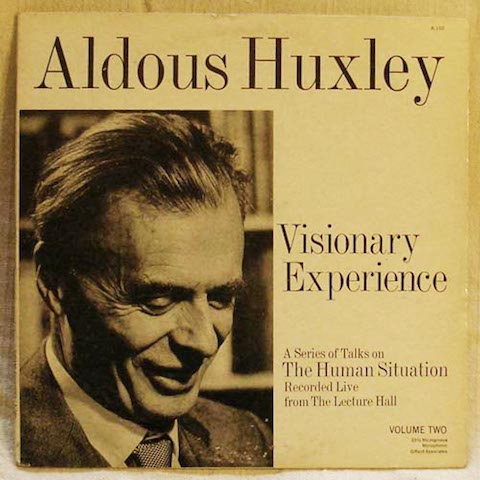
Today, those who get “turned on” to Aldous Huxley (as they might have said back in the 1960s) get it through his books: the dystopian novel Brave New World, usually, or perhaps the mescaline memoir The Doors of Perception. But during Huxley’s lifetime, especially in its final years from the late 1950s to the early 60s, he made no small number of adherents through lecturing. Having transplanted himself from his native England to California in 1937, he eventually achieved great regard among the region’s self-styled intellectuals and spiritual seekers, giving talks at such mystically high-in-the-zeitgeist places as Hollywood and Santa Barbara’s Vedanta temples and even Big Sur’s famous Esalen Institute. But the prolific speech-giver also went farther afield, to far squarer venues such as the Massachusetts Institute of Technology. There, in 1962, he recorded the album Visionary Experience: A Series Of Talks On The Human Situation, which you can hear on Ubuweb, or right below.
At that point, Huxley had already gained worldwide fame for his views on better living, which was sometimes achieved, he believed, through psychedelic drugs. This might have already sounded like old hat in, say, the San Francisco of the late 1960s, let alone the 70s and onward, but in these recordings Huxley says his piece in — I still can’t quite believe it — the MIT of the early 1960s. But Huxley, diagnosed a couple years before with the cancer that would claim his life the next, had nothing to lose by spreading the word of his substance-induced discoveries. These would, as you may remember, even facilitate the death itself, Huxley’s final visionary experience. To learn even more about all those that preceded it, see his collection Writings on Psychedelics and the Visionary Experience (1931–1963), that’s available on the Internet Archive. While we here at Open Culture don’t endorse drug use, we do endorse the words of Huxley as a substitute, and perhaps an even more vivid one.
Walt Whitman’s Leaves of Grass often makes its way into the hands of oversized American characters of, shall we say, uncertain repute. We learned, for example, under scandalous circumstances, of Bill Clinton’s admiration for the book, and we’ll never forget the role it played in the rise and fall of similarly alliteratively named, power-mad Walter White.
Another fictional mastermind—Sideshow Bob—quotes gleefully from Leaves of Grass in a recent Simpsons episode. And perhaps the most outré character of them all—the florid speech of the rogue and pimp Al Swearengen in HBO’s Deadwood—derives in part from the “barbaric yawp” Whitman describes as his native tongue in the poem from which the book’s title comes, “Song of Myself.”
One of the many reasons this particular poem from Leaves of Grass captures the imagination of outlaw intellectuals (and narcissists) may be Whitman’s invention of a new American poetic idiom for the eloquent assertion of stridently defiant personal identities. (As Ezra Pound put it, Whitman “broke the new wood.”) The Guardian placed “Song of Myself” at the top of a 10 best American poems list for the “peerless self-performance” of the poem’s hypnotic cadences. Who better to interpret those lines than another self-invented American contrarian, Orson Welles?
During some difficult times in the fifties—in part due to Welles’ IRS trouble—the great actor/director/multi-media impresario found work on radio plays in England, including The Lives of Harry Lime (based on his character in The Third Man) and The Adventures of Sherlock Holmes (as Moriarty). In 1953, the BBC contracted with Welles to record an hour of readings from “Song of Myself.” BBC 3 broadcast the session, and it later saw release as an LP, now sadly out of print. Fortunately, however, much of this recording has been digitally preserved. At the top, hear Welles read section VI of the poem, and directly above, hear him read the heretical section XLVIII. The Mickle Street Review, an online journal of Whitman studies, hosts a small part of Side 1 and, it appears, all of Side 2 of the record, below. The text of the poem was too long for a full treatment, and Welles, it seems, abridged and adapted some of the work himself. His reading was apparently very well received by the UK press.
Side 1:
Side 2:
While the BBC commissioned the recordings—and Welles no doubt needed the money—he already had an affinity for Whitman. In the same year he completely re-invented American film with Citizen Kane, he also began broadcasting the Orson Welles Show on CBS Radio, on which he and his guests gave dramatic readings from drama, poetry, and fiction. Welles produced 19 episodes, though only 8 have survived. One of the lost episodes, from December 1, 1941, featured Welles reading from Leaves of Grass. As further evidence, we have this photograph of Welles reading Gay Wilson Allen’s The Solitary Singer, a critical biography of the poet.
What draws Welles, and restless personalities like him, to Whitman, and especially to Leaves of Grass? One answer lies in Whitman’s own life. Early on, PBS’s American Experience tells us, Whitman staked out “radical positions… putting him in near constant opposition to society’s prevailing sentiments.” He never moderated his views or his voice, though faced with charges of blasphemy, obscenity, bad writing, and various other public vices at the time. Whitman’s steadfast commitment to his political and artistic vision brought him worldwide acclaim, as well as censure, in his lifetime. A particularly scathing 1882 Atlantic review of the second printing of Leaves of Grass catalogues Whitman’s literary abuses and concludes that “the book cannot attain to any very wide influence.” Despite this terribly wrongheaded prediction, the reviewer at least recognizes Whitman’s “generous aspiration,” a quality held in common by all of Whitman’s admirers, be they heroes, villains, or just average people responding to the poet’s raw self-assertion and capacious, grandiose, and particularly American, form of longing.
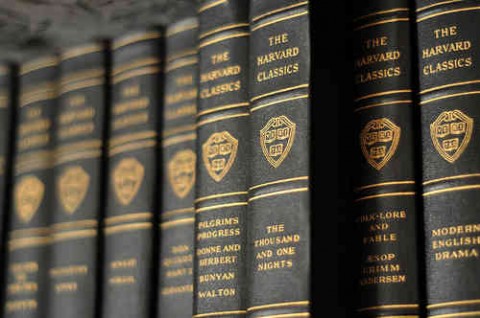
Every revolutionary age produces its own kind of nostalgia. Faced with the enormous social and economic upheavals at the nineteenth century’s end, learned Victorians like Walter Pater, John Ruskin, and Matthew Arnold looked to High Church models and played the bishops of Western culture, with a monkish devotion to preserving and transmitting old texts and traditions and turning back to simpler ways of life. It was in 1909, the nadir of this milieu, before the advent of modernism and world war, that The Harvard Classics took shape. Compiled by Harvard’s president Charles W. Eliot and called at first Dr. Eliot’s Five Foot Shelf, the compendium of literature, philosophy, and the sciences, writes Adam Kirsch in Harvard Magazine, served as a “monument from a more humane and confident time” (or so its upper classes believed), and a “time capsule…. In 50 volumes.”
What does the massive collection preserve? For one thing, writes Kirsch, it’s “a record of what President Eliot’s America, and his Harvard, thought best in their own heritage.” Eliot’s intentions for his work differed somewhat from those of his English peers. Rather than simply curating for posterity “the best that has been thought and said” (in the words of Matthew Arnold), Eliot meant his anthology as a “portable university”—a pragmatic set of tools, to be sure, and also, of course, a product. He suggested that the full set of texts might be divided into a set of six courses on such conservative themes as “The History of Civilization” and “Religion and Philosophy,” and yet, writes Kirsch, “in a more profound sense, the lesson taught by the Harvard Classics is ‘Progress.’” “Eliot’s [1910] introduction expresses complete faith in the ‘intermittent and irregular progress from barbarism to civilization.’”
In its expert synergy of moral uplift and marketing, The Harvard Classics (find links to download them as free ebooks below) belong as much to Mark Twain’s bourgeois gilded age as to the pseudo-aristocratic age of Victoria—two sides of the same ocean, one might say.
The idea for the collection didn’t initially come from Eliot, but from two editors at the publisher P.F. Collier, who intended “a commercial enterprise from the beginning” after reading a speech Eliot gave to a group of workers in which he “declared that a five-foot shelf of books could provide”
a good substitute for a liberal education in youth to anyone who would read them with devotion, even if he could spare but fifteen minutes a day for reading.
Collier asked Eliot to “pick the titles” and they would publish them as a series. The books appealed to the upwardly mobile and those hungry for knowledge and an education denied them, but the cost would still have been prohibitive to many. Over a hundred years, and several cultural-evolutionary steps later, and anyone with an internet connection can read all of the 51-volume set online. In a previous post, we summarized the number of ways to get your hands on Charles W. Eliot’s anthology:
You can still buy an old set off of eBay for $399 [now $299.99]. But, just as easily, you can head to the Internet Archiveand Project Gutenberg, which have centralized links to every text included in The Harvard Classics (Wealth of Nations, Origin of Species, Plutarch’s Lives, the list goes on below). Please note that the previous two links won’t give you access to the actual annotated Harvard Classics texts edited by Eliot himself. But if you want just that, you can always click here and get digital scans of the true Harvard Classics.
In addition to these options, Bartleby has digital texts of the entire collection of what they call “the most comprehensive and well-researched anthology of all time.” But wait, there’s more! Much more, in fact, since Eliot and his assistant William A. Neilson compiled an additional twenty volumes called the “Shelf of Fiction.” Read those twenty volumes—at fifteen minutes a day—starting with Henry Fielding and ending with Norwegian novelist Alexander Kielland at Bartleby.
What may strike modern readers of Eliot’s collection are precisely the “blind spots in Victorian notions of culture and progress” that it represents. For example, those three harbingers of doom for Victorian certitude—Marx, Nietzsche, and Freud—are nowhere to be seen. Omissions like this are quite telling, but, as Kirsch writes, we might not look at Eliot’s achievement as a relic of a naively optimistic age, but rather as “an inspiring testimony to his faith in the possibility of democratic education without the loss of high standards.” This was, and still remains, a noble ideal, if one that—like the utopian dreams of the Victorians—can sometimes seem frustratingly unattainable (or culturally imperialist). But the widespread availability of free online humanities certainly brings us closer than Eliot’s time could ever come.
Today is the 92nd birthday of author and cultural icon Jack Kerouac. Born in Lowell, Massachusetts in 1922, Kerouac was one of the troika of writers – along with Allen Ginsberg and William S. Burroughs – who formed the core of the Beat Generation. He wrote shaggy dog stories — thinly veiled autobiographical tales about sex and drugs, friendship and spiritual yearning. His style was spontaneous and off-hand, yet he crafted passages of such poetic beauty that they make the reader gasp. He wrote his hugely influential book On the Road — legend has it — during a 20-day writing bender. He went so far as to tape together strips of paper into one continuous scroll of paper so as not to break his flow.
It’s hard to imagine Hunter S. Thompson and his distinctive brand of journalism without Jack Kerouac. Both wrote brilliant, rambling tracts about America. Both could turn a phrase like nobody’s business. Both had political philosophies that didn’t fit comfortably on either the left or right side of the spectrum. The difference is that Kerouac was doing all of this while Thompson was just hitting puberty.
So it might be surprising to learn that Thompson apparently loathed Kerouac’s writing when he was a young man. In a letter penned when the future gonzo journalist was a mere 21 years old, he savaged the Beat writer.
The man is an ass, a mystic boob with intellectual myopia. The Dharma thing was quite as bad as The Subterraneans and they’re both withered appendages to On The Road — which isn’t even a novel in the first place…If somebody doesn’t kill that fool soon, we’re all going to be labeled “The generation of the Third Sex.”
Is this a sincere opinion or is this bluster? Or is it both?
Thirty years later, it’s hard to see if Thompson’s opinion of Kerouac has evolved. In a recording from 1998, which you can listen to above, he seems to praise Kerouac while at the same time slipping in the shiv. In the video, an obviously inebriated Thompson can be heard readinga poem dedicated to the author.
Now I want to tell you.… In fact he (Kerouac) was a great influence on me.… So now I wanna put out my poem…This is my Ode to Jack Kerouac, who remains one of my heroes…Uhhhh…How about this… This is called, let’s see…This is called ‘Hippy Ode To Jack’…
“Four dogs went to the wilderness, Only three came back.
Two dogs died from Guinea Worm, The other died from you.
Jack Kerouac.”
Well, Jack was not innocent. He ran over dogs…Just think of it…OK…That’s enough of that for now…Thank you very much. And.…Ahhh…Ya, well…Jack was an artist in every way…I admire the dog thing most of all.
So Happy Birthday, Jack. Hunter brings insults and backhanded compliments with a side of innuendo.
Jonathan Crow is a Los Angeles-based writer and filmmaker whose work has appeared in Yahoo!, The Hollywood Reporter, and other publications. You can follow him at @jonccrow.
Until I read J. R. R. Tolkien’sThe Lord of The Rings, my favorite book growing up was, by far, The Hobbit. Growing up in Russia, however, meant that instead of Tolkien’s English version, my parents read me a Russian translation. To me, the translation easily matched the pace and wonder of Tolkien’s original. Looking back, The Hobbit probably made such an indelible impression on me because Tolkien’s tale was altogether different than the Russian fairy tales and children’s stories that I had previously been exposed to. There were no childish hijinks, no young protagonists, no parents to rescue you when you got into trouble. I considered it an epic in the truest literary sense.
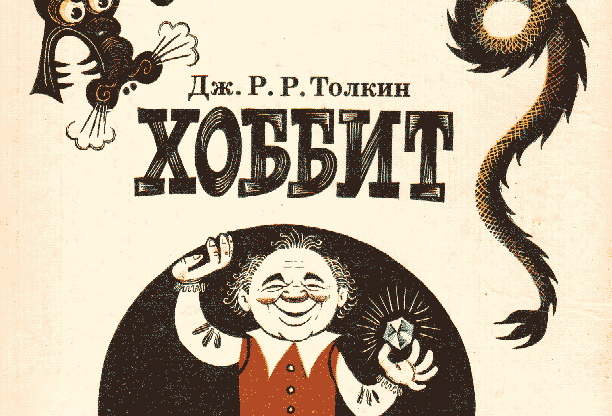
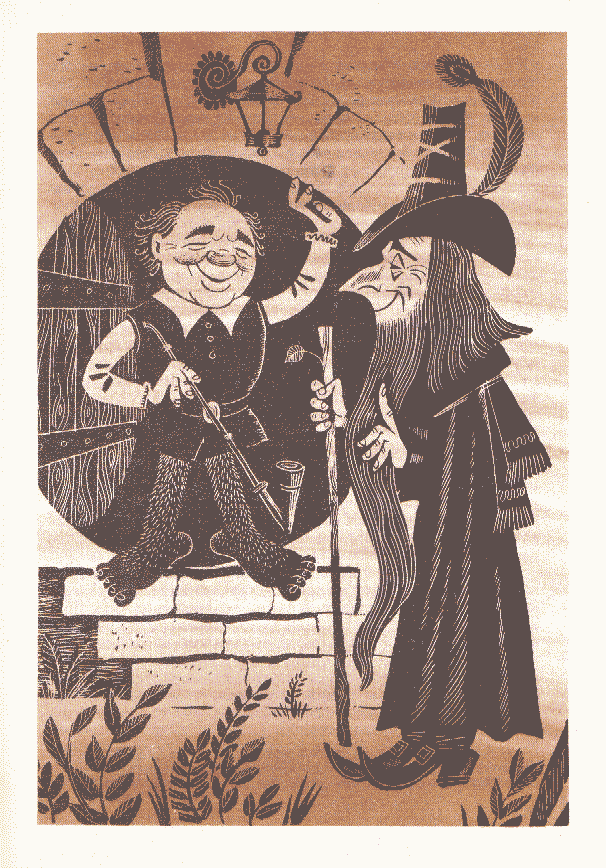
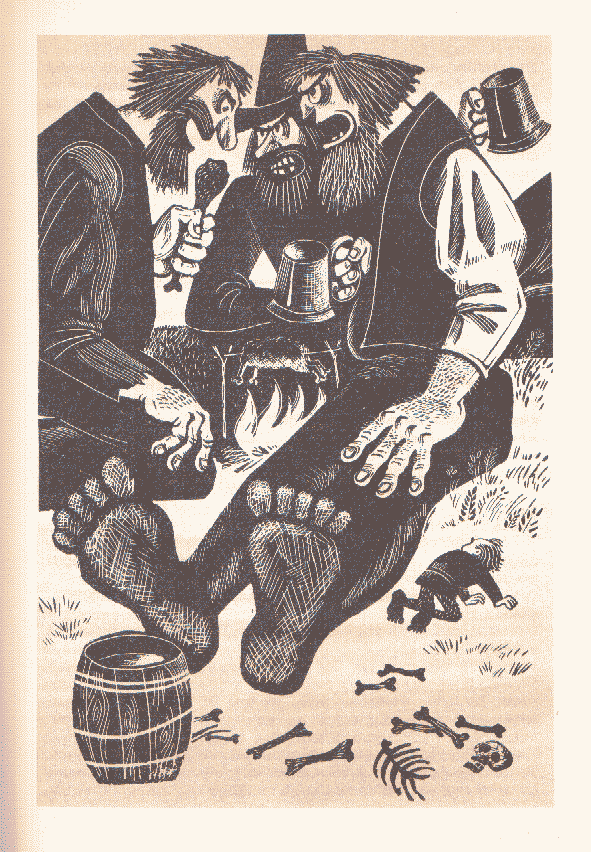
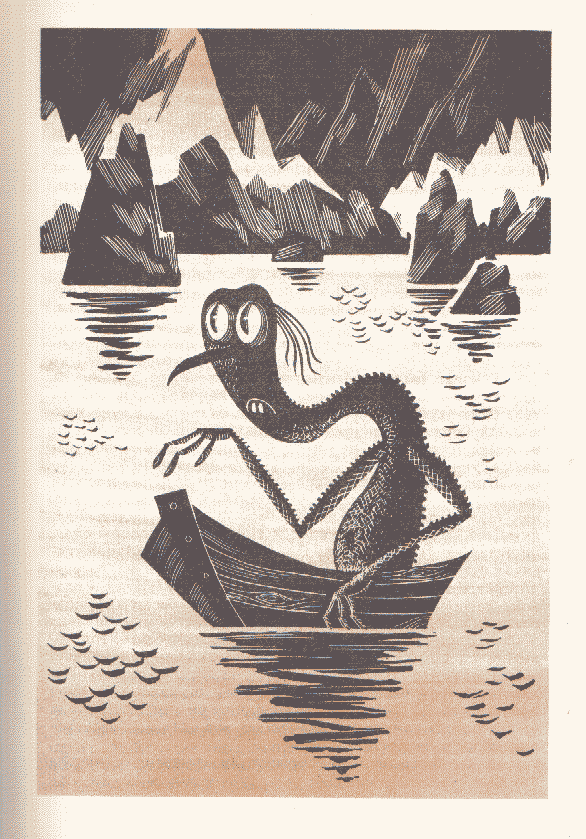
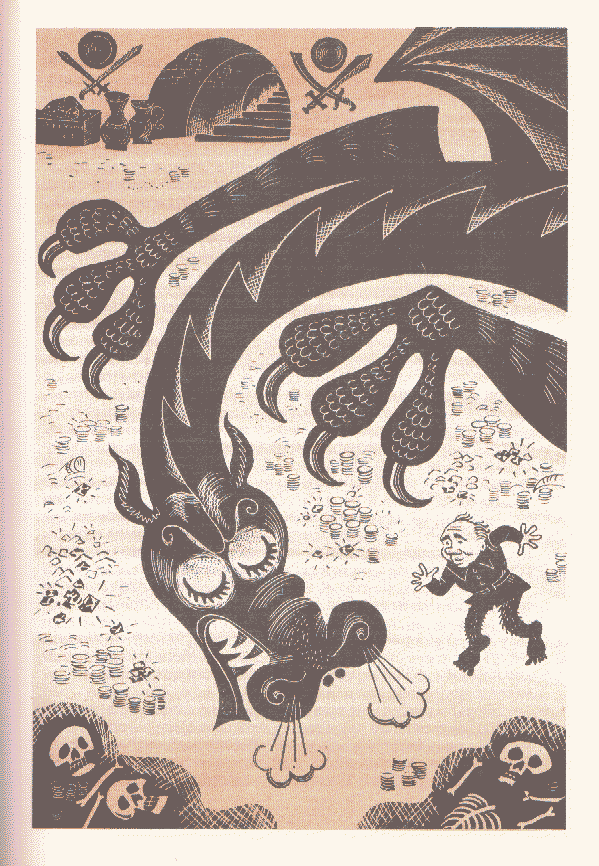
As with many Russian translations during the Cold War, the book came with a completely different set of illustrations. Mine, I remember regretting slightly, lacked pictures altogether. A friend’s edition, however, was illustrated in the typical Russian style: much more traditionally stylized than Tolkien’s own drawings, they were more angular, friendlier, almost cartoonish. In this post, we include a number of these images from the 1976 printing. The cover, above, depicts a grinning Bilbo Baggins holding a gem. Below, Gandalf, an ostensibly harmless soul, pays Bilbo a visit.
Next, we have the three trolls, arguing about their various eating arrangements, with Bilbo hiding to the side.
Here, Gollum, née Smeagol, paddles his raft in the depths of the mountains.
Finally, here’s Bilbo, fulfilling his role as a burglar in Smaug’s lair.
For more of the Soviet illustrations of The Hobbit, head on over to Retronaut.
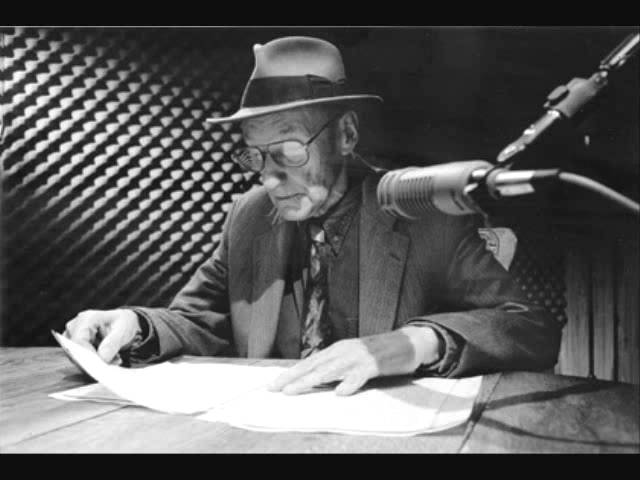
Published in 1959, Williams S. Burroughs’ Naked Lunch ranks with other mid-twentieth century books like Henry Miller’s Tropic of Cancer and the works of Jean Genet as literature that sharply divided both critical and legal opinion in arguments over style and in questions of obscenity. Among its disturbing and subversive characters is the sociopathic surgeon Dr. Benway, who inspired the medical horrors of J.G. Ballard and was inspired in turn by Aldous Huxley’s Brave New World. Benway provides some of the more satirical moments in the book, as you can hear in the section below, which Burroughs reads straight with his distinctive nasally Midwestern twang. A short film of the scene (sadly unembeddable), called “Dr. Benway Operates,” has Burroughs himself playing the doctor, in a dramatization that looks like low rent farce as directed by John Waters.
A series of loosely connected chapters that Burroughs said could be read in any order, Naked Lunch seems both fascinated and repelled by the grisly medicalized violence in scenes like those above (one vignette, for example, presents “a tract against capital punishment”). This ambivalence was not lost on writers like Norman Mailer. The highest praise of the novel probably came from Mailer during the novel’s 1966 obscenity trial before the Massachusetts Supreme Court. In one among a handful of literary depositions, including one from Allen Ginsberg, Mailer described Burroughs’ “extraordinary style,” and “exquisite poetic sense.” Despite the fact that its images were “often disgusting,” Mailer called the book “a deep work, a calculated work” that “captures that speech [‘gutter talk’] like no American writer I know.”
Perhaps one of the work’s most damning pieces of criticism comes from the Judicial Officer for the U.S. Postal Service, who called for the book’s banning, appraising the writing as “undisciplined prose, far more akin to the early work of experimental adolescents than to anything of literary merit.” Mailer, Ginsberg, and the book’s other supporters won out, a fact beat essayist Jed Birmingham laments, for a surprising reason: The unbanning of Naked Lunch led to the book’s taming, its gentrification, as it were: “The wild, exuberant offensiveness of the novel fades,” he writes, “in the face of all the legal arguments and the process of canonization.” In fact, the full novel may never have been published at all had it not been for the Post Office in Chicago seizing several hundred copies of The Chicago Review, which contained some few Naked Lunch sections. Hearing of the controversy, French publisher Maurice Girodias hastily threw together a manuscript of the first 1959 text.
And yet, prior to the mid-sixties, the decision to ban Naked Lunch, “even before it was published in book form,” meant “that questions of obscenity and censorship dictated the academic and public reception” of the book. Burroughs commented on the effects of such censorship—using an analogy to “the junk virus”—in part of a new preface to the 50th edition called “Afterthoughts on a Deposition.” The heath risks of opiates “in controlled doses,” he writes,“maybe be minimal,” yet the effects of criminalization are outsized “anti-drug hysteria,” which “poses a threat to personal freedoms and due-process protections of the law everywhere.”
Since the novel’s vindication, critical consensus has centered around sober, reverent judgments like Mailer’s—and to some lesser extent Ginsberg’s terse, irritable testimony. While there are still those who despise the book, it’s significant that Burroughs’ work—which the Washington Post called the first of his “homosexual planet-operas”—has achieved such widespread admiration amidst the notoriety. The novel deals in themes we’re still adjudicating daily in courts legal and public some 55 years later, pointing perhaps to the continued gulf between the thoughts and aims of the reading public and those of hysterical authoritarians and “the media and narcotics officials,” as Burroughs has it. After all, at its 50th anniversary in 2009, Naked Lunch was pronounced “still fresh” by such mainstream outlets as NPR and The Guardian, evidence of its persistent power, and maybe also of its domestication.
“You’re moving it!” “No I’m not; you’re moving it!” Thus spake the excitedly anxious preteen voices of an-early 1990s Parker Brothers Ouija board commercial I must have seen a hundred times in childhood. Though by then such devices had scant import outside the realm of sleepover parties, people took them more seriously in the early twentieth century, especially around the time of the First World War. While some must, alas, have regarded them as functional channels to the great beyond, others saw in them the potential to gin up major publishing events. Here we have one of the most curious, 1917’s small-town Missouri bildungsroman The Coming of Jap Herron, allegedly written Mark Twain, at that point seven years dead. A misplaced manuscript the executors of Twain’s estate found amid his papers, perhaps? Nothing of the sort: he began writing the book in 1915, as a disembodied spirit, through a Ouija board. So claimed, at least, one Emily Grant Hutchings, who brought Jap Herron to publication, presenting herself as a mere scribe taking dictation from the deceased icon of American literary humor.
She’d even had some contact, albeit through the mail, with the living one: “In their exchange of letters he had given her advice and, interestingly, also marked one of her letters with the words: ‘Idiot! Must preserve.’ ” That priceless find comes from The Public Domain Review’s post on Jap Herron, where you can read the short book in full, a much easier option than struggling to find a copy that survived the ceasing of publication and subsequent pulping ordered by Twain’s daughter. (You can also access it by clicking on the image above.) And how does this “final work,” whether composed as a pastiche or paranormally, hold up? “The humor impresses as a feeble attempt at imitation,” said a contemporary New York Times review, “and while there is now and then a strong sure touch of pathos or a swift and true revelation of human nature, the ‘sob stuff’ that oozes through many of the scenes, and the overdrawn emotions are too much for credulity. If this is the best that ‘Mark Twain’ can do by reaching across the barrier, the army of admirers that his works have won for him will all hope that he will hereafter respect that boundary.”
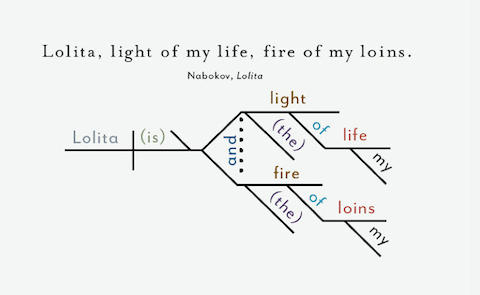
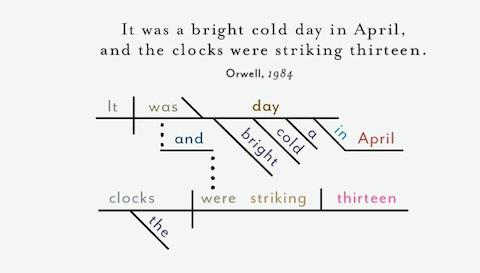
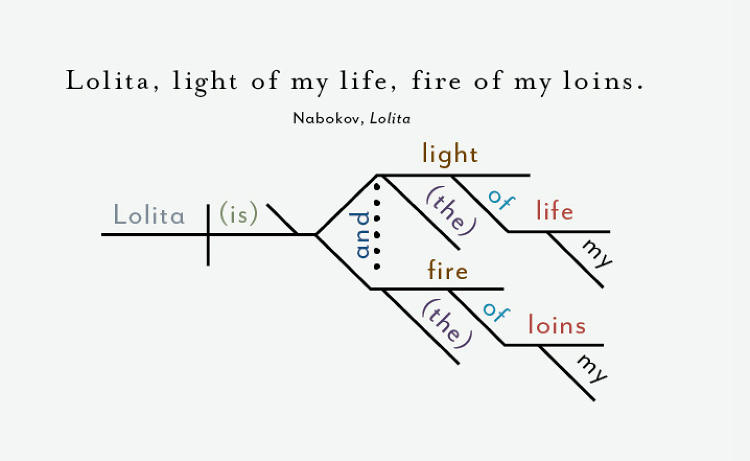
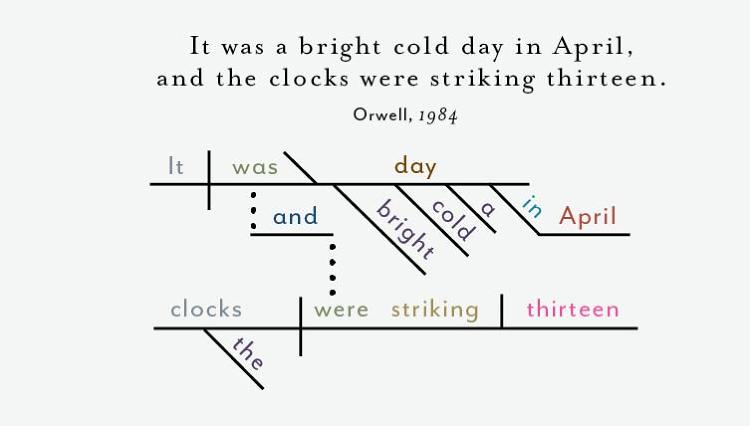
I admit it: I still don’t understand sentence diagramming. Though as a middle schooler I dutifully, if grudgingly, submitted to that classic English classroom exercise, the practice didn’t stick, nor did whatever habit of composition it meant to convey. Some of my teachers tried to make sentence diagramming interesting, but they could only do so much. They could only do so much, that is, without Pop Chart Lab’s “A Diagrammatical Dissertation on Opening Lines of Notable Novels,” a poster that “diagrams 25 famous opening lines from revered works of fiction according to the dictates of the classic Reed-Kellogg system,” with each and every graphic “parsing classical prose by parts of speech and offering a partitioned, color-coded picto-grammatical representation of some of the most famous first words in literary history.”
At the top of the post, we have the poster’s diagram of Humbert Humbert’s famous first words, by way of Vladimir Nabokov, in Lolita: “Lolita, light of my life, fire of my loins.” That immortal sentence may always have struck you as incomplete — doesn’t it need a verb? — but hey, it diagrams, at least with the addition of the implicit (is) and a couple implicit (the)s. Follow the branches and you find the words’ concealed complexity visually revealed. Just above, you’ll see diagrammed a more traditional opening sentence from George Orwell, a much more plainspoken writer. “It was a bright cold day in April,” goes the first line of 1984, “and the clocks were striking thirteen” — a more linguistically involved description, as you can see, than it may at first seem. Fifteen years after the specter of Reed-Kellogg darkened my desk — in which time I’ve made writing my career — I still can’t claim the ability to produce properly diagrammed sentences for myself. But I like to think that I can appreciate them, especially when they show me the workings of a sufficiently great sentence.
We're hoping to rely on loyal readers, rather than erratic ads. Please click the Donate button and support Open Culture. You can use Paypal, Venmo, Patreon, even Crypto! We thank you!
Open Culture scours the web for the best educational media. We find the free courses and audio books you need, the language lessons & educational videos you want, and plenty of enlightenment in between.