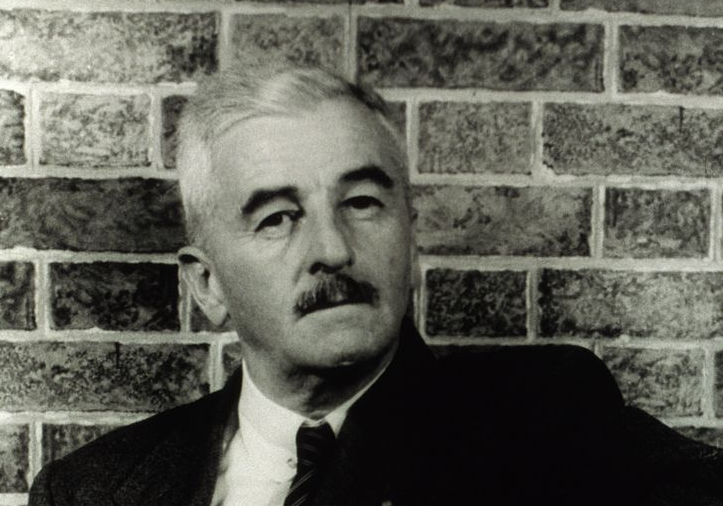
My two favorite William Faulkner novels are, without a doubt, Absalom, Absalom! and The Sound and The Fury. After readers get thrust into the narrators’ dizzying streams of consciousness, both books mount in tension to a frightful, almost unbearable pitch, before reaching their grim, cathartic climaxes. I’ve always felt that the white-hot intensity of the novels meant that, somehow, they had meant more to Faulkner than his other writings. According to an audio recording of Faulkner himself, it turns out that I was half right.
In 1957 and 1958, Faulkner served as the Writer-in-Residence at the University of Virginia at Charlottesville, and today the school retains what is likely to be the largest Faulkner archive in the world. In addition to Faulkner’s private library, original manuscripts, letters, and personal effects, the archive also contains hours upon hours of Faulkner’s Q & A sessions, speeches, and readings. In April of 1957, during a class lecture, a student asked Faulkner about his favorite novel. Listen to the audio clip here:
Unidentified participant: Mr. Faulkner, what do you consider your best book?
William Faulkner: The one that—that failed the most tragically and the most splendidly. That was The Sound and the Fury—the one I worked at the longest, the hardest, that was to me the—the most passionate and moving idea, and made the most splendid failure. That’s the one that’s my—I consider the best, not—well, best is the wrong word—that’s the one that I love the most.
The recordings themselves are a fascinating resource, with Faulkner commenting widely on his novels and stories. Where else could one hear, for example, what the author considered the best book to start with when reading him? Listen here.
Unidentified participant: Do you think that there’s a particular order in which your works should be read […]? Many people have offered a sequence. Do you think there’s a particular sequence that your books should be read in?
William Faulkner: Probably to begin with a book called Sartoris. That has the germ of my apocrypha in it. A lot of the characters are postulated in that book. I’d say that’s a good one to begin with.
For those interested in learning more about Faulkner and his writing, the Southeast Missouri State University’s Center for Faulkner Studies is offering a promising MOOC called Faulkner 101, led by the Center’s founder, Dr. Robert Hamblin, as well as its current director, Dr. Chris Rieger. You can sign up now. Or find countless other MOOCs in our big, ever-expanding list of MOOCs.
Promo portrait photo of author Raymond Chandler, via Wikimedia Commons
Raymond Chandler – along with his hardboiled brethren like Dashiell Hammett and James M. Cain – sandblasted the detective novel of its decorousness and instilled it with a sweaty vitality. Chandler, through the eyes of his most famous character Philip Marlowe, navigated a thinly veiled Los Angeles through the desperation of those on the low end of society’s totem pole and through the greed and venality of those at the top.
Instead of creating self-contained locked room mysteries, Chandler created stories that looked outward, struggling to make sense of a morally ambiguous world. He dedicated his career to the genre, influencing generations of writers after him. His very name became synonymous with his terse, pungent style.
So it isn’t terribly surprising that Chandler had some very strong opinions about crime fiction. Below are his ten commandments for writing a detective novel:
1) It must be credibly motivated, both as to the original situation and the dénouement.
2) It must be technically sound as to the methods of murder and detection.
3) It must be realistic in character, setting and atmosphere. It must be about real people in a real world.
4) It must have a sound story value apart from the mystery element: i.e., the investigation itself must be an adventure worth reading.
5) It must have enough essential simplicity to be explained easily when the time comes.
6) It must baffle a reasonably intelligent reader.
7) The solution must seem inevitable once revealed.
8) It must not try to do everything at once. If it is a puzzle story operating in a rather cool, reasonable atmosphere, it cannot also be a violent adventure or a passionate romance.
9) It must punish the criminal in one way or another, not necessarily by operation of the law.… If the detective fails to resolve the consequences of the crime, the story is an unresolved chord and leaves irritation behind it.
10) It must be honest with the reader.
These commandments are oblique jabs at the locked room whodunits popular during the Golden Age of the detective novel during the 1920s and 30s. Chandler delivers a much more pointed criticism of these works in his seminal essay about crime fiction, The Simple Art of Murder.
After taking thoroughly apart the murder mystery The Red House by A. A. Milne (yes, the writer of Winnie the Pooh), Chandler rails against detective stories where the machinations of plot outstrip any semblance of reality. “If the situation is false, you cannot even accept it as a light novel, for there is no story for the light novel to be about.”
He goes on to trash other British mystery writers like Agatha Christie and particularly Dorothy L. Sayers, who Chandler paints not only as a hypocritical snob but also as boring. “The English may not always be the best writers in the world, but they are incomparably the best dull writers,” he quips.
Chandler then offers praise to his hardboiled colleague Dashiell Hammett who infuses his stories with a sense of realism. “Hammett gave murder back to the kind of people that commit it for reasons, not just to provide a corpse; and with the means at hand, not with hand-wrought duelling pistols, curare, and tropical fish….He was spare, frugal, hardboiled, but he did over and over again what only the best writers can ever do at all. He wrote scenes that seemed never to have been written before.”
Whether conscious or not, this passage is a fair description of Chandler as well.
Jonathan Crow is a writer and filmmaker whose work has appeared in Yahoo!, The Hollywood Reporter, and other publications. You can follow him at @jonccrow.
The Travels of Marco Polo—tales told by the Venetian explorer to Italian romance writer Rustichello da Pisa—purportedly describes in great detail Polo’s encounter with “The East,” a place in the medieval European mind as alien and fantastical as the interstellar realms of science fiction. Like other travel narratives of the period (notably the spurious Travels of Sir John Mandeville), Polo’s stories mixed accurate geographical and cultural information with folklore, myth, and Orientalist misapprehension. While the appearance of monsters and marvels seems capricious to the modern reader, these elements may have felt almost mundane to Polo’s contemporaries. Or maybe not. After all, the Italian title of Polo’s travelogue—Il Milione—may refer to Polo’s reputation as the teller of “a million” lies.
But let us leave the puzzles of authenticity to historians. As readers, we get lost in these fascinating romances because the worlds they describe are both so strange yet so unsettlingly familiar. Medieval travelogues like Polo’s open up the possibility of fairy kingdoms with outlandish customs thriving almost within reach. These tales of strange and unknown lands were, after all, prominent inspiration for C.S. Lewis’s Narnia books. (Listen to the Chronicles of Narnia in a free audio format here).
For grown-up readers, no author better evokes the uncanny geopolitics of the medieval imagination than Italo Calvino, whose Invisible Cities imagines Polo’s supposed journey to the imperial seat of Mongol ruler Kublai Khan. In Calvino’s novel—more a collection of prose-poems—Polo regales Khan with his accounts of 55 exotic cities, while the busy emperor’s functionaries come and go. “At some point,” says author Eric Weiner, “you realize that Calvino is not talking about cities at all, not in the way we normally think of the word. Calvino’s cities—like all cities, really—are constructed not of steel and concrete but of ideas. Each city represents a thought experiment.”
Similar observations can be made of any of the author’s oddly enchanting allegorical fictions—Seamus Heaney called Calvino’s stories “fantastic displays” inspired by “symmetries and arithmetics.” In the audio above, you can hear the author read selections from several of his works, including Invisible Cities and Mr. Palomar, a work of “even more archness and architectural invention.” Do not be daunted by Calvino’s Italian. I find it very pleasing to listen to, even if I do not understand it all. But if you’d rather skip ahead to the English portion of his reading—recorded at the 92nd St. Y on March 31st, 1983—it begins at 8:40 where Calvino reads from a section of Invisible Cities called “Thin Cities.” In this excerpt, Polo tells Khan of a place called “Armilla”:
Whether Armilla is like this because it is unfinished or because it has been demolished, whether the cause is some enchantment or only a whim, I do not know. The fact remains that it has no walls, no ceilings, no floors: it has nothing that makes it seem a city except the water pipes that rise vertically where the houses should be and spread out horizontally where the floors should be: a forest of pipes that end in taps, showers, spouts, overflows […]
You can read the remainder of the “Armilla” section here, along with other selections from Invisible Cities. A portion of the text of Mr. Palomar is available here. Calvino’s reading is long—nearly an hour and a half—and very rewarding, both for the rich musicality of his accented English and the spellbinding charms of his philosophical fictions. And if you are so inspired, you may wish to read Calvino’s short essay “Why Read the Classics?” to which I often turn for a fuller grasp his wide-ranging literary inheritance.
Edgar Allan Poe isn’t read much as an essayist, which is too bad. His essays reveal a quick and ironic cast of mind where his dark poetry and stories often mark him as a single-minded hypersensitive, “like a peony just past bloom.” Where Poe the poet can be lugubrious, Poe the essayist is brisk, incisive, and, well… kinda catty. Take the following aphoristic witticisms from his 1846 “A Few Words on Etiquette”:
Never use the term genteel — it is only to be found in the mouths of those who have it nowhere else.
Green spectacles are an abomination, fitted only for students of divinity.
Almost every defect of face may be concealed by a judicious use and arrangement of hair.
Are these casual bon mots or serious prescriptions? Why not both? An editor at the Edgar Allan Poe Society of Baltimore notes that the etiquette essay “bears much the same humorous tone and mixture of genuine and satirical commentary as Poe’s essay ‘The Philosophy of Furniture’ from 6 years earlier.” Indeed, in that earlier critical work on interior design, Poe makes confident judgments, leaps from point to point with delightfully specific examples, and employs a mix of levity and gravity.
Poe begins “The Philosophy of Furniture” with “a somewhat Coleridegy assertion” from Hegel then launches into a pitiless critique of various national styles. His last point—“The Yankees alone are preposterous”—is the basis for what follows, a disquisition on the sad state of American interior design, brought about by “an aristocracy of dollars” in which “the display of wealth” takes the place of heraldry. His critique recalls (and perhaps alludes to) English poet Alexander Pope’s “Epistle to Burlington,” whose satirical target makes such a tasteless mess of his villa that his neighbors cry out “What sums are thrown away!”
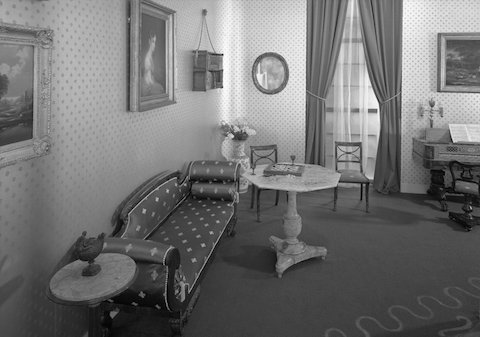
In Poe’s case, the offending estate is “what is termed in the United States, a well-furnished apartment.” He decries the injudicious use of curtains, the poor display of carpets (“the soul of the apartment”), and the problem “of gas and of glass.” Poe deliciously details the decorating habits of a parvenu American aristocracy, whose defects are discernable by even the “veriest bumpkin.” But he offers more than snark. “Like any good critic,” writes The Smithsonian, “Poe doesn’t just condemn, he offers solutions.” In the final, lengthy paragraph of “The Philosophy of Furniture,” Poe turns his talent for vivid description to a portrait of his perfect boudoir. Above, you can see a 1959 recreation of Poe’s “small and not, ostentatious chamber with whose decorations no fault can be found.” But this may be redundant. Poe furnishes us with sufficient fine detail that we can better create his ideal room in our imagination. See the excerpts below, and read Poe’s complete essay here.
The proprietor lies asleep on a sofa — the weather is cool — the time is near midnight: I will make a sketch of the room ere he awakes. It is oblong — some thirty feet in length and twenty-five in breadth — a shape affording the best (ordinary) opportunities for the adjustment of furniture. It has but one door — by no means a wide one — which is at one end of the parallelogram, and but two windows, which are at the other. These latter are large, reaching down to the floor — have deep recesses — and open on an Italian veranda. Their panes are of a crimson-tinted glass, set in rose-wood framings, more massive than usual. They are curtained within the recess, by a thick silver tissue adapted to the shape of the window, and hanging loosely in small volumes. Without the recess are curtains of an exceedingly rich crimson silk, fringed with a deep network of gold, and lined with silver tissue, which is the material of the exterior blind. There are no cornices; but the folds of the whole fabric (which are sharp rather than massive, and have an airy appearance), issue from beneath a broad entablature of rich gilt-work, which encircles the room at the junction of the ceiling and walls […]
The carpet — of Saxony material — is quite half an inch thick, and is of the same crimson ground, relieved simply by the appearance of a gold cord (like that festooning the curtains) slightly relieved above the surface of the ground, and thrown upon it in such a manner as to form a succession of short irregular curves — one occasionally overlaying the other. The walls are prepared with a glossy paper of a silver gray tint, spotted with small Arabesque devices of a fainter hue of the prevalent crimson. Many paintings relieve the expanse of paper. These are chiefly landscapes of an imaginative cast — such as the fairy grottoes of Stanfield, or the lake of the Dismal Swamp of Chapman. There are, nevertheless, three or four female heads, of an ethereal beauty — portraits in the manner of Sully. The tone of each picture is warm, but dark […]
Two large low sofas of rosewood and crimson silk, gold-flowered, form the only seats, with the exception of two light conversation chairs, also of rose-wood. There is a pianoforte (rose-wood, also), without cover, and thrown open. An octagonal table, formed altogether of the richest gold-threaded marble, is placed near one of the sofas. This is also without cover — the drapery of the curtains has been thought sufficient.. Four large and gorgeous Sevres vases, in which bloom a profusion of sweet and vivid flowers, occupy the slightly rounded angles of the room. A tall candelabrum, bearing a small antique lamp with highly perfumed oil, is standing near the head of my sleeping friend. Some light and graceful hanging shelves, with golden edges and crimson silk cords with gold tassels, sustain two or three hundred magnificently bound books. Beyond these things, there is no furniture, if we except an Argand lamp, with a plain crimson-tinted ground glass shade, which depends from the lofty vaulted ceiling by a single slender gold chain, and throws a tranquil but magical radiance over all.
Again, the Edgar Allan Poe Society editor helpfully notes that “Poe, in this article, has adopted an intentionally humorous tone.” Should we take this seriously or treat is as Poe-ean satire? Why not both?
In 1966, Hunter S. Thompson launched his career with the publication of Hell’s Angels: The Strange and Terrible Saga of the Outlaw Motorcycle Gangs. The book was the result of Thompson living with the bikers for a year. He drank with them, hung out with them and witnessed both their comradery and their brutality. “I was no longer sure whether I was doing research on the Hell’s Angels or being slowly absorbed by them,” he wrote. He was ultimately seduced by their outlaw mystique and particularly by their passion for motorcycles.
There was no helmets on those nights, no speed limit, and no cooling it down on the curves. The momentary freedom of the park was like the one unlucky drink that shoves a wavering alcoholic off the wagon.
Thompson’s flirtation with the Hell’s Angels ended abruptly when he called out a biker named Junkie George for engaging in domestic abuse. “Only a punk beats his wife,” he quipped. Junkie took umbrage and proceeded to beat him senseless.
The book, when it came out, similarly didn’t impress the Angels. In the clip below, which aired on Canadian TV, an Angel confronts a surprisingly quiet and twitchy Thompson before a studio audience.
Jonathan Crow is a Los Angeles-based writer and filmmaker whose work has appeared in Yahoo!, The Hollywood Reporter, and other publications. You can follow him at @jonccrow.
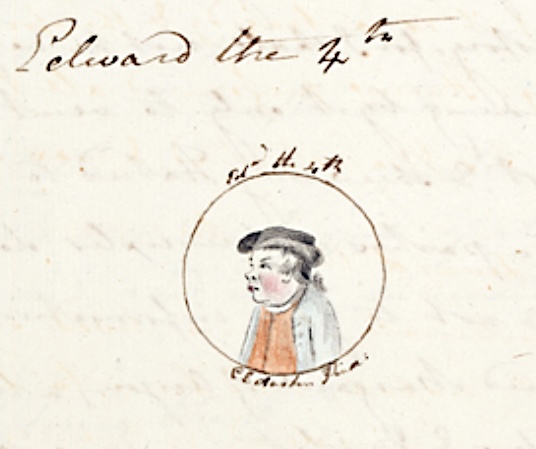
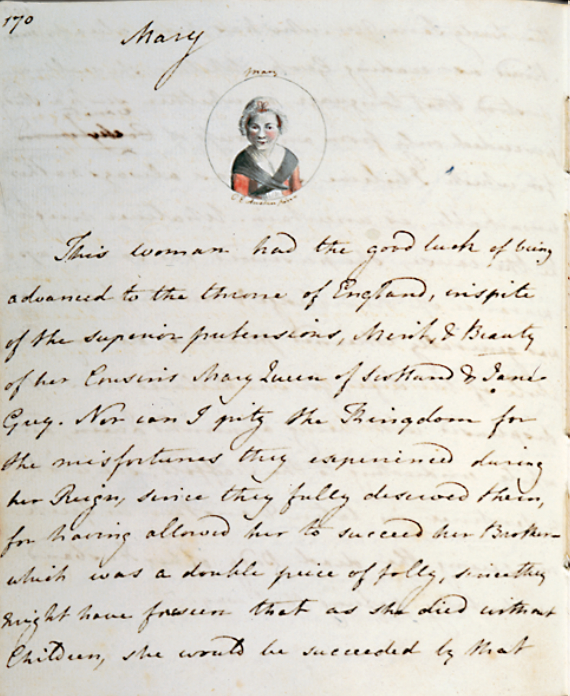
Austen was, by and large, a homeschooled and autodidactic child. Although she had taken part in some formal schooling between the ages of 7 and 10, illness and the family’s lack of means dictated that she had to rely on her father’s extensive library for an education. By the time she was fifteen, Austen had evidently gathered sufficient material to fuel her writing, and had completed a history of England, beginning with Henry IV (1367–1413), and ending with Charles I (1600–1649). Above, you can see one of the book’s many illustrations drawn by Jane’s elder sister, Cassandra, depicting Edward IV, of whom Austen writes, “This Monarch was famous only for his Beauty & his Courage, of which the Picture we have here given of him, & his undaunted Behaviour in marrying one Woman while he was engaged to another, are sufficient proofs.” In spite of its brevity — the book numbers only 36 handwritten pages — Austen’s juvenilia shows unmistakable signs of her distinct satirical voice. The volume is, in fact, a parody of the stuffy claims of objectivity found in 18th century grade school history textbooks, like Oliver Goldsmith’sThe History of England from the Earliest Times to the Death of George II. Rather than follow suit, Austen skips trivialities such as key dates and events, noting to her readers in the introduction to a section on Henry VIII,
“It would be an affront to my Readers were I to suppose that they were not as well acquainted with the particulars of the King’s reign as I am myself. It will therefore be saving them the task of reading again what they have read before, & myself the trouble of writing what I do not perfectly recollect, by giving only a slight sketch of the principal Events which marked his reign”
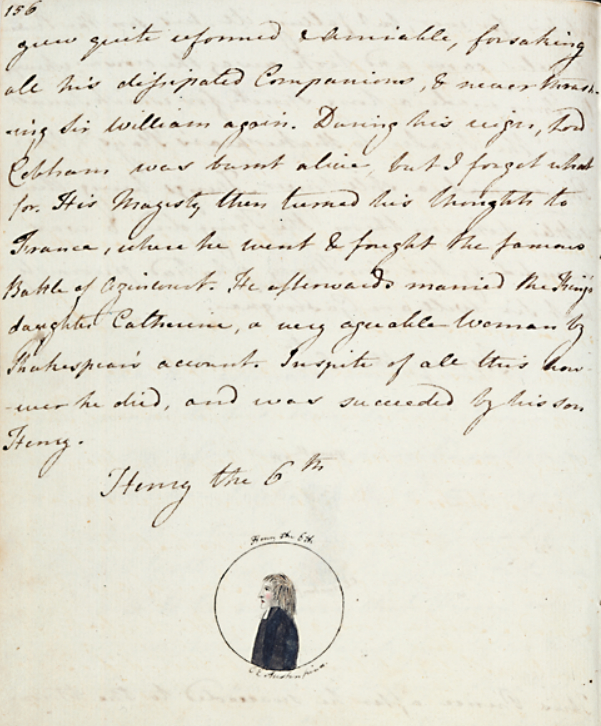
I had the sense that Austin relished writing such humorous prose as much as I enjoyed reading it. Unconstrained by the formalities of her medium, she takes to referencing Shakespeare and giving voice to her numerous opinions. Take, for example, her entries on Henry V and Henry VI:
Henry the 5th
This Prince after he succeeded to the throne grew quite reformed and amiable, forsaking all his dissipated Companions, & never thrashing Sir William again. During his reign, Lord Cobham was burnt alive, but I forget what for. His Majesty then turned his thoughts to France, where he went & fought the famous Battle of Agincourt. He afterwards married the King’s daughter Catherine, a very agreeable Woman by Shakespear’s account. Inspite of all this however, he died, and was succeeded by his son Henry.
Henry the 6th
I cannot say much for this Monarch’s sense. Nor would I if I could, for he was a Lancastrian. I suppose you know all about the Wars between him & the Duke of York who was of the right side; if you do not, you had better read some other History, for I shall not be very diffuse in this, meaning by it only to vent my Spleen against, & shew my Hatred to all those people whose parties or principles do not suit with mine, & not to give information. This King married Margaret of Anjou, a Woman whose distresses & misfortunes were so great as almost to make me who hate her, pity her. It was in this reign that Joan of Arc lived & made such a row among the English. They should not have burnt her — but they did.
The whole book, including the above pages on Queens Mary and Elizabeth, may be viewed at the British library’s website.
Like many David Foster Wallace fans, I bought a copy of J. Peder Zane’s The Top Ten (previously featured here), a compilation of various famous writers’ top-ten-books lists, expressly for DFW’s contribution. Like most of those David Foster Wallace fans, I felt more than a little surprised when I turned to his page and found out which ten books he’d chosen. Here, as quoted in the Christian Science Monitor, we have the Infinite Jest author and widely recognized (if reluctant) “high-brow” literary figure’s top ten list:
Thrillers, killers, and a dose of Christianity to top it off; I didn’t blame Zane when he asked, “Is he serious? Beats me. To be honest, I don’t know what Wallace was thinking. But I do think there’s a certain integrity to his list.” Wallace himself seemed to read assiduously all over the map — or, more to the point, all up and down the scale of critical respectability. Rattling off “the stuff that’s sort of rung my cherries” to Salon’s Laura Miller in 1996, for a contrast, he named, among other worthy reads, Socrates’ funeral oration, John Donne, “Keats’ shorter stuff,” Schopenhauer, William James’ Varieties of Religious Experience, Wittgenstein’s Tractatus, Joyce’s Portrait of the Artist as a Young Man, Hemingway’s In Our Time, Don DeLillo, A.S. Byatt, Cynthia Ozick, Donald Barthelme, Moby-Dick, and The Great Gatsby. (You can find many of these texts in our Free eBooks collection.)
That, some Wallace readers may think, sounds more like it. But those who’ve paid close attention to Wallace’s language — that often breathlessly but hopelessly imitated mixture of high-caliber vocabulary, casually spoken rhythm, deceptively sharp-edged perception, shrugging presentation, and deliberate solecism — know how fully he simultaneously embodied both “high” and “low” English writing. Just look at the Literary Analysis syllabus from his days teaching at Illinois State University, which demands students read not just The Silence of the Lambs but another Thomas Harris novel, Black Sunday, as well as more C.S. Lewis (in this case The Lion, the Witch, and the Wardrobe) and Stephen King (Carrie). Lest you doubt his commitment to the serious reading of popular fiction, note the presence of Jackie Collins’ Rock Star. In the classroom and in life, Wallace must truly have believed that there exists no low fiction; just low ways of reading fiction.
Looking for free, professionally-read audio books from Audible.com? Here’s a great, no-strings-attached deal. If you start a 30 day free trial with Audible.com, you can download two free audio books of your choice. Get more details on the offer here.
Despite his respected facility with the English language, Argentine master craftsman of short fiction Jorge Luis Borges did his best work in his native Spanish. Though we remember prolific interviewer and even more prolific writer William F. Buckley for his formidable command of English above all else, he didn’t even learn it as his first language, starting in on his English education at age seven, having already learned Spanish (not to mention French).
This must have placed him well to appreciate Borges’ writing, and indeed, in his introduction to their Firing Line conversation above, Buckley cites Borges’ reputation as the greatest, most influential writer then alive. “We met in Buenos Aires, in 1977, during the military junta days,” Buckley recalls of the taping in a Paris Review interview. “He seemed astonishingly frail, but he spoke without a pause.”
Buckley goes on to provide many choice quotes from Borges’ answers to questions about his sight (“When you are blind, time flows in a different way. It flows, let’s say, on an easy slope”), his love of American writers like Emerson and Melville, his languages (“Of course, my Latin is very rusty. But still, as I once wrote, to have forgotten Latin is already, in itself, a gift”), and where he finds beauty and art (“A man may say a very fine thing, not being aware of it. I am hearing fine sentences all the time from the man in the street, for example. From anybody”), and how he taught (“I tried to teach my students not literature—that can’t be taught—but the love of literature”). For more on that last, see also “The Daggers of Jorge Luis Borges,” a piece on the new book Professor Borges: A Course on EnglishLiterature, by Michael Greenberg in the New York Review of Books.
We're hoping to rely on loyal readers, rather than erratic ads. Please click the Donate button and support Open Culture. You can use Paypal, Venmo, Patreon, even Crypto! We thank you!
Open Culture scours the web for the best educational media. We find the free courses and audio books you need, the language lessons & educational videos you want, and plenty of enlightenment in between.